Your Lean-Agile foundation. The speed of AI. One operating model.
This exclusive six-part series is a designed path into the new version of SAFe. Each session reveals the specific architectural shifts being built into the SAFe Framework to ensure your organization doesn’t just ‘do AI,’ but delivers value at the speed of AI. Witness the cumulative build of the world’s leading Lean-Agile Framework into the AI-Native SAFe operating model. Join us to learn how to bridge the gap between AI potential and real-world execution.
AI-Native SAFe Teams and ARTs: Understand how Agile Release Trains, teams, and ways of working change when AI becomes part of daily delivery.
Reimagining PI Planning and SAFe events for the age of AI: Explore how PI Planning, coordination, and delivery flow evolve to match the speed of AI.
Building AI-Empowered products with continuous innovation and governance: Understand how AI drives changes in innovation, governance, compliance, and continuous improvement cycles across the enterprise.
Adopting AI-Native SAFe: Recognize the steps to migrate from your existing practices to AI-Native SAFe.
Why Attend?
You’ve spent years building a culture of Lean-Agile excellence. Now, don’t let the confusion of AI sabotage your future. While the market is flooded with AI hype, successful organizations know that technology is only as good as the operating model it runs on.
“Sacem quickly focused on SAFe because of its ability to scale across the organization, something Scrum lacked. Feedback from companies like Spotify and BPIFrance (Public Bank of Investment) which were also inspired by SAFe, and the Framework’s focus on portfolio management, PI Planning, and cross-department collaboration made it an ideal fit.”
—Sylvie Labouesse, CTO of Sacem
Challenge:
To maintain its global leadership and enhance economic efficiency, Sacem needed to adapt to a rapidly evolving music industry by accelerating the digitalization of its systems and processes.
Industry:
Music, IT, Digital Media
Quick Facts:
Founded in 1851 and managed by its members, Sacem is a society of authors, composers, and publishers of music.
Sacem represents more than 240,000 members and 176 million works.
Sacem collects author rights directly in more than 180 countries.
The organization has more than 1,300 employees and has supported more than 3,600 cultural projects.
510,000 authors, composers, and music publishers are paid worldwide thanks to Sacem.
Overview
The Society of Authors, Composers, and Publishers of Music (Sacem), is the world leader in the collective management of authors’ and composers’ rights. Founded in 1851, Sacem has continuously evolved to meet the challenges of a fast-changing music industry, driven by digital innovation and new consumption models.
With deep expertise in digital rights management, data processing, and royalty distribution, Sacem has positioned itself at the forefront of the global digital transformation of collective management organizations. Its leadership is built on its ability to adapt rapidly, embrace cutting-edge technologies, and offer innovative, high-quality services to its members, customers, and partners worldwide.
The Challenge
To maintain its global leadership, Sacem needed to:
Enhance its economic efficiency.
Cope with a constantly changing music industry.
Strengthen its competitive position.
Accelerate the digitalization of its processes and royalty management systems.
Develop tailor-made services for its members, customers, and employees.
The Path to SAFe
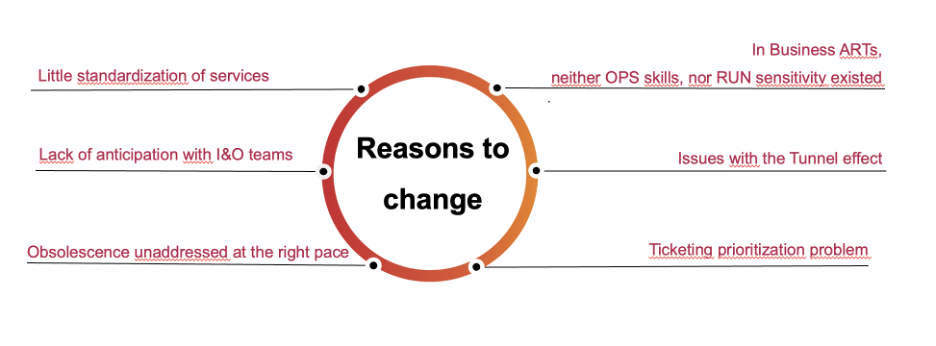
Sacem’s IT departments initially explored Scrum in 2017 – 2018. After a leadership change in 2019 and some reflection in 2021, it became clear that the transformation needed to scale across the entire IT department and align better with the business transformation. Sacem’s complex IT architecture and extensive operational value streams required a comprehensive transformation.
Undergoing this transformation with SAFe ensured Sacem could stay competitive in a dynamic and fast-moving market with evolving technologies and new platforms.
Outcomes
Before the SAFe transformation, projects were perceived as too long and costly. Working methods were heterogeneous, and the organization needed more synergy with the trades. Sacem wanted to enable IT to develop and deploy the technologies of the future.
The transformation brought tangible improvements in several areas:
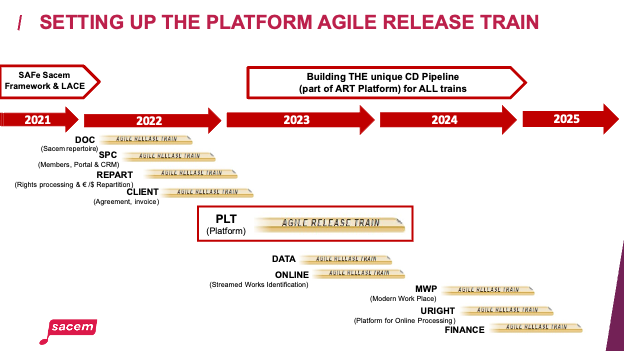
Acceleration: The speed of delivery for business initiatives increased by 20 percent, largely due to building a state-of-the-art Pipeline CD Product and promoting its adoption to move toward DevOps. The product approach of the Platform ART (private and public cloud automation, Identity and Access Management Product, middleware product, and API Management Product) is the key success factor to faster delivery. The involvement of the Platform Train in the PI Planning processes of the Business Trains—and vice versa—has also significantly contributed to acceleration.
Time-to-market: The time required to implement technical architectures for Business-enabled trains improved a lot. What used to take several weeks now takes only a few days, thanks to better alignment with best practices.
Modernization: By May 2024, Sacem reduced technical obsolescence by 15 percent. From June 2024, the rate of obsolescence increased due to the rapid pace of technological changes. Nevertheless, sharing obsolescence in the PI Planning processes of the Business Trains facilitates managing technical obsolescence for risk reduction. Modernization also concerns offering the latest products on the CD pipeline and introducing new technologies to create opportunities for Business Trains (containers).
Autonomy: There has been a 60-percent reduction in handovers and dependencies, as the Business Trains have adopted better skills and become more autonomous in managing their infrastructure.
Predictability: The predictability rate for the Platform Train stabilized at 85 percent, a significant improvement from the initial 60 percent before starting the journey.
Service Quality: The availability of critical applications for the Business Trains reached a target of 98.9 percent per month. This has positively impacted operations and customer satisfaction.
Deployment Speed: Deployment times have reduced drastically, from a day and a half to just five minutes, thanks to the integration of a standardized and unique Pipeline CD.
Cost Reduction: Running costs have decreased, aided by the decommissioning of obsolete applications and systems, contributing to overall operational efficiency.
In addition, Sacem reports that collaboration has improved between teams, as shown by satisfaction surveys during I&A sessions. Business satisfaction scores have risen, and Sacem’s new digital and innovative image has helped attract top talent. The shift from silos to integrated teams has created a culture of mutual respect and understanding. The wall between DEV and OPS is now broken. Everybody is doing studies, build, and run. Everybody is sharing the same vocabulary.
“…people who work together in harmony and deliver the best service to the business customers, beneficiaries in happy relationships and all that? That’s what gets me up in the morning. I want to make sure that people are working together fine. And what frustrates me the most is to see within our government agency how so much energy is wasted in silos, wasted because people are not communicating properly and all this nice energy is lost. And so that’s really too bad.”
— Cecile Auret, Internal Change Agent and SAFe 6.0 Practice Consultant, France Travail
Industry:
Government, Public Sector
Quick Facts:
France Travail employs approximately 59,000 people, with 1600 working to develop digital services
The organization paid a total of 36 billion Euros to beneficiaries in 2023
They processed almost 8 million benefit requests in 2023
They saw 478 million visits to their website in 2023 (59% of those on mobile devices)
They processed 17 million phone calls to call centers
And, they saw 6.6 million in-person visits to local branches
After launching its first Agile Release Train more than six years ago, today, approximately 70 percent of France Travail’s software production is delivered through ARTs
Key Takeaways:
ARTs are not enough to cut through silos. Even when trains are working happily together, they can hit a ceiling if the silo mentality and culture above the trains doesn’t change.
Everyone is an actor in the transformation. By trying things and improving in their area, individuals can plant seeds for the rest of the organization. With persistence, at some point, it attracts sponsorship from the management level.
Change needs to happen on every level: middle managers, top managers, change agents, and the team level.
The Framework offers both stability and ideas for improvement, with the big picture as the main compass for the organization to navigate change.
Overview
France Travail is the French public employment service, a government organization that supports unemployed citizens and employers, offers financial benefits, and provides intermediation services. They offer assistance to people who are in transition, in between jobs, or looking for new employment. They also support small employers and recruiters that don’t have the infrastructure for recruiting.
France Travail is a big agency on its own, but in January 2024 it became part of a larger network of partners: The network for employment. Together, the network helps people not only find work, but also remove impediments to work, such as securing housing and finding daycare. France Travail also develops an IT platform of digital services for all the partners.
“Don’t accept the status quo. Try things… If you believe you can improve, try things. And don’t let others tell you that you shouldn’t try. Be confident and try… and eventually you’ll attract interest from top managers.”
— Cecile Auret, Internal Change Agent and SAFe 6.0 Practice Consultant, France Travail
“When we considered in fact switching to SAFe, we had this failure and we gained this information. We knew why we had to change the process instead of being waterfall and turn toward being a Lean-Agile organization.”
— Thomas Quartier, Principal Lean-Agile SPCT, Capgemini
Industry:
Government, Transportation
Quick Facts:
The French Ministry is made up of 12,500 driving schools, 84 public offices, and several hundred agents
The system serves 1.4 million driving candidates per year
The Ministry launched the first SAFe for Government station in France
Outcomes
SAFe allowed the Ministry to change the culture of the department by working with stakeholders, observing processes, and understanding the end user and their needs.
With SAFe, they improved lead time and accelerated flow of value to citizens without interruptions
They restored trust both within operations and between the government and citizens
ART mood scores registered 4 out of 5 over 17 PIs, which indicates high overall satisfaction among workers
Employee retention rates went from an average of 6 months to more than 2 years
ARTs and releases achieved predictability rates near 100 percent over 17 PIs
Key Takeaways:
Increase trust with stakeholders and teams by creating an inclusive and dynamic work environment
Build and maintain deep business knowledge, mission agility, and business agility
The public sector should strive for excellence and state-of-the-art practices in the same way private enterprises do
Overview
When it comes to implementing SAFe in a government setting, sometimes the value delivered to customers is measured in protected lives. Such is the case for the French Ministry of Interior, the government organization tasked with meeting the needs and expectations of safety and security for its people. The Ministry’s purpose is to define and implement road safety policy. This includes processes and systems for earning a driver’s license and for reducing accident rates.
“We have a simple mission. Our mission is to protect life, to save life and to protect users, car drivers, motorcycles, cyclists, pedestrians, scooters, everybody. So, the road safety is everybody’s concern,” explains Amine Fendri, RTE, Head of Business Applications at the French Ministry of Interior.
The driver’s license program is one of the biggest, most complex systems within the French Ministry. In 2013, the Ministry tried to update its systems using waterfall methods and suffered major failures. At that point, they understood that they needed to pivot and try something new. In 2015, they began developing a new information system using more agile practices. The Ministry opted for a long implementation schedule in order to fully learn SAFe, to experiment with proof of concepts (PoCs) and Minimum Viable Products (MVPs), and to comply with government requirements. In 2019, the Ministry launched its first Agile Release Train. By 2022, they launched a second ART. Today, they credit SAFe with helping them improve the culture of the department, get closer to their stakeholders, and deliver greater value in less time.
“Three words in Japanese that are stuck in my head… follow the rules, break the rules, then transcend the rules. It was very important, particularly in the public sector. So we strictly applied SAFe by the book during four increments and then… we observed that our teams were mature enough and have a strong agile mindset. So we moved forward and adapted… And with Covid episodes we learned how to work efficiently with a mix of remote and onsite, which was very important. We know now that this was possible thanks to a technology foundation of the program, which was clear, simple, and easy to maintain.”
— Amine Fendri, RTE, Head of Business Applications at the French Ministry of Interior
Generative AI tools like SAFe CoPilot have unlocked significant productivity gains for SAFe roles. By reducing the routine, repetitive tasks that create toil for the individual contributor, SAFe CoPilot enables more ‘time in zone’ for higher-order, critical thinking work. In this interactive session, we will unravel the potent capabilities of SAFe® CoPilot by diving into the tool in real time.
We’ll also discuss its positive impact on SAFe roles and how SAFe® CoPilot offers a competitive edge in the tech development landscape.
Speakers
William Kammersell
Director of Product Management, Scaled Agile, Inc.
Unlock Unprecedented Productivity: The Flow Metrics Path to Agile Success
Whether you are new to the concept of flow metrics or looking to deepen your understanding and application, this session will equip you with the knowledge and tools to start leveraging flow metrics for remarkable improvements in your organizational performance.
When:
April 24, 2024, 10:00 am – April 24, 2024, 11:00 am MST
Where:
Zoom
Who:
Agile Leaders, LACE Leader, Product Manager, SAFe Practice Consultant, SAFe Program Consultant, Transformation Leader
In today’s competitive business landscape, attaining enterprise agility is more crucial than ever. Many are intrigued by the potential of Value Stream Management (VSM), yet find it intimidating and overly complex, even a colossal challenge. What if the journey to enterprise agility could be significantly simplified?
This session focuses on demystifying “flow metrics” – it’s the fastest and most effective path to extract immediate value for any organization. Flow metrics offer a lens through which organizations can view the efficiency, speed, and quality of work moving through their processes.
By attending this webinar, you will learn:
– What Flow Metrics Are: An introduction to flow metrics and their role in tracking the movement and delivery of value in the enterprise.
– Why They Matter: Explore the critical importance of flow metrics in identifying bottlenecks, reducing waste, and improving overall system performance, leading to enhanced enterprise agility.
– How to Get Started: Practical steps to begin collecting and analyzing flow metrics, even without fully implementing Value Stream Management (VSM). We’ll break down the seeming complexity of VSM, showing how any organization can derive significant value from flow metrics.
–Transformative Insights: Discover the kinds of insights flow metrics can provide and how these insights can be used to make informed decisions, prioritize work, and drive continuous improvement.
Real options promote flexibility in decision-making and enable organizations to pivot, change course, or seize new opportunities as circumstances evolve.
When:
May 21, 2024, 12:00 pm – May 21, 2024, 1:00 pm MST
Where:
Zoom
Who:
Consultant, Director, LACE Member, Program or Project Manager, SAFe Program Consultant, Transformation Leader
Imagine exchanging ideas, troubleshooting challenges, and recounting tales with fellow RTEs and STEs worldwide without leaving the comfort of your home.
You’ve just described RTE Circles. And you’re invited.
Join us as we explore Empowering Government Transformation through Agile Innovation. SAFe Day Government explores the paradigm shift in the Federal government when fostering a culture of Agile innovation. This conference brings together visionary leaders, policymakers, and Agile practitioners to explore and champion the adoption of Agile methodologies in government. Through collaborative discussions, real-world case studies, and interactive sessions, we aim to inspire, educate, and empower government agencies to embrace agility as a fundamental driver of positive change.