Your Lean-Agile foundation. The speed of AI. One operating model.
This exclusive six-part series is a designed path into the new version of SAFe. Each session reveals the specific architectural shifts being built into the SAFe Framework to ensure your organization doesn’t just ‘do AI,’ but delivers value at the speed of AI. Witness the cumulative build of the world’s leading Lean-Agile Framework into the AI-Native SAFe operating model. Join us to learn how to bridge the gap between AI potential and real-world execution.
AI-Native SAFe Teams and ARTs: Understand how Agile Release Trains, teams, and ways of working change when AI becomes part of daily delivery.
Reimagining PI Planning and SAFe events for the age of AI: Explore how PI Planning, coordination, and delivery flow evolve to match the speed of AI.
Building AI-Empowered products with continuous innovation and governance: Understand how AI drives changes in innovation, governance, compliance, and continuous improvement cycles across the enterprise.
Adopting AI-Native SAFe: Recognize the steps to migrate from your existing practices to AI-Native SAFe.
Why Attend?
You’ve spent years building a culture of Lean-Agile excellence. Now, don’t let the confusion of AI sabotage your future. While the market is flooded with AI hype, successful organizations know that technology is only as good as the operating model it runs on.
“Adopting SAFe has been an incredible and proud journey for us. The collective commitment and determination from leadership to Agile teams enabled us to overcome periods of uncertainty and challenges, leading to our first significant achievements. By bridging the gap between the business and technical worlds and fostering alignment across the entire organization, SAFe has proven to be an indispensable framework… for sustainable growth and long-term success.”
— Trang Duong, COO of Mobio
Overview
Mobio offers an all-in-one Customer Relationship Management (CRM) and Customer Data Platform (CDP) that serves more than 50 organizations worldwide. They pride themselves on being more than just a technology provider. They are a strategic partner assisting in digital transformations. Mobio’s goal is to empower marketing, sales, and service teams to work in harmony and build deeper customer relationships–all from a single, unified platform. Read on to learn more about how Mobio was able to align business and technical teams with the Scaled Agile Framework.
The Challenge: Finding Alignment Between Business and Technical
The greatest challenge Mobio faced before transitioning to SAFe was the lack of alignment between the business world and the technical world. Business objectives and customer pain points could not effectively reach the product development teams due to a missing feedback loop, which resulted in outputs lacking empathy and difficulties for users in adoption.
At the same time, as our product grew into a more comprehensive solution, the fragmentation among Agile teams and between different solution components became increasingly evident, making integration and scale-up efforts highly challenging.
Previously, Mobio had applied Scrum, which was suitable in the early stage when the product scale was small and focused on a single product line. However, as Mobio expanded into three parallel product lines with strong interdependencies, Scrum began to show its limitations. Overlaps in collaboration created difficulties in maintaining alignment, transparency, and ensuring both speed and quality — critical factors for the company’s long-term goals.
These challenges ultimately drove Mobio to adopt SAFe — a framework designed to scale, orchestrate cross-team and multi-product collaboration, while preserving agility. With SAFe, Mobio has been able to establish a synchronized and sustainable development process, bringing our solutions closer to customers.
Why use SAFe?
When facing these challenges, Mobio’s leadership team proactively sought solutions and explored several methodologies and frameworks, including Scrum of Scrums, LeSS, and Scaled Agile. After carefully comparing the strengths and weaknesses of each, Mobio chose SAFe for these key reasons:
First, when mapping against their biggest pain point, Mobio recognized that SAFe’s mindset, core values, and principles are oriented toward outcomes rather than outputs. This ensures top-down strategic alignment, connecting the objectives of the entire organization with each Agile team’s objectives.
Second, SAFe strongly supports customer-centricity and the economic view at every level and role across the enterprise.
Third, while the framework is inherently complex, this very characteristic brings clarity in roles and responsibilities, along with detailed guidance on how the system should operate. This makes communication, training, and implementation significantly more effective.
Above all, SAFe is designed for building complex solutions with a product-development mindset, rather than just creating simple tools within a project-based approach. “This is precisely what we were looking for, and so far, it has proven to be the right decision,” says Duong.
Results and Business Outcomes with SAFe
Since implementing SAFe, Mobio has observed significant improvements across process, Agile teams, and business outcomes:
How SAFe led to process improvements and helped teams align:
Thanks to PI Planning, IT Planning, and regular sync sessions, transparency and collaboration among Agile teams have been markedly enhanced.
Backlogs, progress, and risks are now better managed, with survey results averaging 4/5.
Although PI Objective completion rates fluctuated in some periods, the overall trend has improved due to better dependency identification and stronger delivery discipline. Average completion rates increased from 60% to 82%.
Predictability rose from 65% to 85%, making product planning and releases more accurate.
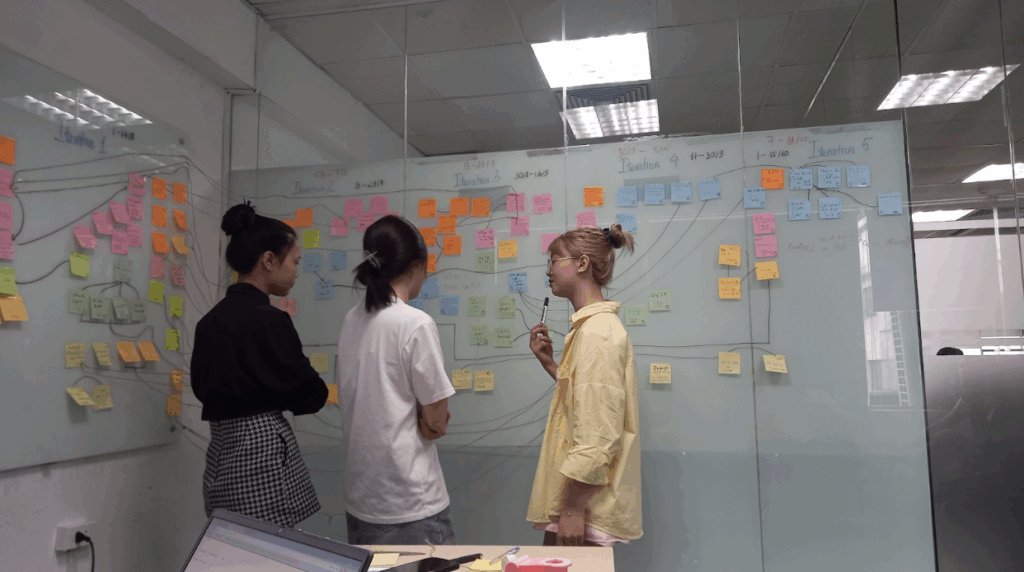
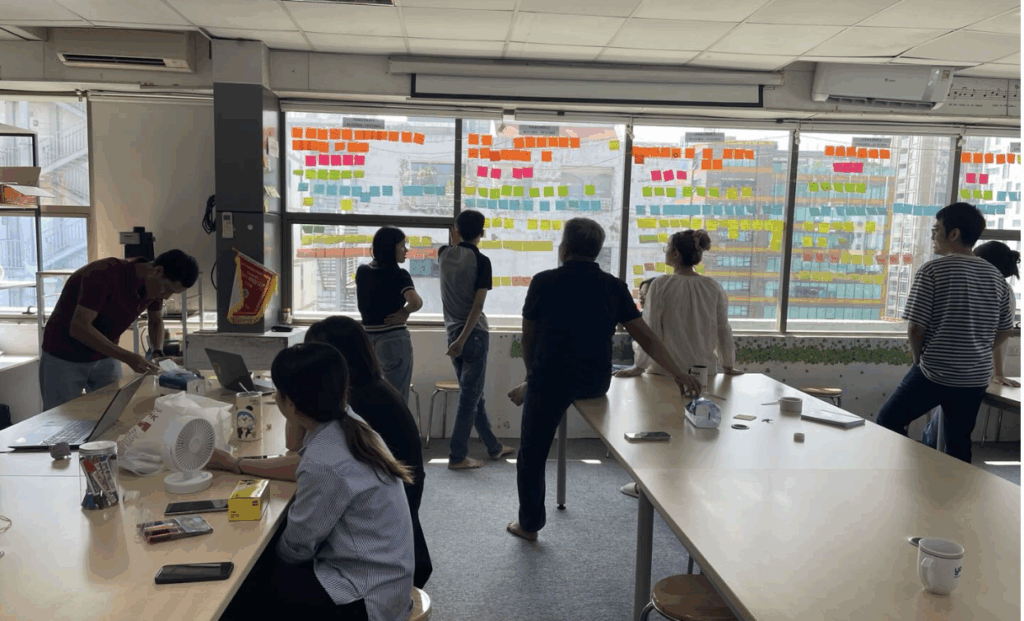
Mobio’s first PI Planning
Mobio’s second PI Planning
Agile team performance:
Teams are more seamlessly connected through Agile Release Trains (ARTs) and PI Objectives.
Survey results show that most members feel their daily work directly contributes to the company’s overall goals.
Team responsibility and cohesion improved significantly, with average scores rising from 3.4/5 before SAFe to 4.1/5.
Blocker resolution time was reduced from 2 days to 0.5–1 day.
Team satisfaction increased by 15–20% after 4 PIs, reflecting higher ownership and stronger team engagement.
Achieving business and customer outcomes with SAFe:
Release cycles are now consistently maintained every two weeks, delivering value to customers faster.
Bug counts decreased by over 30% after 4 PIs, demonstrating continuous product quality improvements.
The ratio of post-release bugs to total development bugs dropped from 8% to 3%, making the product more stable and reducing customer issues after releases.
The percentage of features delivering measurable business value rose from 75% to 90%, showing clear improvement in prioritization and feature selection.
Beyond Business: How SAFe Improved Company Culture
“Beyond the business benefits, what impressed us most about adopting SAFe were the positive impacts on people and culture at Mobio. SAFe’s mindset naturally aligns with and reinforces the core values Mobio embraces even before adopting SAFe: Ownership, Respect, and Growth-Oriented.” -– Trang Duong, COO of Mobio
Through SAFe practices that connect daily work with ultimate outcomes, every team member now experiences greater clarity, meaning, and ownership in their roles, Mobio reports. The company culture has become more open and transparent, as SAFe events encourage participation, facilitation, and the sharing of fresh ideas and perspectives. This has fostered stronger collaboration, mutual support, and alignment toward common goals.
At the same time, a culture of continuous learning and improvement has taken root, enabling the organization to become more proactive, cohesive, and mature with each Sprint and PI. Most importantly, individuals feel their voices are heard, team cohesion has grown, and satisfaction with the work environment has improved significantly — with survey scores rising from an average of 4/5 to 5/5.
In summary, SAFe has helped Mobio become more transparent, aligned, and adaptive in delivering value to customers. This has built a strong foundation for scaling Agile further and achieving even greater business results in the future.
“The most significant gain, in my view, is intangible: Today, the relationship between IT and business is peaceful and collaborative. People work with much more ease and face fewer conflicts.”
—Roberto Lopes de Carvalho, Secretaria da Fazenda do Estado de São Paulo
Industry:
Government
Quick Facts:
São Paulo State Department of Treasury (SEFAZ-SP) has approximately 8,000 employees.
The department manages $230 billion in taxpayer revenue.
Its structure includes 18 regional tax units, dozens of tax posts, as well as administrative and service units covering all 645 municipalities in the state.
With SAFe Essential chosen as the starting point and with the help of Adaptworks as a trusted partner, the first ARTs (Agile Release Trains) were launched in July 2019.
SAFe allowed the department to leverage cutting-edge technologies in electronic systems and digital services.
Outcomes & Lessons Learned:
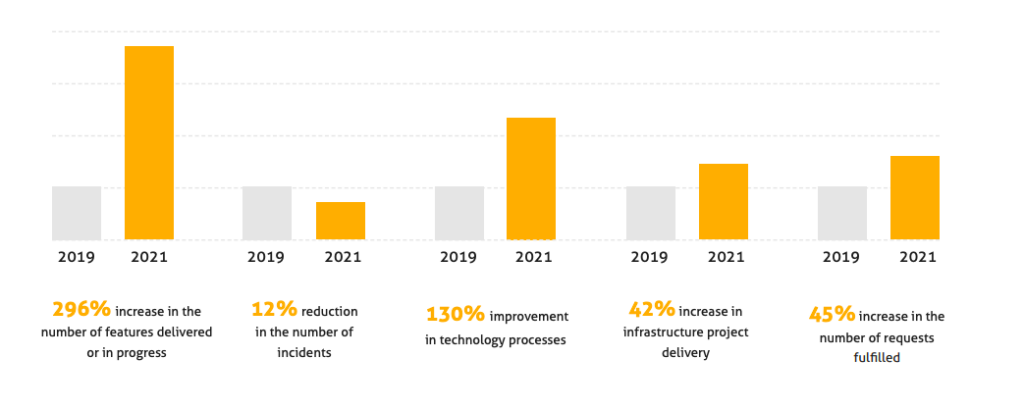
Between 2019 and 2021, the department saw a 296% increase in the number of features delivered or in progress.
Teams saw a 12% reduction in the number of incidents to manage.
The department reported a 42% increase in infrastructure project delivery rates.
They adopted a clearer definition of responsibilities between business and IT.
Stakeholders reported stronger alignment between development, security, and infrastructure through DevOps.
Overview
With the challenge of managing 230 billion in revenue collection from taxpayers in the State of São Paulo, SEFAZ-SP followed a path with the help of SAFe to establish new milestones in the public management of its services.
This journey led to results such as increased efficiency, continuous value delivery, and greater collaboration between the areas involved in the deliveries.
About SEFAZ-SP
The Secretaria da Fazenda do Estado de São Paulo, responsible for the highest ICMS revenue collection among Brazilian states, is headquartered in the capital and operates throughout the state of São Paulo. Its structure includes 18 regional tax units, dozens of tax posts, as well as administrative and service units covering all 645 municipalities in the state.
With a workforce of approximately 8,000 employees, the institution combines the most modern concepts and practices of public management with the continuous improvement of high-quality services for citizens, both in-person and remotely. It leverages cutting-edge technologies in electronic systems and digital services.
Problem Statement
After an evaluation process that took place in 2017, SEFAZ- SP encountered a scenario typical of organizations that are in the early stages of an Agile transformation.
As a response to the situation it was facing, SEFAZ-SP adopted Scrum as a work process for its teams. The results and benefits of this adoption quickly became evident through increased delivery speed and improved alignment between Product Owners and business areas.
According to Margarita Gómez, Executive Director of the PeopleGov Lab at the Blavatnik School of Government, University of Oxford, one of the main challenges of public service in Brazil is aiming for a government that is agile, flexible, and innovative.
And it was precisely in this direction that SEFAZ-SP initially guided its transformation strategy, under the leadership of Roberto Lopes de Carvalho, Deputy Director of the Information Technology Department, responsible for the entire organization, structure, and service delivery related to technology products and services.
“We were facing a problem with incremental and waterfall management models, using PMI techniques for tracking. Essentially, there was a constant state of conflict and contract renegotiation between technology and business areas, which we decided to address by adopting Scrum for team management. We started with a few teams and quickly expanded as the initial experience was excellent,” says Roberto Lopes de Carvalho, Secretaria da Fazenda do Estado de São Paulo
An important step had been taken, but there was still something SEFAZ-SP needed to address to further accelerate its transformation: Scaling all its Agile initiatives across the institution without compromising the quality, efficiency, and value generation that had been individually achieved by the teams up to that point.
The Challenge
Over time, it became clear that although teams were delivering individual results, they still needed better alignment with operations and the institution’s service area. The challenging scenario involved a large number of applications requiring integrations with both internal and external services. Even though development had become faster, it still lacked synchronization and cadence across the various teams.
“For a while, we experienced the phenomenon of a fast car without a rearview mirror. It was common for a team to be developing an application, complete one stage, and then realize that the next stage—handled by another team, sometimes requiring a different integration—was not yet ready,” adds Carvalho.
The lack of synchronization and alignment, along with the loss of knowledge at the end of projects due to the reallocation of professionals, raised a red flag for Roberto.
The Path Forward
In 2019, after an evaluation led by Roberto and supported by market references and data, SEFAZ-SP decided that SAFe could meet their needs.
The process began with a consultation with Scaled Agile, where SEFAZ-SP sought a certified and reliable partner capable of offering the full portfolio of SAFe training, along with the consulting support they needed.
Adaptworks was recommended as the pioneer in bringing SAFe to Brazil in 2014 and for establishing itself as the leading SAFe company in Latin America, recognized for its consulting support to various organizations and for having trained over 5,800 professionals in SAFe.
With SAFe Essential chosen as the starting point, the first ARTs (Agile Release Trains) were launched in July 2019. As the process gained momentum, representatives from all technology areas, agile teams, and key stakeholders from business areas were integrated into the ARTs, assuming roles such as Business Owners, Product Managers, and Product Owners.
One of the initial challenges was skepticism and resistance to the ongoing changes, as well as uncertainty among professionals regarding their roles and responsibilities within the new framework.
This natural adaptation process was mitigated through SAFe alignment ceremonies and coordination meetings with all stakeholders.
“We found a work framework with well-defined roles, which greatly helped in identifying the right people for each role and clarifying their responsibilities. Once we overcame this initial challenge, we had to launch the ARTs and form the teams — each sometimes at different levels of maturity and with varying experiences in agility. However, we always respected these differences and embraced the methods or solutions that each ART discovered for itself,” highlights Carvalho.
Over the course of several months, Adaptworks contributed to the learning journey of Business Owners, RTEs, Product Managers, and agile team members by delivering 100% of the SAFe training offered by Scaled Agile.
Adaptworks also provided support for launching the ARTs, which played a key role in enabling SEFAZ-SP to maintain and offer its 72 digital services to the citizens of São Paulo.
Results
The result of the partnership between SEFAZ-SP and Adaptworks is reflected in the absolute numbers achieved between 2019 and 2021:
In addition to the gains mentioned above, other notable improvements have emerged from SEFAZ-SP’s adoption of SAFe, generating a positive impact across the organization:
Clearer definition of responsibilities between business and IT
Stronger alignment between development, security, and infrastructure through DevOps
A shift in how technology-related matters are perceived, leading to greater alignment with the modernization of strategic planning, which now incorporates quarterly OKRs synchronized with Program Increment (PI) cadences.
Together with our partner Deloitte, we are bringing together leading minds from administration and Agile transformation to discuss solutions for the future.
Speakers
Felix Dinnessen
Partner | Government & Public Services, (Deliotte)
Dr. Thomas Karl
Director | Technology Strategy & Transformation – Industry Lead GPS, (Deliotte)
This one-day event intends to bring practitioners of agile together with those who are interested in seeing how to look different at hardware engineering. Explore this field with inspiring talks, workshops and interactive sessions.
Ethics-Driven AI: How Scaled Agile’s Approach Balances AI’s Advantages with Social Responsibility
Join us for an insightful webinar on “Ethics Meets Agility: Scaled Agile’s Approach to Achieving Responsible AI” where we will delve into the essential principles and best practices for developing and deploying AI responsibly.
When:
August 6, 2024, 9:00 am – August 6, 2024, 10:00 am MST
Where:
Online via Zoom
Who:
Agile Coach, Business Analyst, Director, Program or Project Manager, SAFe Program Consultant
This session will address the dual challenges of Fear of Missing Out (FOMO) and Fear of Messing Up (FOMU), offering strategies to harness AI’s potential while mitigating risks. A significant focus will be on how the Scaled Agile Framework (SAFe) can help organizations achieve these goals and realize the benefits of AI in a responsible manner. By leveraging the same patterns, roles, and practices that enable business agility, SAFe provides a structured approach to integrate responsible AI practices into your enterprise transformation efforts.
Speakers
Dr. Steve Mayner
Scaled Agile
Dr. Stephen Mayner is passionate about coaching businesses on digital age leadership, organizational change, strategy, continuous learning culture, artificial intelligence, Agile contracts, and SAFe® practice in government. His 35-year career in business includes roles as vice president in multiple Fortune 500 companies and chief technology officer for a health IT startup.
Doug is an energetic and relentless Agile Transformation Coach passionate about helping organizations navigate their journey to agility. He has over 20 years of multidisciplinary consulting service experience, with the last decade aimed at driving the adoption of Agile values, principles, and practices to help people go beyond DOING Agile to BEING Agile.
Real options promote flexibility in decision-making and enable organizations to pivot, change course, or seize new opportunities as circumstances evolve.
When:
May 21, 2024, 12:00 pm – May 21, 2024, 1:00 pm MST
Where:
Zoom
Who:
Consultant, Director, LACE Member, Program or Project Manager, SAFe Program Consultant, Transformation Leader
In SAFe there are many roles in the big picture. But the existing „Manager“ function and role that we have in traditional enterprises is not shown in SAFe Big Picture, like Department Manager, Project Manager, Operation Manager, General Manager, IT Manager, and much more. In this meetup, we would like to discuss some scenarios and transition aspects for the manager role.
—
Bei SAFe gibt es im Großen und Ganzen viele Rollen. Aber die bestehende „Manager“-Funktion und -Rolle, die wir in traditionellen Unternehmen haben, wird in SAFe Big Picture nicht gezeigt, wie z. B. Abteilungsleiter, Projektleiter, Betriebsleiter, Geschäftsführer, IT-Manager und vieles mehr.
Southwest Airlines is famous for its employee-first culture, dedication to customer service, and sense of warmth, friendliness, and fun. And when it comes to meeting the urgent demands of technology development in a highly complex logistical environment, a thriving culture is just the start to meeting the challenge.
To live up to Southwest’s purpose of connecting people to what’s important in their lives through reliable, low-cost air travel, Southwest began its Agile transformation in 2018 in operations. The fantastic results led to SAFe® adoption throughout Southwest.
Now four-plus years into their Agile transformation, more than 2,000 Southwest employees collaborate cross-functionally across the organization.
Quick Facts:
Operates at more than 120 airports across 11 countries worldwide
Carried 126 million customers in 2022
Operates more than 4,000 flights per day during peak season
Started SAFe transformation in 2018
More than 2,000 employees involved in SAFe across reservations, customer experience, crews, scheduling, training, aircrafts, ground operations, maintenance, and more
Key Outcomes:
Streamlined the number of steps and handoffs between business and technology and made them more predictable, saving time and money.
By adopting SAFe at the portfolio level, Southwest went from 7–9 months of planning in 2017, plus variable building, testing, and deploying timeframes (see timeline below) to releasing every iteration in 2020
From 2018–2020, they saw increased deployment success and 5x faster time to market (28 releases with 45% deployment success in 2018, to 349 releases and 93% deployment success in 2020)
Experienced better alignment around business value while measuring greater than 80% of business value delivered
To survive in today’s rapidly evolving business landscape, organisations must respond to market changes and expedite delivery cycles without compromising quality. However, implementing an Agile approach across all levels of the organisation to accelerate flow can be challenging within a complex enterprise. How can you achieve visibility? And how do you measure success?
The latest iteration of SAFe, version 6.0, highlights SAFe principle #6 – Make Value Flow Without Interruptions and the eight “flow accelerators” as the means to accelerate value flow across all enterprise levels. At this upcoming fireside chat, Mik Kersten, CTO of Planview, will discuss this principle’s practical applications to accelerate flow at all levels.
The event will consist of 45 minutes of panelist content, followed by 30 minutes discussion and Q&A.