Welcome to the third post in our value stream identification in practice blog series. You can read the first post here about preparing for a successful workshop. And the second post here with helpful tips for identifying value streams.
The Scaled Agile Voice of the Customer (VoC) is a community of our most inspiring customers. All of whom are driving measurable change at their organizations.
This group of individuals comes together—virtually and twice a year—to share, connect with each other, and give us feedback to help us prioritize our most important work. Pretty simple, right? But very powerful in practice.
That power resides in how the VoC has been designed to promote continuous exploration and customer centricity. Each time we meet, we do exercises that encourage our community to look both backward (this is what we built based on your previous feedback) and forward (defining what our epic priorities should be). For example, at our last VoC event, Dean Leffingwell spent some time reviewing what we had worked on over the past six months.
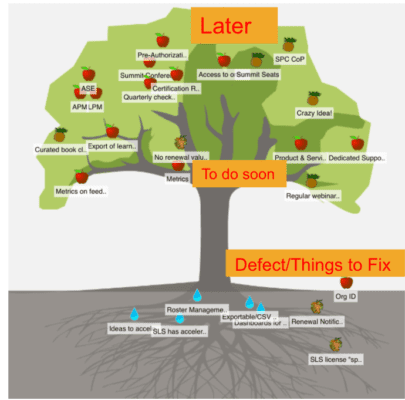
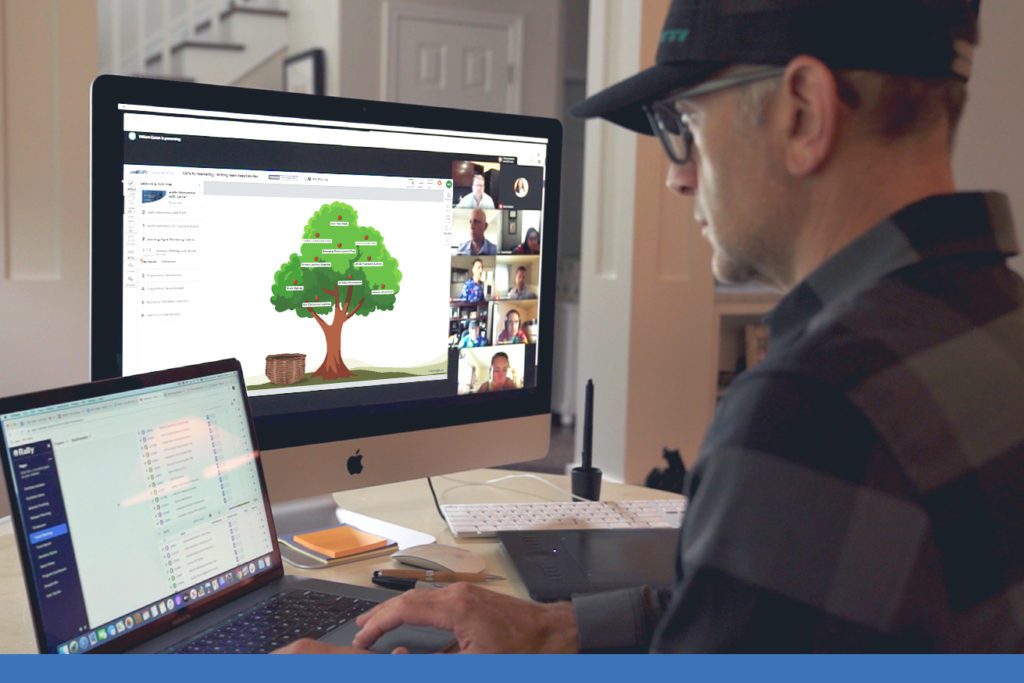
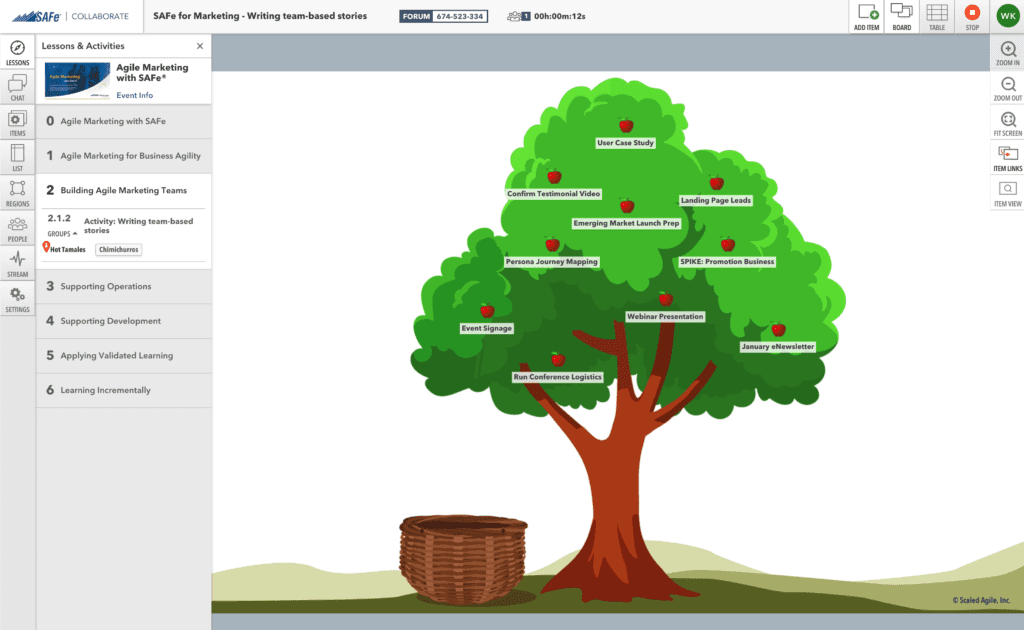
We also went through an exercise called “Prune the Product Tree,” which is designed to reveal the features most important to our customers. Participants place apples, which represent features, onto a tree. Items nearest the trunk are a higher priority than those placed farther up the tree.
From our customers, we heard quite clearly that organizing around value was the top-rated epic. The overwhelming agreement within the community around this feature kicked off a renewed internal focus on Principle #10: organizing around value. Although we now had our purpose, we weren’t sure how to get started, nor what part of organizing or mapping value was the biggest challenge. So before jumping in and creating new tools and materials, we went back to our community to gain more clarity about the needs.
We asked some of our participants to spend 30 minutes with us in an empathy interview. We wrote a script of eight, open-ended questions designed to help us understand how organizing around value applies to their context. The questions were intended to uncover the obstacles they faced in organizing around value. Some of the biggest challenges were related to preparing for the workshop and getting executive buy-in to attend. One aha moment was when we learned how many organizations stand up ARTs without relying on the Value Stream Identification Workshop. So, our new guidance would actually need to reflect that reality.
Now that we had a sense of next steps, we knew it was important to bring our customers along for the journey to keep us moving in the right direction. We created a study group representing a smaller subset of our VoC community. As the name implies, this group’s purpose is to gather and apply a critical eye to new intellectual property and how it serves the challenges they identify.
This VoC study group has been critical in helping us understand the complexities large organizations face as they organize around value. But we’re not finished yet! With this group’s help, we’re developing new pre-workshop guidance. Our goal is to create new tools that will better serve our internal champions by:
Generating buy-in: getting executive level and internal support for holding the workshop. The 10 Tips for Value Stream Identification blog post is a good place to start.
Facilitating the workshop: guidance for creating an interactive and action-oriented event.
Taking action: tips for implementing workshop results.
In fact, we’re testing it out this quarter with the study group. And, as always, keeping the customer at the center as we design, test, and iterate.
Want to see the impact of the group’s feedback on early guidance? Some of the updates include:
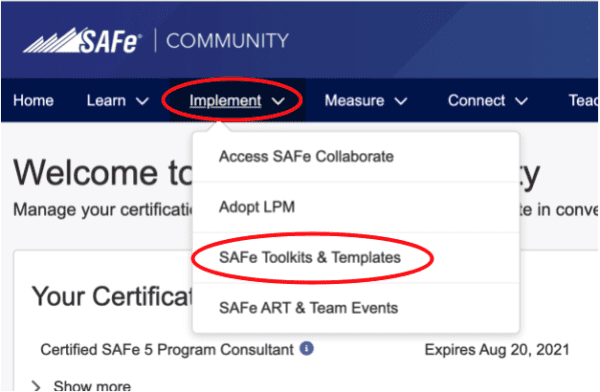
Value Stream and ART Identification Workshop toolkit. Or, navigate to the “Implement” tab on the SAFe Community Platform, selecting “SAFe Toolkits & Templates,” then selecting “SAFe Value Stream and ART Identification Workshop Toolkit 5.1.”
What’s new in SAFe 5? How about Operational Value Streams as first-class citizens?
About Jennifer Roberts
Jennifer Roberts leads the Voice of the Customer community within the Marketing Enterprise Solutions team. Prior to joining Scaled Agile, she worked at Cisco where she led the global social selling and demand generation team. She lives in Boulder, Colorado and does not believe chili has beans.
Welcome to the second post in our blog series about value stream identification in practice. Read the first post here about preparing for a successful Value Stream and ART Identification workshop.
When deciding where to launch an Agile Release Train (ART), it can be tempting to look within existing organizational boundaries. But, considering Lean-Agile Principle #10, which reminds us to organize around value, we must challenge ourselves to look outside of our comfort zone, and consider a team more optimally focused on delivering value.
In light of organizational politics, doing so can be challenging, if not scary. To help people focus on the task at hand, we’ve developed a Value Stream Identification workshop. It can be especially helpful for organizations that aren’t actively managing value streams. It also teaches all those who attend the Implementing SAFe® course the method to facilitate a value stream identification event.
All SPCs are trained to facilitate a value stream mapping activity. But executing these workshops is an art mastered only after you’ve done in-depth studies on the topic (check out Value Stream Mapping by Karen Martin and the SAFe Value Streams article to start), and have participated in several events under the guidance of a skilled practitioner.
If you’re a new SPC who doesn’t have the opportunity to co-facilitate an event, here are 10 tips to help make your first few value stream identification sessions more productive.
Your operational value stream is probably bigger than you think.
When considering your operational value stream, remember the baseline definition of a value stream:
“… set of actions that take place to add value to a customer from the initial request through the realization of value by the customer. The value stream begins with the initial concept, moves through various stages of development and on through delivery and support. A value stream always begins and ends with a customer.”
Or, simply stated, from concept to cash.
In my years of helping organizations better understand their value streams, I’m often presented with initial maps that begin with input from an upstream process and end with an output to a downstream process. These aren’t value streams. To understand the value stream that your ART serves, it’s likely you need to zoom out from the perspective you’re most familiar with and consider the products and services that you support. I often direct people seeking to understand their value streams to start with the products or services section of their organization’s website. Another point of reference is the organization’s earnings report. A profit and loss statement will often represent the organization’s operational value streams.
Your development value stream probably doesn’t follow organizational structures.
The development value stream, which is where your ART(s) will align, represents the design-build-test activities that support change within the operational value stream. Though it may be tempting to align development value streams and ARTs to the organization’s reporting structures, this is suboptimal. To determine the best development value stream alignment, you must first understand the complexity of the social network required to serve the operational value stream. How? By gaining clarity around architectural complexity, or understanding who must collaborate and how often to develop valuable changes to the operational value stream. Over time, our goal is to simplify and optimize both technical and business architectures. To start doing that, we must do our best to optimize for flow by reducing bottlenecks associated with handoffs and dependencies.
After identifying the operational value stream, we continue the conversation of value stream identification. This is where we seek to understand the systems that support the operational value stream, and which steps of it they interact with. The resulting picture will help us make a more informed decision of where to align our development value stream, and determine which type(s) of development value stream supports our operational value stream.
Agreeing with operational and development value stream alignment is harder than you think.
Aligning around value, though critical to delivering better products and services to customers faster, is often challenging. In large enterprises that historically reward those who operate well within the hierarchy, the goal to operate well cross-functionally may feel difficult. The leaders of each functional area are asked to relinquish control of their organizations to better serve the customer. Though few will argue the merit of such a decision, we must be empathetic to the fact that this sort of change is difficult and often scary.
As a value stream identification workshop facilitator, you’ll find it valuable to proactively partner with the organization’s change management professionals to better understand the audience impacted by the workshop. These change professionals can help you better understand potential roadblocks and relationships. And they can recommend conversations you should have before the workshop to begin establishing trust, rapport, and purpose.
You may have more guidance than you think.
Understand the nuance between value stream identification and value stream mapping. Value stream mapping is the art and science of defining, measuring, and optimizing value streams and capabilities over a long period of time. SAFe discusses value stream identification in the context of launching an ART. It’s where we need to have an informed discussion of the most logical place to launch an ART based on our best understanding of how value flows within our area of influence. Value stream identification doesn’t replace value stream mapping but certainly proves the need to invest in the latter.
Words matter. When referencing the one- to two-day workshop to determine the best place to launch an ART, be careful to reference this as value stream identification. A business architect’s job is to maintain and optimize value streams and their underlying capabilities. If they overhear a well-intended SPC state that they intend to map a value stream in a day or two, the SPC may inadvertently make an adversary out of a would-be supporter.
If the organization you’re working with happens to have business architects on staff, then there may be many more inputs available for the value stream identification conversation than you’d initially suspect. If so, seek to partner with the business architect and leverage the assets they’ve created. At the very least, the fact that these people exist indicates an undeniable organizational willingness to organize around value.
Your business architecture will make it hard.
The architecture of a business, the flow of processes and interactions from concept to cash, will introduce complexity to the value stream identification exercise. Those complexities will typically represent years of acquisitions (without integration), good and bad relationships, canceled projects, partially finished projects, and other forms of organizational debt.
One of the most exciting—and troubling—things about an Agile transformation is how the new ways of working effectively shine a spotlight on issues that have been plaguing the organization for years. This is your opportunity to do something about it. Remember, the goal of value stream identification is to make an informed decision about the best, most logical place to launch your release trains. And those ARTs will evolve as the organization and architecture change. The goal isn’t to solve all of the organization’s challenges. But be aware of what you learn so that you can address the challenges and complexities moving forward.
Your technical architecture will make it harder.
As messy as an organization’s business architecture may be, it’s likely that its technical architecture is worse. I’m talking about outdated systems, mainframe databases, hard-coded variables, and systems that we’re not too sure of what they do, but certain that it’s something important. The conceptual diagrams of most architectures tend to look like a hurricane.
Though challenging, this is also a huge opportunity. If the intent is to move faster and with greater stability, you must invest in reducing technical debt, refactoring, and modularizing their architecture. The value stream workshop can help identify some of the largest risks in the technical architecture and begin aligning people in a way that will support a better future state.
A good way to think of investments in business and technical architecture is to reflect on this video.
The goal of a race is to cross the finish line first. Pitstops are an obvious bottleneck in that process. To alleviate delays in the pit, engineers and team owners had to invest in developing specialized skills among the pit crew and specialized tools optimized for efficiency. And redesign the car with the intent of making every component on it as fast as possible. This includes the architecture for changing tires, fueling, and more. These days, nobody is polishing the windshield. Instead, the visor on the driver’s helmet has been optimized to minimize glare, shed water, resist fog, and with roll-offs for when things get messy.
What’s your organization’s race car? What investments do you need to make in the car so that your organization can achieve its goals? Investments in architecture aren’t optional. But you should make it clear how each investment will help the organization perform at a higher level.
There are several types of operational value streams.
When considering operational value streams in an organization, it’s important to be aware that there are more than one type.
Fulfillment value streams represent the steps necessary to process a customer request, deliver a digitally enabled product or service, and receive remuneration. Examples include providing a consumer with an insurance product or fulfilling an e-commerce sales order.
Manufacturing value streams convert raw materials into the products customers purchase. Examples include consumer products, medical devices, and complex cyber-physical systems.
Software product value streams offer and support software products. Examples include ERP systems, SaaS, and desktop and mobile applications.
Supporting value streams include end-to-end workflows for various supporting activities. Examples include the life cycle for employee hiring and retention, supplier contracting, executing the annual budget process, and completing a full enterprise sales cycle.
Development value streams support operational value streams.
While operational value streams may vary significantly depending on their purpose, the development value stream steps are fairly standard: design, build, validate, and release the systems that support the operational value stream as it delivers value to the end-user. The titles of the people who work within the development value stream will vary based on the specific type of work being done, but the responsibilities of the people involved with the development value stream will be aligned with the steps mentioned above.
This is only a starting point.
Remember, the value stream identification workshop is designed to help people determine the best, most logical place to launch a release train. The decisions made in the workshop are a starting point. Following the workshop, reflect on opportunities to improve business operations, technical architecture, and the benefit of actively managing value streams for flow. Launching your first ART, development value stream, and portfolio is only the beginning of a lifelong pursuit to improve.
Once you start, evolve and seek excellence.
As you continue to optimize your operations and architecture, expect that the ART configuration and team topology will evolve. As the Agile Manifesto reminds us, we hope to build resiliency through a commitment to responding to change by following a plan. And the SAFe House of Lean reminds us how important it is to commit to relentless improvement in pursuing value delivery.
Look for the next post in our blog series about how our voice of the customer sessions influenced Scaled Agile’s recent value stream work.
In the meantime, you can download the updated Value Stream and ART Identification Workshop toolkit by navigating to the “Implement” tab on the SAFe Community Platform, selecting “SAFe Toolkits & Templates,” then selecting “SAFe Value Stream and ART Identification Workshop Toolkit 5.1.”
About Adam Mattis
Adam Mattis is a SAFe Program Consultant Trainer (SPCT) at Scaled Agile with many years of experience overseeing SAFe implementations across a wide range of industries. He’s also an experienced transformation architect, engaging speaker, energetic trainer, and a regular contributor to the broader Lean-Agile and educational communities. Learn more about Adam at adammattis.com.
The Value Stream and Agile Release Train (ART) identification workshop are some of the most critical steps to generate meaningful results from your SAFe transformation. That’s because it enables you to respond faster to customer needs by organizing around value. This workshop can also be the hardest step. It’s complex and politically charged, so organizations often skip or mismanage it.
A savvy change agent would invest in the organizational and cultural readiness to improve the chances of its success. Attempting to shortcut or breeze through change readiness would be the same as putting your foot on the brake at the same time you’re trying to accelerate. Get this workshop right, and you’ll be well on your way to a successful SAFe implementation.
Why Is It So Difficult?
Aside from the complex mechanics of identifying your value streams, there is also a people component that adds to the challenge. Leaders are often misaligned about the implications of the workshop, and it can be tough to get the right participants to attend. For example, a people leader could soon realize that ARTs may be organized in a way that crosses multiple reporting relationships, raising the concern of their direct reports joining ARTs that don’t report to them.
In reflecting on my battle scars from the field, I’ve distilled my advice to three steps to prepare the organization for a successful workshop.
Step 1: Engage the right participants
The Value Stream and ART identification workshop can only be effective and valuable if the right audience is present and engaged. This is the first step to ensure the outcome of the workshop solves for the whole system and breaks through organizational silos.
“… and If you can’t come, send no one.” —W. Edwards Deming
The required attendees will fall into four broad categories:
Executives and leaders with the authority required to form ARTs that cut across silos.
Business owners and stakeholders who can speak to the operational activities of the business, including ones with security and compliance concerns.
Technical design authorities and development managers who can identify impacted systems and are responsible for the people who are working on them.
Lean-Agile Center of Excellence and change agents supporting the SAFe implementation and facilitating the workshop.
Use some guiding questions to identify the right audience for the workshop within your organization. Are the participants empowered to make organizational decisions? Do the participants represent the whole value stream? Is the number of attendees within a reasonable range to make effective decisions?
Step 2: Build leadership support and pre-align expectations
To support engagement and address potential resistance, I recommend performing a series of interactions with leaders in advance of the workshop. In such interactions, the change agent would socialize a crisp and compelling case for change in the organization, supporting the “why” behind running the workshop.
The change agent needs to be prepared to address leader trepidation about the possibility of having their reporting-line personnel on ARTs that they don’t fully own. Most compelling is a data-based case made by performing value-stream mapping with real project data to expose the delays in value delivery due to organizational handoffs.
Interaction opportunities can include one-on-one empathy interviews, attending staff meetings, internal focus groups, and overview sessions open to all workshop participants.
I highly advise setting expectations with leaders in advance of the workshop. This will help them understand the workshop implications, help identify potential misalignment or resistance, and coach them in how to signal support for the workshop purpose.
The following are useful expectations to set with the participants in advance to help shape how they view the upcoming workshop:
Allow the designs to emerge during the session. This is meant as a collaborative workshop.
Expect to be active and on your feet during the session, actively contributing to the designs.
Be present and free up your schedule for the duration of the workshop as key organizational decisions are being made.
Alleviate the anxiety of broad, big-bang change by clarifying that they get to influence the implementation plan and timing to launch the ARTs.
Address the misconception about organizational change by explaining that ARTs are “virtual” organizations, and that reporting lines need not be disrupted.
Step 3: Prepare the workshop facilitators
A successful Value Stream and ART identification workshop will have the main facilitator, ideally someone with experience running this workshop. Additionally, you’ll need a facilitator, typically an SPC, per every group of six to eight attendees. Prior to the workshop date, schedule several facilitator meetings to prepare and align them on the game plan. This will go a long way in helping your facilitators project competence and confidence during the workshop. Discuss the inherent challenges and potential resistance, and how the facilitators can best facilitate such moments. Share insights on change readiness based on the leadership interactions and empathy interviews. Finally, prepare a shared communication backchannel for facilitators, and build in sync points during the event to ensure alignment across the groups.
While these simple steps and readiness recommendations don’t necessarily guarantee a successful workshop, they’re a great starting point. You’ll still need to understand the mechanics of identifying value streams. This is what Adam will cover in the next post in our value stream series. Look for it next week.
Deema Dajani is a Certified SAFe® Program Consultant Trainer (SPCT). Drawing on her successful startup background and an MBA from Kellogg Northwestern University, Deema helps large enterprises thrive through successful Agile transformations. Deema is passionate about organizing Agile communities for good, and helped co-found the Women in Agile nonprofit. She’s also a frequent speaker at Agile conferences and most recently contributed to a book on business agility.
What if you could see a great example of SAFe® in the wild; a vision of a possible future as you prepare to launch your first ART? Would you want to stand in the middle of where the work is done and gain insights into what could inhibit your success? I’d like to share an approach I’ve used to leverage the power of a Gemba walk. I believe it to be one of the most powerful accelerators available for those considering implementing SAFe.
What is Gemba?
Gemba is a Japanese term that means “the real place.” It represents going to where the work is done or the place where value is created from a Lean-Agile perspective. Within an automotive plant, it’s the manufacturing floor, at a hospital, it could be the ER or operating room, and in the U.S. Government, it could be inside a Sensitive Compartmented Information Facility (SCIF).
Traditionally, a leader would take a Gemba walk to visit where the work is being done to observe the value being created and interact with the people and processes. Together, they can identify opportunities for improvement. Within SAFe, Gemba walks are among the collaborative research techniques product management will use for continuous exploration.
I encourage enterprise executives, Lean Portfolio Management executives, and ART stakeholders to take Gemba walks of PI Planning from a relentless improvement perspective. Gemba walks to allow them to truly understand the Framework while raising awareness of systemic issues that may require senior leadership assistance. Even before you’ve launched your ART, a Gemba walk of PI Planning is valuable. It is similar to someone looking to invest in a restaurant franchise who visits an existing location to get a closer look at what might be ahead of them.
While I have used this within large corporations, I have found it particularly applicable to the federal government. Many of the corporation-to-corporation or even business-unit-to-business-unit challenges that exist in the private sector do not apply as civil servant leaders are, ultimately, all part of the same overall entity. I’ve seen an incredible willingness for government leaders to share with others across agencies, such as the USAF/US Army program leader inviting NASA leaders to observe PI Planning before their ART launch. In this case, “the real place” is a live PI Planning event for an established ART.
Doing a Gemba Walk at PI Planning
As you can imagine, observing PI Planning before attempting to launch your ART will always provide valuable insights. Even if you only glean some examples of things you might do differently, there is no substitute for actually experiencing a live event.
I recommend you find the best example of SAFe you can and arrange to observe it with an experienced tour guide.
Tip: Look for ARTs organized around value, with dedicated Agile teams that meet the commitments they make themselves. If you can, find an ART where the Business Owners, Product Management, System Architect, and RTE have cleared their schedules to be 100-percent available during the entire event. Seek an ART where leaders demonstrate Lean, Agile, and SAFe values in how they work while genuinely seeking to cultivate transparency, create alignment, and deliver value together.
Interested? Here are the steps I like to take:
1. Find an ART that represents the type of SAFe implementation you hope to achieve yourself. Starting with the practices alone can still bring value, as not every company, business unit, or government program is ready to weave the values and principles necessary for great success. Additionally, some see SAFe as a process to be implemented by the numbers, pushing practices out, and directing how everything will work. Others understand that implementing SAFe, or any scaling agile framework requires shifts in mindsets and people making decisions based on new values and principles. I focus on the latter, as it’s the one that creates the deep roots needed to sustain and grow.
2. Obtain permission from the program leaders, understand what values they seek from experience, and address any concerns. Often, this idea of a Gemba walk is part of the introduction email between leaders of both programs.
3. Facilitate an orientation meeting before the planning event. This orientation allows you to introduce leaders from both programs, review the host ART’s schedule, and set the working agreements to ensure minimal disruption and maximum learning. Additionally, this meeting allows the host to share any context-specific ways they have leveraged the Framework. The visitors and the tour guide will understand the reasons for the changes before observing the event.
Tip: If remote, provide an overview of the tooling and methods used to replicate the deep collaboration model present in a face-to-face event.
4. Arrange for a dedicated tour guide who doesn’t need to facilitate the actual PI Planning event. If they have an SPC, as well as experience coaching ART launches, I recommend that the new program’s coach be the guide. Otherwise, the existing coach from the host program is a solid choice. The purpose of the tour guide is to help the visitors connect their knowledge to the field experience while highlighting best practices and answering questions in real-time without disrupting the host ART’s event. Ensure that everyone stays connected by having a persistent chat channel available for coaches and visitors throughout the event, and pre and post syncs to reflect on the insights gained.
Tip: If you consider bringing in an SPC as a coach or consultant, deeply explore their field experience. You might even find one who has a previous customer willing to share their perspective or allow you to observe their PI Planning event.
5. Allow visitors to observe the entire PI Planning event. If this isn’t feasible, see how many of the key events are available, such as opening briefings, team breakouts, plan reviews, management review, ROAMing of program risks, and the confidence vote. Understanding the host’s parameters and the visitor’s role can help you prioritize if time is limited.
6. Facilitate daily meet-afters between both sets of leaders. Standing meet-afters provide a safe forum to ask tough questions and discuss sensitive topics with honesty. Those who have the experience can share their tips and tricks with those preparing to embark on their SAFe journey.
7. Encourage connections between each visitor and the individual in their corresponding ART role. Personal relationships create an opportunity for those in the various roles to connect beyond the event. These introductions also can spark the creation of role-specific communities of practice.
Remember: SAFe is a framework, and while some essential elements, patterns, and practices lead to success, it is not one size fits all. As you look to customize your implementation, understanding why the methods are in place and which values and principles power them will serve you well.
A Gemba walk is one of the best ways to turn your knowledge of PI Planning into real understanding. It provides insights for hosts and visitors alike while creating community connections that foster alignment, transparency, quality, and execution.
Gemba resources
If you would like to learn more about Gemba within the Framework, check out the Continuous Exploration article. If you want to take a deeper dive, Jim Womack’s book, Gemba Walks Expanded, 2nd Edition is a great resource, and you can connect with one of the SAFe Fellows through the “Ask an Expert” forum on the SAFe Community Platform portal (login required).
About Phil Gardiner
Phil Gardiner, a SPCT, is focused on enabling people to achieve sustainable success through greater business agility. He has served various markets from Fortune 10 corporations to the U.S. federal government.
It’s quite common for people to nod knowingly when you mention leading indicators, but in reality, few people understand them. I believe people struggle with leading indicators because they are counterintuitive, and because lagging indicators are so ingrained in our current ways of working. So, let’s explore leading indicators: what they are, why they’re important, how they’re different from what you use today, and how you can use them to improve your innovation and product development.
What Are Leading and Lagging Indicators?
Leading indicators (or leading metrics) are a way of measuring things today with a level of confidence that we’re heading in the right direction and that our destination is still desirable. They are in-process measures that we think will correlate to successful outcomes later. In essence, they help us predict the future.
In contrast, lagging indicators measure past performance. They look backwards and measure what has already happened.
Take the example of customer experience (CX). This is a lagging indicator for your business because the customer has to have the experience before you can measure it. While it’s great to understand how your customers perceive your service, by the time you discover it sucks it might be too late to do anything about it.
ROI is another example of a lagging indicator: you have to invest in a project ahead of time but cannot calculate its returns until it’s completed. In days gone by you might have worked on a new product and spent many millions, only to discover the market didn’t want it and your ROI was poor.
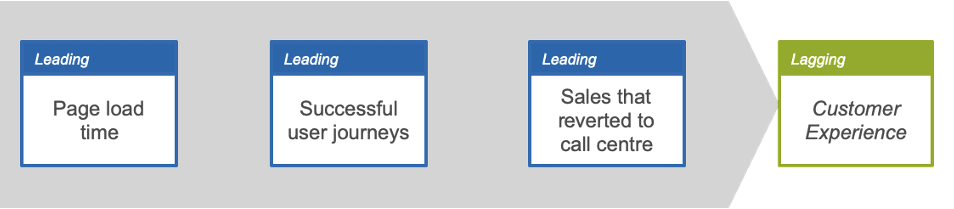
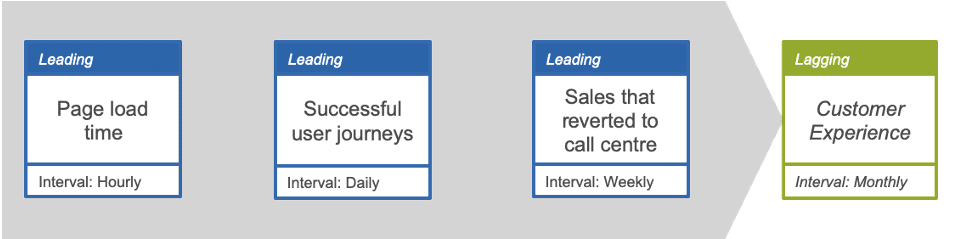
Online retailers looking for leading indicators of CX might look instead at page load time, successful customer journeys, or the number of transactions that failed and ended up with customer service. I often tell clients that if these leading indicators are positive, we have reason to believe that CX, when measured, will also be positive.
Don Reinertsen shares a common example of leading vs. lagging indicators: the size of an airport security line is a leading indicator for the lagging indicator of the time it takes to pass through security screening. This makes sense because if there is a large line ahead of you, the time it will take to get through security and out the other side will be longer. We can only measure the total cycle time once we’ve experienced it.
If you operate in a SAFe® context, the success of a new train PI planning (which is a lagging indicator) is predicated on leading indicators like identifying key roles, training people, getting leadership buy-in, refining your backlog, socializing it with the teams, etc.
Simple Examples of Successful Leading Indicators
The Tesla presales process is a perfect example of how to develop leading indicators for ROI. Tesla takes refundable deposits, or pre-orders, months if not years before delivering the car to their customers. Well before the cars have gone to production, the company has a demonstrated indicator of demand for its vehicles.
Back in the 90s, Zappos was experimenting with selling shoes online in the burgeoning world of e-commerce. They used a model of making a loss on every shoe sold (by not holding stock and buying retail) as a leading indicator that an online shoe selling business would be successful before investing in the necessary infrastructure you might expect to operate in this industry.
If you are truly innovating (versus using innovation as an excuse for justifying product development antipatterns, like ignoring the customer) then the use of leading indicators can be a key contributor to your innovation accounting processes. In his best-selling book, The Lean Startup, Eric Ries explains this concept. If you can demonstrate that your idea is moving forward by using validated learning to prove problems exist, then customers will show interest before you even have a product to sell. Likewise, as Dantar P. Oosterwal demonstrated in his book, The Lean Machine, a pattern of purchase orders can be a leading indicator of product development and market success.
Leading Indicators Can Be Near-term Lagging Indicators
Let’s loop back and consider the definitions of leading and lagging indicators.
Lagging: Measures output of an activity. Likely to be easy to measure, as you’ve potentially already got measurement in place.
Leading: Measures inputs to the activity. Often harder to measure as you likely do not do this today.
Think about the process of trying to lose weight. Weight loss is a lagging indicator, but calories consumed and exercise performed are leading indicators, or inputs to the desired outcome of losing weight.
While it’s true that both calories consumed and exercise performed are activities that cannot be measured until they’re completed, and therefore might be considered near-term lagging indicators, they become leading indicators because we’re using them on the path to long-term lagging indicators. Think back to the CX example: page load time, successful customer journeys, and failed transactions that end up with customer service can all be considered near-term lagging indicators. Yet we can use them as leading indicators on a pathway to a long-term lagging indicator, CX.
How to Ideate Your Leading Indicators
The most successful approach I’ve applied with clients over many years is based on some work by Mario Moreira, with whom I worked many moons ago. I’ve tweaked the language and application a little and recommend you create a Pathway of Leading to Lagging Indicators. To demonstrate this, I will return to the CX example.
If we walk the pathway, we can estimate that an acceptable page load time will lead to a successful user journey, which—if acceptable—will then lead to fewer failed transactions that revert to customer service, which ultimately will lead to a positive customer experience metric.
Work Backwards from Your Lagging Indicator
To create your Leading to Lagging Pathway, start from your lagging indicator and work backwards looking at key successful elements that need to be true to allow your lagging indicator to be successful.
At this stage, these are all presuppositions; as in, we believe these to be true. They stay this way until you’ve collected data and can validate your pathway. This is similar to how you need to validate personas when you first create them.
Add Feedback Loop Cycle Times
Once you have your pathway mapped out, walk the pathway forward from your first leading indicator and discuss how often you can and should record, analyze, and take action for that measure. You should make these feedback loops as short as possible because the longer the loop, the longer it will take you to learn.
All that’s left is to implement your Leading to Lagging Pathway. You may find a mix of measures, some which you measure today and some you don’t. For those you already do measure, you may not be measuring them often enough. You also need to put in place business processes to analyze and take action. Remember that if measures do not drive decisions, then your actions are a waste of resources.
Your leading indicator might be a simple MVP. Tools like QuickMVP can support the implementation of a Tesla-style landing page to take pre-orders from your customers.
Applying Leading Indicators in Agile Product Management
A common anti-pattern I see in many product management functions is a solution looking for a problem. These are the sorts of pet projects that consume huge amounts of R&D budget and barely move the needle on profitability. Using design thinking and Lean Startup techniques can help you to validate the underlying problem, determine the best solution, and identify whether it’s desired by your potential customers and is something you can deliver profitably.
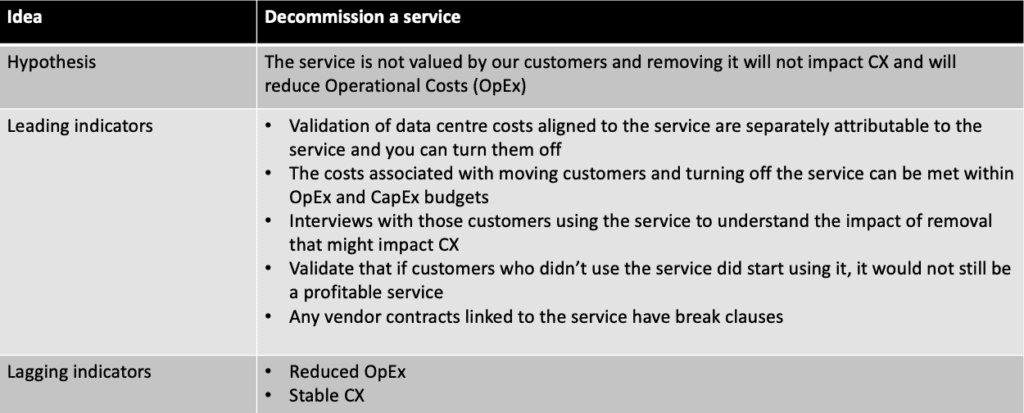
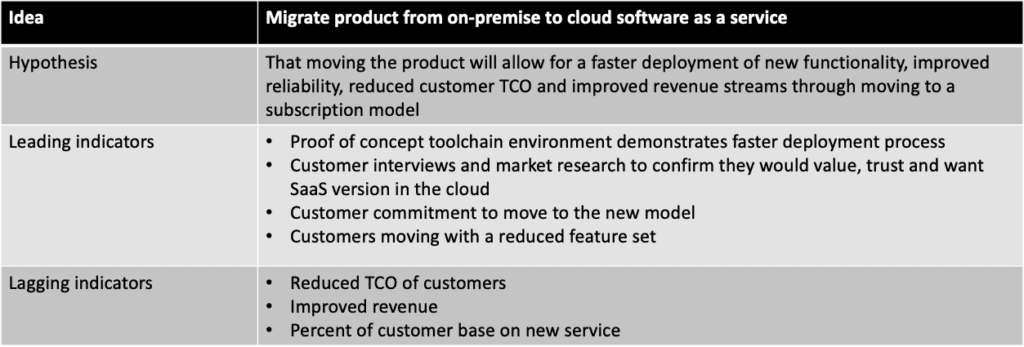
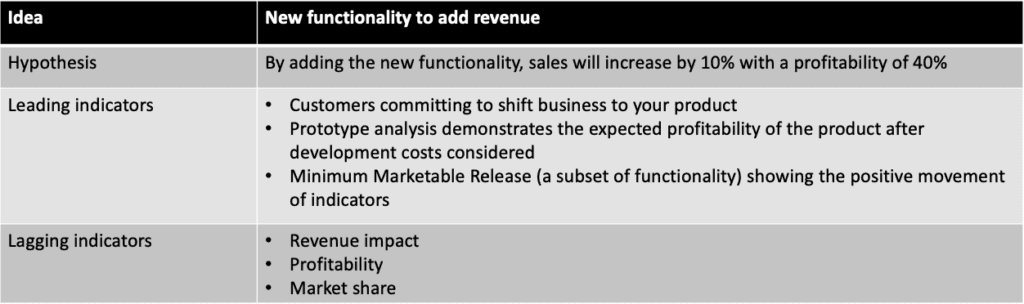
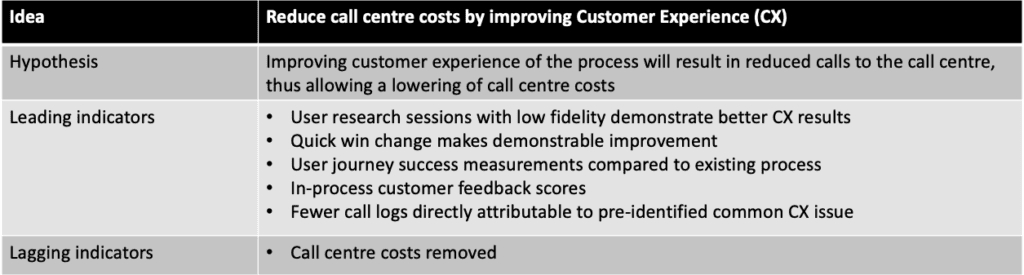
In SAFe, leading indicators are an important element of your epic benefit hypothesis statement. Leading indicators can give you a preview of the likelihood that your epic hypothesis will be proven, and they can help deliver this insight much earlier than if you weren’t using them. Insight allows you to pivot at an earlier stage, saving considerable time and money. By diverting spending to where it will give a better return, you are living by SAFe principle number one, Take an economic view.
Let’s look at some working examples demonstrating the use of leading indicators.
I hope you can now see that leading indicators are very powerful and versatile, although not always obvious when you start using them. Start with your ideation by creating a Leading to Lagging Pathway, working back from your desired lagging indicator. If you get stuck, recall that near-term lagging indicators can be used as leading indicators on your pathway too. Finally, don’t feel you need to do this alone, pair or get a group of people together to walk through this process, the discussions will likely be valuable in creating alignment in addition to the output.
Glenn Smith is SAFe Program Consultant Trainer (SPCT), SPC, and RTE working for Radtac as a consultant and trainer out of the UK. He is a techie at heart, now with a people and process focus supporting organizations globally to improve how they operate in a Lean-Agile way. You will find him regularly talking at conferences and writing about his experiences to share his knowledge.
Hollywood has a way of portraying philosophers as pretentious finders of fault. (Emily in Paris, I love you, but you are guilty of this.) What’s more, the mention of the stoic philosopher leads to images of people who are emotionless and incapable of feeling (Spock, anyone?).
These portrayals are unfortunate, because we all stand to learn a great deal from the stoics of ancient times. Especially agilists.
Over the last year, my wife and I have focused a portion of each day studying the stoic philosophers Chrysippus, Marcus Aurelius, Seneca the Younger, and Epictetus. Our daily meditation has helped us be in better control of our emotions and hone our world view. It’s helped me become a better consultant and coach. Most significantly, the lessons have helped my wife process what she has seen as a nurse in the year of COVID.
Each of us, agilist or otherwise, can build a healthier outlook by taking a moment to reflect on these ancient lessons. Here are a few insights I’ve gained that have helped me better engage with enterprises and agilists during this tumultuous year.
The discipline of perception
Clarity. For an agilist, clarity is achieved through a combination of education, experience, and making mistakes. The stoics remind us that we should remain humble as we gain more clarity. As we learn to observe, absorb, and reflect, we begin to recognize patterns, and we need to remain empathetic to the circumstances that cause these patterns. The more we learn, the more open we become to others’ circumstances, emotions, and conflicts.
Passions and emotions. As a coach or consultant, it’s incredibly important that we lead with passion, while keeping our emotions in check. The stoics remind us that the journey belongs to our client, and it is our responsibility to walk that journey with them. With a calm dignity, we must steady the impulse to act on what we think we know, to not give in to the self-fulfilling prophecy of fear that may be felt by those we are guiding, and to avoid making the job of change harder than it needs to be.
Awareness. The fall of many energetic agilists comes from an eagerness to act before fully appreciating the situation at hand. Awareness is where philosophy begins, and is the starting point of any transformative journey. We must observe, take the time to appreciate history, and seek to understand the interconnected nature of the people working within the system. We work with a firm footing in the present but with a keen eye on the future. One day, it will all make sense.
Unbiased thoughts. The Agile community is full of some of the most volatile, well-intended people I have ever come across. To their own undoing, many have firm opinions based on perception and bias. As the stoics teach us, the more we think we know about an issue, the less we understand. A person who remains unbiased, as all agilists should, will seek to understand, do their own research before forming an opinion, and welcome a change of perspective.
To be so firmly rooted in a position of being (Agile) or not leaves one in a position to be alienated and left behind by an ever-evolving idea.
The discipline of action
Right action. As we lead others along the pathway to a new way of working, it’s a common mistake to tell others what to do—especially when they ask you to. The problem with direction and execution is that context and intention, and thereby learning, are lost. As a SAFe coach or SAFe consultant, we must avoid this temptation and instead show a client what they need to do. You can accomplish this through demonstration, facilitation, and showing up to perform even on the hard days. In the spirit of carpe diem, we, along with our clients, must do our best to make the most of the present while maintaining awareness of the end goal, and giving little thought to the future.
Problem solving. In problem solving, we have to be flexible. As we learn through many problem-solving tools, the problem is rarely what we think it is. It’s in our best interest to remain flexible and to have a mental reverse clause, no matter how well we think we know what we know (the freedom to admit when you’re wrong.) There isn’t room for pride in problem solving; growth and learning is what we’re here for.
Duty. This is the single world embodying everything it means to be a servant leader. Servant leadership is a rallying flag common to nearly all agilists, but true servant leadership is a call few are willing to answer. The sense of duty that comes with putting the needs of others before your own is one of selfless service and sacrifice. As a servant leader, you must show up, do your job, learn, and embrace the ethos that doing the right thing for those you’re serving is the only thing you can do—even if it’s the wrong thing for you personally.
Pragmatism. One of the most important skills that pragmatism teaches those of us with an agile heart is to not expect perfection. Perfect agile is subjective and should never be the goal. Instead, focus on helping clients achieve better business outcomes, helping employees attain a healthier and more fulfilling work experience, and creating a culture that is focused on outcomes and free of blame.
The discipline of will
Fortitude and resilience. You’re going to fail. People will struggle. People will be angry with you. Do you have the fortitude to endure? Are you resilient enough to endure this again and again? Transformation is a messy job. It’s often thankless until the moment it isn’t, and then the agilist is on to the next engagement and asked to start over. It’s rare that the agilist is in a position to enjoy the fruits of their labor, but it shouldn’t be about that. We work with a steady resolve. We’re resistant to the blame, the negativity, and the haters. Our hidden power is to know what the pain is for. We know the indisputable benefits of our craft. We’ve seen lives transform and organizations flourish through this new way of working. All reasons why we shall endure, again and again.
Virtue and kindness. The most beautiful thing any of us can do is to be kind to others. Kindness is especially important when others are fraught with struggle and may not be able to be kind to you. Will you look out for those who are unkind anyway? The stoics teach us that character is fate. People won’t remember what you said, but they will remember how you made them feel, especially when they may be embarrassed by how they made you feel.
Acceptance. The strong accept responsibility. They never complain, they never explain. Instead, they seek to control their own attitudes and responses to those events. The only thing that could have happened will happen, and we must seek to learn all we can from that outcome. As a stoic agilist, we must do our best to apply the guidance of Marcus Aurelius (Meditations, 8.7), which suggests that our acceptance of events and nature moves freely when it:
Accepts nothing false or uncertain
Directs its impulses only to acts for the common good
Limits its desires and aversions only to what’s in its own power
Embraces everything nature assigns it
We accept the outcome of our best efforts, reflect, grow, and share.
Meditation. A career focused on changing human behavior and organizational psychology is not for the faint of heart. It takes strong resolve to let the little things go so that we can elevate ourselves from the day’s chaos to evaluate the big picture. Are we making progress? What is the goal? Where is their pain? Am I inflicting pain? How can I help make the situation better? Am I the person best suited to help this team?
As agilists, we must take the time to reflect, to ensure we’re not burning the candle at both ends, and to give thanks for the invitation to help others do what is hard. Our calling is noble, our purpose transcendent, and the impact undeniable. By studying the stoics we can help assure that we are showing up as our best selves and that we stay firmly rooted in the intent that brought us to this type of work.
Adam Mattis is a SAFe Program Consultant Trainer (SPCT) at Scaled Agile with many years of experience overseeing SAFe implementations across a wide range of industries. He’s also an experienced transformation architect, engaging speaker, energetic trainer, and a regular contributor to the broader Lean-Agile and educational communities. Learn more about Adam at adammattis.com.
Due to the global pandemic, almost overnight, we had to convert all 2020 SAFe® classes to virtual delivery. I’m most proud of how the worldwide SAFe community came together and experimented to figure out remote delivery. My contribution was to imagine the class experience and determine how to help instructors facilitate learning activities remotely. We came up with remote training aids which were simple slide templates for each activity that groups could collaborate indirectly. It was an early stage MVP in our journey to evolve remote learning.
Remote was not for the faint of heart
As instructors, we had to figure out the tooling and how to set up those templates for the class. I remember when I remotely delivered new Lean Portfolio Management Alpha and Beta classes, it took me close to 30 hours to set up the activities and groups for each class. Delivering back-to-back classes, while good for our work, was exhausting because setup activities would bleed into our evenings and weekends. I could definitely understand why some SPCs were hesitant to venture into remote delivery.
The virtual classroom evolution
We kept experimenting with different formats and tools in class, and learning with each one how to make the experience better. We started to use SAFe® Collaborate, our cloud-based visual workspace, to standardize the activity templates. Early feedback was positive about the learning and ideation experience. But attendees still felt that having too many windows open was distracting and tedious, especially during activities with short timeboxes. For instructors, it took time to set up these templates for each group and class. And while we were able to automate a portion of the setup via script, that wasn’t the case for course updates. Instructors still had to revise class activities when Scaled Agile introduced a new class version.
During a hackathon at Scaled Agile, colleagues built an interactive virtual classroom prototype in SAFe Collaborate that solved the navigation and usability challenges.
This hackathon idea won first place and got approved as a feature during our next PI Planning.
Virtual classroom for the win
I recently taught my very first class using our virtual classroom, and it was such a wonderful experience. I’ve switched from being a sceptic to a fan because it’s so awesome! All the templates were indexed by lesson, well organized, and easily accessible for both students and teachers. Students could quickly navigate to their own group activity and even browse around to see what other groups were doing.
The learning experience was much richer and more fun for the students, especially when we got to the PI Planning simulation. The best part for me as an instructor? I could set up the class and groups with a single action! I simply showed up to class, clicked a button to designate the number of groups, and started teaching.
Lean Agile Centers of Excellence (LACEs) and SPCs that need to update templates with every course upgrade will score an even bigger win with the virtual classroom experience. Scaled Agile now provides the activity templates and automatically updates them when new course versions are released. This is a huge value and time saver.
If you’re an SPC or a LACE member, I encourage you to try our virtual classroom in your next class. Just select “SAFe Virtual Classroom” as you set up your next remote class, and explore the different activities. Or, watch the remote trainer enablement video to see a demo.
If you’re like me, you’ll find it hard to go back!
About Deema Dajani
Deema Dajani is a Certified SAFe® Program Consultant Trainer (SPCT). Drawing on her successful startup background and an MBA from Kellogg Northwestern University, Deema helps large enterprises thrive through successful Agile transformations. Deema is passionate about organizing Agile communities for good, and helped co-found the Women in Agile nonprofit. She’s also a frequent speaker at Agile conferences and most recently contributed to a book on business agility.
There are few sentences more toxic to a workplace than, “That’s the way we’ve always done it.” A marketing team is often tasked with ongoing maintenance work that must be done. Updating a webpage, a piece of collateral, or a social feed can often feel like everyday, run-of-the-mill work that rarely gets seen or appreciated. It just sort of runs in the background and quietly eats away at the work day. As a result, this unappreciated, untracked work usually gets thrown into an ever-expanding pile of just-get-it-done tasks that mandate no thought and no context. Before you know it, someone’s asking why we do it at all, and that toxic answer resurfaces: “That’s the way we’ve always done it.”
To me, this answer is a symptom of the larger problem. Born out of years of repetitive tasks that never see the organizational light of day. We always do it that way because we’ve never had the time to closely examine our process. Or, it’s been so long that literally no one can remember why those decisions were made in the first place.
Agile marketing provides multiple tools to marketing leaders to help focus their teams’ efforts. Our goal is to never just eliminate business as usual (BAU) work; just make sure it’s the right one. This was the challenge I faced when I recently took over an agile marketing team. How could I leverage the Scaled Agile Framework® (SAFe®) to make sure we’re doing the right work to keep the ART on track, rather than just busywork? Luckily, agile marketing gave me a few tools I never had before in previous marketing leadership roles. I have visibility into and clarity around the work that had never existed before, and my team has reaped the benefits.
Data: It’s not just for open rates anymore
Agile preaches that all work should be visible. But as previously stated, BAU work rarely is. Being an agile team that leverages a Kanban board to visualize the flow of work getting done, we made a small tweak. We tagged every user story that fit the description of BAU. Voilà! I could now pull clean reports on exactly what type of BAU we were working on, what percent of our time we were dedicating to it, and who on the team it affected the most.
We found that we were spending a staggering 31 percent of our time on BAU! And as we examined more closely, we found many people had no idea why we were working on these things at all. It was just the way we had always done it.
Most importantly, the ART and the team had no idea just how much time all this work was taking. No one had ever calculated it. By taking a data-driven approach to the issue of BAU, we did something crazy: We timeboxed it.
Capacity allocations
There are only so many hours in a day and any good leader wants to make sure their team is getting the top-priority things across the line. Our goal is not to eliminate BAU work, but to ensure it’s the right work. By following agile marketing practices we can calculate exactly how much we can accomplish in a two-week iteration. Leveraging ‘capacity allocation’ helps marketing leaders limit BAU’s ability to derail the priorities.
And that’s exactly what we did. Our team allocates 20 percent of our available time to deal with BAU work like website maintenance, monthly newsletters, and updates to graphics. This creates a forcing function in evaluating BAU. Is this BAU user story more important than another one? To answer that question, team members have to fully understand the work and the product owner (PO) has to understand the customer’s needs. If no one understands why they’re working on something, they shouldn’t be working on it.
Hypothesis-driven development
Marketers love a good A/B test. It’s short and simple. But harder, more in-depth questions like “Does this webpage provide value to the reader?” take more effort and thought. When evaluating BAU, we found we needed to develop some muscle memory around answering these harder questions. And we wanted something more defensible than our personal opinions.
To do this, we’ve introduced an agile marketing concept called hypothesis-driven design. Essentially, it means you develop a testable hypothesis and the experiment to validate or falsify it. In other words, you leverage the scientific method to evaluate your work.
After the team took the Agile Marketing with SAFe®course, we began to apply hypothesis-driven design to our website and our underperforming monthly newsletters. This won’t come as much of a surprise to marketing professionals, but we found we’re pretty good at designing tests; not so great at writing hypotheses that can be tested. Introducing hypothesis-driven design was a meaningful step toward building more intention into our BAU work.
So what happened?
Since adopting these practices, our team has seen a 42 percent decrease in capacity spent on BAU. This work is being turned into productive, value-delivering efforts that support the ART’s overall go-to-market strategy.
By leveraging agile marketing we’re no longer just busy: We’re busy delivering value.
About Hannah Bink
Hannah Bink heads the Marketing Success team at Scaled Agile. She has nearly 15 years of B2B marketing experience and studied business at Pennsylvania State University. Prior to Scaled Agile, Hannah spent the majority of her career in telecommunications and healthcare sectors, running global marketing divisions. She is also author of the “Musings of a Marketeer” blog, and lives in Denver, Colorado.
If you’ve spent much time working in enterprise environments, you might have heard about the Scaled Agile Framework® (SAFe®). And if that’s the case, there’s also a good chance that you’ve heard many opinions about what SAFe is and what it’s not.
Maybe you’ve found yourself in a ‘SAFe-adjacent’ space, are curious about how SAFe concepts can help you, or are new to the space entirely. Regardless, here are eight facts about SAFe that you should know.
1: SAFe is based on nearly 100 years of lessons learned
The concepts within SAFe are nothing new. In fact, one key aspect of the Framework—flow—was first documented by Shigeo Shingo and Taiichi Ohno in the 1930s as the Toyota Production System (translated to Lean manufacturing).
2: Enterprises of all sizes are using SAFe to solve the digital transformation equation
For organizations such as MetLife, Lockheed Martin, and PepsiCo, SAFe has proven to be a significant factor in helping them figure out what it means to be a digital organization and how to remain competitive in a post-digital economy. What have we learned? That is in 2020, every company is a digital company that may serve a specific customer or market. Mastering customer-centricity and technology are not optional.
3: Enterprises use SAFe to successfully run their entire business
Though SAFe has helped many large organizations address the challenges of large and complex solutions, the Framework is not effective only in those circumstances. In fact, many smaller organizations (such as Mattis & Company and Scaled Agile itself) have found success running their entire business using Portfolio SAFe. It doesn’t matter if technology is your entire business or only part of it, the concepts of organizing around value, Lean startup, and business agility transcend the type of work being done.
4: Enterprises use SAFe to successfully build complicated cyber-physical solutions SAFe has helped organizations, such as FitBit, solve the complexity of delivering cyber-physical solutions (the art of marrying software and hardware) within a tight market rhythm to achieve quality and predictability. Organizations like FitBit also appreciate the guidance around Agile Product Management and Lean Portfolio Management to help them achieve strategy agility.
5: SAFe helps highlight opportunities for improvement
When organizations begin their SAFe journey, many systemic issues become very clear. Issues such as bloated processes, communication bottlenecks, duplicative work, and a lack of understanding around what customers teams serve. While SAFe won’t fix these problems for you, applying the Lean-Agile Mindset, SAFe Lean-Agile Principles, and SAFe Core Values can help you figure out the correct path given your unique context and circumstances.
6: SAFe is more about what you value than what you do
Many well-intentioned people have relied on the processes within SAFe to address their issues. And more often than not, these people have been quick to learn that SAFe is less about what we do and more about why we do it. Changing mindset, values, and principles is hard to do on your own. Fortunately, there is a plan to help you get started, and plenty of seasoned professionals to guide you along the way.
7: Enterprises use the tools within SAFe to solve all sorts of problems
You’re in the right headspace if you consider SAFe a giant toolbox—a resource full of proven concepts and patterns that can be used to solve a wide variety of problems, like quality, time-to-market, and employee engagement. But those aren’t the only problems SAFe can help an organization address. At Scaled Agile, we regularly maintain and expand our library of valuable resources, including toolkits, workshops, and videos—all freely available to members of the SAFe Community Platform. Consultants and coaches use these resources daily to help organizations create solutions that are rooted in the Lean-Agile Principles and applied in organizations’ specific contexts.
8: SAFe is constantly evolving
As the global business climate continues to change at an ever-accelerating pace, the Framework is changing along with it. From providing guidance around participatory budgeting, SAFe® for Marketing, and people agility—and in the spirit of relentless improvement—the Scaled Agile team is constantly working to refine these concepts. We’re committed to understanding markets, evolving business guidance, and helping you help others win in the post-digital economy.
Join us at this year’s 2020 Global SAFe Summit to learn more about SAFe from the people practicing it, and explore a wide variety of concepts and topics. I hope to see you there!
About Adam Mattis
Adam Mattis is a SAFe Program Consultant Trainer (SPCT) at Scaled Agile with many years of experience overseeing SAFe implementations across a wide range of industries. He’s also an experienced transformation architect, engaging speaker, energetic trainer, and a regular contributor to the broader Lean-Agile and educational communities. Learn more about Adam at adammattis.com.
The SAFe program board, or program dependency board, is a key artifact used in PI Planning and execution. The Agile Release Train (ART) teams and stakeholders used it to align, anticipate risks, and adapt the plan accordingly.
This inspection and adaptation of the plan based on insights from the program dependency board is first-loop learning—making changes in the plan based on what we see.
Deeper learning from the program dependency board
What we rarely see, though, is deeper learning from what the program dependency board shows us. It’s like the good old times where you would see a project manager/PMO working their Microsoft Project Gantt Chart, moving things around, but rarely stopping to ask deeper questions around the base structure of their plans and why they’re based on a waterfall model.
Program dependency boards can drive deeper learning about the structure of our ART and its alignment with the kind of mission/vision we’re pursuing, and the backlog of features we’re working on. If we see too much red yarn on our boards, it isn’t something to be proud of. Yes, we can be proud that we identified the dependency and even more that we were able to massage our PI plan to deal with it in a reasonable way. But too much red yarn means too many dependencies. Too many dependencies mean our Value Stream network isn’t configured well. It means we should probably look at ways to reconfigure the network (meaning restructure teams and maybe even the ART).
When to do this deeper learning
I get it. This sort of learning is hard to pursue in the heat of PI Planning. And all too often when PI Planning is done and we have a workable plan in hand, it’s tempting to just move into execution. Resist the temptation. Let the dust settle, but find the time that makes sense to have a deeper retrospective that is based on the patterns you see on the program board. This can be a good discussion in your Scrum of Scrums or with an extended forum that includes the wider ART leadership.
There’s no need to wait for the next inspection and adapt (I&A). It’s fresh now and outcomes from this retrospective might anyhow require a lot of refinement and consideration before they’re actionable. Start the process early in the PI, so hopefully, you’ll be in a position to reconfigure the network going into the next PI as needed.
A typical pattern is when such a retrospective raises the need to rerun a Value Stream identification (VSI) workshop.
Validating the Value Stream design hypothesis—a key but often skipped step
Speaking of the VSI workshop, one key element in it that many practitioners skip is the validation of your Value Stream design hypothesis. After identifying a development Value Stream, run some water through the pipes—take some work in the form of Features or even higher-level Epics/Themes and explore how they will flow through this Value Stream/ART/Solution ART. If the work flows nicely with a minimal number of dependencies, you found a good setup. If even in this ‘dry run’ you already see you have too many dependencies, time to rework the design!
PI Planning dry run
And yes, what this dry run means is that ideally, even in this early phase, before even launching the ART, you should consider doing a light version of PI Planning with the Value Stream design you have in mind to see that it makes sense. You don’t want to train everybody, spend a serious amount of time on preparing to launch the ART, and then find it’s not a self-sufficient ART or that it’s comprised of teams that aren’t self-sufficient.
Summary
I’ve talked about some recommended SAFe best practices here—some are implicitly mentioned in SAFe, and some complement the formal guidance. The key point I wanted to make is how important is it to aim for the right Value Stream network and to continuously inspect and adapt so that value can easily flow with minimal dependencies and slowdowns. And if your Value Stream network is configured well, everything else becomes much easier.
If you’d like to read more about my SAFe experiences in the trenches, I’ve written an e-book. I’ll also be at the upcoming 2020 Global SAFe Summit on the Agile Marketing panel, at the AgileSparks booth in the Partner Marketplace, and at the SAFe Experts Coaching Station. I look forward to connecting with you.
About Yuval Yeret
Yuval Yeret is the head of AgileSparks (a Scaled Agile Partner) in the United States where he leads enterprise-level Agile implementations. He’s also the steward of The AgileSparks Way and the firm’s SAFe, Flow/Kanban, and Agile Marketing. Yuval is a SAFe Program Consultant Trainer (SPCT5), a Professional Scrum.org Trainer (PST), an internationally recognized Kanban Trainer, a thought leader, recipient of the Lean/Kanban Brickell Key Award, and a frequent speaker at industry conferences.