Aligning Global Teams Through Agile Program Management: A Case Study – Agile Transformation

Agile Program Management

Like many organizations, Planview operates globally, with headquarters in Austin, Texas, and offices in Stockholm and Bangalore. About two years ago, we launched a company-wide initiative to rewire our organization and embrace Agile ways of working—not just in product and R&D, but across every department and team, starting with marketing. We developed three go-to-market (GTM) teams, whose goals and objectives centered around building marketing campaigns to create a pipeline for sales. Each team aligned to a different buyer group, with members from the product, marketing, and sales.

The challenge: integrating international teams in our Agile transformation

Like many organizations, we struggled to align and execute our marketing programs across our international teams, defaulting to “North-America-first efforts” that other regions were then left to replicate. As we built out these new groups, we considered how to best include our five-person team of regionally aligned field and demand marketers in Europe, the Middle East, and Africa (EMEA).

At the beginning of our Agile transformation, the EMEA marketers were often misaligned and disconnected from big-picture plans. The EMEA teams were running different campaigns from those in North America. Before forming cross-functional GTM teams, the EMEA team had to individually meet with the different functions in marketing, product marketing, and other departments. The extra complications of time zones and cultures also made it difficult to get things done and stay on strategy.

With team members feeling disconnected, at Planview we suffered lower-impact campaigns and less-than-ideal demand generation. To succeed in our Agile transformation journey, it was critical to properly align the international team through an integrated Agile program management strategy.

The approach: forming and integrating the EMEA team into Agile program management

While the three GTM teams had dedicated cross-functional members representing demand generation, content strategy, and product marketing, it was clear that assigning an EMEA team member to each of these teams wouldn’t solve the problem. Each EMEA marketer is organized by region and language, not by GTM Agile Release Train (ART), so we needed to develop our own EMEA Agile program that would meet the challenges and achieve the needed international alignment.

Working with our Chief Marketing Officer and other stakeholders, we determined that we would continue to align our EMEA team by region/language. Now that the GTM teams were formed (with each team having all the necessary people to deliver end-to-end value), the EMEA team could meet with each team in the context of the prioritized strategic initiatives. Drawing on our local expertise, we could weigh the campaigns from the three GTM teams against each other to determine which would drive the most pipeline and impact in each region. This structure enabled EMEA marketers to opt into GTM campaigns that were regionally impactful, instead of creating standalone campaigns. This approach has been a success. At our last PI planning event, EMEA progressed from just replicating campaigns into co-planning and co-creating the campaigns that were of local interest and fit.

By including the distributed teams in Agile program management, we achieved better alignment as a global marketing team; gave our EMEA marketers the opportunity to leverage fully supported, regionally impactful campaigns; and ultimately, achieved better results for our demand generation campaigns.

Agile Program Management

Learning 1: When starting the process of shifting to an Agile approach, there is an advantage in letting the GTM team form, storm, and norm before involving the EMEA team. That delay allows for the EMEA team to finish up previously committed (sales-agreed-upon) deliverables. It gives the team and the sales stakeholders time to observe and see the benefits of Agile GTM teams without feeling that they are not getting the support they were expecting.

The practice: virtual, inclusive PI planning

Our model continues to evolve in a positive way. We’ve now been through five PI planning events and have transitioned from a “one EMEA representative” approach to including our full marketing team in a truly global planning event.

What does a global planning event look like in practice?

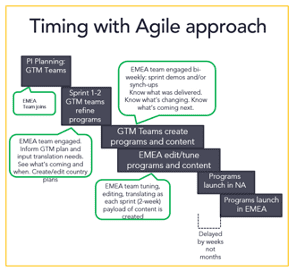
When our EMEA team started to participate in PI planning, we had one representative join to understand the process and feed the critical milestones into the team’s plans. We then matured to the full team joining remotely, which meant that we needed to create a system that would enable inclusive planning across continents.

We created a process of “continuous planning.” First, our global team would plan “together,” from Austin and virtually via web conferencing for EMEA. Our EMEA teams would log off during the evenings in their time zones, and the US team would continue to plan with recorded readouts. The next morning, while the US teams were offline, the EMEA teams would listen to the readouts, adapt plans accordingly, and provide their own readouts on changes made once the team was back together during mutual business hours. While tricky at first, this process ensured that everyone was engaged and that all teams’ contributions were heard and considered. Most recently, we’ve conducted fully virtual planning in mutual time zones.

Learning 2: The gradual inclusion in PI planning meant the GTM teams were already well-established and well-versed in the process. The maturity of the teams and the process helped a lot in the inclusion of the international team.

The results: greater alignment, faster time-to-market, better campaigns

Stock photo of woman at white board talking to people seating in chairs

The impact of our EMEA Agile program can be broken down into three main categories: alignment, time, and utilization.

The collaboration between the EMEA and GTM teams has created significantly stronger connection and alignment, evidenced by both the improvement in campaign quality and our working practices. Our teams have increased visibility into shared and separate work and developed a better understanding of how decisions impact overarching shared goals.

Our Agile ceremonies, combined with the use of Planview LeanKit, have served as a catalyst and a framework to bring us closer together. Communication is easier, more frequent, and more productive, as everyone is aligned to the same goals and plans and has visibility into each other’s progress, needs, and capacity. The greater team can now make conscious trade-offs based on mutual priorities, which enables the EMEA team to focus on the right things and deemphasize asks that are not aligned to the goals. EMEA marketers feel more involved and have an important seat at the table. That is both motivating and effective.

Learning 3: Ceremonies and visual planning tools are absolutely necessary, but only really benefit teams with the right enablement and coaching. To this day we still meet weekly with our Agile coach to refine our LeanKit board and discuss WIP limits, sizing, retros, etc.

From a time-to-market perspective, we’ve seen substantial improvements. Before aligning EMEA to the GTM teams, there were delays in deploying campaigns because EMEA would “find out” about campaigns rather than being part of them from the beginning. Now, the team can give early input and feedback on how a campaign could be adapted to provide the most impact for EMEA, then roll it out more quickly. As a concrete example, we have reduced the time for campaign tactics to go live from three months to three weeks.

The volume and quality of campaigns and campaign materials has increased significantly as well. In the past, the EMEA team often made do with the materials (especially translated materials) that were available, not the assets that were ideal. There were campaign ideas that we could not realize due to a lack of localized material. Without dedicated resources for EMEA, the team had to share creative and translation services with North American providers, who often needed to prioritize programs led by corporate/North America.

Now that EMEA has full visibility into the North American programs, they know what kind of material is in development.

They give input on what is needed to execute campaigns in global markets and when delivery will happen. That means EMEA campaigns can begin at almost the same time as the North American ones, and their marketers can prepare for when translated assets and other materials will be available.

Overall, by transforming our EMEA Agile program, the region went from running one or two campaigns each PI to running five campaigns per PI. EMEA marketing went from approximately four to six new localized assets/materials per year to 18 – 20. We added three translated, campaign-specific landing pages per language. And, most importantly, we’re beginning to see direct indication of pipeline improvements.

Agile program management can be challenging with international, distributed teams. By integrating our global team members into our planning processes from the beginning of our Agile transformation, we’ve been able to achieve measurable benefits across the marketing organization.
Scaled Agile

About Verena Bergfors

Verena is the Marketing Director for Planview’s EMEA markets

Verena is the Marketing Director for Planview’s EMEA markets. She’s from Germany but moved to Sweden around 10 years ago and has been with Planview for over four years. Prior to living in Sweden, she worked in Shanghai for seven years where she held positions in marketing and sales. Verena’s true passion is languages and she enjoys working on diverse international teams.

View all posts by Verena Bergfors

Share:

Back to: All Blog Posts

Next: Use WSJF to Inspire a Successful SAFe Adoption
Use WSJF to Inspire a Successful SAFe® Adoption – Agile for Business

SAFe® Adoption

By definition, Weighted Shortest Job First (WSJF) is a prioritization model used to sequence jobs to produce maximum economic benefit. Utilizing WSJF relies on the Cost of Delay and job size to determine its weight in priority. Think of the Cost of Delay as the price you pay for not delivering a feature to the end-user in a timely manner. For instance, if you know a competitor is also working on a similar initiative to yours, you can acknowledge the risk of losing customers if the experience you deliver pales in comparison.

I like to refer to WSJF as a tool that helps you take the emotion and politics out of a decision and rely on facts instead. WSJF allows us to take an economic view and not be swayed by the loudest complainer (aka squeaky wheel) or the person with the longest title in the room.

I’m sure we can all relate to being in a prioritization meeting either before, during, or after your SAFe® adoption where people demand that their feature be the top priority. But what they can’t clearly explain is why they want it, why that feature is important to the business, end-user, or buyer, and how it aligns with the organization’s purpose. After the WSJF exercise, participants often assume that the biggest, most needed items will find their way to the top of the priority list and are surprised by what features actually get selected. Remember, in Agile, we like to show value quickly. So, WSJF also helps participants identify features that could be too large to ever get to the top, forcing them to break down the work into more manageable batches.

Here’s an example from a retail company I worked with. The company’s top priority at the time was a single-sign-on (SSO) integration feature that was considered critical to improving the user experience. SSO was all everyone was talking about. So, after going through the WSJF exercise, a marketing executive was surprised that aspects of their SSO integration weren’t at the top of the list. The conversation surrounding this—which, by the way, involved the squeaky wheel and the person with the longest tile—enabled participants to break the work down into smaller batches. Everyone involved in the discussion got the context they needed to see that by changing the scope of the work, teams could provide incremental value to customers more quickly. We then went back through the WSJF exercise with the smaller batches of work, some of which moved to the top of the priority list and others moved further down.

Going through this exercise gave participants the context and information to explain:

  • Why and when items were being delivered
  • How customers would be delighted with ongoing improvements versus one large release in the future

Having those key stakeholders in the room allowed us to work through the tough conversations and gain alignment more quickly. That’s not to say the conversations were any easier. But showing how the larger batches of work could be broken down into small batches provided proper context based on end-user value and faster delivery.

In the end, WSJF doesn’t only help an organization deliver the most value in the shortest amount of time, it also fosters decentralized decision-making. This requires your RTE or Product Managers to be steadfast in their approach to ensure trust and belief in the process. When members of the team see leadership supporting this new approach, even when that leader’s feature doesn’t land at the top, it goes a long way in building the trust and culture to inspire a successful SAFe adoption.

About Elizabeth Wilson

Elizabeth Wilson

For more than a decade, Elizabeth has successfully led technology projects, and her recent experiences have focused on connected products. As an SPC, she’s highly versed in Agile methodology practices, including SAFe, and leverages that expertise to help companies gain more visibility, achieve faster development cycles, and improve predictability. With a wealth of practical, hands-on experience, Elizabeth brings a unique perspective and contextual stories to guide organizations through their Agile journey.

View all posts by Elizabeth Wilson

Share:

Back to: All Blog Posts

Next: The SAFe Coach

The SAFe® Coach

a group of business professionals studying with a SAFe coach

Coaching appears in the Scaled Agile Framework® (SAFe®), but there isn’t one place where we define the SAFe coach. According to our recent internal survey of 2,500 SAFe Program Consultants (SPCs), over 70 percent are actively engaged in coaching SAFe implementations. In general, a SAFe coach is a servant leader, someone who can facilitate both change and collaboration at scale. A SAFe coach embodies the attributes of our Lean-Agile mindset as well as a learning and growth attitude to lead by example, while continuously fostering positive change. 

A servant leader

There are many roles or labels the coach could play within a SAFe transformation, including Scrum Master, Release Train Engineer, and SPC. Regardless of the roles and functions inherently associated with a coach, coaching takes place throughout all of SAFe’s core competencies. And all of the competencies have one characteristic in common: to guide organizations in fostering better ways of working. So that we can compete and thrive in the digital age by quickly responding to market changes and emerging opportunities with innovative business solutions.

Within the competencies, servant leadership is unique. It’s a behavior designed to continuously serve the teams, enable product delivery, and benefit the overall enterprise. Using active listening and the collective mindset and principles of SAFe, a coach as a servant leader can become more aware, and more connected to the people within their organization. This approach brings neutrality to the enterprise. So that people feel safe in voicing their thoughts and opinions, and can collaborate to realize the benefits of shared understanding, innovation, learning, and growth. By embodying servant leadership, a SAFe coach can help the organization increase SAFe’s effectiveness and relentlessly expand collaboration, coordination, knowledge transfer, and consistent information flow. 

A facilitator of change

SAFe’s dual operating system enables efficiency, stability, and the speed of innovation. Another key benefit of this system is the ability to evolve the social structure organized around value: the Agile Release Train (ART). This is brilliant, and as referenced in The Power of Empathetic Leadership in an Evolving World, Chuck Pezeshki writes, “How you set up your social structure is THE critical factor in how knowledge and synergies in design will be created. Using Conway’s Law, one can predict a priori what the functional form of a design will be. It matters who talks to who.” 

By organizing around value and creating the social structure around the ART, we design a social structure that encourages knowledge sharing and helps us use empathy and design thinking to innovate around the value we’re creating for customers. Pezeshki further states, “Inside the social structure, empathy is the dynamic that creates synergies in design. While empathy is always valuable, even within the simplest social structures—people that connect are much more likely to transfer correct information to each other—it is essential in creative enterprises.” In our world of ever-evolving complexity, creating social structures can help us transfer information that is accurate, reduce risk, and continuously increase the speed of delivering value. 

Coaching these social structures or networks is part of SAFe’s approach to the dual operating system. These networks take the form of virtual organizations such as ARTs or Solution Trains. And within these virtual organizations, coaches need to have personal agency as their own values and behaviors, so they can coach empathetically and address change quickly. The coaches are empowered to serve the social structure by using these synergies, creating knowledge flow, and facilitating positive growth and change. 

a group of people having a meeting in a small office space.

A facilitator of collaboration at scale

According to Jean Tabaka, author of Collaboration Explained, Facilitation Skills for Software Project Leaders, there’s an intangible component of team and organizational power fostered by collaboration. That component brings out the best in people, and in turn, the value the enterprise delivers to its customers. 

As agilists, it may seem obvious that collaboration is a key component of building software and systems. It is, after all, called out in the third value of the Agile Manifesto: Customer collaboration over contract negotiation. If your leaders ask you why this is so important as a coach, there’s a deeper understanding of the why that’s reinforced in Jean’s book, and that has decades of history in Lean highlighted in Ikujiro Nonaka’s book The Knowledge-Creating Company. He calls out the tacit knowledge—the valuable and highly subjective insights and intuitions that are in people’s heads and difficult to capture and share. 

Collaboration is what helps make that knowledge transferable, or explicit, within your enterprise. Organizations also benefit from converting tacit knowledge into explicit knowledge because it represents a way to express the inexpressible. When building software and systems at scale, there is obvious complexity. There’s literally no one that has all the knowledge. It’s inherently shared across our valued people across the value streams and the enterprise. It takes thousands, if not tens of thousands of people to build today’s computers, cars, aircraft, and satellites.

This evolution of knowledge sharing helps you grow your business through a culture of understanding and aligning with your company’s overall strategic goals. The expanded mission of SAFe 5.0 is to enable the business agility that is required for enterprises to compete and thrive in the digital ageFacilitating tacit knowledge is critical and supported through the extension, behaviors, and mindset of all the SAFe competencies. It’s also measured through the latest Measure and Grow evaluations of how well the enterprise is progressing toward overall business agility. 

The SAFe coach in the enterprise needs to find ways to coach and continuously improve collaboration. Sharing that tacit knowledge through SAFe events is one of the most powerful ways to allow people to continually innovate and gain the knowledge and collective mindset to integrate and deliver the highest level of value. 

Coaches need coaches, too

A SAFe coach needs an extensive toolbox to evolve and accelerate their organization’s SAFe implementation. There are many tools to support coaches in learning how to be servant leaders and facilitate change and collaboration. None of this comes easy. Can you imagine intuitively knowing how to do all of this in your first SAFe coaching gig? Coaches need coaches, too. We learn from others and vice versa. If we model the SAFe coaching behavior we’d like to evolve, it will become a self-reinforcing learning experience that will enable coaches to help each other, cultures to evolve, and people to be happy and heard. All of this can help us truly become that relentless learning organization that solves some of the world’s largest problems. We could all use a little of that right now.

Here’s where you can learn more about evolving your SAFe coaching expertise: 

Stay tuned for upcoming blog posts on SAFe coaching.

About Jennifer Fawcett

 Jennifer Fawcett - a retired, empathetic Lean and Agile leader

Jennifer is a retired, empathetic Lean and Agile leader, practitioner, coach, speaker, and consultant. A SAFe Fellow, she has contributed to and helped develop SAFe content and courseware. Her passion and focus has been in delivering value in the workplace and by creating communities and culture through effective product management, product ownership, executive portfolio coaching, and leadership. She has provided dedicated service in these areas to technology companies for over 35 years.

View all posts by Jennifer Fawcett

Share:

Back to: All Blog Posts

Next: Shared Objectives and Collaborative Sense Making

How to Pass a SAFe Exam and Get Certified

Updated February 18, 2026

SAFe Exam and Get Certified

We’re sharing the following study and test-taking guidelines to help you pass your SAFe exam:

  1. Understand the SAFe exam format
  2. Study for the SAFe exam by interacting with the content in multiple ways
  3. Take the SAFe exam in prime condition

Learn more about each tip in the following sections.

Tip 1 | Understand the SAFe Exam Format

Before you can begin studying, you should understand the test format and structure. Important things to know about your exam include

  • Exam style
  • Number of questions
  • How much time you have to complete the whole exam
  • Average time per question
  • Passing score
  • Exam rules

SAFe exam question types

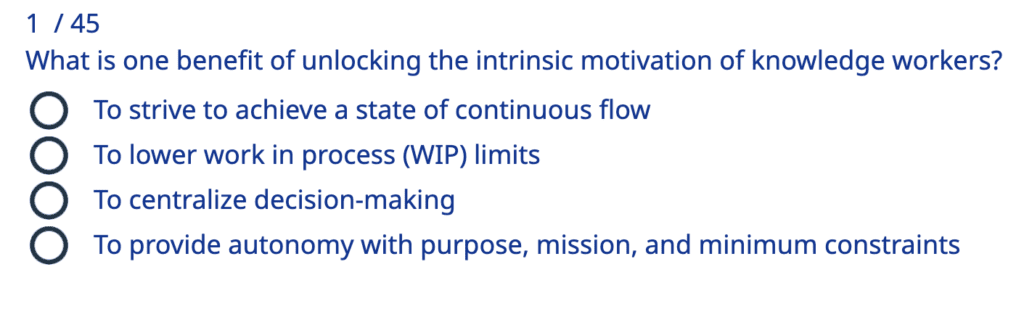
Example of a multiple choice question
Example of a multiple choice exam question

All of our SAFe 6.0 exams are multiple choice (one answer). However, the number of questions and time you have to complete your exam vary. 

Here are some tips for tackling these types of questions:

  • Look for clues to understand the key knowledge being tested: Action words are a great way to determine what is being asked inside the question and what level of knowledge is being tested. This can help you dive deep to find the answer.
  • If the answer is only partly true, it’s probably incorrect: Don’t convince yourself an answer is true if it isn’t. We don’t put trick questions in our exams, so it’s probably incorrect unless the answer is obviously true. 
  • Make predictions: After reading the question, guess the answer before reading the choices. If one of them is the same as the answer you came up with, it’s probably the correct one.
  • If you get stuck on a question: Skip it and come back. Other questions and answers may jog your memory. Our exam platform, QuestionMark, makes skipping questions easy because you can flag questions to return to later during the exam. Review the instructions at the beginning of the exam to understand how to flag.  

See your specific SAFe exam details here.

Tip 2 | Interact with the SAFe Exam Content in Multiple Ways

The first way to learn exam content is by participating in your SAFe course. Once you’ve learned the content, here are a few ways to remember it.

Step 1: Study SAFe materials

The My Learning section in Studio is the best place to start when studying for your exam. When you log in, you’ll see materials for each course you’ve taken. These materials include

  • The course digital workbook
  • The SAFe exam study guide
  • The practice test

Review the course slides and your notes after the class. Then download the SAFe exam study guide provided and read through it.

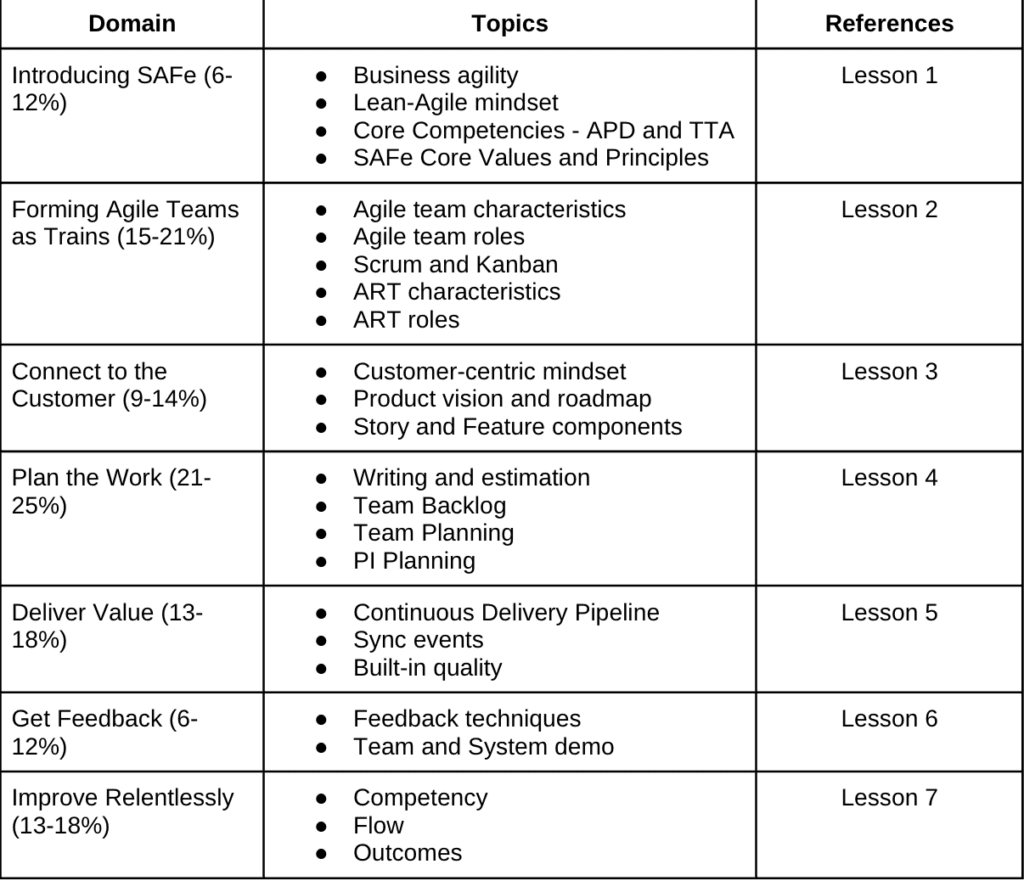
Example of a SAFe exam study guide

The exam study guide is a great tool for determining what percentage of the exam will be made up of a specific domain and the topics within it. These topics will also show in the feedback reports for both the practice test and exam.

You can also learn from others’ experiences in SAFe Connect. Start a discussion thread in one of the groups or message someone directly.

Additionally, there are plenty of SAFe videos that break large Framework concepts into smaller, visual pieces that can be easier to study if you’re a visual learner. 

When all else fails, ask a peer who has already passed their exam which materials they found most helpful when studying.

Step 2: Target your weaknesses by taking a practice test

To make the best use of your time, you need to target not only your perceived weaknesses but your objective weaknesses. One of the best ways to do this is by taking the practice test in the same conditions in which you’ll take the certification exam. 

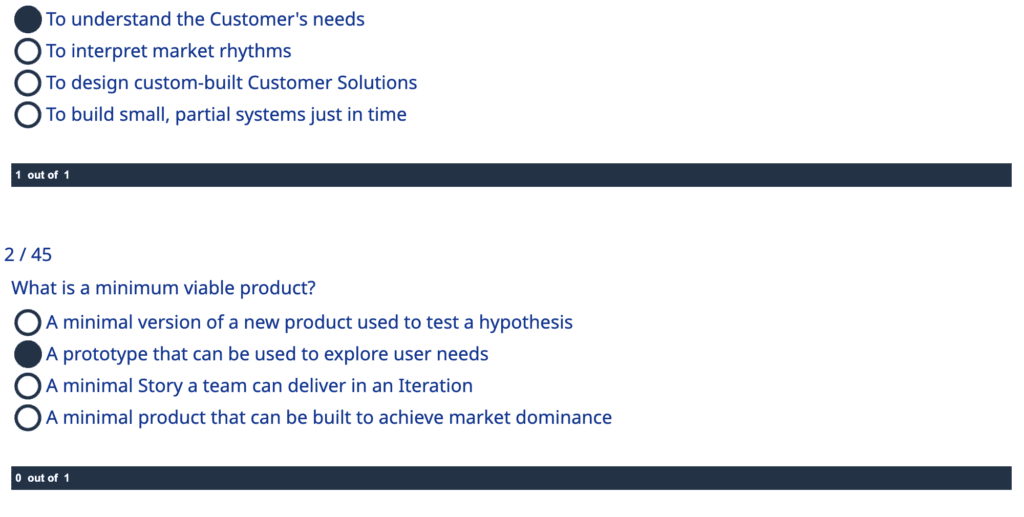
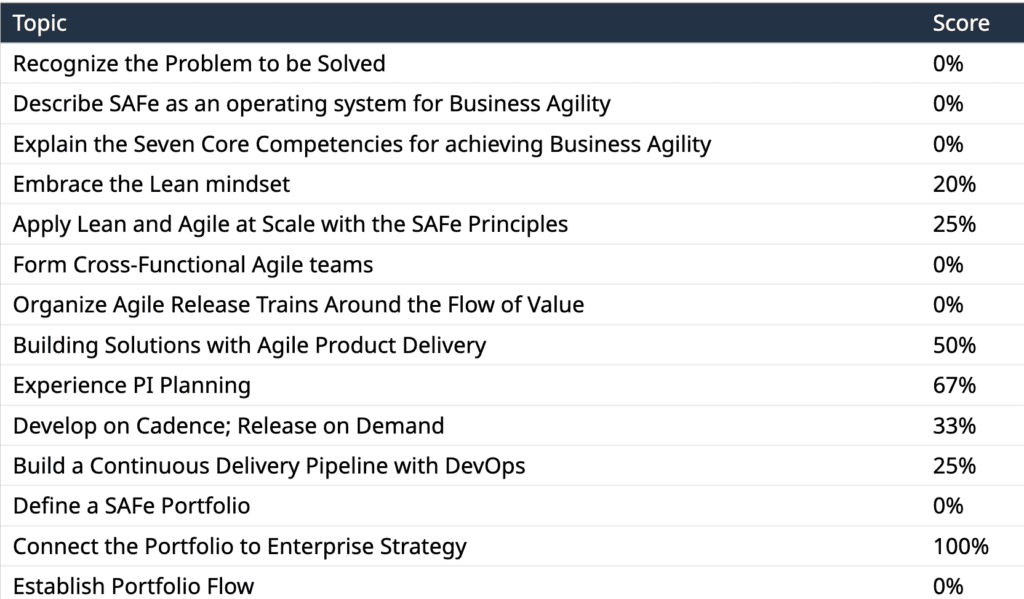
In SAFe practice tests, you can see which questions you got wrong but not the correct answers. You can also see a category breakdown and the percentage you got right in each. This breakdown gives you specific topics to focus on when studying.

A screenshot of practice test results
A screenshot showing how the practice test displays the breakdown of each category and the percent you got correct
 How the practice test displays the breakdown of each category and the percent you got correct

I recommend using the practice test to guide your studying. Take it after you’ve finished the class before you’ve begun studying earnestly. Then prioritize studying the categories in which you received the lowest scores. 

A word of caution: do not try to memorize the practice test. The questions on the actual exam aren’t the same. 
Focus instead on the concepts. Ensure you’ve clarified all the terms and content you felt shaky on in the practice test.

Step 3: Engage creatively with the content

Now you need to try to learn the material you’re weakest in; reading the articles over and over isn’t going to cut it. These were my favorite ways to engage creatively with the content and study.

Teach the material to someone unfamiliar with it

Explain the Big Picture to someone. If you’re familiar with all of the icons on the Big Picture and can explain them well, you’re in good shape.

Bonus points if it’s someone not familiar with the Big Picture or SAFe. They’ll have many questions to test your knowledge further.

Build a case study

Use a real company, your company, or a fictitious company and try to apply some of the abstract concepts with which you’re struggling. 

For example, while studying for the SPC exam, one learner created a fake company called Lib’s Lemonade. She outlined its strategic themes and objectives and key results (OKRs). She then made a Lean business case for a proposed product. Finally, she attempted to map the company’s value streams. 

Bonus points if you share it with someone else who is knowledgeable in SAFe and who can check for correctness.

Review your work through a SAFe lens

What matches the Framework? What doesn’t? Does your team write stories using user-story voice? Do you use the IP iteration for innovation and planning? Does your team have WIP limits on its Kanban board? Do you have a scrum master? What would it be like if your company did things differently? 

Have a conversation with a coworker about these discrepancies. If you have some influence, make some of these changes. Or shadow and learn from someone in your company who works in the same role for which you took the course.

Have someone quiz you on high-level topics

Make flashcards with questions on the front and the answers on the back. Then ask a friend to quiz you with the cards with the question side facing you and the answer side facing them. This method lets you simultaneously see the question while they check the answer on the back.

If you can’t find someone to practice your flash cards with, try using AI to build your own and quiz yourself. For example, you can upload your study sources into NotebookLM to create flashcards for you using the material you upload.

Find a study partner

If you know someone who took the class with you and is also studying for the exam, meet up to study with them. Ask each other questions, hold each other accountable, and wish each other luck when you take the exam. 

Preparing for an exam with a partner makes it more approachable and can make the experience more fun and comfortable.

If you don’t have a real-life study buddy, you can study with SAFe CoPilot. It can help you:

  • ​Provide practice-style questions and explain the reasoning behind the answers
  • ​Explain the exam format and what to expect for your specific course
  • ​Walk through core topics like Planning Intervals (PI) and Value Streams

Take the SAFe Exam

SAFe Exam and Get Certified

The only thing left is to take the exam. Chances are, it’s probably been a while since you last took an exam. 

Here are some test-taking tips to help dust off the cobwebs.

Don’t wait until the last minute

Take the SAFe exam as soon after class completion as possible. For the best chance of success, we recommend waiting no more than 30 days. Also, take the exam when you have the appropriate time, space, internet connection, and quiet to focus.

Track the time

The countdown clock at the top of the screen will help you keep track of the time. Use this to pace yourself throughout the exam.

Read each question carefully

You can also read them aloud to ensure you slow yourself down and reduce your chances of misreading the question. Once you’ve read the question, don’t forget to read all the answer choices, even if you think you know the answer before you’ve read them all. There may be a more correct answer waiting for you to select it.

Review your answers before submitting

Make sure each answer you chose actually answers the question. Also, only change your answer when you know with certainty that your previous answer was a mistake. Changing your answer based on a whim is a bad idea.

Use process of elimination

Sometimes, when you read the question, you won’t be sure what the correct answer is. But chances are you’ll know that some answers are incorrect. Eliminate them, and don’t look at them again. This technique will free up your working memory to focus on the final two or three options remaining.

Prime your mind

The power of association is strong. And according to this article, the sense of smell most strongly recalls memory. 

So, if you chew mint gum while studying for your SAFe exam at the desk in your home office at night, research shows that you’ll prime yourself to do well on the exam if you chew mint gum while taking your SAFe exam at the desk in your home office at night. 

Some people use a scented perfume, lotion, or lip balm to elicit the same effect. And as long as you were in a good headspace while studying, you’ll likely be in a good headspace while taking the exam.

Calm your nerves

Many people have test anxiety. Knowing what to expect for the exam can help decrease this anxiety significantly. 

Confidence from studying the content can also ease your nerves. Going into the exam well-prepared always helps. 

If worst comes to worst, and you don’t pass the exam on the first try, knowing that you can retake the exam and pass can also be a comforting feeling.

Conclusion

Here are some additional resources to help you with studying for and passing the exam:

Please note that we highly discourage visiting websites that claim to have real SAFe exams or answers. Test material changes often, and it’s a violation of our ethics and certification standards to use these resources.

There you have it: the keys to passing a SAFe exam to get certified. And after you pass your exam, don’t forget to claim your well-earned certification badge. Here’s how.

Now it’s time to begin your exam. Good luck from the Scaled Agile, Inc. team! You’ve got this.

Experiences Using the IJI SAFe Principle Cards – Benefits of SAFe

Games to play with leaders and teams to embed the principles in your organization.

IJI Principle Cards

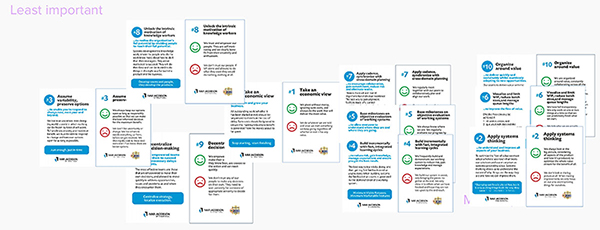
It’s been over two years since we first launched our popular SAFe® Principle cards. With the advent of SAFe version 5.0, the introduction of a new 10th principle and the launch of a new, updated set of principle cards, it’s a great time to look back at how we’ve been using the cards and the benefits they’ve generated.

This blog post is split into four sections, covering:

  1. A brief introduction to the cards (and where to get them)
  2. Engaging executives and other leaders
  3. Reflecting on how well the principles are being applied
  4. Brightening up training events

A brief introduction to the cards

As one of the first SPCTs in Europe, I’ve delivered more than my fair share of Implementing SAFe® and Leading SAFe® courses, and, to be completely honest, I’ve always struggled to get through all of the principles (I’m usually flagging by principle 6 or 7) and thought there must be some way to make them more accessible. To me, it always felt like we were learning the theory behind the principles rather than getting excited about the principles themselves.

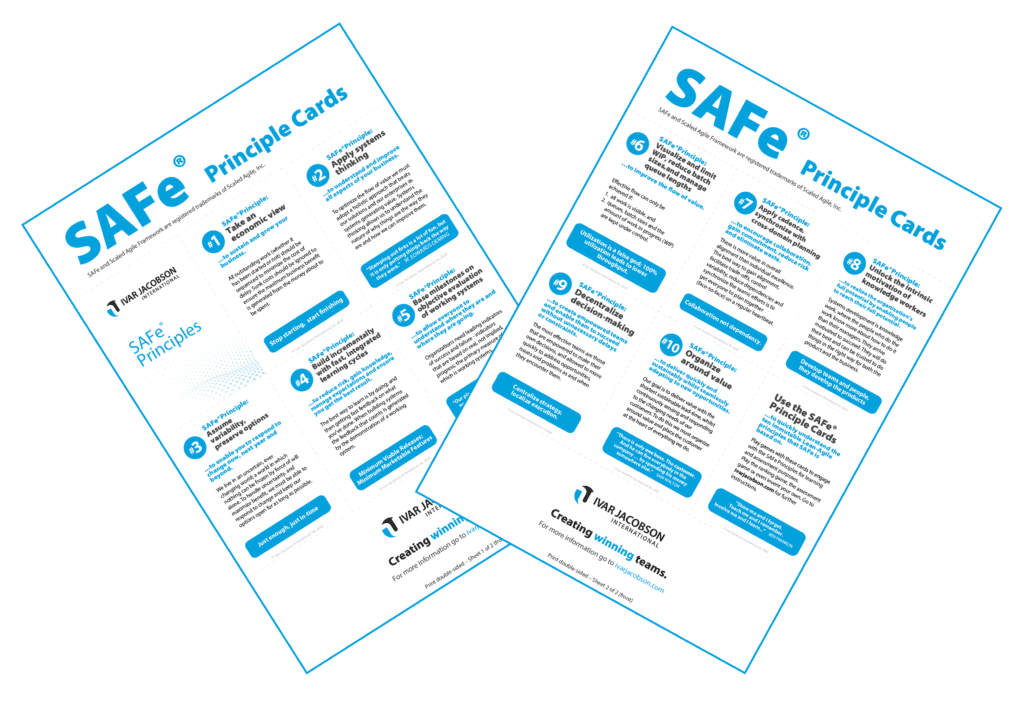
Whilst co-teaching with my colleague, and fellow SAFe Fellow, Brian Tucker, I tried to come up with a simpler, more accessible way for people to engage with, sign up to, and remember the principles. The end result was the set of Ivar Jacobson International (IJI) SAFe Principle cards, now updated with the new 10th principle—Organize Around Value.

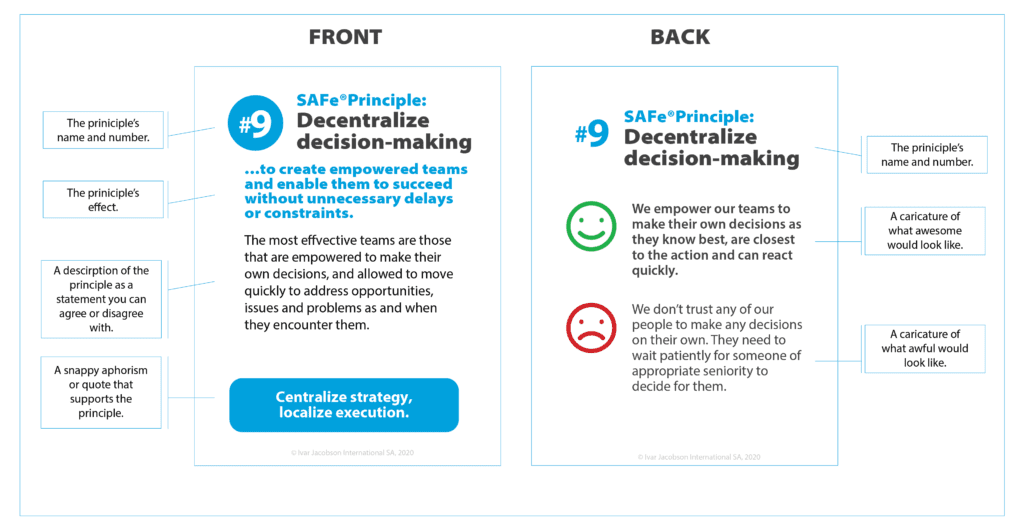
The cards try to do a number of things. For each principle, they:

  • Explain why the principle is important
  • Describe it in a form that is more like a principle and less like an instruction
  • Provide a snappy quote or aphorism that can be used to support it
  • Bring it to life with examples of what awesome and awful behaviour would look like
IJI Principle Cards
IJI Principle Cards

All on something the size of a small playing card.

In the old days, the full set would readily fit on one sheet of paper, but now with the introduction of the new 10th principle, we’ve had to expand to two sheets of paper.

The cards are freely available from the IJI website here.

Engaging executives and other leaders

Our experience with executives is that you are unlikely to get them to attend a two-day course or sit through an hour or more’s lecture on the SAFe Principles. They will play the penny game, but their appetite for being talked at is minimal.

This is a shame, as it is absolutely essential that they support and embody the principles in their day-to-day work.

Using the SAFe Principle cards to play the ‘principle ranking’ game, we’ve found that we can get them to engage with, understand, discuss and sign up to the SAFe Principles—all in under 30 minutes (20 is usually enough).

The game itself is very simple and can be played in a number of ways.

It is best played in groups of 3 – 4 people, as this maximizes discussion and ensures that everyone stays engaged throughout.

Equipment: One set of cut cards for each group and one set of uncut cards for each participant. The cut cards will be used to play the game and the uncut cards as a reference. If you want to look up a specific principle, it’s a lot easier to find it on the uncut set of cards than in a pack of cut cards.

The game: Give each group a set of cut principle cards and ask them to rank them in importance to the execution of their business. Separate any that don’t apply, or that they explicitly disagree with, from those that they would actively support.

Once the groups have finished their rankings, ask them if there are any principles they would discard.  We’ve done this many times, at many different organizations, in many different industries and no one has ever discounted or rejected any of the principles. There are a number of ways to produce the ranking:

  • Higher/lower. Someone takes the lead and places the first card on the table. The group discusses and makes sure they understand the principle. The next principle is then selected, discussed, and placed higher or lower relative to the ones already in play. The game continues until all cards are placed.
  • Turn-based. A more formal variation of the previous approach where the members of the group take turns to either add a card to the ranking or reposition one of the cards that have already been played, explaining and discussing their justification as they place or move the cards. The game continues until no one wants to move any of the cards.
  • Four piles. A simplified ranking where you distinguish the top three, the bottom three, and any rejected cards, and leave those not selected in a pile in the middle. This usually results in three piles as typically none are rejected.

Whichever way you choose to rank the cards, remember that it is OK for cards to have the same rank.

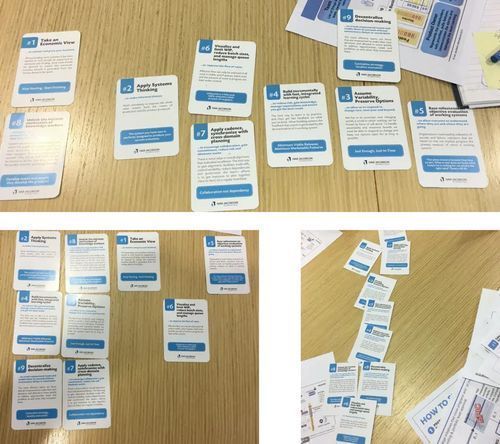
The results of the ranking can be interesting, particularly the difference between the different groups—but really this is just a forcing function to make them play with the cards. These pictures show the results from playing this game with a company’s IT leadership team. I’ll leave it as an exercise for the reader to spot which group was the architecture team.

IJI Principle Cards

The real goal of the exercise though isn’t the ranking itself; it’s to get everyone actively engaged with and discussing the principles. The discussions can get quite lively with the participants often referring to the awesome/awful caricatures as well as the descriptions of the principles themselves.

As mentioned above, we’ve never seen any of the principles rejected but we have seen many different rankings. Rankings that often reflect the executive’s area of responsibility— for example, the CFO will typically place the cards in a different order to the head of human resources (HR).

This activity has always gone down really well—it’s active learning, engages everyone in the discussion and doesn’t take a lot of time. It has been so well received we’ve had executives ask to take the cards away to share with their teams. In one case, the head of HR grabbed one of the cards and said, “This is just what I need. I thought one of the ‘Agile’ team leaders was encouraging the wrong behaviours, but I had nothing to challenge them with.”

A good trick to close out the activity is to ask them, as they now understand the principles, “Would you be prepared to sign up to them?” If they say yes, take an uncut set of cards and get them all to physically sign them.

We’ve found that this exercise works almost as well in a virtual environment as it does face-to-face. Using tools such as Mural, it is possible to create an interactive experience that is close to that of playing with the cards face-to-face (but let’s be honest, nothing beats standing up with the cards in your hands).

Reflecting on how well the principles are being applied

The cards are a great tool to use in retrospectives to remind people of the principles they should be applying and to generate actions to encourage everyone to be better at applying them.

One simple way is to use them as a trigger for improvements during a retrospective. The two most effective approaches we have used are:

Pick a card. A very simple activity that throws a bit of randomness into the retrospective process. Every so often (every other retro / once a PI), randomly pick one or two cards to discuss and generate ideas for improvement. To make things fun, you could generate your own awesome and awful examples. The more methodical of you might want to work your way through all the principles one at a time—reducing the set of cards to be picked from each retrospective until you’ve got through all 10.

IJI Principle Cards

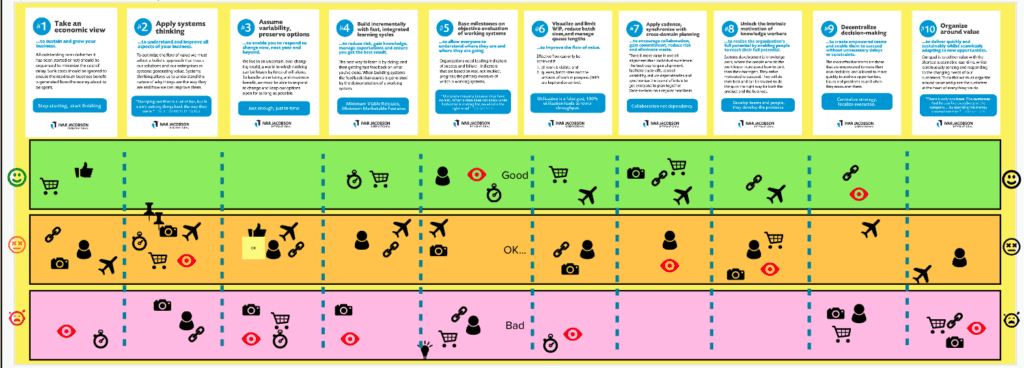
Value versus practice.

  1. Create a three-by-three grid with the x-axis being how important the principle is to the group (high, medium, low), and the y-axis being how well the principle is being applied (badly, meh, excellently).
  2. For those in the highly important/badly applied section, discuss what is going on, identify specific examples of bad behaviour, and generate concrete actions for improvement.

You can also use the cards to do a simple principle-based assessment. This is a great complement to the SAFe self-assessments and other practice-based assessments.

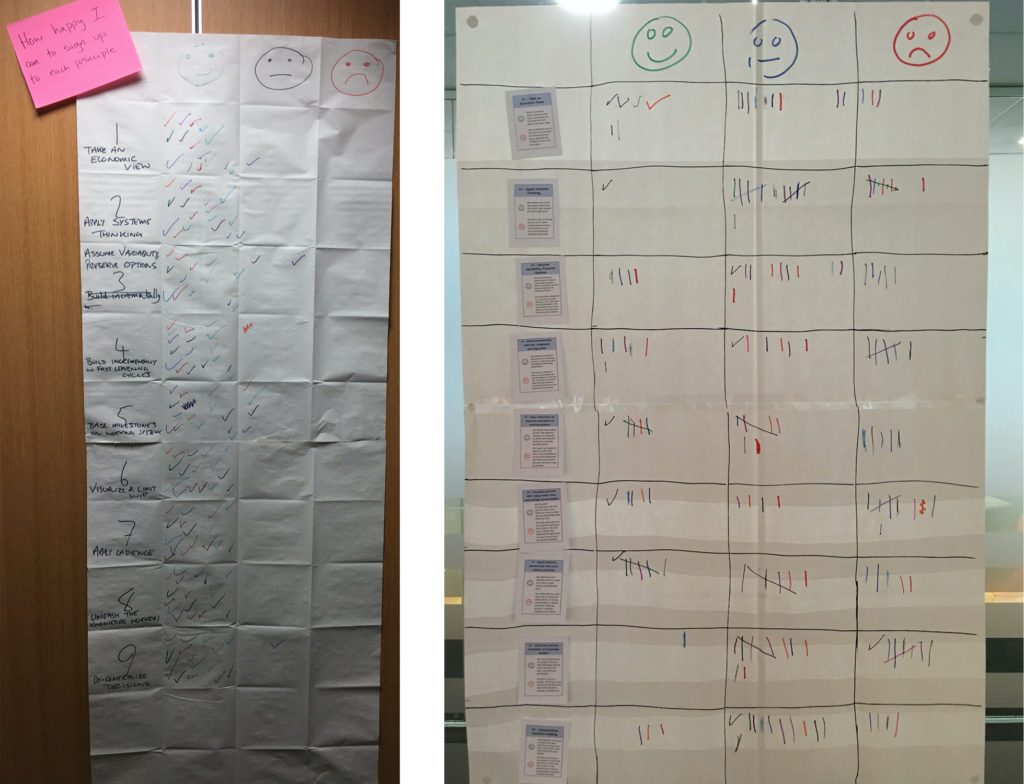
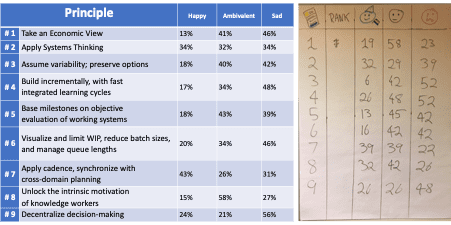
The simplest approach is to create a ‘happiness radiator’ with four columns (principle, happy face, neutral face, and sad face) and then get the assessors to tick the relevant box—as shown in the photos below. This can be done at the team level, train level, or even for the whole organization. The important thing is that everyone has their own vote—you want to avoid consensus bias as much as possible.

Note: If people are new to the principles, play the ranking game first to ensure that they understand the principle before voting.

IJI Principle Cards
Here are examples of the cards being used in Mural to perform both the ranking exercise and to build a happiness radiator, respectively.
IJI Principle Cards
The Mural Template for both these exercises is freely available from the IJI website here.

These assessments could, of course, be done without using the cards, but we’ve found that having the cards in their hands really helps people relate to the principle and tick the correct boxes. Even when working virtually, being able to see and manipulate the cards is invaluable.

To make life interesting, the feedback can be generated about a specific community or aspect of the framework such as Product Management and Product Ownership. The table below shows a set of results generated at the Global SAFe Summit in 2017. It also shows the results of performing the assessment at a meetup in Amsterdam.

It is scary how few Product Management Teams are exemplifying the SAFe Principles. I was shocked to see that only 13 percent of the SAFe practitioners surveyed at the SAFe Summit (about 100 people) thought that the Product Managers in their organization took an economic view. If the Product Management Team isn’t adhering to our underlying Lean and Agile principles, then I truly believe this will severely limit how Agile and effective the teams can be. If the Product Managers and Product Owners are not behaving in an Agile way, then there is no way that their teams can be truly Agile.

IJI Principle Cards

To help with these role-based assessments, we have produced sets of role-specific principle cards, one of which is shown on the left.

To get access to these cards and for more information on how to use them, go to the main Principle card page here. RTE and Architect cards are also in the works and will be accessible from the same area.

About Ian Spence

Ian Spence is an Agile coach, SAFe® Fellow

Ian Spence is an Agile coach, SAFe® Fellow, and Chief Scientist at Ivar Jacobson International. He has helped literally hundreds of organizations in their Agile transformations by providing leadership, training, consultancy, facilitation and all levels of coaching. An experienced Agile coach, consultant, team leader, analyst, architect, and scrum master, Ian has practical experience of the full project lifecycle and a proven track record of delivery within the highly competitive and challenging IT solutions environment.

View all posts by Ian Spence

Share:

Back to: All Blog Posts

Next: Quarantine and COVID-19: Beware of Burnout

Quarantine and COVID-19: Beware of Burnout

Quarantine and COVID-19

COVID-19 has affected all of our lives, and I’m sure its impact will be felt for quite some time. Working from home part-time is not so new for many of us, but working from home while sequestered full-time is something a lot of us have never experienced—and it’s forcing us into a new way of working.

Initially, I found myself wrestling every day with this new way of working. For example, when does the work day end?

Here was my routine pre-COVID19.

First, I had a policy that I would check my email three times per day: once in the morning, just before lunch, and just before leaving for the day. This way I could stay focused on my work, but still have a good cadence for anything new that needed my attention and synchronization. When I first sequestered, I had moved away from that and was always checking and immediately responding to my email. I then jumped around between tasks or requests without focusing and completing anything: very wasteful. I have since corrected that.

Second, when I left work, I would physically shut down the computer, write some notes down about what I had accomplished that day, write down a few more notes about what I would like to accomplish the following day, and perform an introspective on what I completed that day.

Finally, I would shut off the lights in my cubicle, say good night to my coworkers, physically leave the building, get in my car, and drive home.

In January of 2020, I left my role in the federal government and started working as a consultant, and in March, COVID-19 quarantine set in. The ritual I was committed to suddenly stopped. No traveling every day to work, no consulting or teaching face-to face classes, nada.

I had no routine for this new way of working.

Then I happened to come across an article, “5 strategies for combating WFH-based burnout.” I realized I needed a new routine.

It made sense: I needed to get back to what I was doing and bring some order back to my life. I realized that if I treat the end of each day as I did when I commuted to work, it becomes easier to define my workday.

So, here are my recommendations for building in some work from home (WFH) routines:

  • Set up an office area that is your work area.
  • Set up office hours and have the discipline to adhere to them.
  • Set up a commuting-to-work routine before you go to work.
  • Put on your professional persona (work clothes, etc.) during your time at work in your work area.
  • Set up a leaving-work routine as you transition home.
Work From Home

I now mimic my routine at the beginning and the end of each day.

Fortunately, I have an office space at home with a door. That door is a very powerful signal to my brain, and I use it to help begin and finalize the end of my workday. I open the door in the mornings to start the workday, and close the door in the evenings to end it. In our new working world, find a metaphor that signals the beginning and end of your workday.

Leaders and managers, please take note: set up the same type of routine to preserve your sanity, and exhibit that lead-by-example behavior for your knowledge workers. Better yet, solicit and publish quarantine agreements from your teams. This will help shape the environment for them to be successful. Let them know it’s OK to be away from work during non-work hours.

I know everybody has a different situation in this crisis, so try to find what works for you. The intent here is to find a personal routine where we can mentally leave and arrive at work. I believe this way of working will be the new normal for many of us, and we need to balance life and work for the foreseeable future.

We’re all in this together.

About Joe LaTorre

Joe LaTorre

Joe LaTorre is a Senior Enterprise Agility Coach at Agile Rising (a Scaled Agile partner) and a SAFe Program Consultant Trainer (SPCT) candidate. He’s a proactive leader experienced in integrating enterprise vision and strategy with effective deployment of Lean-Agile teams.

View all posts by Joe LaTorre

Share:

Back to: All Blog Posts

Next: Ten Steps to Landing Change Well

POs and PMs: A Dynamic Duo – SAFe Best Practices

Welcome to the second post in our series about SAFe best practices to create a healthy relationship between product owners and product managers that drives product success. You can read the first post here.

I’ve heard lots of metaphors used to describe the relationship between a product owner (PO) and a product manager (PM). One of my favorites is oil and vinegar—separately, they’re just liquid on a salad, but mix them together and you’ve got a great dressing.

POs and PMs - A Dynamic Duo

A PO and a PM working together creates a positive tension that leads to a great relationship—despite different opinions—that’s in others’ best interests. But combining the PO and PM into one role is a recipe for disaster. 

I know because I experienced the trouble firsthand.

Think about the core responsibilities for both roles:

  • Be the voice of the customer
  • Analyze data
  • Manage backlogs
  • Make customers happy
  • Organize cross-team syncs
  • Create roadmaps
  • Support planning
  • Seek out competitive intelligence
  • Aid support escalations
  • Help sales activities

One person simply can’t do all these activities in a typical work week. When I’ve been in this situation, I found that the urgent, tactical things come first as people clamor for responses, feedback, and direction on their daily work—ultimately causing important strategies to suffer. Some days, I’d already made two to three stressful decisions before morning tea and was expected to make more at strategic levels. I quickly experienced decision fatigue. When your company and solution are small, you might be able to do it all, but it doesn’t scale.

There’s a strong stereotype that PMs need to be mini CEOs and be just as stressed out. That’s not sustainable as a product person. When a PM is also doing the work of a PO, expecting them to do strategy and manage the team backlog throughout the PI isn’t realistic. You miss the strategic work, you miss pivot-or-persevere opportunities. I’d often ask myself, “Am I really looking at the big picture or just surviving?” 

The power of an Agile team is that it’s a high-functioning group that collaborates. And when the PO and PM roles are performed by two different people, they can work together to support those teams, and ultimately, the organization. When I was a PO working with a PM to deliver a new onboarding experience for our product, we stayed in sync. I focused on what our technology allowed and what the team could implement. She focused on market impact and educating our sales team. We had healthy, productive conversations with positive conflict about what should happen next, and split the duties of attending meetings. All while continuing our business-as-usual activities and still finding time to recharge for the next day.

POs and PMs - A Dynamic Duo

If you’re a leader, avoid having one person take on both roles. If you’re doing both of these jobs, don’t. Perhaps there’s someone in your organization who can help you by serving informally in the other role. Finding the balance that I just described is key to your and your product’s success. POs and PMs don’t have to be in the same places but they need to connect, be aligned, and maintain that positive tension. It’s why we teach these roles together in our SAFe POPM class—you need to know how to best collaborate with your peer PO or PM to excel.

If you’re free on August 26 at 6:00 PM MDT, join Lieschen and I at an online Agile Boulder meetup where we’ll talk about this very topic.

Check back soon for the next post in our series about shared objectives and collaborative ‘sense making.’

About William Kammersell

William Kammersell is a Product Manager and SAFe® Program Consultant (SPC) at Scaled Agile

William Kammersell is a Product Manager and SAFe® Program Consultant (SPC) at Scaled Agile. With over a decade in Agile software development, he loves researching customer problems to deliver valuable solutions and sharing his passion for product development with others. William’s journey as a developer, scrum master, Agile coach, product owner, and product manager has led him through a variety of B2B and B2C industries such as foreign language learning, email marketing, and government contracting.

View all posts by William Kammersell

Share:

Back to: All Blog Posts

Next: How Planview Executed a Successful, Virtual PI Planning

Product Owners, Product Managers, and the Feature Factory – SAFe Structure

Product Owners and Product Managers

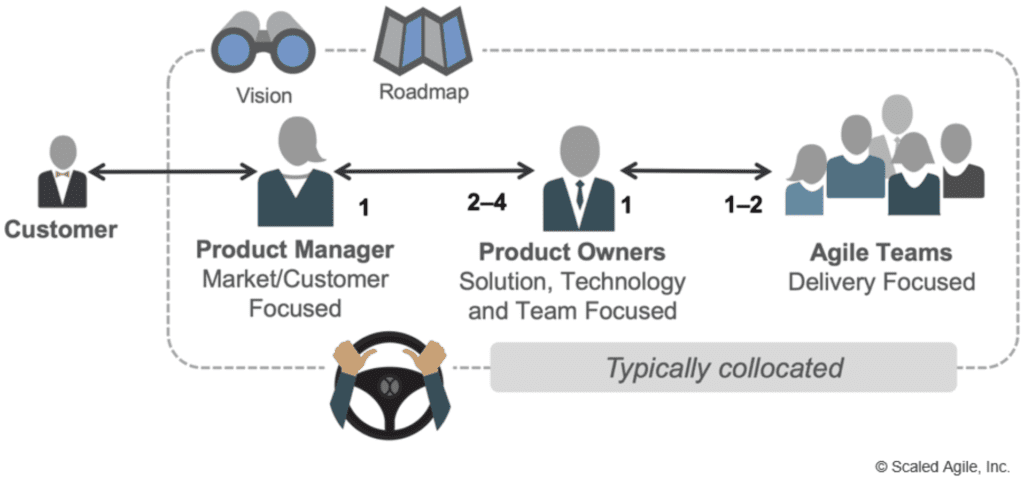
Both product owners (POs) and product managers (PMs) have “product” in their titles. Both roles connect people to the customer to ensure we’re building the right thing. Both roles rely on data to inform decisions and spot trends by correlating that data to everything that’s going on across the organization. Both roles manage backlogs. And both roles make customers happy. So, what’s the difference between a PO and a PM?

Product managers concentrate on the program backlog and features, look one to three program increments ahead, and focus on product viability. They collaborate with business owners and those at the solution and strategic levels within SAFe®

Product owners concentrate on the team backlog and stories, look one to three months ahead, collaborate with the team, and focus on product feasibility.

Seems straightforward enough, but we’ve heard feedback from people in the field that the PO-PM structure within SAFe isn’t so great.

“I’ve trained dozens of teams who are using SAFe and I have never seen this work well. The Product Owners are disconnected from their users and incapable of creating effective solutions for them that really solve their problems, because they do not understand the problems well. The Product Managers are essentially ‘waterfalling’ down the requirements to them and the teams are not allowed to prove if these are the right things to build or not. No one is doing validation work.” 

—Melissa Perri, Product Manager vs. Product Owner

The feature factory

What’s described above is something many call “the feature factory.” Organizations quickly fall into the feature-factory trap when POs stop talking to external customers, going with the word of the PM instead and losing sight of the user’s needs. It also happens when PMs become disconnected from the teams, choosing to write requirements that are handed off to POs instead of aligning with teams and POs on objectives about how to best achieve them. By not connecting with the team, over time, PMs start making all the decisions on their own and there’s no room for teams to provide ideas to their own backlogs—essentially ‘waterfalling’ their PIs as described above and creating a culture of meeting acceptance criteria instead of focusing on objectives. 

We often also see feature factories when PMs and POs never say “no” to requests from customers or business owners. Catering to the desires of a few large clients or to executives’ individual objectives can cause PMs and POs to drop validation work and strategy in response to those requests. Without validation work, there aren’t any clear pivot-or-persevere moments for checking in to see if we’re understanding the problem correctly or even solving their problems. Instead, we’re practicing waterfall and calling it SAFe.

In this blog series, William Kammersell, our curriculum product manager, and I will share practices to help you avoid the feature factory and create a healthy PO-PM relationship that drives product success.

Read the next post in the series here.

About Lieschen Gargano Quilling

Lieschen Gargano is an Agile Coach

Lieschen Gargano is an Agile coach and conflict guru—thanks in part to her master’s degree in conflict resolution. As the scrum master for the marketing team at Scaled Agile, Lieschen loves cultivating new ideas and approaches to Agile to keep things fresh and exciting. She also has a passion for developing best practices for happy teams to deliver value in both development and non-technical environments. Fun fact? “I’m the only person I know of who’s been a scrum master and a scrum half on a rugby team.”

View all posts by Lieschen Gargano Quilling

Share:

Back to: All Blog Posts

Next: Elevate Your Remote Production to Super Awesome

Inspect and Adapt: How a 30-year-old PPM Company Became a Case Study in Agile Transformation

Agile Transformation

In 2017, Planview (a Scaled Agile partner) realized that its customers and market were evolving beyond their traditional product lines. A leader in project portfolio management (PPM) solutions, Planview recognized the need to adapt both strategically and operationally and looked to Agile to power a much-needed transformation. (Read the full story in Harvard Business Review).

While the development departments had practiced Agile for some time, the larger Planview organization really began its forays into Agile starting in 2017 via the acquisition of a company with strong Agile DNA and a powerful Kanban product. Sporadic successes after the acquisition, however, didn’t translate to the change the company needed. Planview knew that real transformation required a top-down commitment, and in late 2018, established a company-wide goal to rewire its organization through a new Agile Growth Initiative.

The initiative focused on five key objectives:

  1. Infuse agility into the organization by increasing Agile DNA throughout
  2. Admit we couldn’t do it alone and bring in outside coaching support
  3. Embrace Agile practices and ceremonies from leadership to the teams
  4. Reorganize people and teams to focus on customer value
  5. Empower everyone to have a voice and do their best work

Led by the marketing department, Planview brought in external Agile experts as guides and kicked off its first Agile discovery session. When the team asked sales, marketing, and product leaders to list their top priorities, every department was different. It became clear that scaling across functions was the organization’s biggest challenge—and most promising opportunity.

Planview accelerated its Agile initiative by creating three cross-functional Agile teams that comprised the first Go-to-Market Agile Release Train. Through Program Increment (PI) Planning events, the teams shared, according to Harvard Business Review, “… some hard conversations that ultimately resulted in reorganizations and the realignment of people and funds.”

The result: a new emphasis on solutions vs. products that enabled the organization to provide value to their customers in meaningful, innovative ways. With Agile, Planview successfully shifted from a 30-year-old PPM company to an Enterprise Agile Planning Solution Leader. That’s true transformation, although for Planview, it’s simply one more step in a continuous process of inspecting and adapting.

Read the full story of Planview’s transformation in Harvard Business Review.

About Brook Appelbaum

Brook Appelbaum

Brook Appelbaum is the Director of Product Marketing for Planview’s Lean and Agile Delivery Solution. With nearly 20 years of marketing experience, Brook has led many different product and digital marketing teams. However, her favorite leadership role is that of a Product Owner. As part of an Agile marketing team inside Planview, Brook drives the campaign and product marketing strategy for the Lean and Agile Delivery Solution. And she thinks LeanKit is the coolest.

View all posts by Brook Appelbaum

Share:

Back to: All Blog Posts

Next: Scrum Master Stories: Building Relationships

What’s a Product Owner to Do – PO role within SAFe

Product Owner

When I coach companies on Lean and Agile methodologies, I strive to have dedicated, co-located Product Owners (POs), Scrum Masters, and teams. In the 21st century and given our current context, many companies involved in a SAFe® transformation have POs and Scrum Masters who are leading multiple remote teams. 

It can be challenging to coach Agile teams remotely and consistently on the Agile Manifesto and SAFe principles and values, such as Business people and developers must work together daily throughout the project or Program Execution. Often during these transitions, some companies expect an employee to be a part-time PO in addition to his/her day job.

Many times I have had Product Owners ask me to help supervisors understand the time commitment involved with the role. One way is to describe what a typical PO does each day. In this post, I’ve created a list of what a PO does on a daily basis. This list is not exhaustive, nor is it in any specific order:

  • Attends the team’s daily stand-up meeting to understand the team’s progress and impediments toward the Iteration goals.
  • Capture customer requirements and ideas by writing (or helping others write) stories and Enablers.
  • Continuously accepts or rejects completed stories and Enablers. 
  • Is available to the team each day to answer questions and clarify stories.
  • Works with the System Architect to ensure Enablers are properly prioritized so as not to mortgage the future of the architecture.
  • Verifies that stories are in the proper format, contain valid confirmation (aka acceptance criteria), and are in line with the Program vision and scope. This includes any necessary design details, business rules, NFRs, etc.
  • Ensures that the team is aligned to the PI Objectives, and Iteration goals are clearly defined and communicated.
  • Helps remove or escalate obstacles to Product Management.
  • Makes sure that the Agile team has a direct connection with the business through story development and the Iteration review.
  • Meets regularly with Product Management (e.g. PO Sync) to keep stakeholders informed on how much incremental value has been generated.

In addition to that, on a cadence, POs:

  • Participate in the Iteration retrospective event.
  • Present the stories and Enablers during Iteration Planning.
  • Meet with the team each week to refine the Team Backlog.
  • Work with the team to decompose stories and Enablers into small increments. Ideally something that can be completed every two to three days.
  • Prioritize and update the Team Backlog.
  • Work with the team to create and commit to Iteration goals.
  • Collaborate with team members to form PI Objectives.
  • Help identify dependencies with other teams during PI Planning.
  • Meet with Product Management and stakeholders regularly to field questions and inform them of any updates or changes to scope.
  • Conduct the Iteration review with the team and participate in the System Demo to demonstrate the incremental functionality to the Agile Release Train and stakeholders.

In your context, look at all the activities that your POs are engaged in and consider whether it’s realistic for a part-time PO to do them all. If it’s not, speak to your part-time POs and have them present this data to their managers or as an issue during your Inspect & Adapt workshop.

To learn more on the PO role within SAFe, read this article.

About Joe Vallone

Joe Vallone, SPCT, SAFe Fellow, is an experienced Agile trainer

Joe Vallone, SPCT, SAFe Fellow, is an experienced Agile trainer who has helped coach several large-scale Agile transitions at Zynga, Apple, Microsoft, VCE, Nokia, AT&T, and American Airlines. He’s also an effective leader and speaker with more than 20 years of software development and management experience. As a change agent, Joe is passionate about teaching and coaching organizations to reach their full potential by embracing Agile values and Lean thinking.

View all posts by Joe Vallone

Share:

Back to: All Blog Posts

Next: We Did It! Our Very First, Fully Remote, Distributed PI Planning.