
As the post-digital economy begins to boom and the worlds of business process and technology come together, it’s time to think about how we optimize the whole from a unified, customer-centric perspective. Some organizations have begun to master the idea of experience architecture, whereas others are just beginning.
During my years consulting, I’ve had the opportunity to work with complex system architecture. Such as the APIs and data structures across multiple federal agencies that manage annual earnings and death records for every person in the United States. I’ve also experienced complex business architectures responsible for moving passengers, aircraft, and cargo around the world in a safe and predictable manner.
What was obvious to me in these and other scenarios was that there was no way we could treat the disciplines of business architecture and technical architecture as independent variables. Especially if these organizations hoped to keep up with the speed of innovation. In early experiments, I hypothesized that by pairing business architects with their peer application architects, we could better design experiments to achieve business outcomes that were efficient and technically sound. My hypothesis was partially proven. There were still missing pieces of the equation.
In later experiments, I treated the various architects in the value stream as an Agile team composed of all architectural perspectives that we needed to deliver the solution. Those perspectives included business architecture, application architecture, systems architecture, data architecture, information security, and even Lean Six Sigma Black Belts to help keep the group focused on flow efficiency. That experiment had some cool outcomes, though I had come to realize one obvious hole: the lack of consideration for the people in the system. We needed a different skill set. We needed experience in architecture.
Curated Experiences and Powerful Moments
In their book The Power of Moments, Chip and Dan Heath give many examples of how people remember exceptionally good and exceptionally poor experiences. The authors illustrate how average experiences are largely forgettable. Conversely, experiences that are repeated merge together so that customers develop a general perception of the experiences, but don’t remember any experience in particular.
My family visits Disney. A lot.
Before I met my wife, I’d been to Disney World twice in my life. Once when I was eight and again as a teenager. I have fond memories of each trip and can remember specific moments. These were positive experiences and here’s why.
Since having met my wife, I’ve been to Disney an average of twice annually and as many as four times in a single year. Each of those experiences has been positive, but I can’t articulate why. I know that I enjoy Animal Kingdom and the Avatar ride in Pandora. I know that the Magic Kingdom gives me anxiety and that you can get prosecco at Epcot. Unlike the trips of my youth which are memorable, not a single visit as an adult stands out. The experiences have merged.

My Disney experience is what most customers experience as they interact with our value streams. The customer will form a general feeling and only talk about the experience: if it was exceptionally good or exceptionally bad.
Need proof? Check out the reviews on Amazon or Google. You’re likely to see mostly very positive and very negative reviews without much in the middle. There is power in moments. The moments are what we remember and they can be curated when an organization makes investments in experience architecture.
Map Value Streams and Understand the Experience
Similar to the steps of value stream identification and business architecture, the first step in articulating a customer experience is to map the operational value stream. With alignment on how the business operates, the next step in understanding the customer experience is to visualize the technology that supports the operation and the development value streams that maintain the technology. Speaking of value streams, check out this cool webinar where I talk about them with Danny Presten.
With the value streams mapped, the next step is to embark on a journey to optimize the whole by eliminating technical and operational debt. With the help of business architecture, we can leverage the time focused on improvement to begin identifying opportunities for large-scale improvement in operational throughput. Additionally, the organization can begin investing in capability modeling with the goal of running more experiments for strategy implementation, faster.
With the operational value stream mapped, the underlying architecture understood, and a commitment made to relentless improvement, we can now begin exploring the customer experience.
Map the Experience
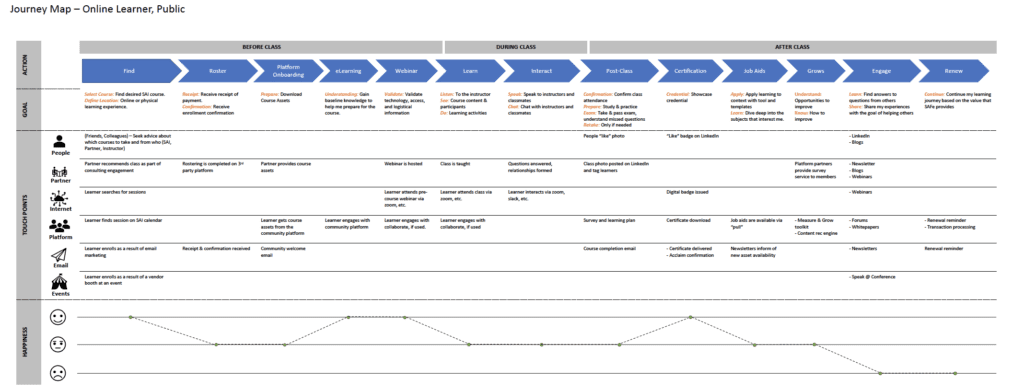
Now that we’re ready to map the customer experience, we begin by seeking to better understand the customer. SAFe® advocates using design thinking as a framework for customer centricity to best use personas, empathy maps, and experience maps. The art of experience mapping follows similar best practices used in other forms of value stream mapping. The distinct difference is that we engage with customers to understand their journey from their perspective.
Below is an example of an experience map that depicts the experience of an online public learner in the SAFe ecosystem. At the top, you’ll notice the phases of the customer journey, followed by the operational value stream. We continue by seeking to understand the customer’s goal within each component of the value stream, the touchpoints that Scaled Agile has with the customer, and finally, the customer’s happiness after having completed the operational component.
Similar to other types of value stream mapping, with the customer experience articulated, we can now start on a path to relentlessly improve the customer experience and curate memorable moments.
Curate Unforgettable Moments
The Heath brothers explain the power of moments as a key theme in their book. For me, the true power of moments became evident when I purchased a new home in July of 2020. Veterans United Home Loans has made a significant investment in its customer experience and has taken advantage of the power of moments. The proof? The fact that nearly a year later I am blogging about my mortgage experience.
If you’ve ever bought a home, you can probably empathize when I say that it’s a stressful experience. In any mortgage transaction there are two particularly stressful phases for future homeowners: approval, and more notably, underwriting. Through their work in experience mapping, Veterans United was able to recognize this and curate moments to help ease the stress a little. When I received the approval for my home, my mortgage broker, Molly (do you remember the name of your mortgage broker?), sent me a pair of Veterans United socks.

Yes, socks. They weren’t the best quality, they were kind of corny, but they made me smile and I’m still talking about them. Moment curated.
When I closed underwriting, the curated moment was a little more personal. Molly had done her homework and knew that I liked to barbecue. So, she sent me a nice set of outdoor cooking utensils. As you sit there and ponder the ROI on socks and cooking tools, remember that you now know about Molly and Veterans United. ROI achieved.
What low-cost, high-impact moments can you curate for your customers? How can you turn an otherwise forgettable experience into something that people remember for years to come? These actions are key to winning in the post-digital economy. Consumers want to know your organization is human. They want to know that you care. What can you do to help make that connection?
Experience Architecture: Conclusion
Success in the post-digital economy will require business agility and a clear focus on the customer. Experience architecture is something organizations should employ to better understand the customer so they can release on demand, as determined by the market and customer.
If you’re an experienced experience architect, consider sharing your stories in our General SAFe Discussion Group on the SAFe Community Platform. To learn more about working with varying architectural disciplines, while maximizing the amount of work not done, and embracing a just enough, just-in-time approach, check out these architectural runway articles.
About Adam Mattis

Adam Mattis is a SAFe Program Consultant Trainer (SPCT) at Scaled Agile with many years of experience overseeing SAFe implementations across a wide range of industries. He’s also an experienced transformation architect, engaging speaker, energetic trainer, and a regular contributor to the broader Lean-Agile and educational communities. Learn more about Adam at adammattis.com.
Share:
Back to: All Blog Posts
Next: Aligning Global Teams Through Agile Program Management: A Case Study