If you’re working in SAFe® or considering it for your career path, you’re probably wondering about the practical realities: What skills do employers actually value? Where are the real opportunities? And how can you position yourself for success in a changing market?
These are important questions, and they deserve clear, data-backed answers.
That’s exactly why we created the 2026 SAFe Careers Snapshot. This annual report takes a thoughtful look at current job market data to help you understand what’s happening right now and what it means for your career journey.
Whether you’re exploring SAFe for the first time, deepening your expertise in a specific role, or planning your path into leadership, this research gives you the insights you need to make informed decisions about your next steps.
Understanding the shift: AI meets Agile practice
This year’s data reveals something important: AI capabilities are becoming an expected part of many SAFe roles, not just a nice-to-have addition.
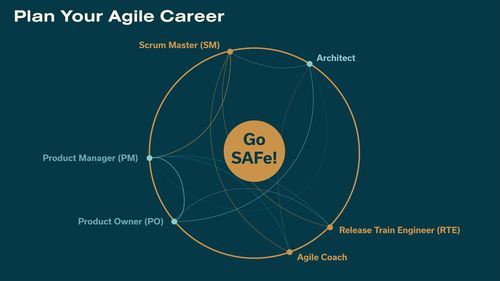
We’re seeing this trend across roles—from Scrum Masters and Product Owners to Release Train Engineers, Architects, Coaches, and SAFe Practice Consultants. Employers are increasingly looking for professionals who can:
Integrate AI tools effectively into their daily work
Use AI insights to enhance flow, planning, and quality decisions
Make more informed, data-driven decisions faster
Guide teams through new AI-enabled ways of working
At the same time, the fundamentals of SAFe practice remain as important as ever:
Certifications continue to be a valuable signal of expertise and commitment
Demonstrating real outcomes still matters more than impressive titles
Hybrid work skills and leadership capabilities are essential
A commitment to continuous learning consistently separates successful candidates from the rest
The opportunity is significant for those who are willing to grow alongside these changes.
What you’ll find in the 2026 Snapshot
We’ve designed this guide to give you practical, actionable information about today’s SAFe job market. The report covers eight key roles and certifications:
Scrum Master
Agile Coach
Product Owner
Product Manager
Release Train Engineer
Architect
SAFe Practice Consultant
SAFe Agilist
For each role, you’ll discover:
Current salary ranges and earning potential based on real market data
Typical years of experience that employers are seeking
Which certifications are required versus preferred
Where demand is strongest across industries
Core responsibilities and the skills that matter most
AI-related capabilities that are increasingly expected
Step-by-step career guidance tailored to your current goals—whether you’re trying to break into a role, grow your expertise, or advance into leadership
Three ways this report can support your journey
No matter where you are in your career, the Snapshot offers guidance designed for your specific situation:
If you’re working to land a role: You’ll learn what employers are really looking for, which certifications to prioritize first, and how to present your experience in the most compelling way.
If you’re focused on growing in your current role: You’ll find direction on building deeper expertise, developing AI fluency, and creating creative outcomes that genuinely increase your value to organizations.
If you’re preparing for leadership: You’ll discover what it takes to expand your impact through broader systems thinking, portfolio-level awareness, and enterprise-wide influence.
Why this matters for your career right now
The SAFe job market is evolving more quickly than it has in recent years. Some roles are consolidating while others are expanding. Organizations are investing more deliberately in professionals who can lead meaningful transformation, not just participate in processes.
Based on our research, the professionals who are finding the most success in 2026 share several characteristics:
They’re combining strong SAFe expertise with developing AI capabilities
They can point to clear business impact from their work
They’re committed to ongoing skill development
They lead change with both confidence and empathy
This Snapshot is designed to help you develop each of these strengths in practical, achievable ways.
Ready to Explore Your Career Path?
We encourage you to download the 2026 SAFe Careers Snapshot and explore the data that’s most relevant to your situation. You’ll find current salary insights, realistic skill expectations, and AI-integrated career guidance that can help you move forward with clarity and confidence.
Your career growth isn’t just about keeping pace with change. It’s about positioning yourself to contribute meaningfully to what comes next. We hope this report helps you do exactly that.
This is the fourth post in the Practice Makes Permanent series. You can get caught up by reading the first, second, and third posts.
Any SAFe® implementation relies heavily on one of the 10 Critical Success Factors: Real Agile Teams and Trains. Let’s break this conversation down to make it easier (small batches, right?) and talk about the “Real Agile Teams” part (the next blog in this series will address the “and Trains” part). The “Agile Teams” article does a great job of describing cross-functional, high-performing teams.
What is a real Agile team? In this post, I hope to avoid the standard message about “what is a team?” and instead share some thought-provoking ideas about what a true
is.
True Agile Teams
I came to a discovery a few years ago: there is no such thing as an Agile team.
Think about it. The Agile Manifesto Principle 12 states, “At regular intervals, the team reflects on how to become more effective, then tunes and adjusts its behavior accordingly.” To me, this means that a team never arrives at true agility, but is constantly striving toward agility. Sure, you can call your team Agile. But, as soon as your team believes they have “arrived,” they have begun to stagnate. True agility is only found when we’re eager to learn what’s next to improve, and when we realize how much room for improvement still exists.
If you’ve ever rowed a boat upstream then you know what happens when you stop rowing—you go back downstream. There is no steady state. If you’re not moving forward, you’re moving backward. This is the reality of relentless improvement and of the spirit of Agile Manifesto Principle 12. Your team(s) may have made incredible progress towards agility, but until you realize it’s a never-ending journey, your path forward will always be in jeopardy.
Empowered Teams
Leaders often tell me that they want to empower their teams because they believe that empowered teams can deliver more value. That’s a valid belief, but leadership often doesn’t understand that our natural state is empowered. In his book Turn the Ship Around Captain David Marquet stated:
“We’re taught the solution is empowerment. The problem with empowerment programs is that they contain an inherent contradiction between the message and the method. While the message is ‘empowerment,’ the method—it takes me to empower you—fundamentally disempowers employees. That drowns out the message.”
In other words, to empower teams (and team members), we must first acknowledge that we have disempowered them through the systemic constraints we have created. If you want true Agile teams to constantly strive toward agility, the secret is to get out of their way. Create an environment with complete clarity on what needs to be done, then trust the competency of the people you have hired to do the right thing. As Marquet stated, “We realize that we don’t have the power to give these talents to others, or ‘empower’ them to use them, only the power to prevent them from coming out.”
So how do you empower teams?
Remove Constraints around Team Members
In Team of Teams: New Rules of Engagement for a Complex World, General Stanley McChrystal observed, “For people who perceived themselves as skilled workers, being recast as mindless cogs in a larger machine was degrading.” Businesses hire the best and the brightest they can possibly find, but in many cases, these skilled people are used as the “mindless cogs” in a machine. They’re asked to do small, separated components of work without being allowed to see or add value to the system overall. In many cases, this is due to a lack of clarity. The teams are given only enough information to solve the task at hand, but not enough to apply their shared intelligence to solve the overall problem in the best way possible.
To begin correcting this, apply SAFe Principle #9: Decentralize decision-making by providing clarity of mission. Here is an easy way to get started:
Select a decision that typically requires sign-off or approval by management or leadership. Deploying to production is a common example.
Ask the person that approves this decision what they are using as criteria to make the approval decision.
Work with the teams to create a framework that will give the approver the confidence that the decision is being reviewed correctly.
Provide the information that the approver has to the team so that they can make the decision by combining what they know (local context) with the approver’s vantage point.
Let the team make the decision but allow the approver to see and hear the decision as it’s being made. I like using Marquet’s approach to this practice by having the team state something like: “We intend to deploy this package to production. All functional, security, and compliance tests are passing. All code has been checked into version control. Appropriate code reviews have been completed. The rollback process is in place and has been tested.” Using this statement of intent is a great way to allow teams to make the decision while keeping the approver in the loop. Over time, the approver will gain confidence in the team’s ability to correctly determine this decision.
Now you can move on to the next decision. And the next, and the next…
Change the Culture
Apply SAFe Principle #8: Unlock the intrinsic motivation of knowledge workers by building a culture of psychological flow.
Psychological flow is a concept stemming from a 1975 study by Mihály Csíkszentmihályi who measured test subjects’ happiness metrics at random times throughout their days. Csíkszentmihályi discovered that people are at their happiest when they are in an environment of:
Intense and focused concentration on the present moment
Merging of action and awareness
A loss of reflective self-consciousness
A sense of personal control or agency over the situation or activity
A distortion of temporal experience, as one’s subjective experience of time, is altered
Experience of the activity as intrinsically rewarding also referred to as autotelic experience
Boiling this down, people are most happy when faced with a clear challenge that’s not too difficult to achieve and is intrinsically rewarding.
If you read my previous blogs, then you know that I’m also a motorcycle road racer and instructor. I have experienced psychological flow many times when in a really good battle with fellow competitors. We all know the finish line, we all know the risks (some better than others), and we are hyper-focused on achieving our goals. This is my happy place. And one of the best parts of this flow is the ability to talk with my fellow racers, who previously wanted to beat me to the finish line but now want to share the experience, after the race.
There are many ways to improve team culture, but incorporating psychological flow is a critical component. We all hear about “self-organizing teams” in Agile, but this doesn’t mean the teams self-form. It means they are formed with a purpose and given specific challenges to overcome with minimal guidelines. Leadership’s motivation is to remove impediments from their team’s path even if the leaders are the key impediment.
If you want to have real teams striving toward agility, one of your first steps is to ensure they are properly challenged. Don’t bring them long lists of requirements. Instead, bring them a problem to solve or an opportunity to embrace. Then step back and watch the engagement begin. Culture changes every day. Take purposeful steps to create the culture needed for real Agile teams.
Crave Fast Feedback
We’ve all heard the need to “fail fast.” At this point, it’s almost cliché. But does it mean we set the teams up so that they will fail quickly? That sounds very demotivating. What fail fast really means is to create an environment where it’s safe to fail. We set out on paths that seem valid, but we continue to look for qualified data that helps with the pivot-or-persevere moments.
Two things need to happen when we hit those pivot decisions. One, celebrate that we were able to truncate an invalid path before pursuing it too far. Two, incorporate the learning from this pivot so that we’re better prepared to find more successful paths and narrow in on the right specifications. For more on this topic, review SAFe Principle #3: Assume variability; preserve options.
Real Agile teams crave feedback that’s accurate, timely, and useful. Teams need fast feedback to quickly fail and invalidate paths; otherwise, they begin to lose focus and validated direction. Do you want to see your teams striving towards agility? Create an environment where feedback continuously flows to the teams.
“Team Leader” Is an Antipattern
Well, at least in the conventional sense. Team leads typically have one or more of these traits:
They’re the person who has exhibited the most skill
They’ve been with the company the longest
They have the most application or product knowledge
But are those the right reasons to look to this person for leadership?
All of us have worked with the “rockstars” of product development. They always have the answer, they can solve just about any problem, and they seem to know how everything works. But why don’t the rockstars create a rock band? Shouldn’t those with that much skill, experience, and knowledge try to bring others up to their level rather than continuing to stand out from the crowd? Solos are great, but we all want to hear music from the whole band.
Let’s look at a much more successful team lead approach, the Kaizen leader. In my experience, the whole team thrives when its leader is focused on continual, relentless improvement. Since leadership should be a role that is held as needed (rather than a title), team leadership can switch from one person to another as new improvement opportunities arise. Create a team environment where this is part of the culture and becomes part of the team DNA.
Getting Started
When talking about enterprise transformation with internal change agents, I often hear “that won’t work here” or “our culture just doesn’t work that way.” You know what? They’re right. Not with the current culture or reality.
However, remember that culture changes every day. Our job is to implement some of these team approaches to create a culture where transformation can really thrive. Teach, learn, and focus on the fifth lean principle of Pursue Perfection: “Perfection is like infinity. Trying to envision it (and to get there) is actually impossible, but the effort to do so provides inspiration and direction essential to making progress along the path.” To pursue perfection in a team is to be more excited about the journey than the destination. Teach your teams to view the pursuit of perfection as a worthwhile but never-ending journey of improvement.
I hope this post helps you to look at things through a different lens. Look for the next post coming soon that will add some of the same thought-provoking concepts applied to the ART.
About Dwayne Stroman
Dwayne is an Enterprise Transformation Coach and Trainer and SAFe Program Consultant Trainer (SPCT) with more than 20 years of experience. He is ultra-passionate about helping large organizations learn how to build the right products and deliver optimal value through learning and customer validation. Dwayne uses his SPCT role to help several Fortune 100 companies, as well as many growing companies in finance, retail, healthcare, and logistics, realize the benefits of a Lean-Agile mindset. Connect with Dwayne on LinkedIn.
COVID-19 has affected all of our lives, and I’m sure its impact will be felt for quite some time. Working from home part-time is not so new for many of us, but working from home while sequestered full-time is something a lot of us have never experienced—and it’s forcing us into a new way of working.
Initially, I found myself wrestling every day with this new way of working. For example, when does the work day end?
Here was my routine pre-COVID19.
First, I had a policy that I would check my email three times per day: once in the morning, just before lunch, and just before leaving for the day. This way I could stay focused on my work, but still have a good cadence for anything new that needed my attention and synchronization. When I first sequestered, I had moved away from that and was always checking and immediately responding to my email. I then jumped around between tasks or requests without focusing and completing anything: very wasteful. I have since corrected that.
Second, when I left work, I would physically shut down the computer, write some notes down about what I had accomplished that day, write down a few more notes about what I would like to accomplish the following day, and perform an introspective on what I completed that day.
Finally, I would shut off the lights in my cubicle, say good night to my coworkers, physically leave the building, get in my car, and drive home.
In January of 2020, I left my role in the federal government and started working as a consultant, and in March, COVID-19 quarantine set in. The ritual I was committed to suddenly stopped. No traveling every day to work, no consulting or teaching face-to face classes, nada.
It made sense: I needed to get back to what I was doing and bring some order back to my life. I realized that if I treat the end of each day as I did when I commuted to work, it becomes easier to define my workday.
So, here are my recommendations for building in some work from home (WFH) routines:
Set up an office area that is your work area.
Set up office hours and have the discipline to adhere to them.
Set up a commuting-to-work routine before you go to work.
Put on your professional persona (work clothes, etc.) during your time at work in your work area.
Set up a leaving-work routine as you transition home.
I now mimic my routine at the beginning and the end of each day.
Fortunately, I have an office space at home with a door. That door is a very powerful signal to my brain, and I use it to help begin and finalize the end of my workday. I open the door in the mornings to start the workday, and close the door in the evenings to end it. In our new working world, find a metaphor that signals the beginning and end of your workday.
Leaders and managers, please take note: set up the same type of routine to preserve your sanity, and exhibit that lead-by-example behavior for your knowledge workers. Better yet, solicit and publish quarantine agreements from your teams. This will help shape the environment for them to be successful. Let them know it’s OK to be away from work during non-work hours.
I know everybody has a different situation in this crisis, so try to find what works for you. The intent here is to find a personal routine where we can mentally leave and arrive at work. I believe this way of working will be the new normal for many of us, and we need to balance life and work for the foreseeable future.
We’re all in this together.
About Joe LaTorre
Joe LaTorre is a Senior Enterprise Agility Coach at Agile Rising (a Scaled Agile partner) and a SAFe Program Consultant Trainer (SPCT) candidate. He’s a proactive leader experienced in integrating enterprise vision and strategy with effective deployment of Lean-Agile teams.
In 2006, I enlisted in the U.S. Army as a Forward Observer. Basically, that meant I spotted artillery rounds to ensure they landed on targets. Every time I neared the end of my contract, I reenlisted to avoid facing the fact that I had no idea how to translate my experience outside of the military. What was I supposed to do: walk into a prospective employer’s office and say that I was really good at land navigation, and ensuring close air support and artillery rounds hit targets? Yeah, not so much.
So, I changed my job to a Criminal Investigation Division Special Agent—think Naval Criminal Investigative Service (NCIS), FBI, or Secret Service but for the Army. I figured that my expertise in areas like interrogation, crime-scene examinations, digital forensics, crisis negotiation, protective service operations, and undercover and surveillance operations would definitely transfer directly to non-law enforcement jobs in the civilian world. Again, not so much.
So, time for plan B. I took what I knew, retired from the military, and got a job at a bank making just about minimum wage. With 10 years of leadership experience, I was barely providing for my family. When my 401k was just about empty, I decided I needed to find a career that could help me give my family the life they deserved.
Making the transition
This isn’t a unique story. Servicemembers looking to get out of the military face two big challenges. Either they can’t commit to leaving or—if they do commit—their roles in the military don’t translate to civilian occupations. Which means they end up in dead-end jobs. The stress adds up: veterans holding cardboard signs asking for help and money appear on every corner, substance abuse/recovery facilities are filled with green duffle bags, and even worse, veterans are committing suicide. There’s a scary statistic cited in a recent report that in 2017, nearly 17 veterans died by suicide each day. It shouldn’t be this hard for transitioning freedom fighters.
But here’s some good news: shifting to a position in an Agile environment can help open doors for veterans, relieve some of that stress, and provide a lucrative career. Remember that dead-end bank job and my determination to find something better? I found it as a Scrum Master at Scaled Agile, and the skills I’ve learned here translate almost perfectly to military roles.
In this blog post, I’ll explain how the roles within the Scaled Agile Framework® (SAFe®) correlate to military positions. I relied on my background and experience to translate the roles into terms aligned with the U.S. Army, U.S. Marine Corps, and the Special Operations community, but veterans worldwide can relate to this.
Agile teams
When you mention Agile teams, most people think about software developers congregating in incubator garages across Silicon Valley. While these folks can be pretty Agile, I personally think that U.S. military teams are the most Agile because they’re on the ground making life-changing decisions instantly. These teams take the most up-to-date information and intelligence and iterate on the plan. Likely, this plan started with a conversation, moved to some sort of slide deck, then to the teams who practiced it using mock cities, sand tables, shoot houses, and other high-speed planning techniques—all to all be derailed by an IED, small arms fire, or chasing terrorists down an unexpected tunnel system. It makes me think of the famous quote often attributed to Dwight Eisenhower: “Plans are worthless, but planning is everything.”
In the military especially, we need Agile leaders who don’t get stuck by analysis paralysis, but rather who can prioritize, execute, and coach their team to get the job done. Aside from the life-and-death implications, the only big difference between working in the military and working in an Agile environment would be that Agile encourages working at a sustainable pace. We want to ensure predictability—always burning the midnight oil creates an unstable and unpredictable environment.
Within SAFe, Agile teams are the foundation of and critical to any Agile transformation. Fortunately, Agile roles translate easily for transitioning veterans in part because Agile teams are essentially a patrol. Using the basic makeup of a patrol, you have a radio transmitter operator (RTO), team leader, pointman, and the gunners on each side.
The RTO is essentially the Scrum Master. This is the person who provides clear and concise communication organization-wide, and removes impediments for the Agile team if it can’t on its own. The Scrum Master has a wider role as well, but I’ll cover that later in this post.
The pointman is most compared to the Product Owner. This person represents the customer on the team and helps the team prioritize its work, guiding it to deliver value that’s aligned with what customers want and with the organization’s goals.
The remaining members of the patrol are considered the Agile team. Because they’re the folks with the intel on the ground, they know what needs to be done to achieve the mission—similar to what’s called the Program Increment (PI) Objectives in an Agile environment. The Agile team can take the priorities from the Product Owner, provide realistic feedback on what is actually achievable, and complete the mission.
To be successful, Agile teams and fire teams need leaders who can put the team/mission/people above themselves. Leaders provide the intent, the motivation, and the way to get people on the team to act.
Frameworks
In military environments, leaders are responsible for defining the concept of the operation in time, space, purpose, and resources (ATP 3-21.8). The Operational Framework greatly supports that by defining associated vocabulary and a way to organize.
In a civilian workplace, leaders are responsible for the same successful outcomes, especially in Agile environments. SAFe is one approach enterprises use to support their transformations and provide full transparency across the entire organization. There’s definitely a learning curve associated with SAFe, and understanding the colloquialisms and jargon is key to a veteran’s transition in any workplace.
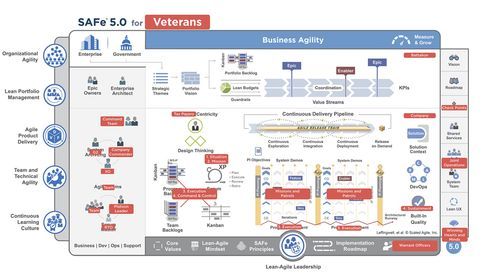
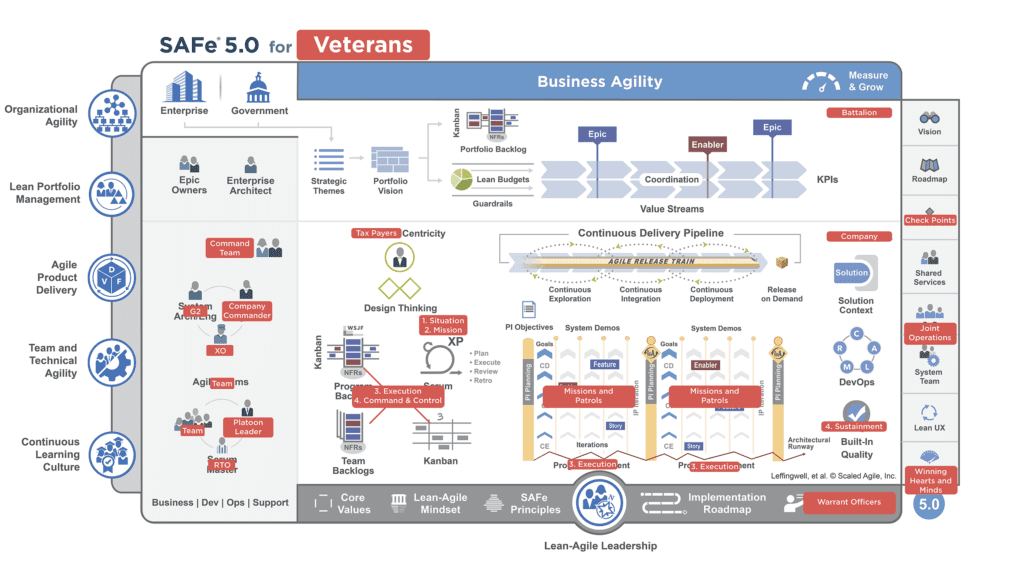
To illustrate this, I labeled applicable areas of the SAFe Big Picture with common military terms. Use your mouse to zoom over each image for a closer look.
The SAFe Big Picture has three configurations—Portfolio, Large Solution, and Essential. These translate to Division, Battalion, and Company levels.
Within Essential SAFe, there are key positions on the left side of the Big Picture—the Agile Team (which consists of 5–11 people) and two specialty roles: the Scrum Master and the Product Owner. Correlating these to military roles, the team is the squad or team, the Scrum Master is the RTO, and the Product Owner is the pointman.
Also in Essential SAFe, above the Agile Team layer, are three additional roles:
The System Architect/Engineer, which is your S2 or company-level intel shop
Product Management, which is your Company Commander
The Release Train Engineer, who’s in charge of keeping the Agile Release Train (ART) on the rails, closely relates to the Executive Officer (XO)
Multiple Agile Teams are part of the ART, which is a company-sized element of people navigating the Agile world. The ART has many mandatory events. To kick off a Program Increment (PI) or deployment—which is a set duration of time, usually a quarter of the year—all members of the ART attend PI Planning. This is where all teams on the ART provide the PI Objectives to the company and plan each of their iterations.
In the context of an Operation Order (OPORD) within the US Army, here’s how Agile works:
Situation can be rolled into the PI Objectives
Mission can be rolled into the PI Objectives
Execution is how the Agile Team operates—it can use Scrum, XP, Kanban, Design Thinking, and other techniques to satisfy the Customer (taxpayers)
Command & Control happens throughout the entire delivery pipeline by means of Daily Stand-ups, Scrum of Scrums, Product Owner Syncs, and other meetings, which focus on consistent communication and updates.
The Sustainment phase of the OPORD directly relates to Built-In Quality and the Architectural Runway.
The double diamonds representing Design Thinking on the Big Picture basically represent sand-table planning and shoot house for the actual mission. Design Thinking allows team members to diverge and converge thinking to release the right product at the right time.
On the bottom right of the Big Picture is the SAFe Program Consultant (SPC)—the change agent who leads all levels of an organization through a Lean-Agile transformation at scale by training, coaching, facilitating, and mentoring. This servant leader plays a critical role by applying expert knowledge of SAFe, and most closely aligns to a Warrant Officer.
Why SAFe?
One of the biggest reasons to go from boots to SAFe is the doors it can open. There are more than 300 Scaled Agile partners, and countless veteran-friendly enterprises undergoing agile transformations—including government contractors and U.S. government entities. As a veteran, once you understand the terminology, your opportunities in the Agile space as a Scrum Master, Product Owner, Agile Coach, Release Train Engineer, SPC (and many others) are virtually endless.
Get started: paying for SAFe Certifications
Taking a SAFe course and earning a certification are the first steps toward jump-starting your career in the Agile space. And there are ways for veterans to get financial assistance.
VR & E program
Through eBenefits associated with the U.S. Department of Veterans Affairs (VA), eligible Veterans and Service members can apply for either Vocational Rehabilitation and Employment (VR&E) benefits or Education/Career Counseling. It’s simple to apply; just follow these steps on the VA website:
Log into your eBenefits account.
Select “Additional Benefits” from your dashboard.
Select “Vocational Rehabilitation and Employment Program.” Be sure to read the program information, update your contact information, and apply for either the “Vocational Rehabilitation and Employment Program” or “Education/Career Counseling.”
If you’re deemed eligible, you’ll be invited to attend an in-person orientation session at the nearest VA Regional Office.
Servicemembers with a disability that began or became worse during active duty and who haven’t yet received a service-connected disability (SCD) rating, don’t need to wait to apply (see VA Form 28-0588 for further instructions). Additionally, ill or injured Servicemembers who haven’t yet received an SCD rating don’t need to wait to apply. Servicemembers expecting a discharge other than dishonorable and who possess a VA memorandum or Integrated Disability Evaluation System (IDES) rating of 20 percent or more—as well as Servicemembers currently going through a Physical Evaluation Board—may be eligible to receive VR&E services.
Just ask
Many of our 300+ Scaled Agile partners that provide SAFe training also offer military discounts. All you need to do is lean forward in the foxhole and send an email to these trainers to find out. Remember, you can catch more bees with honey, so be nice and polite when asking for a discount.
Check out these other helpful links to learn more about SAFe, courses, certification, and partners:
As a Scrum Master for the Learning and Certification team at Scaled Agile, Clint thrives at enhancing capabilities across teams by combining his expertise as an Agile coach at multiple technical companies with his experiences as a 10-year U.S. Army veteran. He’s also a family man who’s had the pleasure of watching Frozen 200+ times and the Grinch 100+ times with his young son and daughter.
I’m the scrum master for the marketing team at Scaled Agile. In the time that I’ve been here, we went from one team to two, and now three, adding new roles along the way.
What I find most useful in my everyday work are my conflict resolution skills. Communication, vulnerability, working through challenges—these all take a lot of time and effort. Being able to coach it and stick through it with teams on their journey to innovation is where we as scrum masters have a chance to shine.
Conflict isn’t just about fighting and yelling; it’s about collaborating and understanding different perspectives, so that the team can come up with something nobody’s ever thought of before—and Agile is so much of that, too.
In a past life on a team I worked with, there were conflicts between people who had been on the team for a long time and people who were newer, but were very advanced in their skills and fields. Figuring out how to collaborate and how to share those ideas without forcing one path or another was really challenging for a team to achieve agility. When we’re experiencing that and struggling to find our place, we often want to avoid having that hard, one-on-one conversation.
So, I did some one-on-one coaching with the people who were struggling and got them to a point where they understood I didn’t want to step in for them; I wanted them to have the confidence to talk to each other and build trust. I coached both of them on what it means to be vulnerable. It’s actually opening up and showing your team that you’re human and that you can collaborate. They were then able to solve the problem themselves and worked together for a long time afterwards very successfully. They started having those conversations more openly—and not just between the two of them but between the whole team and others they worked with regularly.
I love this article about vulnerability and bringing human connection into the workplace. Just remember to lean into conflicts of all shapes and sizes, and recognize that it’s a journey, much like the team formation lifecycle, that cannot be rushed or avoided.
About Lieschen Gargano Quilling
Lieschen Gargano is an Agile coach and conflict guru—thanks in part to her master’s degree in conflict resolution. As the scrum master for the marketing team at Scaled Agile, Lieschen loves cultivating new ideas and approaches to Agile to keep things fresh and exciting. She also has a passion for developing best practices for happy teams to deliver value in both development and non-technical environments. Fun fact? “I’m the only person I know of who’s been a scrum master and a scrum half on a rugby team.”