In 2017, Planview (a Scaled Agile partner) realized that its customers and market were evolving beyond their traditional product lines. A leader in project portfolio management (PPM) solutions, Planview recognized the need to adapt both strategically and operationally and looked to Agile to power a much-needed transformation. (Read the full story in Harvard Business Review).
While the development departments had practiced Agile for some time, the larger Planview organization really began its forays into Agile starting in 2017 via the acquisition of a company with strong Agile DNA and a powerful Kanban product. Sporadic successes after the acquisition, however, didn’t translate to the change the company needed. Planview knew that real transformation required a top-down commitment, and in late 2018, established a company-wide goal to rewire its organization through a new Agile Growth Initiative.
The initiative focused on five key objectives:
Infuse agility into the organization by increasing Agile DNA throughout
Admit we couldn’t do it alone and bring in outside coaching support
Embrace Agile practices and ceremonies from leadership to the teams
Reorganize people and teams to focus on customer value
Empower everyone to have a voice and do their best work
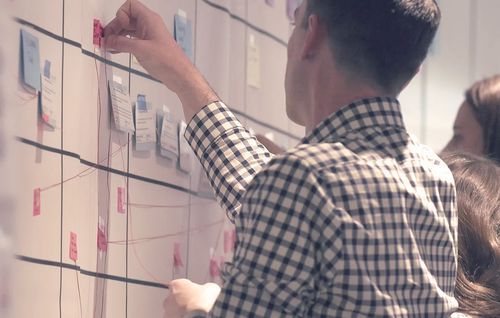
Led by the marketing department, Planview brought in external Agile experts as guides and kicked off its first Agile discovery session. When the team asked sales, marketing, and product leaders to list their top priorities, every department was different. It became clear that scaling across functions was the organization’s biggest challenge—and most promising opportunity.
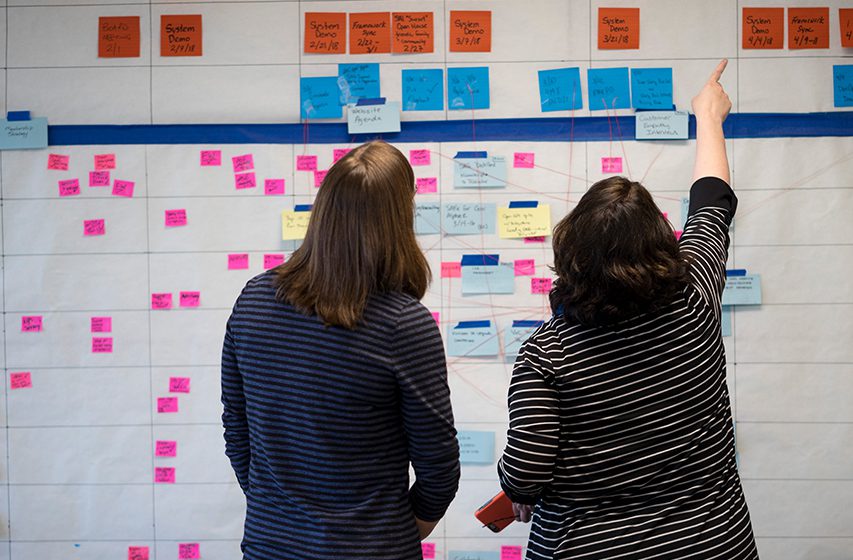
Planview accelerated its Agile initiative by creating three cross-functional Agile teams that comprised the first Go-to-Market Agile Release Train. Through Program Increment (PI) Planning events, the teams shared, according to Harvard Business Review, “… some hard conversations that ultimately resulted in reorganizations and the realignment of people and funds.”
The result: a new emphasis on solutions vs. products that enabled the organization to provide value to their customers in meaningful, innovative ways. With Agile, Planview successfully shifted from a 30-year-old PPM company to an Enterprise Agile Planning Solution Leader. That’s true transformation, although for Planview, it’s simply one more step in a continuous process of inspecting and adapting.
Read the full story of Planview’s transformation in Harvard Business Review.
About Brook Appelbaum
Brook Appelbaum is the Director of Product Marketing for Planview’s Lean and Agile Delivery Solution. With nearly 20 years of marketing experience, Brook has led many different product and digital marketing teams. However, her favorite leadership role is that of a Product Owner. As part of an Agile marketing team inside Planview, Brook drives the campaign and product marketing strategy for the Lean and Agile Delivery Solution. And she thinks LeanKit is the coolest.
As with many conferences across the globe, this year’s European SAFe® Summit has switched to a virtual format. Virtual conferences are unlike webinars and webcasts in that they offer many ways to connect with speakers, exhibitors, and other attendees in real time.
We know that for many of you, this may be your first time attending an immersive, multi-day, online event. So we’ve compiled some simple pro tips to help you make the most of this virtual environment: expand your SAFe knowledge, network with other SAFe practitioners, and have a fantastic conference experience.
Before the Summit
Pre-conference planning takes on a slightly different twist for a virtual event. While you won’t have to check airline schedules or book hotels, you do have to be away from the office, family, and the dog while you attend the Summit.
Plan your schedule. The first step is to look at the online agenda and check out the times for the keynote talks and technical sessions that you want to attend. Put those talks and sessions in your calendar and block out the time so that no other activities interfere with your scheduled time away from your regular work. You’re going to be out of touch with your team while you focus your attention on the great presentations, speakers, and other participants.
Socialize. It’s easy to overlook the social aspect of attending a virtual conference, but you don’t have to forego those conversations about what you just learned and who you’re going to see next. Today’s virtual conferences provide multiple communication channels inside their platforms to allow you to interact with other attendees. Just make sure you let everyone know that you’re planning to attend and would like to meet up with them online during the event.
Pro tip: You can use the free event communication channels, such as private chat or speaking at a moderated discussion area in the lounge, to easily connect. Many people plan ahead and share a link on Slack or set up a Zoom meeting that they keep open on their computer during the conference for sidebar communications. The key is to get in touch with others ahead of time so that everyone you want to meet is in the loop on the best way to communicate during the event.
During the Summit
All right: the first day of the Summit has arrived, and you’re ready to log in with the password you received when you registered. The first keynote is in 30 minutes, so you might want to look around, see what activities are available, and prepare your Summit identity.
Pro tip: Taking a 15-minute walk just prior to signing into the conference will invigorate you and help prepare you for the day ahead. Much like walking down to the convention center from your hotel room and mentally planning out your day, this simple activity will help you enjoy the conference more and allow you to be more relaxed while attending from your home office.
Update your profile. As an attendee, the first and most important thing you should do is create your profile for the Summit. Your profile is the identity you show to other attendees in the virtual world. Setting this up at the beginning of the conference opens up four different communication options available to all attendees. Access your profile by clicking on the Profile link on the navigation bar at the top of the webpage.
Once you’re in the profile section, follow the instructions on the form to fill out the information you want to share. Then, look at the other tabs in this section and you’ll notice a briefcase where you can store documents you’ll download from Exhibitors’ booths or the Resource Center. This is also where you’ll find messages sent to you through internal communication channels. Remember, you don’t have to accept every chat and connection request you receive; they’ll be stored here until you want to respond.
SAFe Expert Coaching Station. If you still have a little time before your first keynote or technical talk, don’t forget to stop by the SAFe Expert Coaching Station. This is one of our most popular features at the Summit and time slots will fill up quickly. You can register for a specific time slot or get on a waiting list for an opportunity to speak with a SAFe expert when a spot becomes available. And, if you only have a quick question, click on the Coaches Chat tab to put in a question. If you want an individual response, just let your coach know and they can respond privately.
Keynotes and technical talks. This year’s keynotes will be presented live, giving you the opportunity to hear firsthand from inspiring, cutting-edge leaders. You’ll also have access to dozens of technical talks on topics ranging from DevSecOps and Lean Portfolio Management to remote facilitation and SAFe for marketing or hardware teams. These talks will be pre-recorded, followed by live Q&A at the end.
Customer stories. Do you wonder what SAFe really looks like when organizations put it to work? We’ll take you inside some of our customer companies—including KBC, Siemens, PepsiCo,Telekom IT, and Achmea—to show you what they’re doing and how it’s working.
Pro tip: Be Q&A ready: it will improve your chances of getting your questions answered by the speakers at the end of their sessions. If you’re familiar with the speaker and topic and know the questions you want to ask, write them down ahead of time. Paste them into the chat window during the talk so the speaker’s moderator can see them and share them with the speaker.
Networking with Peers
Anyone with a profile can communicate one on one during the conference via four different channels:
Internal Summit Conference Email messages. You’ll get a notification that you have an unread email. Just click on the notification window to view it.
Chats. If you receive a chat request, you’ll be able to accept or decline it. You can also send a short message to the chat requester when declining a chat.
vCards. This method is the best way to share your business card during the event. The notification will display that you have a new vCard; just click on the notification window to view it.
Connections. The notification will display that you have a new connection. You can accept or ignore it directly from the request window.
Public chat forums will be placed throughout the virtual conference to allow you to chat with SAFe coaches, other attendees, and Scaled Agile staff. To find a public chat forum, simply navigate back to the Lobby or use the drop-down menu at the top of the web page.
Participate in a group discussion in the lounge by entering a Public Discussion Group or Group Chat. The discussion group allows you to have topic-specific conversations, while the chat is a free-form back and forth among attendees and Scaled Agile staff.
Pro tip: The European SAFe Summit is hosted on a 3D platform: it’s best-viewed on a desktop or laptop. Your phone or mobile device does not effectively support this type of experience.
I hope you enjoy the European SAFe Summit virtual experience! We’re extremely excited about this year’s conference. If you haven’t registered yet, you can do so here. And don’t forget to download the 2020 European SAFe Summit Attendee Guide, with these and more details, tips, and advice inside!
About Micheal Center
As the Senior Industry Event Manager at Scaled Agile, Micheal brings his 25 years of experience to support and produce engaging trade shows and conferences across the globe. He’s also a Certified Digital Event Strategist who’s dedicated to improving attendee and sponsor experiences at Scaled Agile’s virtual conferences and events.
When I coach companies on Lean and Agile methodologies, I strive to have dedicated, co-located Product Owners (POs), Scrum Masters, and teams. In the 21st century and given our current context, many companies involved in a SAFe® transformation have POs and Scrum Masters who are leading multiple remote teams.
It can be challenging to coach Agile teams remotely and consistently on the Agile Manifesto and SAFe principles and values, such as Business people and developers must work together daily throughout the project or Program Execution. Often during these transitions, some companies expect an employee to be a part-time PO in addition to his/her day job.
Many times I have had Product Owners ask me to help supervisors understand the time commitment involved with the role. One way is to describe what a typical PO does each day. In this post, I’ve created a list of what a PO does on a daily basis. This list is not exhaustive, nor is it in any specific order:
Attends the team’s daily stand-up meeting to understand the team’s progress and impediments toward the Iteration goals.
Capture customer requirements and ideas by writing (or helping others write) stories and Enablers.
Continuously accepts or rejects completed stories and Enablers.
Is available to the team each day to answer questions and clarify stories.
Works with the System Architect to ensure Enablers are properly prioritized so as not to mortgage the future of the architecture.
Verifies that stories are in the proper format, contain valid confirmation (aka acceptance criteria), and are in line with the Program vision and scope. This includes any necessary design details, business rules, NFRs, etc.
Ensures that the team is aligned to the PI Objectives, and Iteration goals are clearly defined and communicated.
Helps remove or escalate obstacles to Product Management.
Makes sure that the Agile team has a direct connection with the business through story development and the Iteration review.
Meets regularly with Product Management (e.g. PO Sync) to keep stakeholders informed on how much incremental value has been generated.
In addition to that, on a cadence, POs:
Participate in the Iteration retrospective event.
Present the stories and Enablers during Iteration Planning.
Meet with the team each week to refine the Team Backlog.
Work with the team to decompose stories and Enablers into small increments. Ideally something that can be completed every two to three days.
Prioritize and update the Team Backlog.
Work with the team to create and commit to Iteration goals.
Collaborate with team members to form PI Objectives.
Help identify dependencies with other teams during PI Planning.
Meet with Product Management and stakeholders regularly to field questions and inform them of any updates or changes to scope.
Conduct the Iteration review with the team and participate in the System Demo to demonstrate the incremental functionality to the Agile Release Train and stakeholders.
In your context, look at all the activities that your POs are engaged in and consider whether it’s realistic for a part-time PO to do them all. If it’s not, speak to your part-time POs and have them present this data to their managers or as an issue during your Inspect & Adapt workshop.
To learn more on the PO role within SAFe, read this article.
About Joe Vallone
Joe Vallone, SPCT, SAFe Fellow, is an experienced Agile trainer who has helped coach several large-scale Agile transitions at Zynga, Apple, Microsoft, VCE, Nokia, AT&T, and American Airlines. He’s also an effective leader and speaker with more than 20 years of software development and management experience. As a change agent, Joe is passionate about teaching and coaching organizations to reach their full potential by embracing Agile values and Lean thinking.
As COVID-19 quickly spread worldwide, lots of organizations, including ours, realized that our next PI Planning would have to be entirely remote and distributed. We’d done distributed PI Planning before, where some employees joined on their laptops from global locations, but never one where everyone was remote and in their homes. So, just how were we going to pull this off?
Watch the video for a high-level look at what we did and keep reading the post for a bit more detail.
Planning the Event
For starters, we knew we had to answer lots of questions around locations, agenda, facilitation, tools, and working agreements. So, we started laying the foundation of our event by following the guidance in the advanced topic article from our Framework team, Distributed PI Planning with SAFe, and built our plan from there.
Agenda
I collaborated with our scrum masters and leaders to flesh out what this event would look like, and we knew that a two-day agenda wasn’t going to work. Not just because it’s hard to stay focused and engaged for two full days over video calls, but because we have people in China, England, Germany, India, Japan, Mexico, Singapore, and across the U.S.
If you were to research the words “learning network” via books or an online search, you might come up empty. There isn’t much out there on the topic. In fact, I was excited one day to see “learning network” listed in the index of one of my learning books. But it pointed me toward networks in general, which wasn’t helpful. Not long after that I was telling a colleague about one of my informal learning collaborations and I called it a learning network. It just seemed like the right way to describe it.
We had to accommodate all the different time zones to make sure people weren’t working in the middle of the night (more about that later). So, I set up a recurring weekly meeting with our scrum masters to craft a detailed event schedule. We landed on a three-day agenda that had some people starting early in the morning and others joining toward the evening (and later at night) for a shorter amount of time.
Facilitation
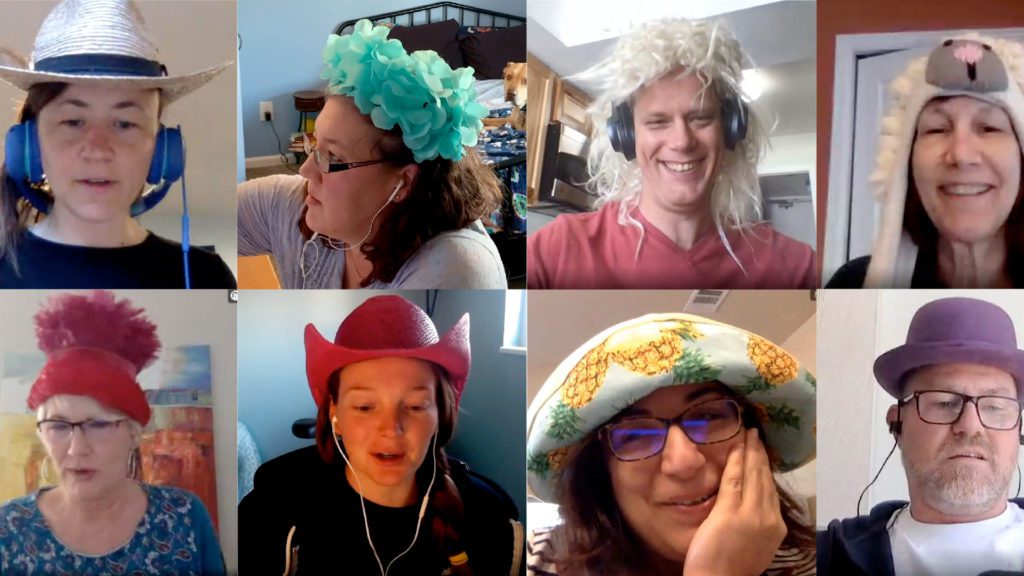
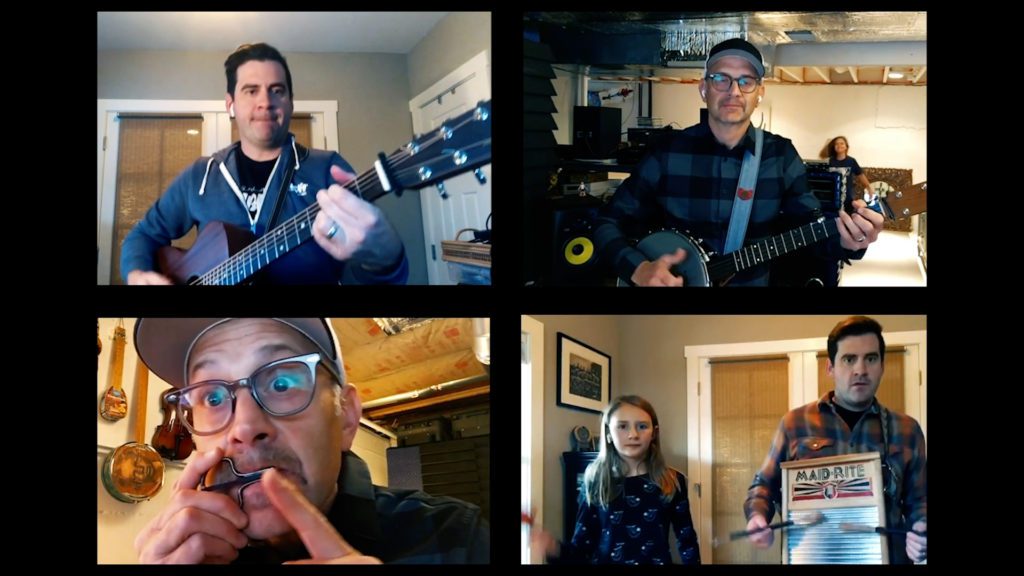
We knew that to engage people remotely over three days, we’d need to get creative. So we came up with icebreakers featuring our talented employee musicians, a crazy hat theme, social video meetups to see people’s pets, a guided meditation session, and random quizzes to keep things light and fun.
In the spirit of relentless improvement, we sent out daily surveys to capture everyone’s feedback about what was going well and what wasn’t, and incorporated that into the next day’s activities.
Tools
The scrum masters and I worked with our information and technology team to figure out how to best use the tools we had to run the event. We set up a central location on our intranet and used our internal collaboration tool to create a main information hub and virtual rooms for each team, the program board, presentations, and the Scrum of Scrum meetings. We use the Google suite at Scaled Agile, so team breakouts happened via Google hangouts, and each team also had a dedicated channel in Slack that other teams could use to discuss joint projects and dependencies, and ask questions.
Hiccups and Takeaways
Overall our event went pretty smoothly, but we did run into some issues. When we set up the team spaces in our collaboration tool, we didn’t realize they were limited to just the individual team members. This meant people on other teams couldn’t access those spaces to interact with the teams they needed to. We managed to fix that issue on day one but it was pretty chaotic and time-consuming.
Another thing we discovered is that it took a while for all of us to get used to communicating with each other both in the main space and in our individual team rooms. There was one hangout link to the main PI Planning room and different hangout links for each team to use during their breakout sessions. On day one, some people got lost in the transition, but by day two, all of us were seasoned pros.
We’ve definitely got a list improvements we plan to make for our next PI Planning, including:
Being more intentional about team synchronization points so the teams come together more regularly throughout each day.
Adjusting the agenda to four days versus three to shorten the hours per day and better accommodate our international folks (at least one of them was online until 2 AM—sorry, Gerald).
Allowing more time for team breakouts, just because collaborating remotely takes longer.
To get even more details about how we executed our first fully remote, distributed PI Planning, I invite you to watch our Fireside Chat webinar on our Community Platform (login required).
For more guidance around running remote PIs, ARTs and teams, listen to episode 27 of our SAFe Business Agility Podcast, which takes a deep dive into the topic.
About Jeremy Rice
As the Release Train Engineer at Scaled Agile, Jeremy is a leader with a desire to help others achieve their greatest success. A U.S. military veteran, Jeremy has a diverse background in technology, engineering, and coaching, mixed with a bit of linguistics and work as a chaplain. You can also find him occasionally posing with baby goats, cows, and pigs on his hobby farm.
In 2006, I enlisted in the U.S. Army as a Forward Observer. Basically, that meant I spotted artillery rounds to ensure they landed on targets. Every time I neared the end of my contract, I reenlisted to avoid facing the fact that I had no idea how to translate my experience outside of the military. What was I supposed to do: walk into a prospective employer’s office and say that I was really good at land navigation, and ensuring close air support and artillery rounds hit targets? Yeah, not so much.
So, I changed my job to a Criminal Investigation Division Special Agent—think Naval Criminal Investigative Service (NCIS), FBI, or Secret Service but for the Army. I figured that my expertise in areas like interrogation, crime-scene examinations, digital forensics, crisis negotiation, protective service operations, and undercover and surveillance operations would definitely transfer directly to non-law enforcement jobs in the civilian world. Again, not so much.
So, time for plan B. I took what I knew, retired from the military, and got a job at a bank making just about minimum wage. With 10 years of leadership experience, I was barely providing for my family. When my 401k was just about empty, I decided I needed to find a career that could help me give my family the life they deserved.
Making the transition
This isn’t a unique story. Servicemembers looking to get out of the military face two big challenges. Either they can’t commit to leaving or—if they do commit—their roles in the military don’t translate to civilian occupations. Which means they end up in dead-end jobs. The stress adds up: veterans holding cardboard signs asking for help and money appear on every corner, substance abuse/recovery facilities are filled with green duffle bags, and even worse, veterans are committing suicide. There’s a scary statistic cited in a recent report that in 2017, nearly 17 veterans died by suicide each day. It shouldn’t be this hard for transitioning freedom fighters.
But here’s some good news: shifting to a position in an Agile environment can help open doors for veterans, relieve some of that stress, and provide a lucrative career. Remember that dead-end bank job and my determination to find something better? I found it as a Scrum Master at Scaled Agile, and the skills I’ve learned here translate almost perfectly to military roles.
In this blog post, I’ll explain how the roles within the Scaled Agile Framework® (SAFe®) correlate to military positions. I relied on my background and experience to translate the roles into terms aligned with the U.S. Army, U.S. Marine Corps, and the Special Operations community, but veterans worldwide can relate to this.
Agile teams
When you mention Agile teams, most people think about software developers congregating in incubator garages across Silicon Valley. While these folks can be pretty Agile, I personally think that U.S. military teams are the most Agile because they’re on the ground making life-changing decisions instantly. These teams take the most up-to-date information and intelligence and iterate on the plan. Likely, this plan started with a conversation, moved to some sort of slide deck, then to the teams who practiced it using mock cities, sand tables, shoot houses, and other high-speed planning techniques—all to all be derailed by an IED, small arms fire, or chasing terrorists down an unexpected tunnel system. It makes me think of the famous quote often attributed to Dwight Eisenhower: “Plans are worthless, but planning is everything.”
In the military especially, we need Agile leaders who don’t get stuck by analysis paralysis, but rather who can prioritize, execute, and coach their team to get the job done. Aside from the life-and-death implications, the only big difference between working in the military and working in an Agile environment would be that Agile encourages working at a sustainable pace. We want to ensure predictability—always burning the midnight oil creates an unstable and unpredictable environment.
Within SAFe, Agile teams are the foundation of and critical to any Agile transformation. Fortunately, Agile roles translate easily for transitioning veterans in part because Agile teams are essentially a patrol. Using the basic makeup of a patrol, you have a radio transmitter operator (RTO), team leader, pointman, and the gunners on each side.
The RTO is essentially the Scrum Master. This is the person who provides clear and concise communication organization-wide, and removes impediments for the Agile team if it can’t on its own. The Scrum Master has a wider role as well, but I’ll cover that later in this post.
The pointman is most compared to the Product Owner. This person represents the customer on the team and helps the team prioritize its work, guiding it to deliver value that’s aligned with what customers want and with the organization’s goals.
The remaining members of the patrol are considered the Agile team. Because they’re the folks with the intel on the ground, they know what needs to be done to achieve the mission—similar to what’s called the Program Increment (PI) Objectives in an Agile environment. The Agile team can take the priorities from the Product Owner, provide realistic feedback on what is actually achievable, and complete the mission.
To be successful, Agile teams and fire teams need leaders who can put the team/mission/people above themselves. Leaders provide the intent, the motivation, and the way to get people on the team to act.
Frameworks
In military environments, leaders are responsible for defining the concept of the operation in time, space, purpose, and resources (ATP 3-21.8). The Operational Framework greatly supports that by defining associated vocabulary and a way to organize.
In a civilian workplace, leaders are responsible for the same successful outcomes, especially in Agile environments. SAFe is one approach enterprises use to support their transformations and provide full transparency across the entire organization. There’s definitely a learning curve associated with SAFe, and understanding the colloquialisms and jargon is key to a veteran’s transition in any workplace.
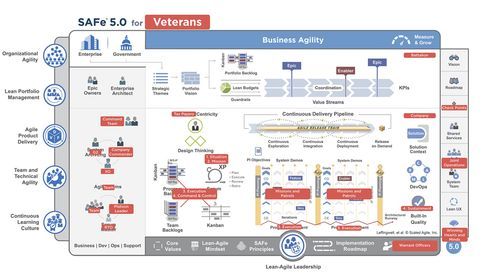
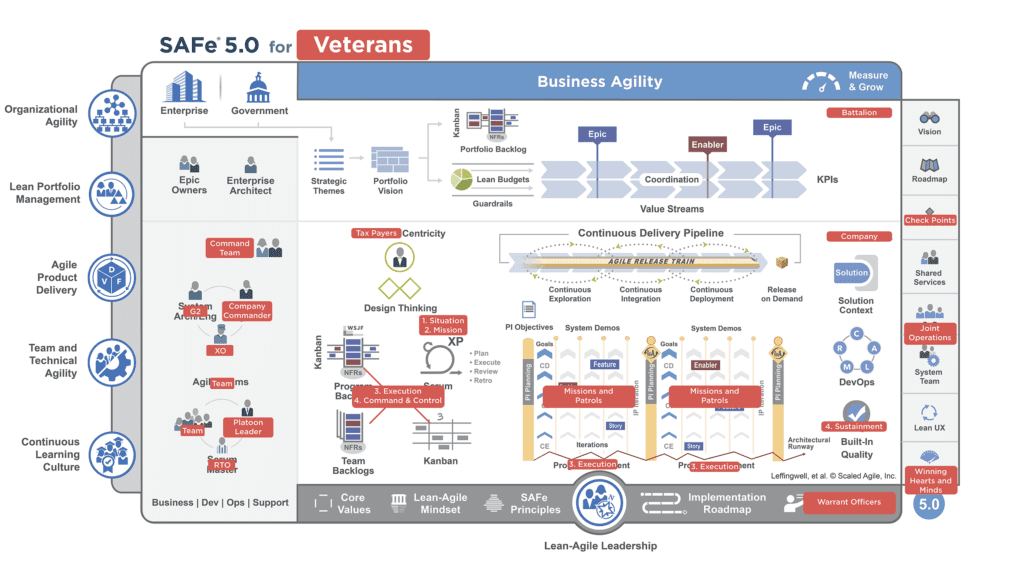
To illustrate this, I labeled applicable areas of the SAFe Big Picture with common military terms. Use your mouse to zoom over each image for a closer look.
The SAFe Big Picture has three configurations—Portfolio, Large Solution, and Essential. These translate to Division, Battalion, and Company levels.
Within Essential SAFe, there are key positions on the left side of the Big Picture—the Agile Team (which consists of 5–11 people) and two specialty roles: the Scrum Master and the Product Owner. Correlating these to military roles, the team is the squad or team, the Scrum Master is the RTO, and the Product Owner is the pointman.
Also in Essential SAFe, above the Agile Team layer, are three additional roles:
The System Architect/Engineer, which is your S2 or company-level intel shop
Product Management, which is your Company Commander
The Release Train Engineer, who’s in charge of keeping the Agile Release Train (ART) on the rails, closely relates to the Executive Officer (XO)
Multiple Agile Teams are part of the ART, which is a company-sized element of people navigating the Agile world. The ART has many mandatory events. To kick off a Program Increment (PI) or deployment—which is a set duration of time, usually a quarter of the year—all members of the ART attend PI Planning. This is where all teams on the ART provide the PI Objectives to the company and plan each of their iterations.
In the context of an Operation Order (OPORD) within the US Army, here’s how Agile works:
Situation can be rolled into the PI Objectives
Mission can be rolled into the PI Objectives
Execution is how the Agile Team operates—it can use Scrum, XP, Kanban, Design Thinking, and other techniques to satisfy the Customer (taxpayers)
Command & Control happens throughout the entire delivery pipeline by means of Daily Stand-ups, Scrum of Scrums, Product Owner Syncs, and other meetings, which focus on consistent communication and updates.
The Sustainment phase of the OPORD directly relates to Built-In Quality and the Architectural Runway.
The double diamonds representing Design Thinking on the Big Picture basically represent sand-table planning and shoot house for the actual mission. Design Thinking allows team members to diverge and converge thinking to release the right product at the right time.
On the bottom right of the Big Picture is the SAFe Program Consultant (SPC)—the change agent who leads all levels of an organization through a Lean-Agile transformation at scale by training, coaching, facilitating, and mentoring. This servant leader plays a critical role by applying expert knowledge of SAFe, and most closely aligns to a Warrant Officer.
Why SAFe?
One of the biggest reasons to go from boots to SAFe is the doors it can open. There are more than 300 Scaled Agile partners, and countless veteran-friendly enterprises undergoing agile transformations—including government contractors and U.S. government entities. As a veteran, once you understand the terminology, your opportunities in the Agile space as a Scrum Master, Product Owner, Agile Coach, Release Train Engineer, SPC (and many others) are virtually endless.
Get started: paying for SAFe Certifications
Taking a SAFe course and earning a certification are the first steps toward jump-starting your career in the Agile space. And there are ways for veterans to get financial assistance.
VR & E program
Through eBenefits associated with the U.S. Department of Veterans Affairs (VA), eligible Veterans and Service members can apply for either Vocational Rehabilitation and Employment (VR&E) benefits or Education/Career Counseling. It’s simple to apply; just follow these steps on the VA website:
Log into your eBenefits account.
Select “Additional Benefits” from your dashboard.
Select “Vocational Rehabilitation and Employment Program.” Be sure to read the program information, update your contact information, and apply for either the “Vocational Rehabilitation and Employment Program” or “Education/Career Counseling.”
If you’re deemed eligible, you’ll be invited to attend an in-person orientation session at the nearest VA Regional Office.
Servicemembers with a disability that began or became worse during active duty and who haven’t yet received a service-connected disability (SCD) rating, don’t need to wait to apply (see VA Form 28-0588 for further instructions). Additionally, ill or injured Servicemembers who haven’t yet received an SCD rating don’t need to wait to apply. Servicemembers expecting a discharge other than dishonorable and who possess a VA memorandum or Integrated Disability Evaluation System (IDES) rating of 20 percent or more—as well as Servicemembers currently going through a Physical Evaluation Board—may be eligible to receive VR&E services.
Just ask
Many of our 300+ Scaled Agile partners that provide SAFe training also offer military discounts. All you need to do is lean forward in the foxhole and send an email to these trainers to find out. Remember, you can catch more bees with honey, so be nice and polite when asking for a discount.
Check out these other helpful links to learn more about SAFe, courses, certification, and partners:
As a Scrum Master for the Learning and Certification team at Scaled Agile, Clint thrives at enhancing capabilities across teams by combining his expertise as an Agile coach at multiple technical companies with his experiences as a 10-year U.S. Army veteran. He’s also a family man who’s had the pleasure of watching Frozen 200+ times and the Grinch 100+ times with his young son and daughter.
I’m the scrum master for the marketing team at Scaled Agile. In the time that I’ve been here, we went from one team to two, and now three, adding new roles along the way.
What I find most useful in my everyday work are my conflict resolution skills. Communication, vulnerability, working through challenges—these all take a lot of time and effort. Being able to coach it and stick through it with teams on their journey to innovation is where we as scrum masters have a chance to shine.
Conflict isn’t just about fighting and yelling; it’s about collaborating and understanding different perspectives, so that the team can come up with something nobody’s ever thought of before—and Agile is so much of that, too.
In a past life on a team I worked with, there were conflicts between people who had been on the team for a long time and people who were newer, but were very advanced in their skills and fields. Figuring out how to collaborate and how to share those ideas without forcing one path or another was really challenging for a team to achieve agility. When we’re experiencing that and struggling to find our place, we often want to avoid having that hard, one-on-one conversation.
So, I did some one-on-one coaching with the people who were struggling and got them to a point where they understood I didn’t want to step in for them; I wanted them to have the confidence to talk to each other and build trust. I coached both of them on what it means to be vulnerable. It’s actually opening up and showing your team that you’re human and that you can collaborate. They were then able to solve the problem themselves and worked together for a long time afterwards very successfully. They started having those conversations more openly—and not just between the two of them but between the whole team and others they worked with regularly.
I love this article about vulnerability and bringing human connection into the workplace. Just remember to lean into conflicts of all shapes and sizes, and recognize that it’s a journey, much like the team formation lifecycle, that cannot be rushed or avoided.
About Lieschen Gargano Quilling
Lieschen Gargano is an Agile coach and conflict guru—thanks in part to her master’s degree in conflict resolution. As the scrum master for the marketing team at Scaled Agile, Lieschen loves cultivating new ideas and approaches to Agile to keep things fresh and exciting. She also has a passion for developing best practices for happy teams to deliver value in both development and non-technical environments. Fun fact? “I’m the only person I know of who’s been a scrum master and a scrum half on a rugby team.”
At the end of the regular episodes in our biweekly SAFe® Business Agility podcast, we answer questions submitted by listeners. In this post, we feature two on the topic of PI Planning, one of which is especially relevant for anyone working at an Agile organization that has restricted travel to limit exposure to the coronavirus.
What’s the best way to conduct PI planning with remote employees?
For many companies with a remote workforce, especially those with a global presence, conducting PI planning can be a challenge. While face to face is always best, it’s not always possible or financially feasible. There are some things you can do if you’re faced with this dilemma.
First, whenever you have remote team members, whether it’s during PI planning or other work-related activities, it’s important to pick times that work for everyone. This means finding meeting times where overlap may exist between work hours for local team members and work hours for remote team members. It can be difficult, but it’s possible.
When work hours don’t overlap, consider times that are a compromise for everyone. That often means some members will end up working late while others will begin their day earlier than their usual start time. Try to keep the compromise to less than four hours either way. Anything more and team members may not be at their best.
That said, one thing that you shouldn’t compromise on is trying to keep whole teams together. For example, don’t have the scrum master in one location and the product owner in another. Keep them all participating together if possible.
Next, let’s discuss how to accommodate remote team members during the PI planning event. While Scaled Agile is a tool-agnostic company, we do have some Gold partners that offer some very helpful tools. One of them, piplanning.io, has a great tool that runs on multiple different platforms that people can use to share information around PI planning.
Also, think about how to address other logistical challenges, like how to keep remote team members engaged when the room is noisy or during a breakout session. We’ve found that it’s helpful to assign a room buddy to a remote team member. The room buddy is responsible for making sure that the remote team member has everything they need to be an active participant in the session.
It’s important to remember that preparation will take longer with remote PI planning. There’s a lot to consider and you may have to make some tradeoffs. However you end up solving this challenge, make sure to always be respectful of your team members—it’s one of the core pillars of Lean.
Fast forward more than three years and a move to another company, I’m still part of a number of informal learning networks with many of my colleagues from that organization. Every time we learn something new that we feel would be beneficial to the others in the network, we share it. And we learn more every time we share in these moments.
For even more details read this advanced topic – tips on distributed PI Planning.
Why is it important to assign business value during PI Planning and how is it helpful to the business?
One of SAFe’s core values is alignment. . Another is transparency, which is critical in an organization’s execution phase. PI Planning and assigning business value is an important component of that. Assigning business value isn’t necessarily about prioritizing things, changing your directions, or shifting responsibility. It’s simply the business owners telling you what they feel is most important, and aligning around that. The business owners may not understand all of the technical nuances that go into building a product but that’s OK. But they do understand why teams are building the product and why their customers want it. The ability to communicate that to the teams that are doing the development work—whether hardware, software, cyber-physical systems, or a business solution—is paramount.
Assigning business value is symbiotic. And Agile is about bridging the silos between the business and IT. When you have those silos, oftentimes the business floods IT with requests. Getting the business owners to assign that business value is that hard prioritization work, and something IT teams can use to ask, “Do we understand your priorities, are we doing things in the right order, and is this of the highest value to our customer?”
Predictability is another important element and there’s a tool in our PI Planning toolkit called the PI predictability measurement that uses the assignment of business value to measure the predictability. That helps you answer the critical question, “Did we do the things that we said we would?” This is a critical part of why companies use SAFe if they want to improve their predictability.
If you haven’t heard the SAFe Business Agility podcast before or want to listen to new and previous episodes, check it out.
If you’ve got a question for us to answer on air, please send it to podcast@scaledagile.com.
Happy listening!
About Melissa Reeve
Melissa Reeve is the Vice President of Marketing at Scaled Agile, Inc. In this role, she guides the marketing team, helping people better understand Scaled Agile, the Scaled Agile Framework (SAFe) and its mission. Melissa received her bachelor of arts degree, magna cum laude, from Washington University in St. Louis. She currently resides in Boulder, Colorado with her husband, chickens and dogs.
How do you get stakeholders to collaborate on a roadmap? What are the seven deadly sins of Agile portfolio management? How do you avoid a “train” wreck with your ARTs? What are some techniques for managing the modern workforce? How did Travelport create psychological safety among its C-level leaders?
The 2020 European SAFe Summit, 10-11 June in The Hague, will answer all these questions and more: each day we’re adding new sessions designed to make this Summit the best one yet. The European SAFe Summit is the largest conference for the top SAFe practitioners, experts, and thought leaders working in Agile today.
Last year’s attendees gave us a diversity of reasons why they appreciated the European SAFe Summit—from the informative keynotes and practical sessions to the helpful staff and delicious food. But here are my top five reasons for why you won’t want to miss it.
1. Gain access to SAFe insiders
From the SAFe founder Dean Leffingwell to the SAFe Fellows and SPCTs, the Summit gives you the chance to learn from and share feedback with the SAFe leaders whose experiences and thinking to shape the framework. Come to the SPCT coaching station to sit one-on-one with experts and discuss solutions to your unique challenges.
2. Hear from SAFe customers
Come and hear from some of the largest organizations in Europe about how they’re using SAFe to improve their planning, portfolio strategy, product quality, and time-to-market. Leaders and change agents from Europe’s top companies will be presenting their experiences, learnings, and advice for making SAFe work inside your own organization.
3. Learn best practices
We know, and you know, that organizations are complex, messy, and resistant to change. That’s why it’s so helpful to hear what works—and what doesn’t—across different types of environments. We invite SAFe customers, trainers, and framework experts to share their insights at the Summit because attendees tell us again and again how valuable SAFe best practices are in accelerating adoption and supporting a culture of change.
4. Make connections that support your business
As Agile adoption has expanded across Europe, the Agile community has become dedicated, tight, and strong. The Summit unites those of us practicing, leading, and experiencing Agile at scale so you can easily make connections and build your network with other coaches, thought leaders, and change agents. Meet other people working with SAFe, identify opportunities to cultivate working relationships, and evaluate service or platform companies that can accelerate your work.
5. Get in-depth training
Stay through 12 June for a dedicated day of hands-on workshops. Enhance your results—and your professional skills—by diving deep into specific topics including business agility, SAFe for really big systems, Agile product management, and Lean portfolio management.
These are just five of the reasons why the European SAFe Summit has become one of the best-attended Agile conferences in Europe. This conference sold out last year, so don’t miss your chance to attend, learn, network, and grow.
Andrew Sales is a SAFe Program Consultant Trainer (SPCT) and a member of the Scaled Agile Framework team. He has been supporting organizations with their Agile transformations for the last 10 years and is a regular speaker at Agile conferences and contributor to the Agile community. Andrew previously led the Agile Services Practice across EMEA for CA Technologies (formerly Rally).
PI planning, a vital component of SAFe® is integral to the Agile process, and the meeting can be an intense experience. Sitting in one big room for two full days, with potentially over 100 team members across the organization, can be taxing. Once the breakout sessions begin, the environment can become stressful for some.
The importance and complexity of the work to be done and the pressure of time can make these sessions challenging. Adding to the stress, there are often many conversations going on at the same time, causing the volume in the room to grow increasingly louder until people are yelling just to talk. All of this adds up to people feeling overstimulated and overwhelmed, causing them to grow weary and disengage. With the high cost and critical nature of these sessions, it’s imperative that organizations keep team members engaged and productive.
Because the stakes are so high, you want to use all the best practices available to you in order to maximize valuable time. Our experience has taught us that making your PI planning events fun can turn the stress of a two-day planning event into excitement about what’s ahead. Setting up a lively environment primes your audience for engagement and creativity.
First, we start all of our PI planning sessions with 10 minutes of gratitude. We take the time to encourage planning members to acknowledge and appreciate other team members. Using a mic runner, we have an open mic and find that once the praise gets started, our 10 minutes goes pretty fast, leaving everyone smiling, primed for positivity and ready to get down to business.
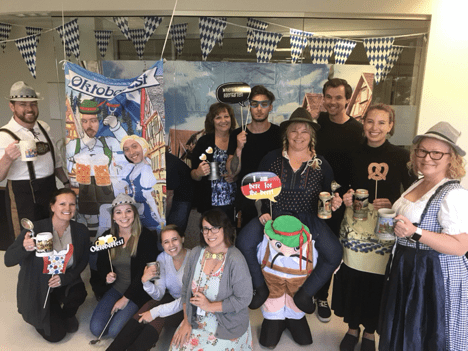
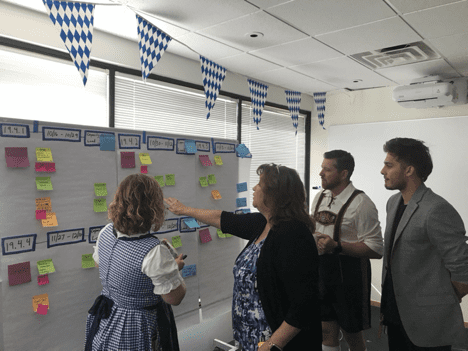
Next, we use a chosen theme and incorporate it into slides, written materials, props in the room, snacks, and even stickers, toys, games, and prizes. If you need ideas for your own theme, do some online research for themed parties. Recently, we used an Oktoberfest theme where team members dressed up in traditional costumes, like lederhosen and dirndls. We passed out beer steins (without beer of course) for drinking, and had snacks including pretzels and mustard (be sure to offer gluten-free snacks too). We put up Oktoberfest flags, props, and background scenes—we even had an Oktoberfest backdrop and created a photo booth that the teams enjoyed using.
I’ve learned through trial and error that themes need to be relevant to the times, relatable to the audience, and provide an environment that people want to experience and be a part of.
For example, it’s not enough to say that your theme is “baseball” without also providing the environment to give people an opportunity to interact with the theme. This includes setting expectations in advance, especially if you are asking people to take risks like wearing costumes or using props in front of their coworkers.
It helps with engag
It helps with engagement if the PI planning event organizers and release train engineers (RTE) serve as models, participating in the theme as a way of making it safe for others. Our RTE wore lederhosen and our CEO and founder wore Bavarian hats during the vision statement portion of PI planning.
Another idea is to include games or gamify aspects of PI Planning. Word Bingo is a fun way to keep people engaged over the two long days. Hand out cards with some common and not-so-common words that are likely to be said (or intentionally said) throughout the planning. You could have a single winner, but even better, everyone can get a prize once their card is complete. Prizes should be simple but fun, like themed socks or small desk toys. Treasure hunts and scavenger hunts are other fun ways to get people working together. Give each team member a list of things to find or do, like visit another team to find program risks and dependencies and determine whether or not they impact the plan being created. This gets teams talking to each other, improving relationships, and finding common goals.
Since we started bringing fun into our PI planning processes, I’ve heard more laughter, I’ve felt the positive energy in the room increase, and I’ve seen teams improve how they work together. People seem more energized and less drained by the end of the event. Contrary to what you might think, incorporating fun doesn’t take up more time and make the sessions last longer. In fact, the sessions are more inclusive, engaging, and productive, with better outcomes and fewer surprises down the road. I encourage you to give it a try.
About Deb Choate
Deb Choate is a scrum master at Scaled Agile with loads of experience leading and supporting successful SAFe transformations, technical teams, and projects. She’s passionate about applying her background in psychology and neuroscience to create high-performing Agile teams, environments, and cultures.
Now that SAFe® 5.0 is live, I wanted to take a minute to reset the baseline on what exactly a framework is, what it isn’t, and what’s required to win with SAFe.
One of the most inspiring things I’ve experienced in working with SAFe is seeing the excitement and energy that it brings out in others. After learning in the classroom, many well-intentioned people run back to their organizations to ‘do the thing,’ but often forget to first understand the problem to be solved and the significance of the change ahead. Many proceed without first rooting themselves in what it is that they, and others, must do. Unfortunately, bypassing this step and failing to broadly communicate the vision can lead to many false starts.
In this post, I’ll explore patterns to consider for improved outcomes when using the Framework, offer some tips to apply tools found in SAFe and relate them to your context, and identify patterns to help avoid making Framework guardrails feel overly rigid.
The case for change
Change for the sake of change is rarely a successful undertaking. And change is hard—really hard. Consider any change you’ve tried to make in your life: a new fitness routine, a new diet.
Without a compelling case to make the change, many of us abandon these new habits before they’re integrated into our lifestyle (culture or lifestyle change is the result of changing; not a reason for change.)
Example: A 5 a.m. run, the second week of January, when it’s cold and you’re sore.
The result: Abandoned change.
Example: Out with coworkers at a pizza joint the second week of a new diet when your body is craving sugar/fat/salt.
The result: Abandoned change.
Example:The beginning of the second PI Planning when there’s no architectural runway, leaders can’t decide on priorities, managers are frustrated with understanding the new way of working, and teams are being pressured to just deliver something.
The result: Abandoned change.
I’m guessing you can probably relate to at least one of these scenarios.
Now, reexamine the same scenarios with a clearly articulated “why” and consider how understanding the case for change may yield different outcomes.
Embracing a new fitness routine [BECAUSE] it’s difficult to keep up with the kids.
The result: Maybe that cold morning is a little more bearable.
Adopting a new diet [BECAUSE] your current one has contributed to pre-diabetes.
The result: Amazing smells or not, that pizza is now a little easier to say no to.
Adopting a new way of working [BECAUSE] your business is at risk of being disrupted by smaller, faster companies who are talking directly to your customers.
The result: Maybe we need to work a little harder to figure out our priorities.
As John Kotter points out, many people underestimate the power of vision 10x. Before starting your journey toward business agility, take a moment to understand the need for change, share it broadly with the impacted parties, and keep the vision visible.
Framework = toolbox
Allow me to be direct: The Scaled Agile Framework® (SAFe) is not prescriptive. It’s not intended to be a method to perpetuate command and control and it’s not an organizational structure. SAFe is intended to be a second-tier operating system that filters together the right people to solve a problem and gives them the focus and support they need to deliver the highest business value items in the shortest sustainable lead time.
If an organization chooses to use the Framework in a manner other than intended, then the result may feel rigid. Though, that has nothing to do with the Framework. SAFe is a toolbox containing proven methods and practices that help businesses solve many of the complex issues they face today. With that in mind, it’s up to the practitioners and leaders to understand their problems, understand the tools available, and determine the Leanest subset of tools needed to address those problems.
Businesses can be complex, and each operating environment is unique. No matter your starting point, it’s the right place for you and your organization. SAFe won’t solve all problems overnight but it will help drive the right conversations at the right time. What SAFe does is help you surface many underlying issues within the system, and as W. Edwards Deming so famously points out, “… only management can change the system.”
Mindset. Values. Principles.
With so much flexibility built into the Framework, people often ask me if one decision or another aligns with SAFe. It’s important to remind yourself that the goal is to delight the customer by delivering high-quality value as quickly as possible—and to do the right thing. The best way to make the best decision in these scenarios is to refer back to the Lean Mindset, SAFe Core Values, and Lean-Agile Principles and ask yourself, “Does this decision move me closer to or further away from these points of reference?” If the decision aligns with the values/mindset/principles, it’s probably the right decision.
The essential elements
The basics are the basics for a reason: they’re the minimum elements required for success in an undertaking, which in our case is scaling an Agile mindset in a complex organization. The basic element of SAFe is the need to bring together more than a few teams to deliver value and delight the customer. If you can accomplish this with one two/three/four team(s), then you probably don’t need SAFe. However, as organizations, architecture, and organizational challenges become more complex, the need to scale becomes apparent. To scale Agility to the team of teams for solution delivery, we must consider the essential competencies and elements.
Three core competencies
Team and Technical Agility describes the critical skills and Lean-Agile principles and practices that high-performing Agile teams and teams of Agile teams use to create high-quality solutions for their customers. Agile Product Delivery is a customer-centric approach to defining, building, and releasing a continuous flow of valuable products and services to customers and users. Lean-Agile Leadership describes how Lean-Agile Leaders drive and sustain organizational change and operational excellence by empowering individuals and teams to reach their highest potential.
The elements of Essential SAFe
An Agile Release Train (ART) is a long-lived team of Agile teams, which, along with other stakeholders, incrementally develops, delivers, and (where applicable) operates, one or more solutions in a value stream. A Continuous Delivery Pipeline describes the workflows, activities, and automation needed to consistently release value to end users. Customer Centricity is a mindset and a way of doing business that focuses on creating positive experiences, such as the customer journey, which takes buyers through the full set of products and services that the enterprise offers. Design Thinking is a customer-centric development process that creates desirable products that are profitable and sustainable throughout their lifecycle. Program Increment (PI) is a timebox in which an ART delivers incremental value. PIs are typically 8 – 12 weeks long, and the most common pattern for a PI is four development Iterations followed by one Innovation and Planning (IP) iteration. Iterations are fixed-length timeboxes that provide the development cadence for Agile teams building Features and components. Each iteration delivers a valuable increment of new functionality. Innovation and Planning (IP) Iteration provides teams with an opportunity to explore and innovate, dedicated time for planning, and learning through informal and formal channels. ScrumXP is a lightweight process for Agile Teams to continuously deliver value. ScrumXP uses the Scrum framework for project management and XP-derived quality practices. Team Kanban is a Lean method that helps teams facilitate the flow of value by visualizing workflow, establishing work in process (WIP) limits, measuring throughput, and continuously improving their process. Built-In Quality ensures that in every solution increment, teams (technical and non-technical) achieve high-quality goals and can readily adapt to change. DevOps is a mindset, culture, and set of technical practices. DevOps provides communication, integration, automation, and close cooperation among all the people needed to plan, develop, test, deploy, release, and maintain a system.
A state of perpetual change
With the significant additions that come with version 5.0 of the Framework, I ask that we all remain diligent along our learning journey. The Framework site offers an overview of the basics of many concepts to consider on the journey to business agility, but it isn’t a formula for assured success. SAFe courseware is intended to rapidly bring students to a new learning plateau and help each learner discover which areas of the Framework content they’re most interested in exploring deeper.
Pick a subject area, learn more, speak to other practitioners on the SAFe Community Platform, and think critically about how to best deploy SAFe tools to guide your organization and customers to a better place. As we discuss in the competency of developing a Continuous Learning Culture, the future belongs to those who learn the fastest.
Scaled Agile will continue to investigate the latest trends in the post-digital economy, and provide recommendations, toolkits, and learning to help the great organizations of the world survive and thrive with new ways of working.
—Adam
About Adam Mattis
Adam Mattis is a SAFe Program Consultant Trainer (SPCT) at Scaled Agile with many years of experience overseeing SAFe implementations across a wide range of industries. He’s also an experienced transformation architect, engaging speaker, energetic trainer, and a regular contributor to the broader Lean-Agile and educational communities. Learn more about Adam at adammattis.com.