Lead the Change: Why Federal Integrators and Contractors Can’t Miss SAFe for Government

by Cynthia Ferreira, Government Strategic Advisor, Scaled Agile, Inc.

With over thirty-five years of experience as a federal contractor, I’ve seen the tides of government priorities, technology, and administration shift more times than I can count. If there’s one constant in federal contracting, it’s change—and those who aren’t prepared find themselves left behind. In today’s rapidly evolving environment, driven by new technology and shifting policies, preparation and adaptability aren’t optional—they’re essential.

The SAFe for Government event on September 25 in Washington, D.C., is designed for integrators and contractors who want more than just survival—they want to lead, adapt, and thrive.

The Reality: Pressing Challenges Federal Integrators Face

Federal system integrators and contractors operate in one of the most complex arenas. In supporting government agencies, we face significant, growing hurdles:

  • Workforce Uncertainty and Talent Shortages: Competition for highly-skilled talent is fierce, with specialized technical expertise in short supply. At the same time, workforce downsizing within agencies creates compliance oversight gaps and delays in contract performance.
  • Compliance and Cybersecurity Complexity: Regulations and requirements, stemming from evolving cybersecurity frameworks, necessitate rigorous oversight, staff training, and continuous adaptation to prevent costly penalties or disqualification from programs.
  • Procurement and Delivery Pressures: Traditional acquisition models slow down innovation. Contractors struggle with rigid federal procurement, red tape, and ever-tightening timelines, making it harder to deliver meaningful outcomes quickly.
  • Financial and Operational Risk: Stop work orders, delayed payments, and shifting funding priorities can threaten financial stability and project continuity for even the most experienced firms.

How SAFe Responds

The Scaled Agile Framework (SAFe) offers a flexible, proven structure for navigating these challenges. The Scaled Agile Government team has tailored government-specific training and guidance to help you on your journey of growth.  Here’s how SAFe helps you succeed:

  • Workforce Agility: SAFe provides a model for building adaptable, cross-functional teams—making it easier to mitigate talent shortages and maintain delivery standards even when resources shift.
  • Streamlined Compliance: Its principles emphasize transparency, accountability, and built-in quality, helping contractors meet federal compliance, security, and reporting requirements more reliably.
  • Accelerated Procurement and Delivery: SAFe’s lean and agile practices allow projects to pivot rapidly as agency priorities evolve, shrinking delivery cycles and increasing client satisfaction.
  • Resilience Amid Change: SAFe fosters a culture prepared for the inevitable: change. Whether it’s technology shifts, new administration mandates, or emergency government actions, organizations grounded in SAFe weather transitions more smoothly.

Why You Should Attend

  • Learn What Works: Benefit from real-world stories of contractors and partners successfully using SAFe to solve today’s obstacles in federal delivery.
  • Get Ahead of Change: Acquire practical tools to anticipate, adapt to, and lead through change—no matter what the next administration brings.
  • Strengthen Your Network: Exchange insights with peers who also support our nation’s missions, and build alliances for the future.

In federal contracting, transformation is non-negotiable. Whether you’re grappling with workforce shortages, navigating procurement hurdles, or ensuring compliance in a shifting landscape, SAFe equips you to not just face change, but drive it.

Join your colleagues on September 25. Invest in the framework that supports bold, capable, and resilient federal delivery. See you at SAFe for Government in D.C.—where innovation meets opportunity.

About the Author:

Cynthia is a seasoned solution architect and change agent with over 25 years of experience driving digital transformation across government, healthcare, higher education, and industry. She partners with C-suite leaders to turn complex initiatives into high-performing portfolios, blending technical agility, systems thinking, and lean leadership. Known for mentoring strong teams and building trusted client relationships, Cynthia uses data, design, and emerging technology to deliver impactful, customer-centric solutions that solve even the prickliest problems.
Turning the State of SAFe into a Workshop That Works

What’s Next for Business Agility? Find out at the 2025 SAFe® Summit

by Hannah Bink, Vice President Marketing, nVeris

The State of SAFe® Report offers an unfiltered look at the patterns, pain points, and progress shaping SAFe adoption. This year’s report surfaces a clear and persistent theme:

Value stream identification remains a major gap. A significant number of organizations have struggled to organize around value, instead maintaining existing hierarchical and project-based structures. Without true value stream alignment, organizations may struggle with dependencies, prioritization, and flow.”

If that sounds familiar, you’re not alone.

Despite gains in delivery maturity and tooling, many SAFe enterprises are still stuck at the starting line when it comes to designing around flow. Value Stream and ART Identification Workshops are meant to help. But for many teams, these sessions can feel like more friction than fuel.

So what’s getting in the way—and how do we fix it?

Why Value Stream and ART Identification Workshops Often Stalls Before It Starts

Based on conversations with SAFe leaders across industries, a few patterns emerge:

  • Most teams are still operating from project-era org charts, not from true value delivery paths.
  • Sessions often get bogged down in politics, ambiguity, or endless sticky-note debates.
  • Facilitators report spending weeks prepping, only to lose momentum in the first hour.
  • And many teams—despite good intentions—walk away with a diagram, but not a decision.

The report highlights that many organizations are struggling to move beyond initial implementation, often falling into anti-patterns like adopting SAFe in name only or maintaining legacy structures. These gaps present a critical opportunity to equip internal leaders with better tools for enabling real alignment.

SAFe provides the structure. What many organizations need now is a better way to activate it in the room.

A Better Way to Run Value Stream and ART Identification Workshops

This year at SAFe® Summit Denver, a new Master Class is offering a hands-on way to close this critical capability gap.

Master Class: Running High-Impact Value Stream & ART Identification Workshops

Date: Monday, September 8, 2025
Time: 9:00 AM – 4:00 PM
Location: SAFe Summit Denver (Pre-conference training)
Cost: $595 (includes one-year access to nVeris)

This full-day experience is designed for anyone who’s ever led (or been asked to lead) a Value Stream and ART Identification Workshop and thought, “There’s got to be a better way to run this.” There is. And you’ll learn it in one day.

What You’ll Learn and Do

This is not a lecture. It’s a live simulation experience, designed to help Agile leaders:

  • Simulate a value stream in real time—no weeks of prep required
  • Defuse political tension with anonymized scoring and structured facilitation
  • Model the financial impact of proposed improvements—in the room, not as a follow-up
  • Align cross-functional teams fast by visualizing flow and friction together
  • Build repeatable confidence to lead high-stakes sessions anywhere in the enterprise

Plus, you’ll leave with a toolkit to use immediately, backed by One-year access to nVeris, the AI-powered value stream mapping platform behind the session.

Who This Master Class Is For

If your role involves facilitation, transformation, or coaching inside a SAFe enterprise, this session was built for you:

  • Agile Coaches & SPCs
  • LACE, CoE, and Transformation Office leads
  • PMO and VMO leaders

Whether you’ve run dozens of workshops or are about to lead your first, this class gives you the framework, language, and tools to show up with credibility and drive real change.

Turn Insight Into Action

The 2025 State of SAFe Report articulates a real problem. But the gap in value stream & ART identification does not have to be permanent.

With the right tools, structure, and simulation in hand, it’s possible to go from alignment theory to alignment reality in a single session.

Before the Summit begins, give yourself a powerful advantage.
Add the Master Class to your SAFe Summit registration today.


Learn more and register now »

If you have already registered and want to add this session, you can go back to your registration and modify it, or you can email us at summit.registration@scaledagile.com, and we will be happy to help you.

About the Author:

Hannah Bink is a tenacious, energetic marketing professional with a strong B2B marketing and research background. She is currently the Vice President of Marketing at nVeris, a Scaled Agile Partner.

Atlassian’s new approach to Enterprise Strategy and Planning

by Zack Brown, Partner Solutions Strategist, Atlassian

Introduction
Atlassian has recently published a white paper outlining how we define Enterprise Strategy and Planning and as someone who has been a SAFe Program Consultant (SPC) for close to a decade now, I wanted to provide an summary translation for practitioners on how I see this working with SAFe and other frameworks.

Introducing six core facets

Core to this white paper is the introduction of six “facets” of Enterprise Strategy and Planning that come together flexibly to define an organization’s current and future approach. Below is a quick explainer of these facets, their purpose and some examples:

Core FacetPurposeExampleTranslation
GoalsTo align team efforts towards common objectivesSetting a company-wide goal to improve customer satisfaction.Instead of using OKRs or systems like AARRR or HEART, this facet focuses on making goals work for everyone
WorkTo visualize the connection between daily tasks and strategic goals.Linking individual tasks to a broader project goal in Jira.This is the primary way folks interact with Atlassian tools today, to manage their work 
TalentTo ensure accountability and visibility of team contributions.Identifying team members responsible for specific objectives.Who is working on what, both in an individual sense and a team sense
FundsTo manage financial resources effectively in relation to strategic priorities.Budgeting for a new software tool as part of operational costs.Both CapEx and OpEx, tracking the costs that it actually takes to achieve work or goals
SystemsTo ensure that the right tools and processes are in place to support strategy.Utilizing a project management tool to streamline workflows.All the tools and platforms it takes to account for goals, NFRs – and bringing hidden costs to the front to maintain a sustainable pace of development
UpdatesTo keep all stakeholders informed about progress and changes.Regularly scheduled updates on project status shared via email or a dashboard.Not just the facets themselves, but the conversation around facets – acknowledging the importance of the three Cs, but tracked in a digital, distributed format

As you can see, these facets align closely with data elements across the Atlassian platform, something that our product teams have been working very specifically on improving. Goals are an integrated experience across the entire Atlassian platform, visible in every application. Work can be tracked in JSM, Jira, Focus or Jira Align but, in all cases, the products are built to be able to navigate from the work you did today to the long-term company strategy without losing context of who is working on it and how it’s going. 

This white paper reinforces concepts that have been researched for years on how difficult transformations can be and proposes that Strategy should be an organizational discipline that manages outcomes the same way that PLM or DevOps have become organizational disciplines that manage product or developer quality.

So what do you do with these facets?

There are a few things you can do with these concepts, as outlined in the paper:

  1. Understand and adjust the facets together – that is to say, these elements are not independent of each other, they come together in smaller groups or together to create strategic priorities, which can improve your personal, team, line of business, or company’s ability to self-govern.
  2. ASSEMBLE the facets to create focus areas – examine your current priorities. Are there any facets missing? You may have a good view to what work needs to be done, who should best be working on it, and how it ladders to company priorities – but is it adequately funded?

Making it work

Different leaders in an organization want to focus on different facets of strategic priorities. Maybe you look at each priority through a solution-driven lens, a portfolio management view, or a cost-focused lens. Atlassian’s tools allow you to create custom views that cut right to the important facets for your perspective while keeping the bigger picture connected. 

In large companies, ways of working are often different across lines of business. Sometimes this is intentionally driven by leaders; other times it’s due to an incremental transformation in progress. Regardless, leaders across these different groups often need to collaborate (extensively!) to complete work across disparate systems in order to achieve their goals.

But why is that important?

Atlassian provides opportunities and a platform, which allows individuals and partners to customize to their needs. This approach is consistent with what Jira has been for organizations for 23 years now, and it helps solidify what we mean when we talk about helping organizations create a system of work.

This is not meant to be a replacement framework for anything that currently exists, nor an evolution of those frameworks, but more of a way to bring your existing system of work to life. This paper is a platform-led perspective that can augment expertise you as an individual and platforms as practices can bring to any company and their strategic priorities.

Conclusion

My own experience

In my short time working at Atlassian, it’s clear this is what everyone wants from us – and in my 10 years in consulting before that, I would have loved to have researched positions from my technology partners that help reinforce organizational change efforts that stalled for various reasons. 

I think this paper will be helpful to you, so take a look for yourself, considering these things: 

  1. What facets am I focusing on in my role, and how are they connected to our overall strategic priorities?
  2. Browse the ESP maturity model. Take a look at how leading organizations leverage ESP and consider how it applies to your context, and how you might use this information to support your ongoing transformation.
  3. Think about how this model can support you in your specific role (people + process), your Atlassian product instances (tooling), and write down one change you want to make based off of what you’ve learned.

Last but not least, please send us feedback. Every approach evolves over time as new information becomes available, and as we broaden the collection of tools available to you to help with Enterprise Strategy and Planning, you can bet we’ll be evolving this approach with practitioner feedback.

About the Author:

Zack Brown is a Partner Solution Strategist with Atlassian where he partners with the biggest consulting firms and enterprises in the world to help solve problems with the Atlassian platform of products.

How SAFe Studio Users Benefit from Comparative Agility

by Comparative Agility

SAFe Studio provides a robust framework for organizations implementing Lean-Agile practices at scale. However, without data-driven insights and benchmarking, tracking progress and refining Agile adoption can be challenging. That’s where Comparative Agility adds immense value to thousands of SAFe members who utilize its advanced assessment platform.

With Comparative Agility, SAFe Studio users can:

  • Benchmark Agile maturity against industry standards and peers.
  • Identify strengths and opportunities for targeted improvements.
  • Enhance leadership engagement to drive successful Agile adoption.
  • Leverage real-time insights for faster, data-driven decision-making.
  • Accelerate continuous improvement through evidence-based strategies.

This article explores the key benefits SAFe Studio users gain from Comparative Agility, with real-world insights from Agile transformations in banking and insurance sectors.

Achieving Data-Driven Agile Transformation

To successfully implement SAFe (Scaled Agile Framework®), organizations need a clear understanding of their Agile maturity and areas for growth. Comparative Agility provides SAFe Studio users with real-time, data-backed insights that:

  • Measure Agile adoption across teams and leadership.
  • Compare performance against industry benchmarks from 90+ countries and 14,000+ organizations.
  • Track transformation progress over time to ensure sustained agility.

Why Data-Driven Insights Matter for SAFe Users

SAFe organizations operate at scale, where Agile maturity varies across teams. Comparative Agility helps them:

  • Visualize Agile adoption trends across different teams and departments.
  • Identify gaps in Lean-Agile leadership to drive stronger buy-in.
  • Ensure alignment between business strategy and Agile execution.

By leveraging Comparative Agility’s platform, SAFe Studio users can move beyond gut-feel decisions and drive Agile transformation with tangible data and structured assessments.

Benchmarking Performance Against Industry Leaders

SAFe Studio users need reliable benchmarks to assess where they stand in their Agile journey. Comparative Agility offers:

  • Validated industry benchmarks across multiple sectors, including government, banking, insurance, and technology.
  • Comparative insights from top-performing SAFe organizations to guide improvement strategies.
  • Real-time data aggregation, allowing users to track trends and refine practices.

How Benchmarking Enhances SAFe Adoption

Organizations that benchmark their Agile maturity gain:

  • clear roadmap to prioritize Agile adoption areas.
  • Competitive insights to stay ahead in their industry.
  • Alignment with SAFe Core Competencies, such as Lean Portfolio Management and Agile Product Delivery.

For instance, in the Banking Agility Report, Comparative Agility data revealed that banks leveraging Agile leadership saw 58% faster revenue growth and 72% higher profitability. Similar insights help SAFe Studio users refine their Agile strategies based on industry best practices.

Strengthening Agile Leadership & Cultural Buy-In

Agile transformations fail without strong leadership. SAFe organizations need leaders who embrace agility and drive cultural change. Comparative Agility supports Lean-Agile Leadership by providing:

  • Targeted leadership assessments to evaluate Agile maturity.
  • Actionable insights on fostering Agile mindsets across teams.
  • Guidance on creating a continuous learning culture.

Why Leadership Buy-In is Critical for SAFe Studio Users

SAFe leaders must:

  • Lead by example, demonstrating Agile principles in action.
  • Break organizational silos to foster cross-functional collaboration.
  • Enable teams to make faster, decentralized decisions.

In the Insurance Agility Report, Comparative Agility data revealed that organizations with open, Agile leadership ranked higher in customer centricity and team agility. SAFe Studio users can apply these insights to refine leadership practices within their organizations.

Accelerating Continuous Improvement with Actionable Insights

Agile is not a one-time implementation—it requires continuous refinement. Comparative Agility enables SAFe Studio users to:

  • Conduct iterative assessments to measure ongoing improvements.
  • Adjust Agile strategies dynamically, based on performance trends.
  • Drive a culture of experimentation and learning for sustainable agility.

How SAFe Studio Users Leverage Continuous Improvement

  • Identify bottlenecks and inefficiencies in Agile workflows.
  • Refine Agile execution, ensuring alignment with SAFe principles.
  • Make data-driven decisions to optimize team and program agility.

For example, data from Comparative Agility’s Banking Use Case[1]  showed that banks adopting iterative feedback loops improved value delivery and customer satisfaction. These principles apply directly to SAFe organizations, helping them improve efficiency at scale.

Why SAFe Studio Users Trust Comparative Agility

SAFe Studio users benefit from Comparative Agility’s robust assessment platform, designed to drive continuous improvement, benchmark performance, and enhance Agile leadership.

Key Reasons SAFe Studio Users Choose Comparative Agility

  • Unmatched Credibility – Our assessments are built by Agile experts and data scientists to ensure accuracy and reliability.
  • Industry-Leading Benchmarks – With data from 90+ countries and 14,000+ organizations, SAFe users can compare their progress effectively.
  • Real-Time Insights for Faster Decision-Making – Comparative Agility provides transparent, actionable data to enhance SAFe adoption.
  • Scalability for Enterprise Agility – From team-level assessments to organization-wide benchmarks, our platform supports large-scale SAFe transformations.
  • Proven ROI – Organizations using Comparative Agility experience greater cost efficiency, improved value delivery, and enhanced competitiveness.

By integrating Comparative Agility into their Agile journey, SAFe Studio users gain a powerful advantage in scaling and sustaining their transformation efforts.

Conclusion: Unlock the Full Potential of SAFe with Comparative Agility

As SAFe change leaders continue their Agile transformation journeys, Comparative Agility provides the insights and benchmarks they need to drive success.

Exclusive Offer for SAFe Studio Users

To help SAFe organizations maximize their Agile transformation, Comparative Agility provides all SAFe users in good standing with 1 free team—valued at $500 per year. This allows teams to:

  • Leverage Comparative Agility’s assessment platform at no cost.
  • Gain industry-leading benchmarks and real-time insights.
  • Accelerate continuous improvement with actionable data.

This exclusive benefit empowers SAFe users to measure, refine, and optimize their Agile adoption without additional investment.

Discover how Comparative Agility can enhance your SAFe adoption and activate your 5 free teams todaycontact us to get started!


Embrace, Engage, and Implement SAFe® with Agile Hive

by Joshua Brock, Seibert Corp. (A Division of Seibert Group, GmbH)

Transforming an organization to agile methods might appear similar to standing at the base of Mt. Everest. You know you must reach the summit and return home safely, but there’s a lot to it. Scaling agile to the enterprise level, then as you’d imagine, could be akin to attempting the mountain twice. It doesn’t have to be that way. There is an incredibly active community of scaled agile practitioners who’ve seen everything, in industries ranging from healthcare to automotive and government to information systems. These practitioners are  Product Owners, Scrum Masters, RTEs, Product Managers — every role that’s integral to a successful transformation. That community is the Scaled Agile Framework® (SAFe) and at Agile Hive, we are immensely proud to be part of it. We’d like to give you an overview of our “SAFe in Jira” solution, which enables your teams, ARTs, solution trains, and portfolios to do everything from PI Planning to execution and reporting in one, fully integrated solution.

SAFe and Agile Hive

In this post, we’ll touch on a variety of topics, including:

  • An overview of Agile Hive
  • Partnering with Agile Hive and KEGON
  • SAFe leadership and community
  • The 2025 SAFe Summit Sorrento, Italy

An Overview of Agile Hive

Initially a handful of interrelated plugins for Jira, Agile Hive has been developed and refined over the course of almost a decade. Today, as one wholly integrated solution for enabling SAFe methodologies in the Atlassian ecosystem, Agile Hive ensures users are always up-to-date with the latest standards and is available for both Jira Data Center (DC) and Jira Cloud.

A certified Scaled Agile Platform Partner since 2019, Agile Hive is your single source of truth and the easiest and most effective way to implement SAFe in Jira. No individual alone can view the myriad work and processes within teams, across teams, and certainly not across an entire organization. This is where Agile Hive steps in. Regardless of which SAFe configuration you are using, Agile Hive is by your side and supports you with its consistent success patterns approach and correct SAFe nomenclature. Unlike other solutions that support agile processes in the Atlassian environment, Agile Hive automatically provides the entire SAFe configuration such as SAFe artifacts, dependency management, workflows, dashboards, PI Planning views, reports, and much more.

SAFe Implementation in Jira

Plan-Do-Check-Adjust (PDCA) is the cyclical process by which agile teams and Agile Release Trains (ARTs) complete their roles in the SAFe methodology through a series of iterations. PDCA creates the opportunity to make adjustments and improvements during the process, versus waiting until the end. Trying to shoehorn Jira by itself to adhere to SAFe practices can be extremely difficult. A handful of examples can include no overview of the progress within an ART, transferring Planning Interval (PI) planning from a tool into Jira, and having to do the reporting using another tool.

These and a number of other factors actually were the impetus for the creation of Agile Hive; to consolidate a small handful of disparate, separate programs into one combined tool to make SAFe in Jira not only possible but incredibly efficient and productive.

Partnering with Agile Hive and KEGON

A product of Seibert Group, one of the largest Atlassian experts worldwide, Seibert develops successful, scalable product solutions based on Atlassian systems. Seibert Group works to create an environment that promotes collaboration, as seen in their partnership with KEGON in the development of Agile Hive.

KEGON is one of the leading international SAFe experts and supports Agile Hive in all conceptual aspects. This guarantees a clean technical implementation by our development teams with expertise in Atlassian tools on the one hand and a correct technical integration on the other hand, which always takes into account the further development of SAFe. Our partnership with KEGON means customers are not only working with an incredible tooling platform, but also some of the world’s most accomplished SAFe experts.

This partnership helps clients identify and leverage potentials to optimize the speed and efficacy of their SAFe implementation. Together, we will examine the core competencies of Business Agility in an organization, considering the desired outcomes. This will encompass a comprehensive review of people, processes, tools, and their interconnections. To specify next steps and create a personalized roadmap, we then identify and prioritize improvement options hand in hand with our clients.

SAFe Leadership and Community

Seibert Group is officially accredited and part of the worldwide SAFe partner network from which the further development of the product Agile Hive benefits. As a sponsor and active attendee of events and conferences around the world year after year, including SAFe Summit, RTE Summit by Gladwell, SAFe Leadership Forum by Kegon, Jira Day by Deviniti, and many more, the Agile Hive team is deeply invested in connecting with individuals, discovering their needs, and finding the appropriate solution for them.

Additionally, Agile Hive offers monthly public reviews of its DC and Cloud products to highlight updates, review each product roadmap, and answer any questions users may have. Often included with these reviews are relevant SAFe-specific presentations and discussions related to advancements in our application. We host an extensive video library of content on our YouTube channel specific to Agile Hive and SAFe, offer timely updated content on our blog, and use our LinkedIn channel to disseminate information, events, and updates with SAFe users worldwide.

2025 SAFe Summit Sorrento, Italy

Our team is excited to be attending and sponsoring this year’s SAFe Summit in Sorrento, Italy. With over 700 attendees and nearly 250 companies of all sizes and lines of business from across 36 countries, our team is anxious to rekindle that human connection that can only happen at an event like SAFe Summit!

We are very much looking forward to some exceptional keynote addresses, the wide variety of breakout sessions and lightning talks on topics such as reimagining SAFe, experiencing the wide breadth of customer stories, taking in the SAFe experts coaching station, and most especially, networking with attendees from across the globe. 

Will we see you there? If you’re attending the 2025 SAFe Summit, we would love to meet you. Please stop by our booth to say hello and learn more about us!

The Complete 2022 SAFe Summit Recap

We were thrilled to host the 2022 SAFe® Summit at the Gaylord Rockies Resort & Convention Center in Denver, Colorado. This was our first in-person Summit since 2019. It was a pleasure and a privilege to see old friends and meet new ones face-to-face for the first time.

So, what happened during the Summit? It’s hard to summarize the value of new connections, impromptu lunch table conversations, collaborative working sessions, and the sparks that fly with a unique gathering of international SAFe experts.

But we’ll try!

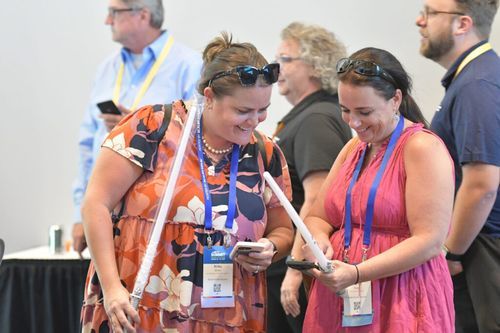
Two attendees conversing and sharing information

Several customers joined us live to share their stories about what they learned and the successes they experienced by using SAFe for large-scale transformations. We launched new products to include everyone in the organization on the journey to business agility. And attendees took home fresh insights and best practices to bring SAFe implementations to the next level.

Overall, we had:

  • Over 80 speakers
  • 34 technical talks
  • 29 countries represented
  • 10 customer stories
  • 9 product labs
  • 3 panels
  • 1 product launch with 4 new features
  • 1 motivational speaker, 1 MC, and 1 surprise musical guest

Keep reading to see what you missed or relive some of your favorite moments.

A picture of the Business Agility Takes off at Southwest Airlines keynote from the 2022 SAFe Summit in Denver

2022 SAFe Summit Customer Stories

SAFe customer stories are a cornerstone at the SAFe Summit. This year’s Summit was no different. However, this year’s customer stories clearly showed a more advanced level of SAFe application. It’s exciting to see sustained progress and results as customers mature their transformations and expand to new business areas.

Below are just a few examples of real-world use cases and results showcased at the Summit.

Southwest Airlines

At four years (and counting) into their Agile transformation, more than 2,000 Southwest employees collaborate cross-functionally across the organization. This has resulted in a 10x increase in production and a 50-percent decrease in errors.

Oracle

Members of Oracle shared how they replaced a core system in just two years using a new mindset and way of working from SAFe. In doing so, they left behind their “painful waterfall process.”

Lockheed Martin

Lockheed Martin used the hit show Ted Lasso to tell the story of how the company overcame language barriers when introducing SAFe to teams. 

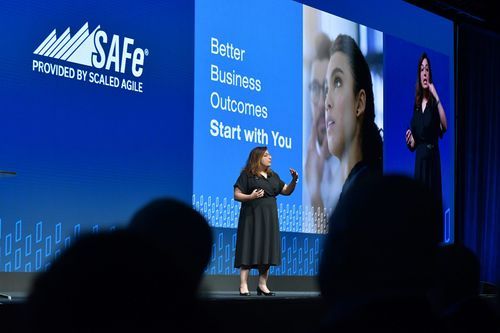
Deema Dajani speaks onstage at the 2022 Summit Product Launch

2022 Summit Launch | Business Agility Needs Everyone

Our latest product launch took flight on the first day of the 2022 SAFe Summit. We highlighted new features and resources that support everyone in the transformation. We heard from:

  • SAFe Content Advisors Bill Sizemore and Hande Kazgan on features that help people in new roles, like SAFe Jumpstart, an online series that helps people new to SAFe quickly get up to speed. SAFe Jumpstart is available to SAFe Enterprise members and Scaled Agile Partners
  • Director of Globalization Services, Yuka Kurihara, on new ways to learn and practice SAFe in your native language, including newly translated courses
  • SAFe Fellow and Product Management Director Deema Dajani on features that help you engage more of the business in your SAFe transformation, including business agility experience reports from transformation leaders who’ve successfully introduced SAFe to new functional areas
  • SAFe Fellow and Principal Consultant Andrew Sales on features that help you measure and improve business agility at your organization, including updated, simplified assessments that make it easier to assess your organization’s progress

See even more features highlighted in the Summit Launch here. Missed the first product launch earlier this year? See an overview of that launch here.

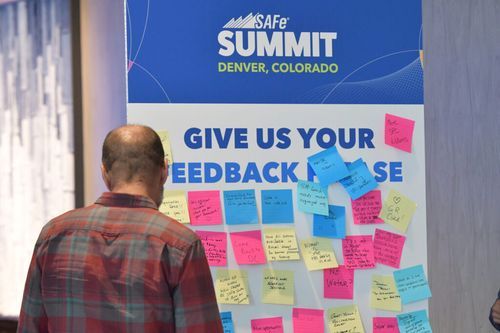
Feedback board at 2022 SAFe Summit

New Takeaways from SAFe Summit 2022

Between inspiring keynote presentations, in-depth learning sessions, and candid customer stories, there were a lot of practical takeaways for 2022 SAFe Summit attendees. To see all the recorded Summit content for yourself, head to the SAFe Community Platform. Not a member? Become one today

New content highlights

  • Our co-founder and Chief Methodologist, Dean Leffingwell, introduced the eight flow accelerators
  • Women in Agile gained some early-morning insights and inspiration from guest speaker Nadya Ichinomiya 
  • Deema Dajani shared a new perspective on Lean Portfolio Management (LPM) by showing us that people determine your LPM success
  • Bill Sizemore revealed his premonition that he’d be taking the SAFe Summit stage once he heard 2019 keynote speaker Jade Simmons

Inspiring keynote guests

Our exemplary MC, Mark Jeffries, brought the first day to a close with an engaging, honest look at the six keys to influencing people. Spoiler alert: you just have to use your B.R.A.I.N.S.

Motivational speaker Cassandra Worthy opened day two with lots of energy while she shared the steps to mastering change chemistry. As a bonus, we learned who in the audience is guilty of hitting the gas at yellow lights.

What did these sessions have in common? Both Cassandra and Mark emphasized that there are right and wrong ways to drive change and influence others. Making change stick requires real listening, empathetic understanding, and acute emotional intelligence. Done right, you can honestly seek to influence teams and leadership to better the whole organization.

What attendees said about the 2022 SAFe Summit

We’ve rounded up some reactions from this year’s Summit. Here’s what attendees had to say about the event:

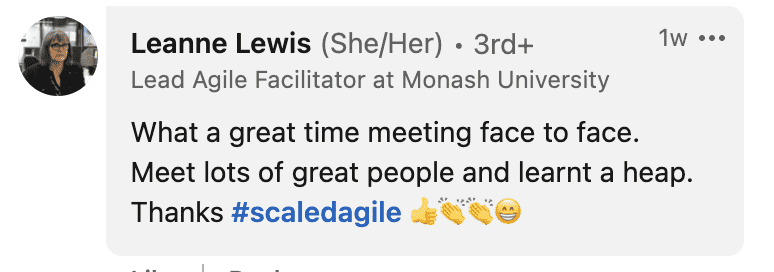
A LinkedIn post from a 2022 SAFe Summit attendee

“Great conference! This is the first conference I’ve ever attended where I learned something new in EVERY session I attended. It is clear a lot of thought and work is put into holding the conference — y’all knocked it out of the park!”

“Everyone seems genuinely happy to be here”

“My 1st but not my last! Excellent Job!”

What about the 2023 SAFe Summit?

Already looking forward to next year? Join us in Nashville on August 15 – 18, 2023. Stay tuned for more info!