AI for Business Leaders: A Practical Guide to Strategic Adoption

For business leaders, the challenge is no longer whether to adopt AI, but how to scale it across the enterprise in a way that delivers measurable business value.

While many organizations have launched AI initiatives, few have successfully moved beyond isolated pilots and experimentation or undertaken AI courses designed for executives. The obstacle is rarely the technology itself. More often, organizations lack the governance, workforce readiness, operating models, and leadership alignment needed to support enterprise-wide adoption.

Successful AI transformation is more than implementing new tools. It’s about building the organizational foundations that allow AI to scale responsibly and sustainably.

This guide explores how business leaders can approach AI adoption strategically, including key benefits, common challenges, practical use cases, and the foundations needed for successful implementation.

The Importance of AI for Business Leaders 

When integrated strategically, AI enables businesses to optimize workflows, uncover actionable insights, and scale innovation across the enterprise.

Key benefits of incorporating AI into business strategies include:

Predictive analytics and forecasting

By analyzing large volumes of historical and real-time data, organizations can identify patterns, predict trends, and improve forecasting accuracy. These insights support better planning, optimized inventory management, stronger demand forecasting, and reduced operational risk.

Process automation and efficiency

Automating repetitive administrative, financial, and operational tasks reduces manual workloads and improves overall efficiency. As a result, teams can dedicate more time to strategic, creative, and customer-focused initiatives.

Faster innovation and product development

AI supports faster experimentation, testing, and product iteration by streamlining research, prototyping, and development processes. This helps organizations bring new products and services to market quicker while improving agility and responsiveness.

Smarter data-driven decision-making

Transforming complex datasets into actionable insights allows leaders to make faster, more informed decisions. With real-time visibility into patterns, trends, and opportunities, organizations can shift from reactive decision-making to more proactive and strategic planning.

AI Tourists vs AI-Native organizations

Too many organizations remain AI Tourists, experimenting with AI tools, running pilots, and generating isolated successes. However, they struggle to embed AI into the way the business operates.

AI-Native enterprises operate differently. They build the governance, workforce capabilities, leadership alignment, and operating models needed to integrate AI into decision-making, value delivery, and long-term strategy. 

For business leaders, the goal is not simply to deploy AI. It is to create the organizational conditions that allow AI to scale across the enterprise.

Why Governance Matters in AI Adoption

Governance plays a critical role in successful AI adoption. While many organizations focus on the technology itself, long-term success depends on having the right structures, policies, and oversight in place. Without strong governance, AI initiatives can create compliance issues, increase risk, and undermine trust across the organization.

Here’s why governance should be taken seriously:

Accountability

Clear accountability ensures there is ownership for how AI systems are developed, deployed, and monitored. Defining roles and responsibilities helps organizations make informed decisions, address issues quickly, and maintain oversight as AI adoption expands.

Trust and transparency

Organizations need confidence that AI systems operate fairly, consistently, and in line with ethical and business expectations. Transparent processes make AI decisions easier to understand, explain, and challenge while helping address concerns around bias, data usage, and fairness. This builds trust among employees, customers, regulators, and other stakeholders. 

Executive oversight

AI adoption should be treated as a strategic business initiative rather than a standalone technology project. Executive oversight helps ensure AI investments align with organizational goals, deliver measurable value, and support long-term transformation efforts.

How Enterprise Leaders Are Using AI to Drive Transformation 

Research from McKinsey shows that 88% of organizations now use AI in at least one business function, while 34% are using it to significantly transform their business models. For enterprise leaders, however, the opportunity extends beyond individual use cases. Success depends on integrating AI into value streams, aligning initiatives with business objectives, and creating the organizational capabilities needed to scale adoption responsibly.

The following examples highlight how organizations are using AI to improve business performance, accelerate value delivery, and drive enterprise transformation:

AI-Powered Product Development

AI is helping organizations accelerate product development by enabling teams to make faster, more informed decisions. Product managers and product owners can use AI to analyze customer feedback, market trends, and usage data to identify emerging needs and opportunities.

These insights help teams prioritize features, refine backlogs, and focus resources on initiatives that deliver the most value. AI also supports rapid experimentation and shorter feedback loops, allowing teams to adapt quickly and deliver customer value faster.

AI Across Enterprise Operations

Organizations are using AI to optimize operational processes that span multiple teams and business functions. By analyzing large volumes of data, AI can identify inefficiencies, predict disruptions, and improve performance across enterprise value streams.

In supply chains, AI supports forecasting, inventory optimization, logistics planning, and risk management. For example, UPS uses AI to help navigate changes in global trade policies and improve shipment routing. AI also improves cross-functional coordination by providing greater visibility into operational performance and emerging risks.

AI-Augmented Decision Making

Business leaders are using AI to improve strategic decision-making across the enterprise. By processing large volumes of data, AI can uncover patterns, identify risks, and generate insights that support better planning and forecasting.

Financial institutions use AI for risk modeling, fraud detection, and scenario planning. HSBC, for example, has deployed generative AI to support servicing teams responsible for millions of client interactions each year, improving efficiency and reducing turnaround times.

AI-Enabled Workforce Productivity

AI is helping organizations augment employee capabilities by automating routine tasks and reducing administrative burdens. Teams use AI to generate documentation, summarize meetings, manage knowledge repositories, and streamline workflows.

By reducing time spent on repetitive work, AI allows employees to focus on innovation, problem-solving, and other high-value activities. It can also support workforce development by helping employees access information and learning resources more efficiently.

AI-Accelerated Innovation

AI is accelerating innovation by helping organizations make better decisions, reduce delays, and move ideas through value streams more efficiently. Rather than focusing on isolated experiments, leading enterprises use AI to strengthen collaboration, improve visibility, and accelerate the delivery of business value.

Organizations such as Philips and Volkswagen Group demonstrate how enterprise transformation depends on aligning people, processes, and technology at scale. By combining modern technologies with Lean-Agile operating models, these organizations have improved coordination across complex environments while increasing their ability to innovate and respond to changing market demands.

Beyond individual use cases, AI can help organizations create repeatable innovation capabilities that drive continuous improvement, faster value delivery, and sustainable competitive advantage.

Developing an AI Strategy: A Step-By-Step Guide

Successful AI deployment requires more than just experimenting with new tools. To generate tangible business value, you need a clear strategy that aligns AI initiatives with your business goals, priorities, and long-term transformation efforts.

While every business’s AI journey will differ, the following steps provide a practical framework leaders can use to plan, implement, and scale AI initiatives seamlessly.

Step 1: Identify business outcomes and value streams

Start by identifying the business outcomes you want AI to support and the value streams where it can deliver the greatest impact. Rather than implementing AI for its own sake, focus on strategic objectives such as:

  • Improving customer experiences
  • Increasing operational efficiency
  • Accelerating product delivery
  • Reducing business risk

Evaluate how work flows across the organization and identify opportunities where AI can help remove bottlenecks, improve decision-making, or create greater value for customers. Aligning AI initiatives with enterprise priorities from the outset helps ensure investments remain focused on measurable business outcomes.

Step 2: Assess data and organizational readiness

Successful AI adoption requires more than quality data. Organizations must also evaluate whether they have the governance structures, leadership alignment, and cross-functional collaboration needed to support AI at scale.

Assess data quality, accessibility, security, and integration across systems while also examining organizational readiness. Consider whether teams have clearly defined roles, decision-making processes, and governance frameworks to manage AI responsibly. 

Workforce readiness is often the biggest barrier to scaling AI. Leaders should assess whether employees, managers, and executives have the skills needed to work effectively with AI while maintaining governance, accountability, and responsible adoption practices. 

Addressing both technical and organizational readiness early can help reduce implementation challenges and improve long-term adoption.

Step 3: Define value-based objectives and KPIs

Establish clear objectives and measurable outcomes for every AI initiative. Success should be defined not only by technical performance but also by the value delivered to customers, employees, and the business.

Develop KPIs that align with organizational goals, such as improved forecasting accuracy, faster product delivery, reduced operational costs, increased productivity, or higher customer satisfaction. Reviewing progress through regular planning and feedback cycles helps organizations evaluate results, adapt priorities, and continuously improve AI-driven initiatives.

Step 4: Prioritize use cases through portfolio thinking

Not every AI opportunity should be pursued at the same time. Evaluate potential use cases based on business value, implementation complexity, strategic alignment, and potential risk.

A portfolio-based approach helps leaders balance short-term wins with longer-term transformational opportunities. Start with high-impact initiatives that can demonstrate measurable value quickly while creating a foundation for broader adoption. Delivering AI capabilities incrementally allows organizations to validate outcomes, learn from experience, and scale successful solutions with greater confidence.

Step 5: Build workforce readiness and AI fluency

As we know, successful AI adoption requires both technical expertise and organizational readiness. This means you may need to hire AI specialists, partner with external consultants, or invest in workforce training and certifications to close skills gaps. 

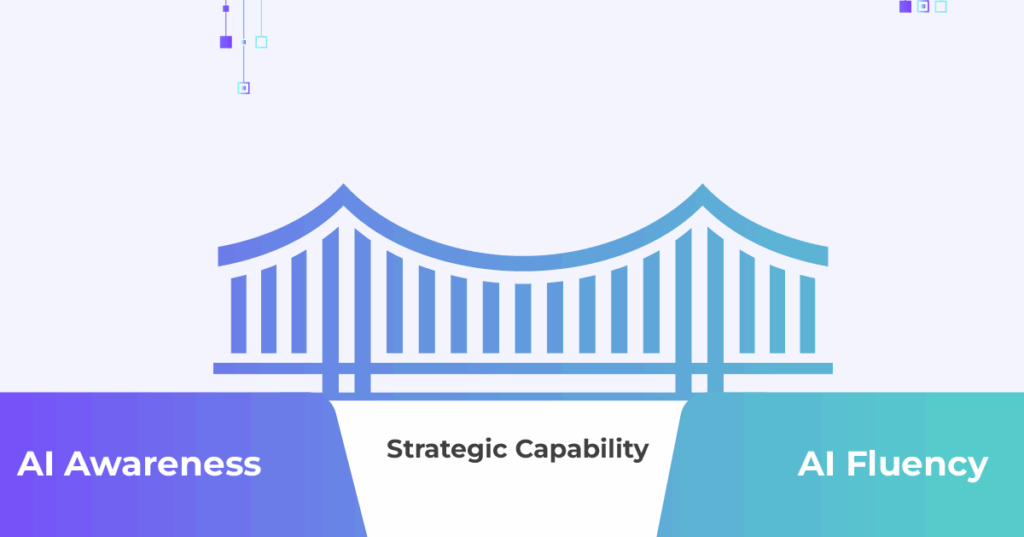
Upskilling existing employees through AI and agile-related certifications can help organizations achieve team-level AI fluency to better understand AI technologies and governance considerations. 

At Scaled Agile, we offer various courses and certificates to build the skills, executive alignment, leadership enablement, and agile manager capabilities needed to successfully integrate AI across your organization. 

Access our Enterprise AI Native Playbook and Executive Guide to AI to better understand how AI can support enterprise transformation and agile ways of working.

Explore our AI learning resources, certifications, and workshops to start building a more agile, AI-enabled enterprise.

Step 6: Implement and scale AI solutions

Once you have your priorities and resources established, you can implement AI solutions within targeted business functions. As suggested above, start with pilot programs to test performance, refine workflows, and address operational challenges before broader deployment. 

Step 7: Monitor performance and iterate

Implementing AI is not a one-off initiative. You should continuously monitor performance, measure outcomes against KPIs, and refine models, workflows, and governance practices over time. This will help you identify improvement opportunities, adapt to changing market conditions, maintain compliance, and ensure AI systems continue delivering valuable results.

Taking the Next Step: Empowering Your AI Journey

Ready to take the next step with AI in business leadership? Scaled Agile is the ideal partner to simplify and streamline your AI adoption journey. 

Organizations that successfully scale AI do not treat it as a standalone technology initiative. They combine governance, workforce readiness, leadership alignment, and Lean-Agile ways of working to create sustainable business value.

Through AI-Native learning pathways, SAFe® certifications, executive workshops, and enterprise transformation guidance, Scaled Agile helps business leaders build the capabilities needed to move from AI experimentation to enterprise-wide adoption.

Whether you’re just beginning to explore AI opportunities or looking to scale existing initiatives, Scaled Agile provides the frameworks, training, and guidance organizations need to adopt AI strategically and responsibly.

AI is reshaping how organizations operate, compete, and deliver value. The businesses that approach AI strategically today will be better positioned to unlock real returns, adapt, innovate, and scale in the future. 
Find a course

AI-Driven Enterprise: A Comprehensive Guide

Artificial intelligence is rapidly becoming part of the operating system of the modern enterprise. Organizations are moving beyond experimentation and embedding AI into products, services, workflows, and decision-making processes.

Yet despite significant investment, many enterprises struggle to scale AI beyond isolated pilots and departmental initiatives. The challenge is rarely the technology itself. More often, organizations lack the governance, workforce readiness, operating models, and leadership alignment needed to deploy AI consistently across the business.

Becoming an AI-driven enterprise needs more than implementing AI tools. It requires building the organizational foundations that allow AI to scale responsibly and deliver measurable business value.
This guide explores what defines an AI-driven enterprise, why many transformations stall, and how organizations can build the capabilities needed to move from AI experimentation to enterprise-wide adoption.

This guide explores what defines an AI-driven enterprise, why many transformations stall, and how organizations can build the capabilities needed to move from AI experimentation to enterprise-wide adoption.

What is an AI-driven enterprise?

What makes an organization “AI-driven” is that artificial intelligence supports major business operations and scalable strategy. An AI-driven enterprise goes beyond isolated experiments by integrating AI, automation, and data-driven decision-making across business operations. Rather than treating AI as a standalone technology initiative, AI becomes embedded within operating models, governance practices, and value streams across the enterprise. 

Becoming an AI-driven enterprise also requires developing an AI-native operating model where teams, technology, and governance practices evolve together.

How enterprises use AI at scale

AI-driven enterprises use artificial intelligence across business functions to improve efficiency, automate repetitive tasks, and support faster, data-driven decisions. Leading organizations integrate AI into operating models, governance frameworks, and value streams to improve how work is planned, executed, and delivered across the business.

Here’s how enterprises use AI to scale: 

Enterprise operations

Large enterprises use AI to streamline complex operations that span multiple departments, teams, and locations. AI automates the following across workflows: 

  • Routine processes
  • Identify bottlenecks
  • Optimize resource allocation
  • Improve visibility 

With reduced manual effort and improved flow efficiency, organizations can increase productivity while maintaining consistency and governance at scale. 

Decision-making

Leaders and teams can analyze larger volumes of data, identify patterns, and generate insights faster than traditional approaches. This allows organizations to make more informed decisions across:

As such, organizations can use AI to support real-time decisions and respond more quickly to changing business conditions, rather than relying solely on historical reporting. 

Risk management and governance

As organizations expand their AI usage, governance becomes increasingly important. Enterprises use AI to: 

  • Monitor compliance requirements
  • Identify security threats
  • Detect anomalies
  • Strengthen risk management processes

Also, AI provides greater visibility into operational risks, helping organizations maintain oversight as AI capabilities scale across the business. 

Cross-functional workflows

Enterprise initiatives often require coordination across multiple teams, business units, and stakeholders. This is where AI helps improve collaboration by automating information sharing, identifying dependencies, surfacing relevant insights, and supporting workflow orchestration across value streams. It enables organizations to reduce delays, improve alignment, and accelerate the delivery of business outcomes. 

Examples of organizations building the foundations for AI at scale

  • Volkswagen Group is transforming one of the world’s largest enterprise IT organizations into a product-driven technology enterprise, aligning teams across brands and regions while improving delivery and responsiveness.
  • Philips used SAFe as part of its shift into a healthcare technology leader, helping align complex software and informatics initiatives with strategic business goals.
  • Centers for Medicare & Medicaid Services (CMS) achieved a 55% reduction in help desk tickets, reduced maintenance costs, and improved employee satisfaction through its Lean-Agile transformation.
  • Pôle Emploi, France’s national employment agency, improved service delivery and stakeholder satisfaction by adopting Lean-Agile ways of working at scale.

While these organizations are at different stages of their AI journeys, they share a common characteristic: strong organizational foundations. Their investments in Lean-Agile ways of working, governance, and alignment create the conditions required to scale emerging technologies such as AI across the enterprise. 

Why so many AI initiatives fail to scale 

While AI adoption continues to accelerate, many organizations remain stuck in what is often called the pilot trap. Individual teams may achieve promising results, but those successes rarely translate into enterprise-wide transformation.

The challenge is not a lack of AI technology. It is a lack of organizational readiness.

Enterprises often struggle with:

  • Fragmented governance and inconsistent policies
  • Siloed teams and disconnected workflows
  • Limited workforce readiness and AI fluency
  • Difficulty aligning AI initiatives with business strategy
  • Legacy operating models that prevent scaling

Without addressing these foundational challenges, AI investments frequently remain isolated experiments rather than sustainable business capabilities.

AI Tourists vs AI-Native enterprises

To add to the previous point, many organizations are still AI Tourists. They experiment with AI tools, launch pilots, and generate isolated successes, but struggle to embed AI into how the business actually operates.

AI-Native enterprises take a different approach. They integrate AI into operating models, governance structures, workforce development, and strategic planning. AI becomes part of how value is delivered across the organization rather than a collection of disconnected experiments.

The difference is not access to technology. It is the organizational capability to scale and sustain AI adoption over time.

Why agile maturity matters for AI success

Businesses relying on manual processes and static dashboards often lack the speed and agility needed in modern markets. AI can fundamentally transform how enterprises scale, adapt, and create value.

The problem is that organizations often view AI adoption as a technology challenge. In reality, it is an organizational challenge.

Successfully scaling AI requires many of the same capabilities needed for enterprise agility:

  • Cross-functional collaboration
  • Governance and accountability
  • Strategic alignment
  • Continuous learning
  • Efficient value delivery

This is why agile maturity and AI readiness are closely connected. Organizations that have already established Lean-Agile operating models are often better positioned to scale AI initiatives across value streams while maintaining governance and oversight.

Rather than treating AI as a standalone initiative, leading enterprises integrate it into the way teams plan, deliver, and continuously improve business outcomes.

Benefits of becoming an AI-driven enterprise  

For many organizations, AI is no longer just a competitive advantage. Here’s why it’s so beneficial: 

Faster value delivery

AI helps organizations accelerate decision-making, automate routine tasks, and reduce delays across workflows. This enables teams to deliver products, services, and business outcomes more efficiently while responding faster to changing priorities and market demands.

Reduced costs and resource optimization

One of the primary reasons companies adopt AI is to optimize supply chains, energy consumption, inventory management, and overall operational efficiency. By reducing waste, minimizing human error, and automating repetitive tasks, organizations can have lower costs while improving efficiency and resource utilization.

Improved strategic alignment

AI provides leaders with deeper insights into performance, risks, and opportunities across the enterprise. With better visibility, organizations can align investments, priorities, and resources more effectively with strategic objectives and business goals.

Greater organizational agility

By improving access to information and supporting faster decision-making, organizations can respond to changes in customer needs, market conditions, and operational challenges with greater speed and confidence.

Enhanced workforce productivity

Employees can spend less time on repetitive, administrative work and more time on high-value activities. From streamlining research to supporting planning and analysis, AI helps teams work more efficiently while improving overall productivity.

Improved scalability

AI allows businesses to scale more efficiently without requiring the same level of operational expansion or manual effort. By automating workflows, accelerating product development, and transforming customer insights into actionable opportunities, AI helps organizations unlock new revenue streams and support sustainable growth at scale.

Stronger governance and risk management 

Successfully scaling AI requires strong governance, accountability, and oversight. AI can help organizations monitor compliance requirements, identify anomalies, detect risks, and provide greater visibility into business operations as AI adoption expands across the enterprise.

Combined with clear governance frameworks, AI enables organizations to balance innovation with risk management while maintaining transparency, regulatory compliance, security, and trust.

Enhanced innovation

Organizations can innovate more efficiently because AI supports product development, service improvement, and new business model creation while increasing agility in changing markets.

Rather than relying solely on time-intensive manual experimentation, AI can analyze large datasets and run thousands of simulations simultaneously, helping teams evaluate ideas, test hypotheses, and accelerate decision-making in a fraction of the time. 

The risks behind fully automated enterprises 

Although AI delivers substantial benefits, businesses cannot afford to overlook the associated risks that come with implementing it. Without proper governance, security, and oversight, AI adoption can create compliance challenges, cybersecurity risks, inaccurate decision-making, and reputational harm.

Organizations need governance frameworks that address transparency, accountability, compliance, and ethical AI usage. Establishing a responsible AI strategy helps reduce risk while enabling organizations to scale AI confidently. 

Technical and security risks

Implementing AI systems can introduce cybersecurity and operational risks if not properly managed. Shadow AI, data poisoning, and prompt injection are all examples of threats that can expose sensitive information or compromise system integrity. 

Operational and reputational risks

Poorly governed AI systems can generate misleading, inaccurate, or biased outputs, disrupting workflows and even damaging brand reputation. Also, an overreliance on automation without any oversight may reduce organizational resilience and critical expertise over time.

Adopting AI can introduce legal and regulatory challenges related to data privacy, intellectual property, and automated decision-making. Because AI systems rely on large-scale data processing and autonomous analysis, they can conflict with traditional legal frameworks designed around human oversight and accountability.

Organizations must ensure AI systems remain transparent, compliant, and auditable to reduce regulatory and litigation risks.

Cultural and strategic risks 

Successful AI deployment depends on strong organizational alignment, effective change management, and clear business objectives. Without employee buy-in or a practical implementation strategy, AI investments can fail to deliver meaningful ROI and may hinder long-term transformation efforts.

How enterprise scale fits into AI strategy and transformation

Enterprise scale refers to an organization’s ability to deploy and manage software, data systems, and operations across the business at high volume without compromising performance, security, or reliability.

In AI transformation, enterprise scale represents the point where AI moves beyond isolated pilot programs and becomes fully integrated into core business operations. Achieving this requires scalable infrastructure, strong security and governance frameworks, and organizational alignment across teams and workflows.

Many organizations struggle with what is often called the “pilot trap”: where experimental AI initiatives deliver localized improvements but fail to scale into enterprise-wide production systems capable of generating meaningful ROI. Overcoming the pilot trap requires alignment between strategy, execution, governance, and organizational learning, areas that many enterprises struggle to coordinate effectively.

At a small scale, AI may help employees complete tasks more efficiently, such as drafting emails or summarizing reports. At the enterprise level, however, AI can orchestrate entire business processes autonomously. Agentic AI systems can coordinate workflows such as:

  • Routing inventory shifts
  • Processing invoices
  • Updating logistics databases
  • Alerting vendors automatically

Rather than simply accelerating individual tasks, enterprise-scale AI enables businesses to automate and optimize end-to-end operational workflows.

How to transform your business into a scalable enterprise using agentic AI 

Transforming a business into an AI-driven enterprise is more than a software upgrade; it’s a strategic operational shift. Organizations must modernize their data infrastructure, workflows, and decision-making processes so they can move from reactive, manual operations to intelligent, real-time automation.

The challenge is scaling AI effectively across the enterprise without becoming stuck in isolated pilot projects. A structured, phased approach can help organizations build a strong foundation while delivering measurable business value over time.

Phase 1: Establish an AI-ready foundation

Rather than implementing technology, start by creating the organizational and data foundations needed to support AI at scale. This includes:

  • Aligning AI initiatives with business value streams
  • Strengthening data governance
  • Establishing clear policies for security, compliance, and responsible AI use
  • Improving data quality

By establishing a trusted foundation, enterprises can ensure AI systems operate on accurate data and support strategic business outcomes from the start. 

Phase 2: Build AI into enterprise operating models and value streams

AI transformation requires organizations to embed AI capabilities into the way work flows across the enterprise. This includes aligning teams around value streams, improving collaboration across functions, establishing governance practices, and creating consistent approaches to planning and execution.

Frameworks such as SAFe® help enterprises coordinate work across multiple teams while maintaining strategic alignment and operational visibility.

Phase 3: Scale AI across value streams 

Once the foundational capabilities are in place, organizations can expand AI from isolated use cases to wider operational workflows. Agentic AI can automate complex tasks, improve productivity, and accelerate decision-making across multiple value streams. At this phase, it’s wise to prioritize high-impact opportunities, continuously measure outcomes, and apply iterative learning to refine AI performance while maintaining human oversight where needed.

Phase 4: Enable AI-Native enterprise

Sustainable transformation depends on developing the people, governance, and culture needed to support long-term AI adoption. Organizations should invest in AI literacy, change management, and leadership enablement while establishing governance frameworks that balance innovation and accountability. 

To help organizations develop these capabilities, Scaled Agile offers AI-Native learning pathways that support leaders, agile teams, and change agents throughout the transformation journey. 

Programs such as AI-Native Foundations help teams develop core AI knowledge, AI-Native Leading equips leaders to guide AI transformation initiatives, and AI-Native Change Agent supports practitioners responsible for driving adoption and organizational change. 

Building AI skills across the enterprise

Technology alone cannot create an AI-driven enterprise. Organizations also need leaders, agile practitioners, product professionals, and change agents who understand how to integrate AI into business processes and decision-making. 

Different roles contribute to AI transformation in different ways: 

  • Scrum Masters use AI tools to improve team effectiveness and workflow optimization. 
  • Product development teams integrate AI capabilities into products and services while maintaining governance and quality standards.
  • Product managers use AI to enhance customer insights, product discovery, and prioritization. 
  • Product owners leverage AI to accelerate backlog management and value delivery. 

Enterprises that invest in AI literacy across these roles are often better positioned to scale AI initiatives successfully. Plus, Scaled Agile’s AI-Native learning pathways support workforce readiness at every level:

For organizations already using SAFe, many role-based certifications now incorporate AI-related skills and guidance, helping Agile practitioners understand how AI influences planning, delivery, and value creation.  

Knowing the defining trends reshaping corporate landscapes is a must if you want to start scaling with AI. 

Multi-agent ecosystems are dominating

Most enterprises are abandoning the idea of deploying a single, massive AI model to handle everything. They are instead deploying networks of narrow, coordinated AI agents with specialized roles. Multiple AI agents outperform a single, massive AI model in business because they divide complex workflows into specialized, parallel tasks.

Small, purpose-built models are preferred 

Enterprises are aggressively pivoting toward smaller, domain-specific models in place of massive foundational models. This shift is likely due to lower costs, as compact models require a fraction of the processing power. Plus, these models are heavily fine-tuned for precise sectors like clinical healthcare, corporate tax auditing, or complex manufacturing.

Rise of AI-Native operating architectures

Organizations are moving away from fragmented legacy systems and adopting unified AI-Native platforms that integrate data, workflows, automation, and monitoring into a single ecosystem. Open interoperability standards like the Model Context Protocol (MCP) also allow AI systems to connect and operate seamlessly across different enterprise platforms without requiring complex custom integrations.

Accelerating AI transformation with Scaled Agile 

For enterprise leaders, the challenge is no longer whether to adopt AI, but how to scale it responsibly across the organization. Achieving that requires more than technology investments alone. It requires the governance, workforce readiness, operating models, and leadership alignment needed to scale AI across the organization. 

Enterprises that successfully make this transition move beyond isolated pilots and embed AI into how they plan, deliver, and create value. They evolve from AI Tourists into AI-Native organizations capable of generating sustainable business outcomes. 

Through SAFe®, AI-Native certifications, workshops, and enterprise transformation guidance, Scaled Agile helps organizations build the capabilities required to integrate AI into business operations at scale.

Ready to build a more intelligent, agile, and scalable enterprise? Explore our Enterprise AI Adoption Playbook, discover how organizations are unlocking measurable AI returns, or build your AI capabilities through our AI-Native certifications and workshops.


Evaluating Whether AI Transformation Is A Problem of Governance

As organizations accelerate AI adoption, many are implementing it faster than they establish the governance structures needed to support the transformation. Without clear ownership, accountability, AI risk management, and decision-making frameworks, AI initiatives can create security risks, compliance concerns, and operational complexity.

These challenges have led many leaders to view AI transformation primarily as a governance problem. However, it’s often only part of the equation. In many cases, governance gaps emerge from deeper organizational issues, including fragmented operating models, disconnected teams, and a lack of alignment between business strategy and execution.

Understanding why AI transformation struggles at scale requires looking beyond governance alone. This article explores the governance challenges organizations face, why AI adoption frequently stalls without effective oversight, and how organizational structure ultimately determines whether AI initiatives scale successfully.

Why Governance Challenges Emerge During AI Transformation

Many enterprises struggle to move AI initiatives beyond the pilot stage (otherwise known as AI Tourism), not because the technology falls short, but because scaling AI requires new ways of working. As adoption expands across teams and business units, organizations must coordinate decision-making, align priorities, clarify ownership, and establish accountability at scale.

Without these foundations, governance becomes increasingly difficult to maintain. Policies and oversight mechanisms can help manage risk, but they cannot compensate for fragmented operating models, siloed teams, or unclear responsibilities. 

Here’s why AI adoption is often seen as the cause of governance issues: 

Organizational misalignment 

AI initiatives often span multiple business functions, including product management, engineering, data science, security, legal, and compliance. Without clear alignment among these stakeholders, decision-making becomes shattered, and accountability becomes difficult to establish. 

Unclear accountability              

Organizations need strict and clear AI governance frameworks to define:

  • Who owns the business outcome?
  • Who stops deployment if a model drifts or behaves unpredictably?
  • Who approves data privacy limits?

However, AI tends to blur traditional ownership lines between business units, IT, and legal teams, leading to unclear accountability. Clear accountability ensures that teams understand who owns business outcomes, risk management, compliance decisions, and model performance throughout the AI lifecycle.

Regulatory exposure

As use cases become more widespread, we’re starting to see strict global frameworks emerge, such as the EU AI Act. And as artificial intelligence regulations and ethical concerns evolve, enterprises need governance mechanisms that provide transparency and traceability without slowing innovation. Effective governance allows teams to move quickly while maintaining compliance and managing risk.

Increase in shadow AI

Enterprises that lack unified, sanctioned AI systems often lead employees to feed sensitive corporate data and customer records into public, unverified models. This is what creates shadow AI: the use of unauthorized, unmonitored, or unvetted AI tools within an organization. These blind spots bypass IT, security, and legal oversight, directly leading to severe data leaks and regulatory compliance violations (like GDPR or HIPAA). 

Organizations should address shadow AI by establishing enterprise guardrails, shared policies, and approved platforms while empowering teams to innovate within clearly defined boundaries.

Bias and hallucination risks

When left unchecked, AI can sometimes perpetuate unintentional bias or incorrect outputs. It harms governance by distorting decision-making, breaching legal and regulatory requirements, and deeply eroding the foundational trust required for democratic and organizational leadership. 

Governance is restored if human oversight, model explainability, and validation processes are deeply integrated into daily workflows. 

The Organizational Challenges Behind AI Governance Failures

After clarifying that artificial intelligence itself isn’t the root cause of governance bottlenecks, but rather organizational challenges, it’s time to look at these in detail. 

Functional silos and fragmented decision-making

AI governance fails when distinct departments operate in isolation. For example, executive leadership chases rapid ROI, the tech team builds infrastructure, and the legal department interprets data privacy and compliance regulations. This misalignment is what causes operational teams to straddle between innovation speed and strict compliance guardrails. 

Unclear ownership and accountability

Even after publishing ethical AI guidelines across departments, many organizations fail to designate explicit owners for them. So, when facing issues like an automated procurement agent executing excessive inventory orders, no one knows who is actually responsible for stopping the agent or fixing the issue. 

Legacy operating models

Unfortunately, many organizations still attempt to scale AI using structures and governance models designed for traditional projects and static software systems.

Additionally, AI initiatives often require cross-functional collaboration, faster decision-making, and continuous adaptation. So, when operating models fail to keep up with AI adoption, governance processes become fragmented and difficult to enforce consistently.

Managing AI throughout its lifecycle

Many organizations lack clear processes and ownership structures for monitoring, validating, and governing AI after deployment. Without continuous oversight, governance frameworks that appeared effective at launch can quickly become outdated as models drift from their original performance and risk profiles.

Data readiness and culture

Models trained on uncurated, siloed, or disorganized datasets commonly fail or return inaccurate results. Plus, a corporate culture that ignores change management, such as employees not understanding the risk of uploading sensitive company data into public systems, means even stringent governance policies can be bypassed. 

Governance Is Necessary, Not Sufficient

Governance alone cannot deliver a successful AI transformation. Organizations also need the operational readiness, cultural adaptability, and agile maturity required to scale AI across teams, products, and business functions.

Successful AI adoption requires:

Agile ways of working

AI development is inherently iterative and experimental. Unlike traditional software projects, AI initiatives often require continuous testing, learning, and adaptation as models evolve and business needs change. Organizations must enable cross-functional collaboration between product, engineering, data science, security, and compliance teams to ensure AI solutions can move from experimentation to enterprise-scale delivery.

Agile ways of working help organizations respond to changing conditions, incorporate feedback quickly, and balance innovation with governance through continuous learning and improvement.

Data readiness and quality

AI strategies struggle to scale when organizations lack the data foundations, governance practices, and operational processes needed to make data accessible, reliable, and usable across the enterprise.

Poor data quality also creates governance challenges. When organizations cannot verify the accuracy, lineage, or ownership of their data, it becomes difficult to establish accountability, maintain compliance, and trust AI-generated outcomes. 

Too much enterprise data lives in legacy infrastructure and unstructured formats like PDFs, call recordings, emails, and Slack channels. As such, organizations often struggle to scale AI initiatives because they lack the tooling, integration capabilities, and data pipelines needed to transform disconnected information into formats that AI systems can effectively use.

In short, impactful data readiness requires coordination across business, technology, security, and governance functions, making it as much an organizational challenge as a technical one.

AI-ready operating models 

An AI-ready operating model bridges the gap between technical AI capabilities and measurable business value. Without the structures needed to coordinate teams, govern risk, and align AI initiatives with strategic objectives, organizations often become trapped in “pilot purgatory,” where promising AI use cases fail to scale beyond isolated experiments.

These models align people, processes, technology, and governance around value delivery. They enable cross-functional collaboration, establish clear accountability, and provide the flexibility needed to manage the speed, complexity, and continuous evolution of AI systems at the enterprise level

Leadership alignment

Leadership alignment is a prerequisite for effectively scaling AI across the enterprise. Without a shared vision, AI initiatives often stall due to competing priorities, divided investment decisions, inconsistent governance, and differing levels of risk tolerance.

This shows just how AI adoption is a fundamental change-management challenge rather than a simple IT upgrade. Therefore, leaders must align on all the things mentioned above. 

Continuous learning and change management

Continuous learning and change management are foundational capabilities for effective AI transformation. While leadership alignment and governance establish the direction, organizations cannot scale AI if employees lack the skills, confidence, or support needed to adopt new ways of working.

AI also introduces a unique challenge: the technology continues to mature long after deployment. Models change, regulations emerge, and new use cases reshape workflows. As a result, change management can no longer be treated as a one-time training initiative. Instead, it must become an ongoing organizational capability that builds AI fluency, supports workforce readiness, and helps teams adapt as their business needs progress.

Organizations that invest in continuous learning are better positioned to move beyond isolated AI pilots and embed AI into how the business operates, creating the foundation for long-term, enterprise-wide adoption.

Lean decision-making

Lean decision-making helps organizations avoid the pilot trap that prevents many AI initiatives from delivering enterprise-wide value. Because AI technologies develop quickly and outcomes are often uncertain, organizations need a disciplined approach to evaluating investments, prioritizing opportunities, and scaling successful initiatives.

Rather than committing large budgets upfront, Lean decision-making encourages enterprises to fund work incrementally, measure outcomes continuously, and adjust direction based on evidence. This approach helps leaders align AI investments with strategic objectives while reducing the risk of wasted spending, unnecessary complications, and technical debt.

AI Tourist vs. AI Native: The Evolution of Governance 

Now we get to the main reason why many organizations get stuck in the AI Tourist stage. They treat governance as a gatekeeper focused on approvals, risk reviews, and compliance checkpoints. While these controls are important, governance that prioritizes oversight at the expense of agility can slow experimentation and create bottlenecks. 

To move from AI Tourist to AI-Native, governance must evolve from controlling AI adoption to enabling AI at scale. This becomes increasingly important as organizations deploy AI agents that can automate workflows and execute tasks autonomously. Without clear governance, these systems can introduce operational and compliance risks. With the right guardrails in place, however, AI agents can help scale productivity and innovation across the enterprise.

So, rather than acting as a barrier, modern AI governance provides the guidelines, decision-making frameworks, and accountability needed for teams to innovate confidently and responsibly.

Since governance alone does not make an organization AI-Native, it should create the conditions that allow AI-Native behaviors, practices, and operating models to emerge and scale enterprise-wide. As governance shifts from a control mechanism to an enabler of innovation, it becomes more than a risk-management function. 

In AI-Native organizations, governance can serve as a strategic capability that accelerates transformation and creates competitive advantage.

Governance as a competitive advantage in the AI-Native enterprise

Effective governance in AI-Native enterprises allows: 

  • Better investment decisions by aligning AI initiatives with strategic priorities and measurable business outcomes.
  • Reduced risk through consistent standards for security, compliance, ethics, and model oversight.
  • Greater organizational trust by establishing transparency, accountability, and confidence in AI-driven decisions.
  • Sustainable AI adoption through governance practices that balance innovation with long-term operational resilience.
  • Faster outcomes by empowering teams to act within clear guardrails rather than waiting for centralized approvals.

AI Transformation Is Ultimately an Organizational Challenge, Not a Problem of Governance 

Governance establishes the guidelines for responsible AI adoption. These frameworks define rules, decision rights, guardrails, and accountability. They answer questions such as:

  • Who approves AI investments?
  • What data can be used?
  • How do we manage risk?
  • What standards must teams follow?

As we’ve mentioned earlier, governance alone cannot transform an organization. It won’t determine whether leaders change how they make decisions, whether employees adopt AI, or how teams redesign their workflows. Those are organizational challenges.

This shows us that governance is the starting point, but enterprises only realize AI’s full value when it’s combined with Agile ways of working, workforce readiness, and leadership alignment. 

Confusing governance for organizational transformation often leads to excessive oversight, slow decision-making, and pilot purgatory where AI initiatives are controlled but never scaled.

Where Scaled Agile Fits in the Governance Gap 

Successfully becoming an AI-Native enterprise becomes easier with the right training and technology. Scaled Agile’s AI-Native SAFe and AI-Native-based solutions help enterprises build the right operating model, leadership capabilities, workforce skills, and decision-making frameworks to scale AI responsibly and effectively.

Here’s how Scaled Agile helps organizations scale AI adoption while strengthening governance and organizational readiness:

  • AI-Native SAFe® provides the operating model, governance structures, and Lean practices needed to scale AI transformation across the enterprise.
  • AI-Native builds AI fluency among practitioners, leaders, and executives, helping organizations develop the capabilities required for long-term adoption.
  • SAFe CoPilot helps organizations assess their AI and Lean-Agile transformation maturity, identify gaps, and prioritize improvement opportunities.
  • AI-Native training and certifications equip teams with the skills needed to work effectively in AI-enabled environments.
  • Lean Portfolio Management helps organizations balance innovation, investment, governance, and risk while aligning AI initiatives to business outcomes.

Whether you’re establishing AI governance, scaling successful pilots, or building an AI-Native enterprise, Scaled Agile provides the frameworks, training, and support needed to turn AI ambition into measurable business outcomes.

Contact us to learn more about our AI-Native and governance solutions.


Unlock Growth & Efficiency in Agile Enterprises by Using AI for Business

Artificial Intelligence in business is rapidly changing how enterprises plan, deliver, and optimize value. For businesses operating within Agile and SAFe® environments, AI technologies are more than just a trend; they are a strategic capability that can accelerate delivery, improve decision-making, and enhance customer outcomes.

The key point is not that AI tools will replace people or automate everything. Rather, AI empowers Agile teams to focus on innovation while automating repetitive tasks and gaining deeper insights from large amounts of data.

How AI Improves Efficiency in SAFe Enterprises

SAFe enterprises operate across multiple layers, from strategic portfolios to individual development teams. Using AI for your business creates efficiency gains at every level by reducing manual effort, surfacing patterns in data, and supporting more informed business decisions throughout the delivery lifecycle. 

Better Planning and Forecasting

AI analyzes historical project data, team velocity, delivery patterns, and risk signals to help leaders make more informed planning decisions. By using AI for business analytics to examine historical performance across value streams, teams can identify bottlenecks before work begins. This improves forecast accuracy and reduces planning rework.

Faster Software Development 

Developers use AI-powered tools to analyze market trends, generate new design concepts, predict material performance, and optimize supply chains. This reduces time spent on repetitive tasks such as data entry or initial drafting, allowing developers to focus on higher-value problem-solving and work that drives real product impact.

Improved Knowledge Sharing 

Large organizations often struggle with information silos. AI-powered assistants help employees find documentation, access policies, and locate expertise more efficiently. These AI solutions reduce friction and improve collaboration across teams, especially when dealing with vast amounts of data spread across systems.

Enhanced Decision-Making 

Executives and Product Managers regularly deal with high volumes of complex data. AI can help synthesize customer feedback, product performance metrics, market trends, and operational data into clear, actionable insights. As a result, faster and more evidence-based business decisions are made at every level of the organization.

How Artificial Intelligence Supports Growth 

It is no secret that in a large enterprise, growth creates value. By freeing teams from repetitive work and improving how organizations interpret data, AI in business creates the conditions for sustained, scalable growth.

Launch Products Faster 

Shorter development cycles mean faster time-to-market and earlier customer feedback loops.

AI can help accelerate activities such as research, documentation, testing, and analysis, reducing the time teams spend on manual work. This allows organizations to validate ideas sooner, gather customer feedback earlier, and adapt products more quickly as needs evolve.

Improve Customer Experience 

AI insights help organizations better understand customer needs and tailor products accordingly by analyzing data and behavioural patterns.

By examining feedback, support interactions, usage patterns, and other relevant data, organizations can identify trends that may otherwise go unnoticed. These insights help teams make more informed product decisions and deliver experiences that better align with customer expectations. 

Increase Innovation 

Teams spend less time on repetitive tasks and more time solving meaningful problems, supported by AI platforms and AI tools that assist ideation and testing.

When repetitive and administrative tasks are reduced, teams have more capacity to experiment, explore new ideas, and focus on solving higher-value problems. This creates more opportunities for innovation across the organization. 

Scale Operations 

AI in business operations helps streamline workflows and improve efficiency across teams, allowing enterprises to handle increasing workloads without increasing headcount at the same rate.

Meanwhile, the technology also provides greater visibility into operational performance by highlighting trends, forecasting demand, and identifying areas for improvement. This helps enterprises scale more effectively as operations become increasingly complex.  

The Impact of AI Across Agile Enterprises 

Now that we have considered a more generalized view of the positive impacts of using AI for business operations, let’s take a closer look at how this technology is transforming roles in organizations practicing SAFe. 

C-Suite Leaders

AI provides executives with faster access to business insights, enabling more informed strategic decisions. By analyzing operational performance, customer behavior, market trends, and portfolio data, AI helps business leaders identify opportunities, anticipate risks, and allocate investments more effectively. 

This ongoing analysis allows organizations to respond more quickly to changing market conditions while improving efficiency and business outcomes. 

Scrum Masters 

AI empowers Scrum Masters by reducing administrative overhead and providing deeper insights into team performance and delivery patterns. This includes anything from analyzing sprint metrics and identifying recurring bottlenecks to summarizing retrospective feedback and tracking action items. 

By highlighting potential risks, dependencies, and workflow inefficiencies early, AI enables proactive problem-solving and continuous improvement. It can also assist with meeting preparation, documentation, and knowledge sharing, helping teams stay aligned and focused on delivering value. 

Product Managers

Leveraging AI as a Product Manager means using its capabilities to anticipate outcomes and inform strategic decision-making. AI can analyze customer feedback, market trends, product performance metrics, and historical delivery data to uncover patterns that may otherwise go unnoticed. 

As AI becomes increasingly embedded in product strategy and delivery, many professionals are also pursuing AI certifications for Product Managers to build the skills needed to apply these technologies effectively.

These capabilities enable PMs to prioritize investments more effectively, identify emerging opportunities, and align product roadmaps with business objectives. By reducing the time spent gathering and interpreting information, AI allows Product Managers to focus on delivering maximum value to customers and stakeholders. 

Product Owners 

For Product Owners, AI can streamline backlog management, improve prioritization, and support the creation of well-defined user stories and acceptance criteria. By analyzing team capacity, delivery trends, and customer needs, AI can help Product Owners make data-driven decisions about what to do next. 

AI-powered tools can also assist with refining requirements, identifying dependencies, and highlighting potential risks early in the development lifecycle. This allows POs to spend less time on administrative tasks and more time collaborating with teams and stakeholders to maximize value delivery. 

Release Train Engineers

AI enhances visibility across Agile Release Trains (ART) by identifying dependencies, highlighting delivery risks, and improving forecasting accuracy. It can automate reporting, support PI Planning activities, and provide insights into flow and capacity, helping Release Train Engineers improve coordination and predictability across multiple teams.

HR and L&D Leaders 

AI supports workforce development by identifying skills gaps, recommending personalized learning pathways, and helping create training content at scale. It can also provide valuable insights into workforce capabilities, enabling organizations to develop the skills needed to support strategic objectives and future growth. 

Enterprise Architects 

AI helps Enterprise Architects manage complexity by analyzing technology landscapes, identifying technical debt, mapping dependencies, and supporting governance activities. By providing greater visibility into systems and architecture, AI enables architects to make more informed decisions that align technology investments with business strategy. 

Why Governance Matters in SAFe AI Implementation 

In enterprise environments, unregulated AI use can introduce risks such as inconsistent outputs, embedded bias, compliance exposure, and reputational harm. 

Effective AI governance is about enabling it safely and at scale. To achieve this, organizations typically extend existing SAFe governance structures across several key areas.

Responsible and Compliant Use of AI

Organizations need clear, role-based guidance on how to use AI tools across different contexts. This includes defining acceptable use cases, ensuring compliance with regulatory requirements, and maintaining alignment with internal policies. As AI becomes embedded in daily workflows, consistency in its usage becomes critical.

Data Protection and Security

AI systems depend heavily on data, making privacy and security essential. Governance must ensure that sensitive information is handled appropriately, AI tools meet security standards, and data usage complies with relevant legal and organizational requirements.

Accountability and Decision Transparency

As AI begins to support or influence decision-making, it is important to define who is accountable for its outcomes. Clear ownership ensures that AI-assisted decisions remain transparent, explainable, and aligned with business intent.

Quality, Accuracy, and Risk Management

AI-generated outputs should be subject to appropriate levels of validation, particularly in high-impact areas. Establishing mechanisms to review accuracy, identify errors, and manage risk helps maintain trust in AI-driven processes.

Continuous Oversight and Capability Development

Because AI capabilities evolve rapidly, governance cannot be static. Organizations need ongoing review cycles to adapt policies, refine controls, and ensure alignment with emerging best practices. Equally important is equipping teams with the training they need to understand both the capabilities and limitations of AI systems.

Embedding governance into AI adoption from the outset creates the conditions for sustainable scaling. Rather than slowing delivery, strong governance enables faster and more confident adoption by reducing uncertainty, protecting stakeholder trust, and ensuring AI is used consistently and responsibly across the enterprise. 

A Step-by-Step Guide to Implementing AI in Your Business  

A successful AI implementation should be intentional, incremental, and aligned with your organization’s strategic goals. These seven steps provide a practical pathway for Agile organizations looking to embed AI capabilities across their enterprise.

Step 1: Identify Your Business Needs 

Define which problems AI should address first. Start by focusing on areas where AI can reduce friction, improve workflows, or make better use of customer data and operational insights.

Step 2: Choose the Right AI Tools 

Evaluate AI tools against your specific workflows, integration requirements, data security policies, and the skills your teams already have. 

Step 3: Develop the Necessary Skills

Train teams to use AI tools effectively so they understand how to apply them confidently in daily work, accelerating value delivery.

However, becoming AI-Native goes beyond simply learning new tools; it emphasizes the value of embedding AI as a core organizational capability that shapes how people work, make decisions, and create value. 

Scaled Agile’s AI-Native training helps leaders, practitioners, and teams build the skills, mindset, and practices needed to make AI a foundational capability that drives lasting business outcomes. 

Step 4: Implement Data Management 

Establish data quality, access, and governance standards. AI is only as effective as the data it is trained on and the guardrails around it. 

Step 5: Pilot Your Projects 

Start small and test AI solutions in controlled environments before scaling. Beginning with a focused pilot reduces risk, builds confidence, and generates real evidence to guide broader rollout.

Step 6: Redesign Existing Operations 

Instead of just automating, rethink business processes around AI capabilities. Identify where workflows can be meaningfully restructured around the possibilities provided by artificial intelligence. 

Step 7: Partner with AI Specialists

Work with experts in artificial intelligence and Agile transformation to reduce risk and accelerate time to value. 

How Scaled Agile Can Support Your Team with AI Implementation 

Scaled Agile offers a range of resources designed to help organizations adopt AI in business effectively and build AI-Native capabilities to complement broader transformation efforts. We provide strategic guidance and role-specific training, as well as implementation playbooks and hands-on coaching. 

Build Your AI Credentials 

We offer dedicated AI training pathways designed for all professionals across business, product, delivery, and operations. 

Practical Guides and Playbooks 

We also provide hands-on resources to help teams and leaders build a coherent AI strategy, make the business case, and start generating real returns. 

Organizations that combine AI adoption with strong governance, continuous learning, and proven Agile practices are better positioned to realize sustainable business value. Whether you’re exploring AI for the first time or scaling adoption across the enterprise, Scaled Agile provides the training, guidance, and practical resources to help you succeed.

Take a look at our AI-Native training, certifications, and enterprise adoption resources.

Frequently Asked Questions 

Will AI replace Agile job roles? 

AI is unlikely to replace Agile roles, but it will change how some work is performed. Tasks such as documentation, reporting, and information analysis can be automated or accelerated, while responsibilities like strategy, stakeholder alignment, and customer understanding remain fundamentally human.

How do Agile enterprises get started with AI?

Start with specific, low-risk use cases where AI can reduce manual effort or improve efficiency. Common examples include summarising customer feedback, drafting user stories, generating release notes, or supporting knowledge discovery. Successful adoption is typically incremental rather than enterprise-wide from day one.

What skills do Agile practitioners need to use AI effectively? 

Agile practitioners benefit from understanding AI capabilities, prompt engineering basics, and how to evaluate AI-generated outputs critically. They should also be familiar with the governance, security, and ethical considerations relevant to their organization.

How does AI fit within existing SAFe governance structures? 

SAFe governance provides a strong foundation for AI oversight. Organizations can extend existing governance practices to address AI-specific considerations such as acceptable use policies, output validation, accountability, human oversight, and model transparency.

Are there risks involved in AI adoption?

Some risks may emerge, such as inaccurate outputs, inconsistent usage, data privacy concerns, and overreliance on AI-generated recommendations. However, clear governance, appropriate oversight, and employee training help organizations mitigate these risks while scaling adoption responsibly.

Which AI use cases deliver the fastest return on investment?

Organizations often see early value from AI-assisted content creation, knowledge management, customer feedback analysis, reporting, and administrative tasks. These use cases typically require relatively low implementation effort while delivering measurable productivity gains.

How can organizations use AI while protecting sensitive data?

Organizations should establish clear policies around data access, storage, and acceptable AI use. Sensitive information should only be shared with approved tools that meet security and compliance requirements, supported by ongoing governance and employee training.

How quickly can organizations see results from AI adoption? 

Many organizations see productivity improvements within weeks, particularly in areas such as documentation, analysis, and reporting. However, achieving enterprise-scale value requires investment in skills, governance, and process improvements alongside the technology itself.

Scaled Agile’s AI training resources help organizations accelerate adoption, empower teams to use AI effectively, and integrate AI initiatives into broader business and transformation goals.


Using AI for Operational Efficiency in Enterprises

Operational efficiency is about executing day-to-day business processes with speed, accuracy, and consistency. Across modern enterprises, this includes tasks such as planning and coordination, inventory and supply chain management, production scheduling, quality assurance, logistics, and ongoing maintenance.

Traditionally, many of these processes relied heavily on manual oversight and reactive decision-making. Today, artificial intelligence enables organizations to streamline operations, automate repetitive tasks, and make faster, data-driven decisions at scale.

In many large enterprises, these business operations are also organized around interconnected value streams and delivery structures, such as those described in frameworks like SAFe® (Scaled Agile Framework). These emphasize improving flow, alignment, and efficiency across complex systems.

Here’s a closer look at how AI can help your enterprise improve efficiency, reduce operational friction, and drive smarter performance.

The Promise of AI for Enterprise Efficiency

AI is focused on building systems capable of performing tasks that typically require human intelligence, a shift that is also redefining how organizations approach product development and delivery. 

In an enterprise context, AI is increasingly being applied to operational environments where it can process large volumes of data, identify inefficiencies, and support or automate decisions at a scale and speed that traditional systems cannot match.

Across enterprise functions, organizations are increasingly exploring how AI can:

  • Reduce operating costs by automating repetitive tasks
  • Boost productivity by augmenting employee decision-making
  • Enhance customer experience through faster, more personalized interactions

These improvements are especially visible in modern product and service organizations where AI is increasingly embedded in day-to-day roles such as product ownership and management

The value of AI adoption depends on factors such as data quality, process maturity, system integration, and organizational readiness. Because AI relies on these operational foundations to function effectively, it often exposes inefficiencies in fragmented systems and workflows. In doing so, it highlights opportunities to improve them. As a result, successful enterprises treat AI as part of a broader operational transformation rather than a standalone technology solution.

Key Areas of Impact for Improving Operational Efficiency with AI 

AI’s impact on enterprise efficiency is not isolated to individual functions. Instead, it compounds across workflows, teams, and value streams, reshaping how work is executed, how decisions are made, and how value is delivered to customers. 

Let’s take a closer look at the key areas where this impact is most visible. 

Improved Workflows

A key element of AI-driven operational efficiency is the streamlining of workflows. By automating repetitive tasks, AI reduces the need for manual intervention, accelerating end-to-end process execution. 

In SAFe-aligned organizations, this directly supports the goal of improving overall flow efficiency by reducing bottlenecks between teams and systems. For example, intelligent document processing systems can extract and validate data from invoices or contracts in seconds, reducing cycle times from days to minutes and enabling smoother progression across downstream processes. 

Cost Reduction

AI-driven automation contributes to cost reduction by replacing manual processes and reducing inefficiencies in fragmented workflows or poorly optimized value streams. In many enterprises, cost is driven up by rework, delays, and coordination overhead between teams rather than individual task execution. 

AI helps surface and reduce these inefficiencies by improving visibility across the value stream and enabling more consistent execution. 

Improved Productivity

AI enhances productivity by augmenting individual contributors and improving throughput across teams, rather than simply accelerating isolated tasks. In SAFe environments, this aligns closely with the goal of enabling high-performing Agile teams that deliver consistent value. 

AI copilots and intelligent tooling reduce cognitive load and support faster decision-making, allowing teams to spend more time on solution development and less on administrative tasks. 

Enhanced Customer Experience

AI improves customer experience by increasing the speed and consistency of delivery across customer-facing value streams. In SAFe terms, this strengthens the connection between development value streams and operational value streams by shortening feedback loops and improving responsiveness.

At an enterprise scale, this translates into faster propagation of customer signals across service and delivery ecosystems. Insights generated from customer interactions can be more rapidly surfaced, interpreted, and incorporated into prioritization and release decisions, reducing the lag between demand signals and operational response. 

Data-Driven Decision Making

AI enables faster, more informed decision-making by improving the flow of insights across teams. In a SAFe context, this supports Lean Portfolio Management by improving visibility into performance metrics, operational signals, and emerging risks across value streams. 

Machine Learning (ML) models detect patterns, forecast outcomes, and highlight anomalies in real time, reducing reliance on slow, periodic reporting cycles. These capabilities are increasingly central to modern product management practices in AI-enabled enterprises

Supply Chain Optimization

AI strengthens supply chain performance by improving coordination, predictability, and resilience across interconnected value streams. In SAFe-aligned organizations, supply chains are increasingly viewed as extended value streams wherein delays or disruptions in a single area impact overall system flow. 

AI helps optimize inventory levels, forecast demand, and anticipate disruptions earlier in the system lifecycle, leading to smoother end-to-end flow across the enterprise. 

AI Technologies Driving Operational Efficiency

Improving operational efficiency with AI requires more than deploying isolated tools. Enterprises increasingly rely on interconnected AI capabilities that support automation, decision-making, workflow optimization, and continuous outcome delivery across teams and value streams.

Machine Learning (ML) 

ML helps enterprises improve operational responsiveness by identifying patterns, forecasting demand, and enabling faster decision-making across interconnected workflows.

Using approaches such as decision trees, neural networks, and regression models, teams leverage ML for demand forecasting, anomaly detection, and resource optimization in enterprises. 

Natural Language Processing (NLP)

NLP allows systems to understand and generate human language, typically using transformer-based models. In enterprise environments, NLP is used to improve the efficiency of information-heavy workflows by classifying and routing unstructured data such as support tickets, contracts, compliance documents, and operational reports. 

This enables faster processing of enterprise knowledge flows across teams, reduces manual effort in document-heavy processes, and improves consistency in how information is interpreted and acted upon within and across business functions. 

Robotic Process Automation (RPA)

RPA automates repetitive, rule-based tasks by mimicking human interactions with digital systems. It is commonly applied by teams for invoice processing, data entry, and reporting. When combined with AI, RPA can handle semi-structured inputs and support more intelligent workflow automation. 

Predictive Analytics

Predictive analytics uses statistical and ML techniques such as time-series forecasting and regression models to anticipate future outcomes. In operations, it is used for demand forecasting, predictive maintenance, and risk detection, helping organizations shift from reactive to proactive decision-making. 

Generative AI

Generative AI is increasingly being used to accelerate knowledge work across the enterprise by automating time-consuming tasks such as drafting documentation, summarizing meetings, and generating reports. This helps teams reduce administrative overhead, improve documentation flow, and support faster delivery cycles.

Agentic AI

Agentic AI represents a shift from isolated task automation toward more autonomous, adaptive, and goal-driven operational systems that coordinate workflows, resolve issues, and support continuous enterprise operations with reduced manual orchestration.

As organizations adopt these technologies, they typically evolve toward more AI-native operating models and enterprise-wide transformation strategies rather than isolated tool adoption. 

Implementing AI for Operational Efficiency: A Step-by-Step Roadmap

Successfully scaling AI in an enterprise environment often requires a structured, iterative approach. The most effective examples of using AI for business operational efficiency often begin with a constrained, high-impact initiative that demonstrates measurable value before scaling across additional processes and value streams. 

Step 1: Identify High-Impact Business Areas

Start by focusing on specific business problems where AI can deliver improvements in cost, speed, or risk reduction. In the initial stages, prioritize processes that are repetitive, data-rich, and operationally constrained. This could include invoice processing, demand forecasting, customer service triage, or incident management.

The goal at this stage is to ultimately select a use case with a clearly defined pain point and measurable outcome, rather than implementing AI strategies without a clear goal in mind.

Step 2: Audit Available Data

Once a use case has been identified, assess the quality, accessibility, and completeness of the required data. Many AI initiatives fail due to fragmented or inconsistent data across systems. 

Ensure that relevant datasets are available, properly structured, and sufficiently reliable to support modeling or automation. In instances where gaps exist, define remediation steps such as data integration, cleansing, or standardization. 

Step 3: Establish Baseline Metrics

Before implementing a solution, define clear baseline metrics that will measure success. These should include operational indicators such as cycle time, error rates, throughput, or cost per transaction, as well as business outcomes such as customer satisfaction or revenue impact.

Establishing a baseline ensures that improvements can be quantified and tied directly to business value.

Step 4: Select the Right AI Solution

Choose the most suitable AI approach based on the nature of the identified problem and the maturity of available data. For example, structured rule-based processes are best suited to automation, while forecasting or classification problems may require ML models.

In some cases, pre-built AI platforms may be sufficient, while more complex use cases may require custom model development or integration with existing enterprise systems.

Step 5: Train and Enable the Workforce

AI adoption is as much an organizational challenge as a technical one. For these systems to work, employees need to be equipped to use, interpret, and work alongside AI-enabled tools within their day-to-day responsibilities.

As such, it is important to implement targeted upskilling programs, including vendor certifications, internal training, and role-specific capability development. In enterprise environments, this increasingly includes structured AI enablement pathways aligned to scaled delivery practices, such as those supported through SAFe-based learning models.  

Building AI literacy across teams helps ensure that tools are used effectively and outputs are correctly interpreted, validated, and integrated into operational decision-making. 

Step 6: Monitor Performance and Continuously Improve

After deployment, continuously track performance against the established baseline metrics. AI systems should be monitored for accuracy, drift, and operational impact. AI models must also be retrained as new data becomes available. It is also critical to refine workflows to ensure that AI outputs are effectively embedded into daily operations. 

Over time, successful initiatives can be scaled across additional processes and integrated into broader enterprise value streams.  

Challenges and Risks of AI Implementation

While there are clear benefits to using AI for enterprise operational efficiency, it is also important to note the risks that come with implementing this technology.

Let’s take a look at the challenges posed when boosting operational efficiency through AI, and consider how one might mitigate them.  

Ethical Concerns

AI systems are only as reliable as the data they are trained on. Biased or incomplete datasets lead to unfair or inaccurate outcomes, especially in areas such as recruitment, customer service, or risk assessment. 

To address this, organizations should implement governance measures such as bias testing, model transparency, and human oversight for high-impact decisions. 

Compliance Issues

AI systems often process large amounts of sensitive information, making compliance with regulations such as the GDPR essential. 

Enterprises should adopt privacy by design principles, ensuring that data collection, access, retention, and consent controls are embedded into AI-enabled workflows right from the beginning. 

Security Vulnerabilities

As AI systems become integrated across enterprise operations, they can introduce new security risks, including data leakage and unauthorized access to sensitive information.

Organizations must prioritize AI solutions that align with existing security, governance, and compliance requirements, supported by ongoing monitoring and access controls. 

Job Displacement

AI-driven automation may change the nature of certain roles, particularly those involving repetitive or highly structured tasks. Successful implementations often enable role evolution, allowing employees to focus more on higher-value activities such as analysis, decision support, and cross-functional collaboration. 

Monitoring indicators such as employee engagement, productivity, and adoption patterns helps organizations understand how effectively AI is being integrated into ways of working and where additional enablement may be required. 

Skills Gap

A lack of AI literacy and delivery capability remains a major barrier to adoption. Organizations must invest in structured training and upskilling programs to ensure teams can effectively work alongside AI systems.

This is where frameworks such as Scaled Agile can support enterprises through AI training programs. These programs include role-based learning, certifications, and scalable ways of working that embed AI into day-to-day operations. 

Embracing AI for a More Efficient Enterprise 

AI is driving a broader shift in how enterprises deliver value, enabling them to operate with greater adaptability, responsiveness, and flow across complex operational environments.

However, successful AI adoption requires you to go further than simply deploying new tools. You need to take a strategic and responsible approach to ensure that strong governance, data quality, security, and workforce readiness are embedded throughout implementation. 

As AI becomes increasingly integrated into enterprise delivery and daily operations, building the right skills across teams is key. This is where Scaled Agile can support organizations through role-based learning pathways designed to help enterprises adopt AI effectively across processes. 

Key certification pathways include: 

Combining AI capabilities with scalable delivery practices and continuous learning helps enterprises move beyond isolated automation initiatives and towards more adaptive, resilient, and efficient operating models. 

Grounded in SAFe’s approach to business agility, organizations that invest in both AI enablement and workforce capability development are better positioned to embed AI-native ways of working across the enterprise and unlock sustainable operational transformation.

Frequently Asked Questions 

What is AI operational efficiency? 

AI operational efficiency refers to the use of artificial intelligence technologies to streamline business processes, reduce manual effort, improve decision-making, and increase the speed and consistency of operational activities across an enterprise. 

How does AI improve enterprise operational efficiency?

AI improves operational efficiency by automating repetitive tasks, analyzing large volumes of data in real time, identifying inefficiencies, and supporting faster, more accurate decision-making. This can lead to reduced costs, improved productivity, faster workflows, and enhanced customer experiences.

What are the most common AI technologies used in enterprises?

Common enterprise AI technologies include:

  • Machine Learning (ML)
  • Natural Language Processing (NLP)
  • Robotic Process Automation (RPA)
  • Predictive Analytics
  • Generative AI
  • Agentic AI systems

These technologies support use cases ranging from forecasting and workflow automation to customer support and autonomous task execution.

Which business areas benefit most from AI implementation?

AI can deliver value across multiple enterprise functions, including supply chain management, customer service, finance, IT operations, human resources, and product development. Organizations often see the greatest impact in repetitive, data-rich processes with clear operational bottlenecks.

What challenges should enterprises consider before implementing AI?

Common challenges include: 

  • Poor data quality
  • Regulatory compliance requirements
  • Security risks
  • Workforce readiness
  • Integration with legacy systems

Successful AI adoption requires strong governance, cross-functional collaboration, and continuous monitoring to ensure long-term value and responsible implementation.

How can organizations successfully implement AI at scale?

Successful enterprise AI adoption typically starts with a focused, high-impact use case supported by reliable data and measurable outcomes. Organizations should take an iterative approach, continuously refine workflows, and align AI initiatives with broader operational and business transformation goals.

Why is workforce training important for AI adoption?

AI implementation requires organizations to build new skills and ways of working across teams. Employees need to understand how to use AI tools effectively, interpret outputs responsibly, and integrate AI into day-to-day operations and decision-making processes.

How does SAFe support AI-driven operational transformation?

SAFe® (Scaled Agile Framework) helps organizations improve alignment, collaboration, and flow across enterprise value streams. When combined with AI capabilities, SAFe supports scalable implementation, continuous improvement, and faster delivery of business value across teams and operational functions.

What is the future of AI in enterprise operations?

As AI technologies continue to evolve, enterprises are expected to move beyond isolated automation initiatives toward increasingly adaptive, data-driven, and autonomous operating models. Organizations that combine AI adoption with scalable delivery practices, workforce enablement, and continuous learning will be better positioned to drive long-term operational efficiency and innovation.


AI Fundamentals Certification: Future-Proof Your Career with In-Demand Skills

Digital transformation is sweeping across industries, with artificial intelligence at the center of that change. Despite the increasing rate of AI adoption around the world, businesses of all sizes face a 71% skills barrier. The time to graduate from an AI Tourist to an AI Native is now. 

But it all starts with understanding the basics. The AI-Native Foundations Certification is a practical two-day course that helps enterprise professionals build confidence with AI, understand its core concepts, and apply AI responsibly in everyday work.

Keep reading to discover what you can expect from our course.

What Are AI Fundamentals?

Understanding the fundamentals of AI stretches beyond simply knowing how to perform basic functions in popular generative AI tools. 

They’re broken down into three main areas of knowledge:

AI principles

The basic building blocks of artificial intelligence:

  • Data
  • Models
  • Machine learning 
  • Large language models 
  • Natural language processing
  • Responsible use

AI practices

How AI is applied in the real world.

AI mindsets

How business leaders, and enterprise teams should think about AI use.

  • Adapting as tools and best practices evolve
  • Applying critical thinking
  • Knowing when to trust and when to verify
  • Being open to learning what AI can do
  • Experimenting safely with new tools and ways of working
  • Using AI thoughtfully, responsibly, and ethically

The AI-Native Foundations class will teach you not only how to use AI responsibly but also how to design built-in AI workflows and maximize ROI from your current and future digital transformation investments. 

Why AI Skills Matter Now

Having AI skills is as important now as typing was in the 1990s and computer literacy was in the early 2000s. With 70% of data leaders asking for AI literacy, official AI certification can support smarter decision-making, better workflows, and more confident participation in AI-driven change.

For companies redesigning their processes with machine learning, automation, and AI, building employees’ AI skills can help reduce resistance, prevent misuse, and drive stronger adoption across the organization. 

Who This Certification Is For

The AI fundamentals certification course is for software and business professionals without any prior knowledge of AI principles. 

The course is designed with professional development in mind. It is highly suitable for executives, product leaders, consultants, product developers, scrum masters, or any forward-looking manager who needs foundational knowledge in order to contribute to their company’s AI strategy. 

What Learners Can Expect 

By the end of the two-day in-person certification course, students will have a firm grasp of the following:

  • EDGE™ Imperative: Understand the exponential, disruptive, generative, and emergent forces transforming work.
  • AI concepts: Understand and be able to explain AI, ML, GenAI, LLMs, RAG, and intelligent agents in your own words.
  • Confident prompting:  Learn how to apply safe and effective prompting techniques to unlock better results.
  • Workflow: Reimagine one of your own work processes with AI for immediate business impact.

Why Get Certified?

You may be wondering, is an AI fundamentals certificate necessary? The answer is that an internationally recognized certification demonstrates your depth of knowledge and the level of fluency needed to use AI in a responsible business sense. 

With technology moving at lightning speed, being able to show foundational knowledge makes you stand out in a workforce still adapting to growing demand.

Once your course is complete, you’ll be eligible to take the AI-Native Foundations exam, a timed, multiple-choice test. As soon as you pass, you’ll receive your certification (renewable yearly) plus a digital badge for sharing on your LinkedIn account.

Why Choose AI-Native Foundations 

With over two million professionals trained across 20,000+ enterprises worldwide, Scaled Agile’s AI-Native courses have set the standard for AI fluency. We help organizations not only achieve certification, but to think AI-natively. 

We define AI fundamentals as the “essential starting point for professionals across business and technology.” This AI course for beginners will teach the essential principles, practices, and mindsets of AI for everyone who knows that they can no longer afford to wait and see where AI is going next. 

Our fundamentals of AI certification course is structured as follows:

  • Foundational Level: New to AI
  • Duration: 2 Days
  • No credentials or prerequisites needed
  • Instructor-led (self-paced classes are currently not available)
  • Only in-person training available
  • Certification is awarded upon passing the exam

Find an AI-Native Foundations Course in Your City

Browse our AI-Native class finder to locate the next two-day certification course near you.

Frequently Asked Questions

Do I have to register through my employer?

Not at all. While SAFe AI-Native courses are designed with professional development in mind, you do not need your employer to enroll you on your behalf.

Are you a senior leader with P&L responsibilities and looking for a course to help streamline your AI strategy across your leadership team? You may be interested in our Leading the AI-Native Organization course.

I live in a small town. Where can I get my training?

We do our best to make our courses accessible to as many people as possible. You’re invited to explore our Training Finder to find a time and location that is most convenient for you. 

Do you offer something more advanced than the Foundation level?

Of course. The AI-Native Foundations certification course is only part of our AI-Native training programs. We also offer courses for advanced learners and business leaders:

Is this available in other languages?

Absolutely. We offer courses in:

  • Brazilian Portuguese
  • French
  • German
  • Japanese
  • Spanish

AI Training Programs for Employees: Embed Intelligence Across Your Organization

Bridge the gap between AI potential and reliable, impactful results

Over 2 million professionals across 20,000 organizations are already using the Scaled Agile framework and certifications to showcase their expertise as change leaders. Choose from our extensive range of purpose-built AI-native courses, helping organizations build the skills needed to responsibly embed intelligence across their business.

AI Training is Essential for your Workforce

Between 70–85% of AI initiatives fail to meet their expected outcomes, leading to wasted resources and missed potential. How can you ensure you turn experimentation into enterprise-scale value? 

AI training for employees is the answer. 

To truly make an impact and use the technology to make meaningful change, you must think with AI, not simply use intelligence tools in isolation. 

This requires your workforce to:

  • Become AI-literate
  • Achieve confidence in adopting AI across the entire business
  • Use AI in ways that are aligned with wider business strategy and objectives

Our AI training programs for enterprise employees systematically solve these challenges. They provide a structured system for building artificial intelligence into every level of your organization.

With new AI-native capability, you can align your people, process, and performance systems to unlock full-scale impact.

What are the Benefits of AI Training for Employees?

The reality is, you can’t afford not to transform your business with AI. 

54% of business leaders believe their companies will not remain competitive beyond 2030 without adopting AI at scale. The question isn’t whether you invest in AI; it’s where to start. 

With Scaled Agile’s AI training programs for employees, you’ll:

Turn Experiments Into Scalable Business Value

Many organizations stall at proof-of-concept. Be the business that turns this into production-grade performance. 

AI-native courses teach teams how to embed artificial intelligence into their day-to-day work and decision-making, so it impacts entire value streams, not one-off projects. 

This allows pilots to scale predictably across the enterprise, resulting in fewer halted initiatives. As a result, you benefit from a higher ROI and faster time to value. 

Build Enterprise-Wide AI Literacy

Understanding and using AI doesn’t just fall to the hands of specialists. AI-native training is designed for everyone, so all your employees can learn a shared language for AI concepts and comprehend the technology’s limitations and opportunities. 

Don’t depend on a few experts; enable better collaboration across all roles. With this fast alignment, you’ll make better business decisions and reduce knowledge silos, ensuring your team stays ahead.

Shift from Using AI Tools to Thinking with AI

Traditional training tends to focus on how to use AI tools, but this doesn’t guarantee impactful business outcomes. 

AI-native courses focus on how work itself changes when AI is present. It reframes planning and problem-solving with AI-enabled thinking, so that execution results in sustainable productivity gains rather than short-lived efficiency boosts, thus improving overall readiness.

Align AI Adoption with Business Goals

AI-native learning centers on the strategic use of AI and how to incorporate it into your business mindset in a responsible and ethical way. Employees understand how AI decisions align with wider business objectives to ensure large-scale impact. But they also navigate this with risk tolerance and compliance requirements in mind. 

Create a workforce that can confidently adopt AI with reduced uncertainty and greater resilience.

Accelerate Adaptability

The rate of AI innovation is rapid, and the market and customer expectations are constantly changing as a result. AI-native courses create a culture of continuous learning and experimentation. 

Employees become more comfortable working alongside intelligent systems, adapting roles and responsibilities as AI capabilities evolve. This enables your workforce to smoothly keep pace with change. 

Strengthen Enterprise Agility

AI-native training complements Agile frameworks like SAFe by demonstrating how AI can enhance core practices, such as PI planning and decision-making, across value streams. It further enhances how work is prioritized and coordinated to improve flow without adding complexity. 

The result? Faster feedback and more responsiveness.

Build High-Impact AI Skills With Native Training Courses

AI-Native Foundations Certification

This two-day immersive course builds fundamental fluency in the best practices and mindsets needed to thrive in the age of AI.

  • Foundational level: No prerequisite knowledge required
  • Duration: 2 days
  • Instructor-Led: Only in-person training available
  • AI-Native Certification: Accreditation upon passing an exam

Understand the EDGE™ Imperative

Get a good grasp of the exponential, disruptive, generative, and emergent forces reshaping the nature of work.

Breaking Down Jargon

Make sense of AI and ML, LLMs, RAG, and intelligent agents, using straightforward language.

Prompt With Confidence

Use safe and effective prompt engineering methods to achieve the best results.

Redesign Workflows

Plan how you can use AI to improve a specific work process of yours, and implement impactful results right away.

AI-Native Change Agent Certification

Gain the skills and confidence to not only understand AI but to use it for wide-scale transformation, fully embedding it across teams and workflows. 

  • Advanced level: Have taken AI-Native Foundations
  • Duration: 3 days
  • Instructor-Led: Only in-person training available
  • AI-Native Certification: Accreditation upon passing an exam

Lead the Value Maximizer Playbook

Learn the Audit, Activate, Optimize, Centralize framework: a practical approach to revealing and harnessing the hidden 80% of value in your AI tools. This offers real impact, far beyond basic adoption.

Translate Risk Into Strategic Advantage

Master the art of Advanced AI Fluency, enabling you to navigate intricate trade-offs (e.g., RAG vs. Fine-Tuning economics), using language that strikes a chord in the business world. Also, employ Feasibility Filters to mitigate risks before a single line of code is written.

Orchestrate the AI Solution Lifecycle

Lead solutions through the Sense, Discover, Design, and Deliver stages. Transform a vague mandate into a concrete, cross-functional AI-Native Value Blueprint, which ensures everyone involved is on the same page.

Amplify Success with Storytelling

Use the AI-Powered Story Amplifier to turn technical success metrics into a captivating narrative, one that connects with the C-suite. The result? Secure your next round of funding and drive company-wide adoption.

Leading the AI-Native Organization Workshop

Transform scattered AI learning into aligned priorities and a roadmap your leadership team can execute with confidence, in a single-day facilitated working session.

  • Foundational level: No prerequisite knowledge required
  • Duration: 1 day
  • Instructor-Led: Only in-person training available
  • AI-Native Certification: Accreditation upon passing an exam

Strategically Align Your Teams

Build a shared fluency to evaluate AI opportunities carefully, rather than just reacting to hype or hedging on decisions.

Build Lasting Momentum

Establish clear goals and signs of success, and secure commitment from leaders to keep the momentum going after the session.

Prioritize AI Investments

Decide which AI initiatives to focus on using the AI Money Map, which helps you assign clear ownership and develop explicit next steps, defining what to accelerate, explore more, or stop.

Establish Governance That Enables Speed

Form agreed-upon rules, ownership, and temporary policies that let you move quickly while keeping risk in check.

Why Choose Scaled Agile for Your Employees’ AI Courses?

The bottom line is this: We don’t just train people to use AI; we help organizations become AI-native.

  1. Proven Impact: 2M+ professionals trained worldwide with proven ability to enable large-scale transformation
  2. Global credible certification model: Recognized globally, our certification reflects 15+ years of experience in improving adoption and performance. 
  3. Grounded in the real world: Led by expert instructors and coaches in every major market and designed for production, not pilots
  4. Centered on human-centric business agility: Empowers people, not replaces them, with practical tools to deliver measurable impact
  5. Vibrant learning community: Ongoing support, peer networks, and continuous updates

Frequently Asked Questions

Why shouldn’t we rely on free generative AI training resources online?

Free AI resources can help raise awareness, but they don’t give you the structure or business context you need to scale AI in a responsible way

On the other hand, AI-Native courses provide your employees with the shared language and practical frameworks they need to turn experimentation into measurable business results.

Which employees need AI training?

Many of your employees may already be using AI, but they probably don’t have official skills and expertise in it. As a result, it’s best to comprehensively upskill your whole workforce by offering structured AI training to all employees, from leaders and managers to individual contributors.

Do these programs include compliance training for safe and responsible use of AI?

Yes. AI-Native courses teach employees more than just how to use AI tools. They also teach them the ethics and compliance requirements they need to consider to use the technology responsibly, making sure they can use the tools safely while still meeting business goals and regulatory standards. By including these practices in effective training, employees use AI strategically, taking ethical considerations into account, and lowering the risk of operational and reputational damage.

How do AI skills translate into measurable productivity gains across the organization?

AI-Native training equips employees with both the knowledge and the confidence to integrate AI into daily workflows and team collaboration. By learning how to apply artificial intelligence strategically (not just leveraging AI technologies), employees can automate routine tasks and uncover insights faster. 

This creates space to focus on higher-value work and boost productivity across teams, including faster project delivery and more consistent outcomes.

What skills will employees gain to prompt and use AI effectively in real work scenarios?

Employees learn how to safely and effectively prompt AI by having a clear understanding of how technologies like AI, machine learning, LLMs, and intelligent agents work. They also learn to use AI in line with business goals and governance expectations, and identify where AI creates real value and redesign everyday workflows.

As their skills grow, employees gain the confidence to plan AI solutions from idea to delivery and communicate impact in business-ready terms. This upskilling ensures that AI use leads to measurable, long-lasting results instead of just isolated experimentation.

AI Project Management vs Traditional Methods

Digital transformation continues to reshape how businesses operate, and AI is one of several powerful forces driving that change. From logistics to staffing to operations to product development, there’s practically nothing that isn’t already enhanced by AI solutions, machine learning, and automation. 

Even project management, which seems to be inextricably linked to human leadership skills, is leaning more and more on the power of AI to speed up timelines, project success rates, and better control project outcomes.

But is artificial intelligence automatically better than traditional methodologies in project management? Let’s compare.

How the Landscape of Project Management Is Evolving

At the risk of sounding trite, project management is changing rapidly in the wake of digital transformation, and in response to technologies that businesses have adopted and everyone now expects. Even as early as 2019, Gartner was predicting that 80% of project management tasks would be taken over by AI by 2030.

From rigid, predictive techniques like Gantt charts, project management has become more flexible and iterative, thanks in large part to Agile, as well as other modern tools. 

This evolution in project management has enhanced planning, budgeting, stakeholder management, risk mitigation, and communication, but it also means that managers need to get used to artificial intelligence in their business environment. lobal GDP, highlighting that disengaged teams are not just a culture issue—they are a bottom-line liability. 

The Difference Between AI and Traditional Project Management At a Glance

StepsTraditional Project ManagementAI Project Management
PlanningFixed upfront, sequential (e.g., Waterfall) ​Dynamic, data-driven, with real-time adjustments ​
Decision-MakingManual human judgment, often delayedPredictive analytics for proactive choices ​
Resource AllocationStatic assignments based on estimates ​Automated optimization via real-time data ​
Risk ManagementPre-identified with contingency plans ​Continuous forecasting and early detection ​
AdaptabillityLow; resists changes to avoid scope creep​High embraces iterations and feedback

What We Mean When We Say Traditional Methods

Traditional project management doesn’t necessarily mean anything that happened before the advent of AI. In fact, traditional project management originally meant methods that predate the Agile Manifesto and the subsequent development of iterative approaches. 

Pre-Agile Era

Before Agile, there were several project management methods:

  • The Waterfall method is what people usually mean when they’re referring to traditional project management. Categorized as linear, rigid, and sequential, the Waterfall method is broken down into five stages: Initiation, Planning, Execution, Monitoring, and Closure.
  • While not its own method, Gantt charts are used by PMs to outline the entire scope of a project and help teams better understand the process. Gantt charts are useful in traditional methods because they facilitate project monitoring.
  • CPPM or critical chain project management (also known as the critical path method) helps PMs keep track of essential resources while they prioritize dependent tasks for maximum efficiency. CCPM is a good strategy to keep an eye on resources so that each task in the critical path has what it needs to reach completion.
  • The PERT (program evaluation and review techniques) method is more focused on timeline analysis. Using this method, the PM calculates the minimum amount of time each individual task needs, and then uses that to determine how long a project will take before dividing up resources.

Pros of Traditional Methods

  • Mapping out project plans ahead of time creates clear expectations and makes it easy to estimate costs, workloads, and resources.
  • Helps everyone on the project clearly understand their responsibilities.
  • Gives PMs abillity to foresee and therefore mitigate potential risks.
  • Helps PMs maintain more control of any changes and makes them solely accountable.
  • Processes and standards are well documented, which helps inform management of other projects.

Cons of Traditional Methods

  • Lack of flexibility can lead to increased costs and delays.
  • Non-collaborative.
  • Limited customer or user feedback due to the linear nature of the process.

Post-Agile Era

These days, the Agile method is the most popular approach to project management because it is iterative, collaborative, flexible—in other words, agile. There are 12 basic principles of Agile, all of which enforce customer satisfaction, adaptability, and cooperation. Common Agile methods and frameworks include: 

  • Kanban is a visual workflow tool designed to help teams limit multitasking by ensuring they only have a certain number of ‘in progress’ tasks at a time. Everyone sees the scope of work, which helps teams better manage workflows and see the “big picture”.
  • The Scrum framework is an iterative approach to tackling complex tasks that requires the adoption of certain roles (i.e. Scrum master, developer, and product owner) and certain Events (e.g., sprint planning, etc.) to deliver usable product increments frequently.
  • The Extreme Programming (XP) method is designed to help teams deliver high-quality software products through ongoing customer feedback and short development cycles. This is achieved through tactics like pair programming, frequent communication, and simple design.


Whether your management style is based more on traditional or Agile methods, AI project management tools primarily enhance Agile methods but also increasingly support hybrid approaches, as we will see.e Framework for establishing cross-functional teams, clarifying roles, and fostering the relentless improvement that drives business agility.


What We Mean When We Say AI Project Management

You’d be hard-pressed to find an organization that doesn’t already have an AI system somehow baked into daily project delivery. When we say AI for project management, we’re not just talking about automating task assignments, though automation is certainly a part of it. Rather, we’re talking about a major shift in intelligence, prediction, and optimization.  

AI PM tools use machine learning to enhance business decision-making and efficiency. These tools excel at:

  • Analyzing historical data for risk prediction (e.g., delays or overruns).
  • Auto-generating schedules and reports.
  • Dynamically allocating resources.
  • Prioritizing tasks.
  • Integrating with Gantt charts and automatically adjusting task dependencies.

What Could an AI PM Workflow Look Like?

Imagine the human project manager types a natural-language prompt into the AI tool. It could be something like, “Help me make a 10-week plan to launch a new feature, with design, build, test, and launch phases for a team of 6.”

The AI tool will then…

  • Generate a timeline and break it down into tasks with their dependencies.
  • Assign tasks to owners and set milestones.


The human PM can then quickly review the project data and tweak any details necessary. As the project tasks are being carried out, all team updates and activities will automatically trigger the AI to auto-update statuses, flag risks like potential delays with confidence scores, and suggest fixes to help teams stay on track and meet their targets. In scaled environments, AI monitors Agile Release Train (ART) work to detect inter-team dependencies and proactively predict bottlenecks.

In the meantime, the AI tool can draft concise status reports for stakeholders and personalized reminders for individuals to minimize the need for manual communication. If a disruption arises, such as a designer going on sick leave, the project manager can ask the AI tool to help simulate their options.

When the project reaches its end, the AI tool can compile a full summary report, including details like:

  • On-time deliverables.
  • Delays and slippages, and what caused them. 
  • Resource patterns (e.g., testing is often underestimated by 25%) and risk outcomes.

Benefits of Using AI in Project Management

When combined with human expertise, automation and ML can introduce the advantage of speed, accuracy, and productivity, and act as intelligent forecasters to help PMs make better, more cost-effective decisions. In a nutshell:

  • Optimized planning and scheduling.
  • Data-backed decision-making.
  • Enhanced risk assessment and mitigation.
  • Better resource optimization.
  • Streamlined task automation.
  • More accurate cost estimation.
  • Insightful predictive analytics and accurate forecasting.

But Before You Invest in AI…

The potential of AI is far-reaching, but without having solid foundations in place, your team may resist adopting it. Becoming AI‑Native means thinking with AI in all aspects of the organization, rather than just seeing it as a tool for course correction. 

But you need to invest in your people first. This means building up their AI literacy and confidence. True adoption happens when project managers and business leaders understand how to frame decisions, interpret data-driven insights, and redesign processes around AI intelligence as a core organizational capability.

AI works best when combined with human judgment, experience, and contextual awareness. As poor data inputs can lead to unreliable forecasts or unrealistic timelines (for example), using AI systematically and consistently rather than experimentally is a high priority.

The Smart Project Management Path

No matter which project management style best suits your organization, AI is the next stage in your organization’s evolution.

With structured training that builds the capability to think architecturally about AI from the ground up, your business can start embedding intelligence into every decision cycle, thereby improving project outcomes.

Ready to scale with SAFe + AI? Get started with our AI-Native training courses.

AI Native Foundations Certification

AI Native Change Agent Certification

Request Private Group Training

What Is AI Native and How to Embed It Into Your Organization

AI isn’t all that effective when it’s just bolted onto existing workflows. Instead, what will really make artificial intelligence work hard for you is building it into your systems from the ground up as a fundamental component, not an added feature. In other words, you need to be AI Native.

To get the most out of AI use, it should be deeply ingrained across your operation in a way that’s focused on specific problems you’re trying to solve. Start by considering your greatest challenges as a business, then ask: can artificial intelligence help solve these and if so, how? 

Using AI in this way enables radical self-improvement through continuous learning from data. Put simply, it opens up entirely new and exciting opportunities for your organization. 

Let’s learn more.

What Does AI Native Mean?

When asking, “what does it mean to be AI Native?”, the simplest answer is to design your organization with AI at the forefront. Not just as a technology choice, but as a cultural foundation. An AI Native organization is one where artificial intelligence is an intrinsic and trusted component in the way teams think. It’s a core aspect of every layer of your system and culture, including its:

  • Operations
  • Decisions
  • Implementation
  • Customer interactions
  • Maintenance
  • Optimization
  • Ethos
  • Role-based employee education

Importantly, an AI Native ecosystem adapts continuously rather than following fixed, predefined rules. This dynamic nature enables end-to-end decision making using real-time, contextual knowledge, with minimal human intervention.

With AI as a pervading underlying resource in both mindset and processes, your business can scale with ease. 

AI Native vs Embedded AI 

To fully understand how to become AI Native, it’s important to appreciate the difference between this and embedded AI. They represent two distinct approaches to integrating artificial intelligence within your company, and each has different implications for your operations. 

Embedded AI involves the incorporation of AI functionality or machine learning into your pre-existing technology systems with the goal of enhancing their functionality and improving performance. 

How is this achieved? Generally, it’s undertaken in one of three ways:

  • Component replacement: This involves replacing an existing component of the technology with one that has AI capabilities. 
  • Addition of AI components: Another method is to add AI-based components to the existing technology stack. These can operate independently or as an API interfacing with an external AI service. This approach offers backward compatibility, meaning it works with the legacy systems without requiring major modifications. 
  • Legacy system optimization: In this more challenging use case, an AI component is specifically engineered to interface with older technologies. This avoids the need for a complete system overhaul by extending the life of existing systems while improving their efficiency. 


AI Native differs from this, as it’s not about adding AI to existing systems; it’s about redesigning your processes, and organization, systemically with AI as a core capability. Rather than retrofitting intelligence into legacy systems, AI Native organizations embed AI into the architecture and culture itself.

Why Native AI Is Important

It’s probably clear by now that becoming AI Native is a large investment. However, implementing AI technologies as a core part of your organization’s underlying infrastructure provides the following tantalizing benefits:

Better Adaptation to Change

AI Native systems are highly agile and can automatically respond to changes, such as market shifts. This is because the systems are built from the ground up to be always learning and context-aware. 

When AI Native capabilities are embedded into your organization’s workflows and decision-making process, these systems can respond in real time to changing conditions instead of waiting for external inputs or manual adjustments. 

Competitive Advantage

Early adopters of AI Native architectures quickly outperform competitors in areas like operational efficiency, real-time decision-making, customer experience, and innovation speed across products and services. 

Once you have this headway, it’s difficult for others to catch up, especially as you compound learning effects that widen the gap over time. 

Enhanced Data Use

In an AI Native system, every system event or interaction can be automatically captured as input for AI algorithms, creating a constantly updating source of actionable insight that fuels smart, data-driven decision-making. 

Your business has a built-in feedback loop that is always learning from the data it generates, ensuring your processes keep improving over time. 

Scalable Intelligence

By becoming AI Native, your intelligence can scale smoothly alongside your business. Because artificial intelligence is built into your core architecture, it can extend its reach across multiple teams or processes without losing effectiveness. 

As you handle more data and interactions, the system automatically expands and continues to learn and optimize despite the added complexity. Put simply, as your operations grow, your AI-driven capabilities grow with them. This is something that couldn’t be achieved with manual processes alone.

Challenges and Considerations for Going AI Native

Becoming an AI Native organization has countless benefits, but it’s not without its hurdles too. As with any major change or transformation, there are certain intricacies and resource demands that can hinder progress if not dealt with correctly. Furthermore, you need your teams fully on board, especially at the leadership level. 

Here are a few common challenges to consider before making the move:

Organizational Resistance

AI often sparks fears of job loss or lack of control for employees, which can naturally cause resistance to its implementation. In an AI-Native organization the role of AI, the role of humans, and how they intersect has been explicitly determined and communicated. This clarity reduces fear. The fear comes from organizations who aren’t truly AI-Native; these are the types of organizations that aimlessly tout the efficiency and productivity gains of AI without ever having a real AI strategy. This type of environment creates an “every employee for themselves” type of feel.

The only way to combat this challenge is by taking an organization-centric approach that prioritizes people and culture, with a shared, deliberate approach to communication. You have to consistently and clearly reinforce the message that becoming AI Native isn’t about implementing tools; it’s about developing the capability to think with AI and redesign processes around intelligence. This will help teams see that the goal of AI is to augment their abilities, not replace them.

Education is also vital here, as the more personnel understand the concept of human-centric AI enablement and how it’s used to empower teams, the easier it’ll be to garner their support. By giving employees a shared language and practical experience, you can move beyond pilots and hype to meaningful execution.

This shared understanding makes it easier to get employee buy-in and align teams around the change.
Relying on expert educational resources which equip you to architect AI into the very fabric of your organization, such as Scaled Agile’s AI Native courses, can help provide reassurance and confidence.

Technical Complexity

Moving to an AI Native model does require specialized expertise, so you’ll have to assess what skills you already have within your team, and which you need to acquire.

You’ll need to navigate the connection of new AI systems to legacy infrastructure and ensure all systems can handle instant processing at scale. There are additional security considerations too, with AI-powered platforms requiring specialized safeguards. 

It may sound overwhelming, but this complexity can be easily managed through a phased migration plan and upskilling where needed. 

Data Quality

At the end of the day, your AI implementation is only as good as your data. So you must consider any aspects that could let you down before you let AI loose on your information. 

Ask yourself: Do we have any missing values, duplicates, or inconsistencies that could undermine model performance and decision-making? If so, your data will require a thorough spring clean to rectify these errors. 

Other considerations include siloed data and freshness. When data is trapped in isolated systems, AI becomes the main tool that can’t generate enterprise-wide learnings of continuous improvement, and outdated information leads to decisions that don’t reflect current conditions. 

To optimize your data quality, you’ll need to enforce standards for collection and validation, and continuously monitor for accuracy and completeness.

Cost and Resource Requirements

AI is a fairly significant investment. There’s no getting around it. To justify that investment, organizations must clearly connect AI initiatives to measurable business outcomes.

The costs you must consider include:

  • Upfront architecture 
  • Talent acquisition and training
  • Operations and maintenance


With 71% of CEOs now labelling AI a top investment priority, and 69% planning to allocate between 10% and 20% of their budgets to AI within 2026, these costs must be framed in terms of expected returns. When AI investments are directly linked to strategic objectives, it becomes easier to quantify ROI and prioritize funding. In many cases, the cost of inaction (such as slower innovation or declining competitiveness) could outweigh the investment needed to adopt AI effectively.

Regulatory Compliance

When looking to integrate AI into your business operations, ensuring regulatory compliance is critical. There are strict rules around data privacy, security, algorithmic decision-making, and ethics, and failure to meet these can lead to significant legal and reputational risks.

To keep compliance a priority as you become AI Native, you must continuously track evolving regulations and embed compliance checks into all AI activities. It’s also important to maintain audit trails for transparency around any artificial intelligence outputs. 

By proactively addressing these governance considerations, you help protect your business while simultaneously enabling AI to scale safely and responsibly.

Key Characteristics of Native AI Systems

What distinguishes an AI system as truly native? There are certain characteristics that really set an AI Native organization apart. They’re more than AI features; they’re deeply rooted principles that work with each other. These are:

Outcome Driven

AI Native systems serve specific business purposes. The goal isn’t just to embed new functionality without an end goal in mind. Rather, they’re centered intentionally around increasing ROI in areas that serve you most and addressing high-impact challenges. 

Because AI is embedded at an architectural level, it can be directly aligned with strategic priorities, so investment is focused where it generates the greatest return.

Integration Across Processes

The foremost distinguisher of an AI Native business is that it holds artificial intelligence as a central component of its structure. It’s embedded into every aspect of your organization, from technology systems to workflows to decision-making and automation. Together, these AI components form an interconnected ecosystem, continuously working in sync to drive smarter and more adaptive decisions.

Continuous Learning and Feedback Loops

An AI Native system gets smarter over time, leveraging AI models without the need for manual updates. This is because every bit of data is fed back into the algorithm to enable ongoing self-improvement and adaptation. It follows the process below:

  • Data collection: Any behavior or outcome is observed by the system
  • Pattern recognition: AI determines what is effective and successful, and what could be improved
  • Automatic adjustment: The system amends its approach in real time
  • Validation: The effects of the changes are noted and fed back into the system to begin the cycle again

Context Awareness

Being an AI-Native company goes beyond simply implementing data processing tools. Native AI systems understand both operational context and business context (such as strategic objectives, customer needs, market dynamics, etc.) By combining these perspectives, AI can act in a way that’s highly relevant and timely. 

This holistic awareness ensures that AI-driven decisions are meaningful within the broader strategic landscape, helping to align people, processes, and technology toward shared goals and enabling your organization to respond intelligently to changing conditions.

Trustworthy AI Capabilities

If AI is so deeply ingrained into your processes, you must ensure its intelligence is accurate, fair, and reliable. To be successfully native, your AI must be transparent, explainable, ethical, and aligned with regulatory standards. 

To ensure this, native AI systems continuously monitor for biases or errors and anomalies. This helps ensure they’re a dependable partner in both strategic and operational processes, and can be used confidently by teams predictably and with accountability.

Core Components of Building an AI Native Architecture 

To become an AI-native business, you need an architecture that integrates AI deeply into the way your organization operates. This doesn’t mean simply adding AI tools; it means designing your operations so that intelligence drives decisions and adapts to change.

The following five components define the foundation for an AI-native architecture. They ensure you unlock AI’s full potential and deliver lasting business value across your organization.

Organizational Strategy and AI-Readiness

Preparing to utilize AI in a native way involves the right preparation to ensure success.

Firstly, you must define a clear AI strategy to ensure adoption is deliberate and purposeful rather than ad hoc. As mentioned earlier, this involves aligning intelligence tools with overall company goals. But it also requires assessing how ready you are to adopt AI more natively. Consider what your current capabilities are and how AI can help enforce these or fill gaps. 

Preparing Your Team

Becoming AI-Native is about far more than just using more AI tools; it’s about building the ability to think architecturally about AI, starting from the ground up.  Teams do need to understand how AI works, but they must also have the ability to redesign their processes and decision-making with intelligence at their core.

This requires structured training that shifts mindsets from ‘using AI’ to ‘thinking with AI,’ a distinction that determines whether organizations merely adopt AI tools or actually become AI Native.

A people-first approach, such as the AI-native training offered by Scaled Agile, ensures teams are ready to collaborate effectively with AI and scale its impact responsibly.

Data Infrastructure

AI systems are fundamentally dependent on data to learn and function, so your data management and infrastructure must be up to scratch; in other words, ready to support continuous intelligence, before you can be truly AI Native. 

A key aspect of AI Nativeness is that data isn’t siloed or processed in slow batches; it flows across systems and teams in real time. To achieve this, establish robust data pipelines that can capture information from many sources as it’s created, combined with scalable storage that can grow as your organization does. Additionally, you’ll need low-latency access, providing the ability to retrieve and use data extremely quickly, so AI can deliver insights in real time. 

By designing data infrastructure this way, you create a foundation that enables continuous, live learning and enterprise-wide alignment.

Governance and Compliance

Because trustworthy intelligence is such a key characteristic of native AI, you need to embed governance into the architecture itself, not try and add it after the fact. 

The first step is to define roles and responsibilities for AI oversight across teams to establish accountability. It’s also beneficial to create a board or steering committee to prioritize AI initiatives and monitor adoption at scale to ensure compliance without slowing innovation.

On the technical side, built-in safeguards are non-negotiable. Your system needs to have explainability (showing how it came to certain decisions), audit trails to document its every action, access controls, and bias detection. 

Integration and User Experience

For artificial intelligence to be embedded across all systems and workflows, integration is key. As mentioned, becoming AI Native isn’t a matter of overthrowing all existing platforms. It involves integrating AI with what you already use to ensure insights flow naturally across teams and operational processes.

To achieve this, you may take a modular approach, using APIs to allow independent services to communicate and interoperate. This integration is also what enables the all-important feedback loops to be created, allowing data on performance and outcomes to be fed back into the lifecycle for continuous improvement. 

When combined with intuitive, consistent interfaces, these components equip AI to become a natural, actionable part of daily work.

Scaled Agile Helps You Build AI-Native Businesses With Confidence

Build the mindset and culture your organization needs to become truly AI Native— thinking with AI rather than simply using it—with Scaled Agile’s AI Native courses. Designed to help teams embed AI into everyday decisions and ways of working, these courses focus on turning AI from a tool into an ethos that creates measurable business impact.

AI-Native Foundation Course is a two-day, immersive experience for professionals at all levels, equipping participants to understand AI’s role in transformation. It’s designed to help you navigate change and drive greater ROI through responsible AI use.

AI-Native Change Agent Course is a three-day, hands-on program that guides participants through a real AI initiative, from identifying opportunity to accelerating value, while avoiding common pitfalls.

Grounded in SAFe®’s proven approach to business agility, Scaled Agile’s training emphasizes mindset over mechanics, enabling teams to embed AI-native ways of thinking and working across the organization, beyond just adopting technology.

View upcoming classes


AI Fluency vs. AI Awareness: What Leaders Must Know

By: Laks Srinivasan

AI Awareness Isn’t Enough for Strategic Success

The Chief Data Analytics Officer of a large multinational company reached out to me with a challenge that’s becoming increasingly common. 

“We do AI,” he explained, “but AI is in pockets. It’s an activity we do, it’s not coherent, it’s not coordinated.”

His leadership team was aware of AI developments. They read industry reports, attended conferences, and could discuss machine learning in board meetings. But when it came to making strategic decisions about AI investments and scaling, they lacked conviction.

This leader had discovered the difference between AI awareness and AI fluency. This gap is quietly limiting competitive advantage across industries while early adopters gain strategic positioning.

Having guided 1000+ leaders through AI fluency development across small enterprises to Fortune 100 companies and multiple industries, we’ve seen this pattern repeatedly. 

Board directors, C-suite executives, and senior leadership teams all struggle with the same fundamental challenge: translating AI awareness into strategic decision-making capability.

Why AI Awareness Isn’t Enough for Strategic Success

Recent research reveals a significant opportunity gap in enterprise AI adoption:

  • 42% of companies abandon the majority of their AI initiatives, up from 17% the previous year (S&P Global, 2025)
  • 70-85% of GenAI deployments fail to meet ROI expectations (NTT DATA, 2024)
  • 80% of organizations see no tangible EBIT impact from GenAI investments (McKinsey, 2024)

Yet only 4% of 1,000+ executives qualify as AI/analytics leaders (Kearney, 2024), while most believe they understand AI well enough to guide strategic decisions.

The Strategic Distinction

AI Awareness means understanding that AI exists and recognizing that it’s creating significant business value for companies, but without knowing what AI actually is or how it generates that value. 

AI Fluency means understanding foundational AI concepts and having the capability to make confident, strategic decisions about AI implementation, governance, and scaling. This includes knowing what AI actually is and how it creates sustainable business value for your specific organization. AI fluency, when put into practice, builds the intuition and conviction leaders need to assess AI opportunities and risks with the same confidence they demonstrate in their core business domains.

“The definition of adoption is getting people to work in a different way… why aren’t more specialists talking about this obvious missing link?” NTT DATA Research, 2024

Most organizations focus on technology implementation without building the organizational fluency needed for sustainable AI advantage.

The High Cost of AI Fluency Gaps

Organizations with leadership fluency gaps face three critical disadvantages that compound over time:

1. Competitive Disadvantage: While competitors with AI-fluent leadership teams achieve productivity gains, organizations stuck in pilot purgatory fall further behind. The fluency gap becomes a permanent competitive moat—favoring those who developed it first.

2. Financial Waste: 46% of AI proofs-of-concept get discontinued due to poor strategic decisions (S&P Global, 2025). Without fluency to evaluate which projects create real business value, organizations fund technology potential instead of business outcomes, burning millions on initiatives that never scale.

4. Talent Acquisition Challenges: Top AI talent gravitates toward organizations where leadership understands their work and can make informed decisions about AI investments. Companies with fluency gaps struggle to attract and retain the best AI professionals, further widening the competitive gap.

These disadvantages persist because traditional approaches to AI education fundamentally misunderstand what leaders need to succeed.

Why Traditional AI Learning Programs Fail Leadership Teams

The AI fluency gap persists because existing solutions address the wrong problem:

Academic Programs Focus on Techniques, Not Decisions
Programs teach supervised learning, neural networks, and algorithmic concepts. However, CEOs don’t need to understand gradient descent; they need confidence to evaluate which AI vendor claims are realistic.

Individual Learning vs. Team Capability
Most executive education targets individuals. But as one of our clients explained: “There are two guys who know AI well, others don’t. The common denominator is that most don’t know, so it gets stuck in pockets.” Team fluency is only as strong as the weakest member.

Case Studies Don’t Build Decision-Making Confidence
Consulting approaches rely on learning by analogy; teaching through project examples from other companies alone doesn’t work. But just because an AI strategy worked at one company doesn’t mean it will work for a competitor, even in the same industry. This approach doesn’t prepare leaders to evaluate what will actually work in their specific organizational context.

How Scaled Agile Builds AI Fluency: Beyond Traditional Executive Education

Most AI programs focus on tools and terminology. Scaled Agile focuses on transformation—the mindset, fluency, and leadership behaviors that define AI-Native organizations.

Through Scaled Agile’s AI-Native Training, we help leaders and teams move beyond using AI tools to developing the fluency to think, lead, and operate differently because AI exists. Each course builds on the last, creating an apprenticeship-style learning path that develops both confidence and capability over time.

Participants progress from foundational understanding to applied mastery, learning how to evaluate AI opportunities, redesign workflows for leverage (not just speed), and guide responsible adoption across the enterprise. Every experience translates complex AI concepts into actionable frameworks that leaders can apply immediately to drive measurable results.

Scaled Agile’s AI-Native Training isn’t just education. It’s an ongoing apprenticeship in how to lead, decide, and compete in an AI-augmented world.


From AI Fluency to AI-Native: Turn Insight into Systemic Advantage

Fluent leaders make better AI decisions. AI-Native organizations turn those decisions into enterprise results.

The next step in your transformation is understanding the EDGE forces—Exponential, Disruptive, Generative, and Emergent—that reshape how organizations must think, work, and scale in the age of AI.

Our latest white paper, Becoming AI-Native: A Practical Guide to Thriving on the EDGE, reveals how leading enterprises embed AI into their operating systems through seven interconnected success factors. This research complements your fluency development with the organizational design that turns capability into coordinated execution and measurable competitive advantage.

Download the white paper to see how AI-Native systems transform fluent leaders into organizations that learn, adapt, and outperform.

Schedule a strategic conversation to explore how your team can evolve from AI-fluent to fully AI-Native—and start building the systems that make AI success repeatable.


About the Author:

Laks Srinivasan Headshot

Laks Srinivasan is a seasoned AI strategist and transformation leader at Scaled Agile, Inc., where he helps enterprises turn artificial intelligence from promise into performance. With more than 15 years of executive experience, Laks has guided global organizations through complex AI transformations, bridging the gap between strategy, technology, and measurable business outcomes.

As the Founder and CEO of the Return on AI Institute (ROAI), now part of Scaled Agile, he helped pioneer proven frameworks for AI operating models, value realization, and leadership fluency. His work continues to focus on demystifying AI for executives and equipping organizations with the knowledge and systems to apply AI responsibly and effectively.