pôle emploi – Benefits of Using SAFe in an Employment Agency

pôle emploi - Benefits of Using SAFe in Employment Agency

Pôle emploi is the French national employment agency tasked with providing and processing benefits for the unemployed and seniors, helping the unemployed find jobs, and providing employers with recruitment resources. They employ over 54,000 civil servants through 900+ agencies, and publish more than 4 million job offers annually.

Industry:

Government

Overview

In 2014, the agency processed 8 million requests for financial aid, distributing $31.7 billion euros in benefits.

In early 2015, pôle emploi was asked to develop a new process for job seekers, no small feat given that the organization was operating in a legacy environment which included a 1600-member IT Department comprised of Scrum and waterfall teams, working with new technology as well as COBOL systems, and integrating work from several external suppliers

They first met with key stakeholders to create the program context and agree on realistic scope, then explored options to fulfill the commitment, and sought a solution to meet the needs of these key areas:

  • What can we do to meet our commitments ?
  • What can we do to stay in sync?
  • What can we do to increase team collaboration?
  • What can we do to reduce integration risks on such a large scope ?
  • How can we maintain a good vision of the product?
  • How can we track the progress of so many teams?
Benefits of Using SAFe in Employment Agency

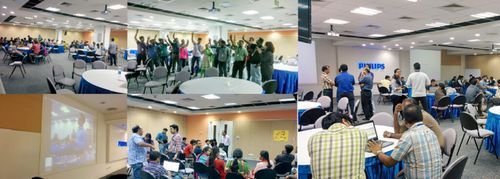
In early 2015, pôle emploi launched a SAFe pilot program to see how the Framework would work within their unique context. As part of this effort, they launched an Agile Release Train (ART) with 5 Scrum teams running on 3-week sprints, managing five cross-functional initiatives. Through Program Increment planning, they brought together all the key actors in the same room to identify key features that needed to be integrated, and dependencies between the different software components. pôle emploi created a new role, Delivery Manager, to track overall progress, and used IBM’s Rational Team Concert (RTC) to track team progress.

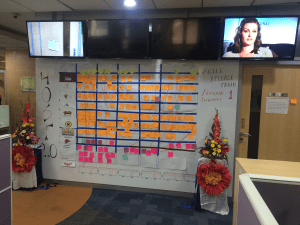
After the first few months, they were able to identify where the Framework mapped easily to their context, where it didn’t, and how to reconcile some of those differences. For instance, they opted to move from the Delivery Manager role to a Release Train Engineer (RTE) role, as defined in SAFe and began using SAFe-recommended templates to increase the visibility of the new business requirements. They also decided to align ART with their business program.

Today, the IT organization operates with both agile and non-agile teams collaborating, and is transitioning the non-agile teams to agile practices through their participation in the SAFe ART. They are working within the Framework to identify areas for continuous improvement and address questions such as:

  • How do we manage to take the business further within Agility?
  • Could WSJF help our prioritization process?
  • Who should assume the Product Management role in our organization?
  • How can we move forward with the system team?
  • Should we organize PO sync?
  • Who can be assigned the System Architect role?
  • Who should deal with the enablers and stories?
  • Will we be able to dissociate PI from our quarterly IT releases?
  • What do we need to do to move more teams to an agile cycle?

Get the rest of the story—including the update—below.

Many thanks to the team at pôle emploi for providing the study, and sharing your experience with the SAFe Community: Cécile Auret (SPC4), Methods Engineer, Jerome Froville (SPC4), Methods Engineer, and Michel Levaslot, Manager.

Back to: All Case Studies

Suggested Case Study:

Centers for Medicare & Medicaid Services

LEGO Digital Solutions – Business Agility Transformation Using SAFe

“ … this has ​improved the motivation​ of the team members. Going to work is more fun when there’s less confusion and less waste. And motivated people do better work, so it’s a positive cycle! Another impact we’ve seen is that other parts of LEGO visit the meeting, get super inspired, and start exploring how to implement some of these principles and practices in their own department. In fact, agile is spreading like a virus within the company, and the highly visible nature of the PI planning event is like a a catalyst.

—Henrik Kniberg and Eik Thyrsted

Update:

January, 2017 : A year after Henrik Kniberg and Eik Thyrsted shared the first phase of LEGO’s SAFe journey, they are back with the next chapter of their story. Their efforts to nip and tuck SAFe for optimal results run the gamut from large edits to small tweaks, and their learnings and outcomes are captured in a 36-page in-depth summary that is full of candid commentary and describes the thought process behind each decision. You can download it below.

Industry:

Consumer Products

Introduction

One of the world’s leading manufacturers of play materials, The LEGO Group is still owned by the Kirk Kristiansen family who founded it in 1932. With headquarters in Billund, Denmark, and main offices in Enfield, USA, London, UK, Shanghai, China, and Singapore, the company employs more than 15,000 people worldwide.

In 2014, LEGO Digital Solutions turned to SAFe to improve their collaboration model and seek out what they like to refer to as the “Land of Awesome.” Their story of business agility transformation was presented at LKCE (Lean Kanban Central Europe) by LEGO’s Head of Project Management, Eik Thyrsted Brandsgård and Lean/Kanban Coach, Mattias Skarin from Crisp.

Much like creating something from LEGO® bricks, they built their transformation one piece at a time, starting with inviting 20 managers to a 2-day Leading SAFe class. From there, they began training the teams; first one, then another until they had 20 teams trained in SAFe. They approached every step as a learning journey, allowing for creativity along the way. When something didn’t seem like a good fit, they weren’t afraid to experiment. Taking results from Inspect and Adapt, they tweaked SAFe to their needs with a simple guiding principle, “Keep the stuff that generates energy.”

“The combination of a structured system, logic and unlimited creativity encourages the child to learn through play in a wholly unique LEGO fashion.” —The LEGO Group

Their first PI Planning event—which they now refer to as their “center of gravity”—went better than expected, with the teams eager to take what they learned and apply it.

“You just can’t replace face-to-face communication, and PI planning is just a fantastic way to do that.”

Their presentation includes insights and lessons learned, such as:

  • You need critical mass
  • They can now better manage expectations
  • Don’t be afraid to experiment
  • To become good at something you need to practice it
  • Experimenting your way forward matters more than your selection of path

SAFe’s creator, Dean Leffingwell, calls their presentation, “One of the most insightful applications and presentations that I’ve yet seen on SAFe.” You can view their 45-minute video below.

Many thanks to Mattias and Eik for sharing their inspiring story!

Back to: All Case Studies

Suggested Case Study:

PlayStation Network

Northwestern Mutual – Adopting SAFe for Lean-Agile IT Transformation

“We had been challenged a number of times in changing our underlying CRM platform. After implementing SAFe, our overall effort actually came in $12M less than originally estimated and 18 months sooner than predicted.”

Bryan Kadlec, Director, Client Digital Experience

Challenge:

Market leader Northwestern Mutual sought to apply Lean-Agile practices to remain competitive, though previous efforts had been stymied by a longtime Waterfall culture.

Industry:

Financial Services, Insurance

Solution:

SAFe®

Results:

  • Collection Feature Cycle Time improved 30-50%
  • IT delivers requested capabilities 80-90 % of the time
  • The overall effort on a project came in $12 million less than originally estimated and 18 months sooner than predicted

Best Practices:

  • Support experimentation—Leadership at NWM fostered an environment, and provided resources, to enable this transformation. “Our forward-thinking leadership knew we needed to bring in some changes so they invested in continuous learning and improvement,” Schindler says.
  • Use proxies for offshore teams—NWM pre-plans with offshore teams and then brings proxy representatives to PI planning events.
  • Customize SAFe—NWM increased engagement with its own spin on the program board, with the Transformation Railway Station.

Introduction

In business, staying ahead of the competition inevitably requires taking some risks. But how do you do this, when a key part of your success depends on keeping risk at bay? That’s the question Milwaukee-based Northwestern Mutual (NWM) had to answer while seeking new ways to maintain and build on their 160-year history of helping families and businesses achieve financial security.

To maintain the leadership position NWM has built over nearly 160 years, the organization has taken an innovative, entrepreneurial approach to business. It’s paid off: The past year (2016) was one of the company’s strongest. The company reported record-level revenue ($27.9 billion), was named by FORTUNE® magazine as one of the “World’s Most Admired” life insurance companies, and has maintained the highest financial strength ratings awarded to any U.S. life insurer.*

300-Day Cycles

In 2012, the company reached a turning point. In addition to a company-wide push for continuous learning and improvement, IT needed to move faster.

“It took over 300 days and many instances to deliver value to our customers,” says Jill Schindler, Manager, Client Digital Experience. “We were getting a lot of questions around, ‘Why does it take so long and cost so much?’ We knew we needed to be more flexible, adaptable and responsive, and it didn’t take us long to realize that Agile was a big part of that.”

Sleeping baby clenches his parent's fingers; Soft focus and blurry

NWM had tried to adopt Lean-Agile practices before, experimenting with a few Scrum teams in the mid-2000s. However, those efforts ran headfirst into a deeply ingrained Waterfall culture.

“We didn’t start with much training or coaching, and teams worked on the aspects they wanted instead of the aspects that we needed,” says Bryan Kadlec, Director, Client Digital Experience. “We fell woefully behind and then were slammed by a waterfall world to put out the fire.”

A Second Attempt at Agile

Northwestern Mutual shelved its Scrum efforts until 2012, when the company embarked on a more methodical approach to Agile. This time, they set out to train as many people as possible. “We wanted to do this and senior leadership believed in it, so we pushed forward,” Schindler says.

At the time, three or four teams experimented with Agile but the organization simply was not set up to accommodate it.

For next steps, they held their first rapid improvement event (Value Stream mapping). The weeklong event brought together Scrum teams and specialized teams with the goal of addressing the challenges of these distinct groups working together. The end result: a better understanding of the problems and a systematic way of approaching them. Key to that was engaging the IT strategy team to help remove barriers.

The Missing Piece

About that time, NWM found the Scaled Agile Framework® (SAFe®) and quickly saw it as the missing piece. “SAFe totally lines up with what we were already trying to do but we just didn’t have a platform for it,” Schindler says. “This was the framework we needed for delivering Agile at scale.”

“In SAFe, we could see Agile and Lean together and had this sense that it was a very powerful thing,” Kadlec adds.

Schindler and Kadlec went back to the leaders of their respective organizations and secured resources to try SAFe—becoming pioneers not just for their own company, but also establishing NWM as the first large company in Wisconsin to take this course. They believed firmly in their chosen path, but it still felt risky to apply new Lean-Agile practices to a large chunk of the company’s portfolio.

“It shaved a few years off our lives!” Kadlec quips. “We believed that the path we were taking would deliver high value, but it still felt high risk. But if we’re going to compete, we had to have a quicker response time.”

The First Program Increment (PI)

Schindler and Kadlec trained as SAFe Program Consultants (SPCs) and additionally tapped Al Shalloway, CEO, Net Objectives, along with SAFe Fellow Jennifer Fawcett to facilitate the company’s first PI planning event. NWM asked 270 people to come together for the first two-day event—in January in Wisconsin—where they launched their first four Agile Release Trains (ARTs).

The response was heartening. People were engaged and ultimately on board. “At the end of the day, we felt a huge sense of accomplishment,” Schindler says. “Everyone understood what was expected of them.” Northwestern went on to train as many people as possible. In fact, for some team members, training was the first sprint.

SAFe for Financial Services

Making the shift in the company’s longtime waterfall culture wasn’t easy. Coaching was key, especially at the beginning. As teams went through cycles of Plan, Do, Check and Adjust, old behaviors would emerge—and need to be addressed. In truth, some individuals chose to leave—but most chose to dedicate themselves to the new way of working. The “new era” behaviors the Agile mindset fosters have taken such a firm hold companywide that they are now a factor in performance reviews.

By the second PI event, again with Fawcett facilitating, Release Train Engineers had a sense of ownership.

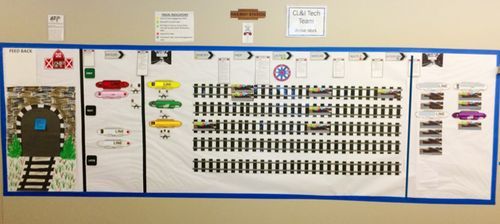
Transformation Railway Station

Northwestern Mutual took a clever twist on the ART program board, dubbing it Transformation Railway Station. On its board, a tunnel image represents the funnel of new work/ideas and cows represent impediments. The former is particularly apt given that, in 1859, two policy owners were killed when a train hit a cow and derailed. When the new company lacked the full funds to pay out those first life insurance claims (for $3500), NWM’s president at the time personally borrowed the funds.

On the board, laminated trains make their way along the track (the Portfolio level) from the departure station through various stages:

  • Identify—Communicate change vision, and determine Value Stream, ARTs, scope, PI planning date and training
  • Prep—Perform SAFe training
  • Launch—Conduct final prep and first PI planning event
  • Mature—Coach and develop the ART
  • Inspect and Adapt—Hold Inspect and Adapt workshop, plus second PI planning event
  • Aftercare—Complete coach strength, weakness, opportunity and threats (SWOT) assessment; discuss future coaching engagement

Through the PI, all parties keep a close watch on progress and metrics. “Leadership can walk up and know where we are at any time,” says Sarah Scott, Agile Lean Organization Coach at Northwestern Mutual.

SAFe for Financial Services
Transformation Railway Station

Cycle Time Improvement

Since deploying SAFe, and beginning its first earnest Agile efforts, Northwestern Mutual reduced Collection Feature Cycle Time by 30-50%. And surveys of business representatives indicate that IT delivers what they requested 80-90 percent of the time.

Ultimately, the changes affected the bottom-line—for the better. “After implementing SAFe, our overall effort actually came in $12 million less than originally estimated and 18 months sooner than predicted,” Kadlec says.

Now in year three, with 12 PIs behind them, the company has five SAFe instances and 14 ARTs in progress across a wide range of product areas. Northwestern Mutual provides leadership for SAFe in Wisconsin, even hosting a Scaling Agile Meetup Group that draws as many as 300 attendees to its monthly gatherings.

“We’re at a tipping point now, continuing to break down barriers,” Schindler says. “The whole organization is in the heart of a major transformation and we’re leveraging SAFe to accelerate our Lean-Agile IT transformation. We’re at a whole other level that I don’t think would have happened as quickly or with as much impact if we’d just had a handful of Scrum teams.”

* Ratings are for The Northwestern Mutual Life Insurance Company and Northwestern Long Term Care Insurance Company, as of the most recent review and report by each rating agency. Northwestern Mutual’s ratings: A.M. Best Company A++ (highest), 5/2016; Fitch Ratings AAA (highest), 11/2016; Moody’s Investors Service Aaa (highest), 1/2017; Standard & Poor’s AA+ (second highest), 6/2016. Ratings are subject to change.

Northwestern Mutual is the marketing name for The Northwestern Mutual Life Insurance Company (NWM), Milwaukee, WI and its subsidiaries.

Back to: All Case Studies

Suggested Case Study: Fannie Mae

AstraZeneca – Using SAFe for Agile Adoption

“We’re delivering faster with greater quality and less manpower—resulting in substantial financial benefits from the teams that have adopted Agile to date. We expect to double our adoption of Agile this year.”

Patty Sheehan, AZ Agile Cultural Change Lead and Coach

Challenge:

Scale Agile practices across a large global change portfolio

Industry:

Pharmaceutical

Results:

  • Substantial financial benefits delivered in the first year
  • Significantly faster time-to-value delivery
  • Reduced team sizes
  • Improved quality of outputs over previous solutions

Best Practices:

  • Address culture change – AZ focused on the culture shift required to support Agile by creating Culture Leaders.
  • Align governance and procurement – AZ aligned funding and governance approval with Agile ways of working, enabling teams to make progress quickly and benefit from Agile delivery.
  • Consider face-to-face ARTs – AZ required face-to-face planning at the launch of a new Agile Release Train (ART).
  • Stay organized – AZ used task tracking and collaboration tools extensively.

Introduction

AstraZeneca (AZ) is a global, science-led biopharmaceutical business employing 61,500 employees worldwide. Millions of patients around the globe use its innovative medicines. AZ activities span the entire life cycle of a medicine, from research and development to manufacturing and supply to the global sales and marketing of primary care and speciality care medicines that transform lives.

SAFe for Agile Adoption

AZ teams are pushing the boundaries of science to make a difference through medicine for patients, their families, our stakeholders, and society in general. AZ believes that scientific research and applying leading technology are key to achieving cutting-edge innovation and at the heart of what we do.

In AZ, IT is helping to push the boundaries of science to deliver life-changing medicines by continuously improving the IT environment and working with business teams to innovate for competitive advantage.

Enterprise-wide Alignment with Agile

AZ has made use of Agile practices for a number of years at a small scale, but up to 2014 had continued to deliver the majority of its programs using traditional SAFe approaches. A decision was taken to adopt Agile methods more broadly across its IT change portfolio in order to bring about a step change in delivery performance. PA Consulting was selected by AZ to support this agile transformation effort, providing organizational change management expertise, Agile transformation strategy, training and coaching. AstraZeneca and PA Consulting selected the Scaled Agile Framework® (SAFe®) in late 2014 as the framework to be applied to support the adoption of Agile.

“We needed the ability to scale Agile quickly because we run large, complex programs at AstraZeneca,” says Patty Sheehan, AZ Agile Cultural Change Lead and Coach. “SAFe is a flexible yet robust framework that has already been proven successful. It has been the right fit for us.”

The SAFe Agile adoption approach focused on organization and culture change, supporting Agile teams directly and ensuring that processes such as procurement and regulatory approval were aligned with Agile. The Agile adoption has so far been extremely successful with teams reporting significantly faster time to value delivery (40-60%), reduced team sizes (cost reduction of 25-40%) and improved quality. Financially, we rigorously monetized a large proportion of benefits from just a small subset of teams.

The AZ team, supported by PA Consulting, rolled out SAFe in the first year to tackle the larger scale programs in its portfolio, focusing on three key areas:

  • Organization and culture change:
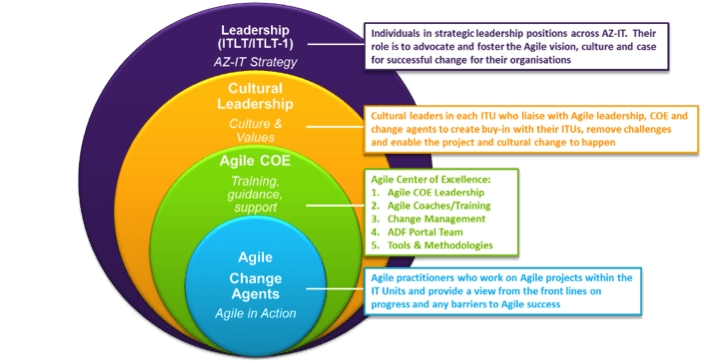
    The transition to Agile ways of working can be a substantial break with traditional corporate culture. AZ defined five key organizational values: customer focus, technical leadership, operational excellence, collaboration and simplicity. By becoming Agile, AZ people would not only know these values but practice them in a methodical way.AZ tied this message into an Agile vision statement and marketing, making the change feel more personal and organic. The culture change approach included creating an extensive network of Agile Culture Leaders across the organization, focused on executive-level buy-in. The company also dedicated additional time at the end of each SAFe training course to the discussion and diagnosis of immediate actions to change culture.
SAFe for Agile Adoption
Figure 1 – The different layers of the AZ Agile change network, from practitioners at the center, supported by the Agile COE, Agile Culture Leaders and Leadership.
  • Alignment of governance, procurement and regulatory processes with SAFe:
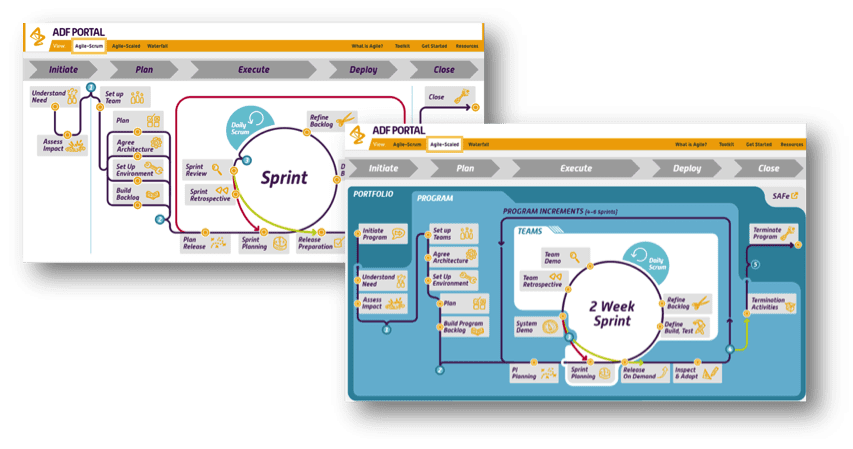
    AZ replaced its traditional project governance framework with a new Adaptive Delivery Framework that was easy to use, lightweight, and crucially, supported both Scrum and Scaled Agile approaches out of the box. With this change, funding and governance approval were aligned with Agile ways of working, enabling teams to make progress quickly and benefit from Agile delivery. As a regulated pharmaceutical organization, AZ also has many regulatory obligations on its systems and processes. Defining an approach with the internal Quality Management group was a key success criteria, allowing the AZ Agile teams to deliver validated software solutions that supported regulatory requirements.
SAFe for Agile Adoption
Figure 2 – AstraZeneca’s Adaptive Delivery Framework, showing the lightweight governance that is applied to Scrum and Scaled Agile teams.
  • Outsourced and offshore teams:
    AZ teams are typically made up of a number of different third-party suppliers working in collaboration with AZ from a variety of sites around the world. We overcame the challenges inherent in this arrangement, building on key elements of SAFe to support this way of working. The PI Planning event was crucial to the alignment and co-ordination of large, off-shore teams. These events were carried out using a mixture of on-site and video conferencing facilities, with a requirement for face-to-face planning at the launch of a new ART. Similarly, iteration alignment and system demos helped the teams to maintain visible synchronization throughout increments. The Legal and Procurement teams at AZ are revising the contractual arrangements and procurement processes to align with SAFe. Task tracking and collaboration tools were used extensively. Following the success of the Agile adoption in the first year, AstraZeneca is now creating a number of internal ARTs to deliver change, again utilizing a multi-site model.

Value Delivered in Year One

AstraZeneca is 18 months into a multi-year transition to Agile ways of working, but with the adoption of the Scaled Agile Framework and the support of PA Consulting, a substantial transformation has already occurred. Twenty large teams have adopted Agile, and over 1000 staff have been trained and supported through a robust coaching regime. More importantly, Agile maturity has increased rapidly over the year with strong adoption in each area of the business. The teams adopting SAFe have observed significantly increased time to value delivery with improved quality of the outputs over previous solutions. This has been achieved more efficiently with reduced team sizes

“We’re delivering faster with greater quality and less manpower—resulting in substantial financial benefits from the teams that have adopted Agile to date,” Sheehan says. “We expect to double our adoption of Agile this year.”

Back to: All Case Studies

Suggested Case Study: Royal Philips

Swisscom – Proper Agility Transformation Using Agile Development Practices with SAFe

Agility Planning with SAFe for Telecom

“It usually takes about 36 months to bring a new TV platform to market but we had a minimally viable product in 8-10 months and brought the full product to market in 18 months. SAFe helped our relatively small team build and run a world-class product and guided us when in doubt, showing us the way toward Agile product development flow.”

Simon Berg, Agile Program Manager, Swisscom Entertainment Projects

Challenge:

Swisscom had to move quickly to bring a new IPTV product to market since a competitor had already begun a similar effort.

Industry:

Telecommunications

Solution:

  • SAFe®
  • Rally® Unlimited Edition (now CA Agile Central)

Results:

  • Swisscom brought TV 2.0 to market in about half the time of comparable projects, ahead of the competition.
  • The company decreased the time from code-ready to mass rollout from 9-12 months to no longer than six weeks.
  • The product won a coveted industry award for “Best multi-screen experience.”
  • Last year, IPTV signups grew by nearly 14 percent.
  • PI Planning recommendation score from participants: 8.3/10

Best Practices:

  • Test Automation—Swisscom reduced end-to-end test team size from dozens to just three, while maintaining quality – and deployed those individuals to other value-producing functions.
  • Program Increment Planning—Planning with SAFe led to new alignment and momentum.
  • Most Valuable Feature First—WSJF Abstract (Weighted Shortest Job First) helped prioritize features and quantify the cost of delay.

Introduction

Across the globe, consumers are increasingly choosing IPTV over cable. In Switzerland, more than 1.37 million customers now subscribe to Swisscom’s cloud-based service, Swisscom TV 2.0.

Agility Planning with SAFe for Telecom

While the growth of Swisscom TV 2.0 is a success story in itself, so too is the company’s journey to bring the product to market in a highly competitive industry where speed can make the difference between success and failure.

Thanks to Agile development practices with SAFe and a new level of collaboration between business and IT, the Engineering group at Swisscom Entertainment achieved the feat in half the time of typical projects, with a small but nimble team that helps proper agility transformation.

“It usually takes about 36 months to bring a new TV platform to market but we had a minimally viable product in 8-10 months and brought the full product to market in 18 months,” says Simon Berg, Agile Program Manager, Swisscom Entertainment Projects. “SAFe helped our relatively small team build and run a world-class product and guided us when in doubt, showing us the way toward Agile product development flow.”

SAFe: The Blueprint Swisscom Sought

In 2012, Swisscom initiated plans to bring a new IPTV offering to the market, to go beyond the basic product currently available.

This time, Swisscom wanted to add features that newly available technology would make possible. Adding urgency, the company’s largest competitor had reportedly already begun work on a similar product.

At the time, Swisscom ran what Berg describes as a PMI-style, waterfall, multi-project environment that was transitioning into a home-grown, scaled Scrum approach. A year prior, Swisscom had taken steps to realize a product house model by moving “business” and “IT development” groups into one organization.

Now, the Engineering group sought to scale Agile in earnest, leading it to the Scaled Agile Framework (SAFe).

“Many things we tried to come up with on our own were already defined in a structured manner in SAFe,” Berg says. “It clicked with us, and we began transitioning to SAFe almost immediately after discovering it. With SAFe, we were able to take incremental transformation steps, profiting from the vast body of knowledge it represents.”

Finally: Big-Room Success

The team had already implemented three-month program increments with teams structured along program lines. However, they had not yet tried cross-functional, big-room planning meetings.

After diving into SAFe, the Engineering group held its first Program Increment (PI) planning session with approximately 70 people across multiple functions, including product owners, IT operations, business operations, product management and experience development.

“I was pleased to see which people were talking to each other, people who had not talked before,” Berg says. “Business owners and IT ops engineers talked about what they do and their priorities. They were giving each other their part of the vision and could finally align and work together.”

“We came out of the first PI planning session with a decent plan that lasted for the PI, except for one other small planning session,” Berg adds.

Today, PI planning has become standard practice. Noted one product manager after the group’s ninth PI planning meeting: “It’s challenging, but I don’t want to work differently ever again.”

More Flexible in a Fast-Changing Market

In total, about 120 people ultimately worked on Swisscom TV 2.0, in more than 10 teams of teams, spanning from pure software development to video streaming, building up the data center capabilities and working to design the TV set-top box and remote control hardware. When you count non-Agile suppliers, the project included approximately 20 teams.

SAFe’s focus on alignment and shared vision kept diverse stakeholders in sync, accelerating progress and enhancing quality. “The focus on showing your work and releasing often for feedback helped us build a better product,” Berg says.

Likewise, SAFe provided flexibility when it mattered most. Mid-project, Swisscom decided to improve the product by removing time limits on the storage of recordings—a major product enhancement.

Agility Planning with SAFe for Telecom

Berg also stresses the value of the WSJF concept (Weighted Shortest Job First) in helping prioritize features. “Quantifying the cost of delay was perhaps the most impactful learning of SAFe,” Berg says. “It was the first formula that really helped us have the right discussion about our priorities and what to build, aligned around the benefits to the customer.”

Such agility in business also helped the company become one of the first IPTV providers globally to launch Ultra HD Video on Demand, as well as Ultra HD live TV in early 2016.

Code Ready in Six Weeks

On the Swisscom TV 2.0 release, the company decreased the time from code-ready to mass rollout from 9-12 months to no longer than six weeks. “We don’t know of a comparable case in the industry,” Berg says.

Swisscom also did it more efficiently. Where test team size was once dozens of people, now with test automation, testing requires just three people while still maintaining product quality. Those testers now focus on other value-generating functions, ensuring that quality gets built into the process.

Beyond internal success, the industry took notice as well. The product went on to win a coveted award for “Best multi-screen experience”—an honor not usually bestowed on telecommunications companies.

Perhaps the greatest rewards: strong customer satisfaction scores and product sales. Last year, IPTV signups grew by nearly 14 percent.

Next Steps

Swisscom now deepens its SAFe adoption, with newly set priorities for elaborating on the economic framework concept and the solution intent concept, along with improving DevOps. Other Swisscom product units have also taken interest in adopting SAFe.

“For Swisscom TV, this has become a new way of doing business,” Berg says. “Others are looking into how we work because they see it drives us forward.”

Back to: All Case Studies

Suggested Case Study: Amdocs

Amdocs – Applying Lean and Agile Practices by Adopting SAFe

Our time-to-value has gone down using the SAFe® process. If reaching production would normally take 1½ years, now it could be eight months with the new processes and approach.

Hrishikesh Karekar, Lead Agile Coach, Amdocs

Challenge:

Long scoping and development times failed to keep pace with the rate of change happening within Amdocs’ client organizations.

Industry:

Software, Telecommunications

Results:

  • More frequent deliveries to production
  • 30% faster delivery for user acceptance testing
  • Monthly demos to customers, enabling early feedback and better alignment with customer expectations
  • System stabilization time down from six weeks to less than a week

Best Practices:

  • Follow SAFe Closely—Instead of modifying the approach for the company, Amdocs chose to follow the Scaled Agile Framework as closely as possible.
  • Leverage Gamification—Gamification, and early successes, motivated teams to push on and commit to the change.

The partner that made it happen:


Introduction

In the complex and competitive communications industry, many of the world’s largest telecom and entertainment players turn to Amdocs for customer care, billing and order management systems. At the $3.6 billion company, more than 24,000 employees serve customers in over 90 countries.

Telecommunication mast with microwave link and TV transmitter antennas in night sky . long exposure about 2-3 minutes

The Amdocs portfolio includes a full set of BSS/OSS capabilities on a variety of platforms and technologies to support communication service providers. Projects can take anywhere from a few months to a few years to complete, requiring close collaboration across widely distributed teams. The Amdocs Delivery organization comprises approximately 5,000 professionals around the world.

In this challenging environment, Amdocs sought ways to improve quality and delivery times. The time from initial scoping to delivery simply stretched too long for the rate of change happening for Amdocs’ customers. Amdocs Delivery had been experimenting with ways to be Agile; however the need for a more structured approach was evident given projects’ scale and complexity.

“We were working in big blocks,” says Levana Barkai, a Lead of Center of Excellence in the Amdocs Israeli office. “Even scoping requirements with the customer could take a year. Only after we closed in on the bits and bytes of customer requirements (long phase of ~8 months) we started the next phases of design, development and testing. But then we would realize that the customer already has new requirements we needed to address. We needed to be more flexible to customers’ changing needs.”

Choosing a Proven, Enterprise-Level Framework

After evaluating several options to scale Agile, Amdocs Delivery decided to adopt the Scaled Agile Framework® (SAFe®) for a number of reasons. For one, the Framework offered a proven, public-facing method of applying Lean and Agile practices at an enterprise level. The Framework also offered the level of detail the company needed to truly roll out the practices at every level of the organization, and to do so quickly.

In late 2014, executives, managers and leaders began SAFe certification training, followed by teams. As they began applying Agile practices to real projects, the Delivery Transformation team, comprised of Agile Coaches, guided the SAFe implementation and execution. Unlike previous efforts at applying Agile methods, this time the company took a more disciplined approach to more closely align the implementation to the framework to reap the benefits of industry learnings.

Barkai said, “This time we’re doing it differently. We’re taking industry best practices and not modifying them for Amdocs. We set the expectation that we are implementing SAFe as is.”

Upping Adoption through Gamification

Gamification played a big role in the change management strategy, especially to drive the adoption of new practices at the Team level. One of the successful gamification techniques included “FLIP,” a game that requires teams to check items off a checklist to ensure Scrum ceremonies are done in the true spirit. Teams earn points based on how quickly they complete the checklists.

FLIP stands for:

Finish–The team finished the current iteration fully

Learn–Teams performed a retrospective to learn for the future

Improve–The retrospective resulted in specific items that teams can focus on to improve in the next iteration

Plan–Teams completed the iteration planning ceremony and are ready to begin execution for the next iteration

Implementing SAFe in Telecommunications

As teams “FLIP-ed,” they took selfie photos and posted them on physical boards with their marked checklists. Only the teams themselves checked whether criteria were really achieved—to prevent the game from being perceived as a monitoring tool.

The FLIP game drove several successful outcomes:

  • Deeper understanding–To win, teams had to review the checklist, encouraging them to delve into the details of the process broadening the number of people with a detailed understanding of the new process.
  • More discipline–More teams began following Scrum in a disciplined way, helping Amdocs Delivery achieve the new status quo much faster.

“Using gamification for Scrum adoption resulted in better outcomes,” says Hrishikesh Karekar, Lead Agile Coach. “It helped us boost motivation, better the engagement and drive positive behavioral change in teams. Most important of all, the teams loved the process and had fun.”

Delighted Customers

Team members also found reward in seeing the new process produce customer satisfaction and real results. After initial hesitance to share early and frequent demos with customers, team members were pleasantly surprised by customer reactions.

“Customers were really delighted,” Barkai says. “They have been giving us great feedback about seeing the system in such an early state. Now teams understand that this is the key to success.”

“We reduced the time to take an idea to production,” adds Karekar. “Our time to value has gone down using the SAFe process. If reaching production would normally take 1½ years, now it could be eight months with the new processes and approach.”

On average, the company has quantified delivery for user acceptance testing 30 percent faster—a major indication of value for Amdocs. Demos take place every two weeks to two months, instead of the previous four months at a minimum.

Likewise, system stabilization time has shortened in step with quality improvements, from six weeks to less than a week. And with more stability comes greater predictability in the early stages.

Next Steps

Word has spread quickly about early teams’ success, with many initiatives now running on SAFe. And management is encouraging company-wide rollout of the Framework, a goal coaches expect to reach by early next year.

“It’s not theory anymore,” Barkai says. “Now we have a lot of evidence that SAFe works. The success with SAFe implementation has generated a lot of interest in raising the bar for excellence, and laid a great foundation for the DevOps journey.”

Back to: All Case Studies

Suggested Case Study: Telstra

Westpac – Implementing SAFe in Banking Services

Westpac - Implementing SAFe in Banking Services

Everyone hearing the same message from the same trainers at the same time was a huge enabler for alignment and a ‘one-team’ culture.”

Em Campbell-Pretty, Context Matters

Challenge:

After the successful rollout of a new online banking platform, Westpac received numerous requests for additional features and needed to deliver quickly.

Industry:

Banking

Solution:

SAFe®

Results:

  • Westpac successfully took 150 people from waterfall to Agile in one week, and garnered positive feedback from teams
  • Team and business engagement went up
  • Cycle time and defects went down

Best Practices:

  • Get executive buy-in—Getting leadership on board—and participating—is essential to achieving team buy-in
  • Include all roles in training—Triple check that everyone is scheduled to get the training they need
  • Prepare, prepare, prepare—A one-week launch takes significant pre-work

Overview

One of Australia’s “big four” banks, Westpac serves approximately 10 million consumer and business customers across Australia, New Zealand, Asia, the United Kingdom, and the United States.

Challenge

In 2015, Westpac launched a new online banking platform. Though very successful—and award-winning—the launch resulted in a huge demand to deliver additional features quickly. The company wanted to take a scaled Agile approach to roll out new capabilities but lacked the quality training and know-how to apply it to this initiative.

Solution

Westpac reached out to Scaled Agile Partner, Context Matters, for guidance, leading to the decision to adopt SAFe, and form an Agile Release Train (ART) for the new features.

Before launch planning began, the company settled on a vision, a prioritized feature backlog, an approach to product ownership and a decision on capacity allocation.

At the time, teams were focused on delivering the final release of the in-flight program. If they were going to change the delivery approach for the next release, they would need to move fast. With a small window of opportunity, a SAFe QuickStart seemed the only answer.

To achieve launch in one week, Westpac began by training everyone at the same time. Midweek, they aligned all teams to common objectives, secured commitment and continued training during planning. By week’s end, they provided orientation for specialty roles, open spaces and tool training for teams.

Development teams would be available in six weeks, so Westpac grabbed that time slot—knowing the window would be tight. After buy-in from executives on the business and IT sides, they were ready for next steps.

To support their efforts, they also established Communities of Practice and hold monthly technical workshops for developers.

Implementing SAFe in Banking Services

2 Days of Leading SAFe® Training

Next, 32 leaders across business and IT came together for two days of Leading SAFe training to discuss SAFe in the Westpac context, generating team excitement. Together, leaders came up with a theme for the train—Galaxy—with all teams receiving related names.

“Giving the train a shared identity helps create a bond across the team of teams that is the Agile Release Train, seeding the “one-team” culture that helps trains excel,” says Em Campbell-Pretty of Context Matters.

SAFe Scrum XP training brought together 60 people in one release train of eight teams over two days with two trainers in one room. The RTE additionally joined team-level training for both days, leading team members to note his commitment to SAFe.

“Everyone hearing the same message from the same trainers at the same time was a huge enabler for alignment and a ‘one-team’ culture,” says Campbell-Pretty.

The following Monday, Westpac launched the train. Some last-minute feature requests presented a hiccup, but the teams and leadership committed to a plan.

Results: Cycle Time, Defects Down

  • Westpac successfully took 100 people from waterfall to Agile in one week, and garnered positive feedback from teams. Team and business engagement went up while cycle time and defects went down.
  • Agile at Westpac continues to grow, with the company holding its third PI Planning session recently.

Additional Reading

For a deeper dive into this SAFe experience, download Em-Campbell Pretty’s presentation to AgileAustralia16.

Back to: All Case Studies

Suggested Case Study: Capital One

Hewlett Packard Enterprise (HPE) Software – Enterprise Agile Expansion with SAFe

“With a proven framework, we can deliver solutions much faster and with less effort. SAFe® defines the roles, teams, activities and artifacts to apply Lean and Agile principles at enterprise scale, and provides outstanding training and coaching materials to increase our chance of success.”

Peter Vollmer, Distinguished Technologist at Hewlett Packard Enterprise (HPE)

Challenge:

HP teams had experimented with Agile methods for years, but efforts were limited to individual teams with mixed results.

Industry:

Information Technology, Software

Solution:

  • SAFe®
  • HPE Agile Manager
  • HPE ALM

Results:

  • Teams run iterations within a number of weeks rather than months.
  • Typically, teams complete sprints within two weeks.
  • The company noticed a 20 percent drop in defects.
  • Company leaders are backing Agile globally as means of meeting strategic business goals.

Best Practices:

  • Start small – Start with one or two teams to reduce risk and create evangelists that will spread the news.
  • Use a light hand – Don’t force teams to go Agile but rather let evangelists share that Agile is fun and delivers better results.
  • Educate, educate, educate – Establish change agents and continuously educate. Many may assume they know what Agile is all about, but in reality may not.

Introduction

Created as a result of the split of Hewlett Packard into two companies in late 2015, the newly formed Hewlett Packard Enterprise (HPE) helps organizations adapt to modern digital demands—to create secure, cloud-enabled, mobile-friendly infrastructures. HPE Software, one of four divisions within HPE, drives a significant percentage of the company’s overall profit.

Abstract background of wires and glowing particles

At HPE, business units span multiple continents, from the headquarters in Palo Alto, CA to Europe and the Asia Pacific. One product team may include members in up to five different locations.

The company’s journey to Agile began as early as 2001 when some HP teams began iterative development independently. In the years that followed, they went on to experiment with a mix of XP, Kanban and Scrum. However, their efforts, while approaching Agile in business, were limited to individual teams with mixed results.

To scale Agile adoption beyond a few scattered teams would require a more formalized effort and a methodical approach to ensure business continuity.

“We needed to respond more quickly to user requests and environmental changes, and reduce the cost of software development using traditional methodologies such as waterfall,” says Peter Vollmer, Distinguished Technologist at HPE. “Yet we could not risk compromising core business processes and KPIs.”

A Proven Framework for Faster Delivery

When team leaders evaluated the variety of Agile methodologies, they found the measured approach they needed in the Scaled Agile Framework® (SAFe®).

“With a proven framework, we can deliver solutions much faster and with less effort,” Vollmer says. “SAFe defines the roles, teams, activities and artifacts to apply Lean and Agile principles at enterprise scale, and provides outstanding training and coaching materials to increase our chance of success.”

HPE began SAFe Agile expansion with a “coalition of the willing,” Vollmer says. The first to raise their hands, a team based in Fort Collins, Colorado, with members in India, became the first to begin SAFe training and training. With the Colorado team underway, a second-team at HPE’s headquarters in Sunnyvale began as well.

Beyond the Classroom

To help teams apply SAFe beyond the classroom, HPE provided some teams with access to a trainer to educate and coach them through the process. Coaches provide feedback to teams, ask questions and help them find the right answers based on context, culture and environment. To coach the first two teams, and now others, Vollmer ramped up on SAFe through a SAFe Program Consultant (SPC) course.

Success with scaling Agile at HPE has hinged on education and ensuring that team members understood SAFe clearly, including taking the effort to get on the same page regarding terminology. “We found a great deal of misunderstanding when it comes to Agile and its principles, which is why teams often struggle with accepting the change,” Vollmer says. “In order to get the most out of Agile practices, each team should have a trainer who educates and coaches them throughout the learning and adoption process.”

HPE Software - Agile Expansion with SAFe

20% Defect Drop

Early SAFe users evangelized their experience, increasing engagement and adoption. To date, several hundred team members have attended SAFe training and achieved certification. Those actively applying Agile methods numbers in the thousands, based on usage of an HPE-developed onboarding portal (Agile Manager), and continues to grow. Between 2014 and 2015, the number of registered users jumped by 50 percent as the effort gained momentum.

Though still adopting SAFe more broadly, HPE already sees an impact. “Our teams run iterations within a number of weeks rather than months, all while executing robust delivery processes,” Vollmer says. And with the change, teams run sprints in two weeks instead of four.

As SAFe practices expanded, the company also noticed a 20 percent drop in defects, as measured by its own defect-tracking application. Within the system, HPE can easily measure key performance indicators, including customer-encountered defects – insight that contributes to customer satisfaction and delivering higher-quality releases on schedule.

“Like most of our customers, HPE Software must adopt Enterprise Agile practices,” says Jerome Labat, CTO of HP Software. “Working closely with our HPE ALM (application lifecycle management) and AGM (Agile Manager) engineering teams allows us to continuously improve our product, scale out our software operations while keeping our costs under control. We‘ve seen tremendous benefits such as efficiencies, improved quality, and a reduction in time-to-market windows.”

Next Steps

Abstract background of wires and glowing particles

So far, HPE has run four Agile Release Trains (ARTs), all in one business unit. In the coming months, another business unit in Sunnyvale will quickly launch another ART.

Next, HPE Software targets training an additional thousand people on SAFe, which includes all R&D and product management roles. Toward that effort, HPE will establish an Agile transformation team and deploy up to three SPC-certified change agents in each major geographic area.

All these steps underscore the increasing importance of scaling Agile in meeting HPE’s broader strategic business goals.

“We have to get the whole of Hewlett Packard Enterprise, from a development perspective, adopting the Agile methodology, so that we can go faster and deliver more to our customers’ expectations,” said Martin Fink, CTO of Hewlett Packard Enterprise.

Back to: All Case Studies

Suggested Case Study: Amdocs

TomTom – Achieving Enterprise Business Agility with SAFe

Implementing SAFe in Consumer Electronics

“There is no doubt in my mind that without SAFe and Rally we would not have launched this in only 140 days. It is also our best new product ever.”

Industry:

Consumer Electronics

Introduction

Best known for being a global leader in navigation and mapping products, TomTom also creates GPS sports watches, as well as state-of-the-art fleet management solutions and industry-leading location-based products. They are the mapping provider for Apple Maps, and the maps and traffic data provider for Uber drivers in over 300 cities worldwide. Headquartered in Amsterdam, TomTom generates 1 billion euros in annual revenue, with 4,600 employees worldwide.

In 2012, the organization was facing a number of challenges:

  • Organised as waterfall projects
  • Many projects working in all parts of the code with minimal module or component ownership
  • Many releases are months-quarters late
  • Multiple code lines and branches
  • Negligible automated testing & no continuous integration
  • “downstream” teams spend 3,4,5 months accepting the code and often changing it
  • Poor visibility and facts-based decision-making

After reading Dean Leffingwell’s Agile Software Requirements—their SVP read it cover-to-cover on his vacation—they decided to transition to SAFe. Their first step was to provide SAFe training for their CTO, SVPs, and 50 CSMs and CPOs. From there they began reorganizing from the Scrum teams up, arranging product clusters and component Scrum teams around the idea of one Agile Release Train (ART) per product.

Six months into the SAFe transition, they were given a previously unheard-of goal of a 126-day launch cycle for their 4th generation of consumer navigation products. This put SAFe to the test, as it cut their development time down almost two-thirds from what was previously a 1-year cycle. Launching 5 ARTs—1 product each—they assigned 4-14 teams to each train, working across multiple locations.

Highlights of SAFe Benefits

  • Reliable and predictable releases of production code
  • Fail fast (<2 weeks) is better than after 6 months
  • Detect/prevent issues with each new submission
  • No bottleneck at the end
  • Reduces waste as others stay up to date
  • Improved transparency and info sharing
  • Teams establish ways of working & esprit du corps
  • Improves estimating by allowing historical comparisons
  • Team controls their own commitments
  • Sustainable development
Implementing SAFe in Consumer Electronics

Today SAFe is practiced by all of TomTom’s large product teams representing navigation software, online services, map creation and sports software. That represents approximately 750 FTEs, with 200+ trained and certified in SAFe.

Their 32-page case study is well worth the read as it summarizes their experience over a 5-year period, revealing both wins and challenges. Their breakdown of the “Good” the “Bad,” and the “Ugly,” makes it particularly interesting for any large enterprise wanting to understand the ins and outs of a real world SAFe adoption.

A special thanks to TomTom’s  James Janisse, VP Connected Navigation System, and Han Schaminee, SVP Location Technology Products, for sharing your story.

Back to: All Case Studies

Suggested Case Study:

Air France- KLM

SK Hynix Memory Solutions – Adopting SAFe to Improve Enterprise-grade SSDs Production

SK Hynix Memory Solutions - SAFe to Improve Enterprise-grade SSDs Production

Industry:

Technology, Semiconductors

Overview

SK hynix memory solutions (SKHMS) is a subsidiary of  the SK Hynix, Inc, which ranks #82 in the Fortune Global 500, and is the 5th largest semiconductor company in the world. Hynix memory is used by Apple, Asus, Google, IBM, Dell, and Hewlett Packard, as well as in products such as DVD players, cellular phones, set-top boxes, personal digital assistants, networking equipment, and hard disk drives.

Being a leading provider of custom system-on-chip (SOC) solutions for the solid state disk (SSD) storage market, SKHMS wanted to maintain their competitive edge via relentless improvement for producing enterprise grade SSDs. They teamed up with Scaled Agile Gold Partner, CPrime, to assess areas of improvement, and to understand the major impediments in their product delivery life-cycle. They gave careful attention to:

SAFe to Improve Enterprise-grade SSDs Production
  • How hardware was coordinated with firmware development.
  • How testing was conducted throughout the current PDLC process.
  • Departments involved in building and delivering the product.
  • How often these products were released to the customer and/or to the market.
  • Source code management and build deployment.
  • Tooling in place to support the Agile pilot.
  • The U-Curve optimization (analysis of transaction costs) for delivering work.

They ultimately chose SAFe as the Framework best equipped for agility transformation and to address the complex issues often associated with the firmware development. Kicking off a 1-year pilot program, they started with 5 Scrum teams with 50 people to support their first Agile Release Train (ART), and set their Program Increments (PIs) at 3 months, with a two-week iteration cycle.

Software and Hardware Align Through Program Level, Value Stream

They decoupled the Hardware group from the Firmware ART because their work was not conducive to two week iterations with the Scrum Teams. Instead, the Hardware group worked in a Kanban like fashion with SLAs on their work based on the Backlog prioritization. For example, knowing what features were coming down the pipe, they were able to prioritize their own work and in some cases, put out proto-hardware for testing purposes during the Program Increment. This coordination was possible because representatives from the Hardware group attended critical Program level meetings as stakeholders and because they were part of the Value stream for delivering the product.

Early Results Reveal Tangible Value

The Pilot was off to a solid start and teams were embracing the change, and seeing the tangible value of using SAFe. The overall metrics and feedback indicated:

  • 60% improved transparency
  • 55% defect reduction rate
  • 50% improved service delivery predictability

The 8-page study, provided below, is well worth the read, as it includes helpful detail and insights that include:

  • Their Preparation Checklist
  • Program Backlog Prioritization
  • Business Value
  • Timing Criticality
  • Opportunity Enablement/Risk Reduction
  • Feature Analysis & Architurecture Design
  • PI Planning
  • Continuous Integration

A big Thank you! to Johnny Lam, Director at SKHMS, and Dr. Sanjeev Raman Enterprise Agile-Lean Coach from cPrime, for sharing your SAFe experience.

Back to: All Case Studies

Suggested Case Study:

Seamless Payments