By: Laks Srinivasan
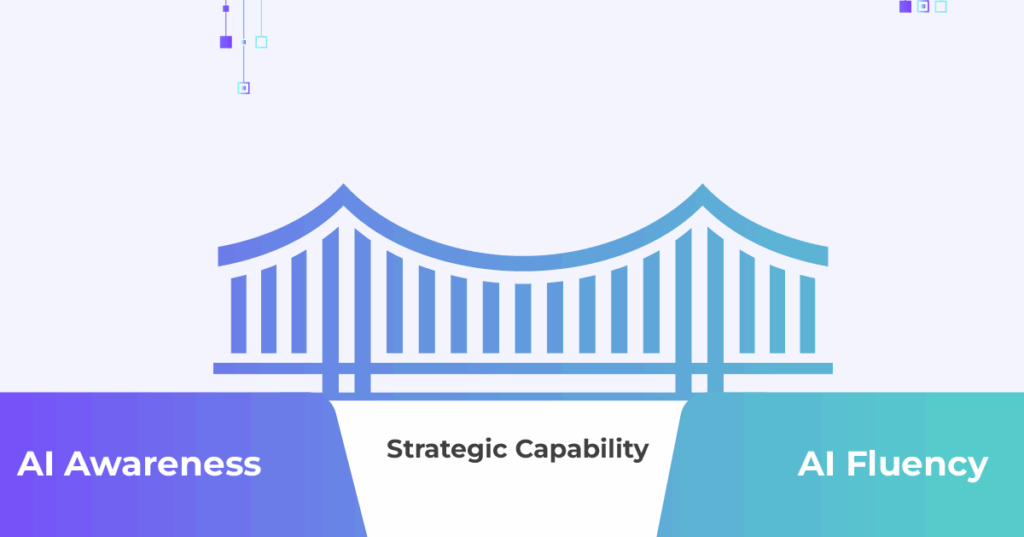
Why knowing about AI trends doesn’t equal the fluency needed for strategic AI decision-making
AI Awareness Isn’t Enough for Strategic Success
The Chief Data Analytics Officer of a large multinational company reached out to me with a challenge that’s becoming increasingly common.
“We do AI,” he explained, “but AI is in pockets. It’s an activity we do, it’s not coherent, it’s not coordinated.”
His leadership team was aware of AI developments. They read industry reports, attended conferences, and could discuss machine learning in board meetings. But when it came to making strategic decisions about AI investments and scaling, they lacked conviction.
This leader had discovered the difference between AI awareness and AI fluency. This gap is quietly limiting competitive advantage across industries while early adopters gain strategic positioning.
Having guided 1000+ leaders through AI fluency development across small enterprises to Fortune 100 companies and multiple industries, we’ve seen this pattern repeatedly.
Board directors, C-suite executives, and senior leadership teams all struggle with the same fundamental challenge: translating AI awareness into strategic decision-making capability.

Why AI Awareness Isn’t Enough for Strategic Success
Recent research reveals a significant opportunity gap in enterprise AI adoption:
- 42% of companies abandon the majority of their AI initiatives, up from 17% the previous year (S&P Global, 2025)
- 70-85% of GenAI deployments fail to meet ROI expectations (NTT DATA, 2024)
- 80% of organizations see no tangible EBIT impact from GenAI investments (McKinsey, 2024)
Yet only 4% of 1,000+ executives qualify as AI/analytics leaders (Kearney, 2024), while most believe they understand AI well enough to guide strategic decisions.
The Strategic Distinction
AI Awareness means understanding that AI exists and recognizing that it’s creating significant business value for companies, but without knowing what AI actually is or how it generates that value.
AI Fluency means understanding foundational AI concepts and having the capability to make confident, strategic decisions about AI implementation, governance, and scaling. This includes knowing what AI actually is and how it creates sustainable business value for your specific organization. AI fluency, when put into practice, builds the intuition and conviction leaders need to assess AI opportunities and risks with the same confidence they demonstrate in their core business domains.
“The definition of adoption is getting people to work in a different way… why aren’t more specialists talking about this obvious missing link?” — NTT DATA Research, 2024
Most organizations focus on technology implementation without building the organizational fluency needed for sustainable AI advantage.
The High Cost of AI Fluency Gaps
Organizations with leadership fluency gaps face three critical disadvantages that compound over time:
1. Competitive Disadvantage: While competitors with AI-fluent leadership teams achieve productivity gains, organizations stuck in pilot purgatory fall further behind. The fluency gap becomes a permanent competitive moat—favoring those who developed it first.
2. Financial Waste: 46% of AI proofs-of-concept get discontinued due to poor strategic decisions (S&P Global, 2025). Without fluency to evaluate which projects create real business value, organizations fund technology potential instead of business outcomes, burning millions on initiatives that never scale.
4. Talent Acquisition Challenges: Top AI talent gravitates toward organizations where leadership understands their work and can make informed decisions about AI investments. Companies with fluency gaps struggle to attract and retain the best AI professionals, further widening the competitive gap.
These disadvantages persist because traditional approaches to AI education fundamentally misunderstand what leaders need to succeed.
Why Traditional AI Learning Programs Fail Leadership Teams
The AI fluency gap persists because existing solutions address the wrong problem:
Academic Programs Focus on Techniques, Not Decisions
Programs teach supervised learning, neural networks, and algorithmic concepts. However, CEOs don’t need to understand gradient descent; they need confidence to evaluate which AI vendor claims are realistic.
Individual Learning vs. Team Capability
Most executive education targets individuals. But as one of our clients explained: “There are two guys who know AI well, others don’t. The common denominator is that most don’t know, so it gets stuck in pockets.” Team fluency is only as strong as the weakest member.
Case Studies Don’t Build Decision-Making Confidence
Consulting approaches rely on learning by analogy; teaching through project examples from other companies alone doesn’t work. But just because an AI strategy worked at one company doesn’t mean it will work for a competitor, even in the same industry. This approach doesn’t prepare leaders to evaluate what will actually work in their specific organizational context.
How Scaled Agile Builds AI Fluency: Beyond Traditional Executive Education
Most AI programs focus on tools and terminology. Scaled Agile focuses on transformation—the mindset, fluency, and leadership behaviors that define AI-Native organizations.
Through Scaled Agile’s AI-Native Training, we help leaders and teams move beyond using AI tools to developing the fluency to think, lead, and operate differently because AI exists. Each course builds on the last, creating an apprenticeship-style learning path that develops both confidence and capability over time.
Participants progress from foundational understanding to applied mastery, learning how to evaluate AI opportunities, redesign workflows for leverage (not just speed), and guide responsible adoption across the enterprise. Every experience translates complex AI concepts into actionable frameworks that leaders can apply immediately to drive measurable results.
Scaled Agile’s AI-Native Training isn’t just education. It’s an ongoing apprenticeship in how to lead, decide, and compete in an AI-augmented world.
From AI Fluency to AI-Native: Turn Insight into Systemic Advantage
Fluent leaders make better AI decisions. AI-Native organizations turn those decisions into enterprise results.
The next step in your transformation is understanding the EDGE forces—Exponential, Disruptive, Generative, and Emergent—that reshape how organizations must think, work, and scale in the age of AI.
Our latest white paper, Becoming AI-Native: A Practical Guide to Thriving on the EDGE, reveals how leading enterprises embed AI into their operating systems through seven interconnected success factors. This research complements your fluency development with the organizational design that turns capability into coordinated execution and measurable competitive advantage.
Download the white paper to see how AI-Native systems transform fluent leaders into organizations that learn, adapt, and outperform.
Schedule a strategic conversation to explore how your team can evolve from AI-fluent to fully AI-Native—and start building the systems that make AI success repeatable.
About the Author:

Laks Srinivasan is a seasoned AI strategist and transformation leader at Scaled Agile, Inc., where he helps enterprises turn artificial intelligence from promise into performance. With more than 15 years of executive experience, Laks has guided global organizations through complex AI transformations, bridging the gap between strategy, technology, and measurable business outcomes.
As the Founder and CEO of the Return on AI Institute (ROAI), now part of Scaled Agile, he helped pioneer proven frameworks for AI operating models, value realization, and leadership fluency. His work continues to focus on demystifying AI for executives and equipping organizations with the knowledge and systems to apply AI responsibly and effectively.