What Is AI Native and How to Embed It Into Your Organization

AI isn’t all that effective when it’s just bolted onto existing workflows. Instead, what will really make artificial intelligence work hard for you is building it into your systems from the ground up as a fundamental component, not an added feature. In other words, you need to be AI Native.

To get the most out of AI use, it should be deeply ingrained across your operation in a way that’s focused on specific problems you’re trying to solve. Start by considering your greatest challenges as a business, then ask: can artificial intelligence help solve these and if so, how? 

Using AI in this way enables radical self-improvement through continuous learning from data. Put simply, it opens up entirely new and exciting opportunities for your organization. 

Let’s learn more.

What Does AI Native Mean?

When asking, “what does it mean to be AI Native?”, the simplest answer is to design your organization with AI at the forefront. Not just as a technology choice, but as a cultural foundation. An AI Native organization is one where artificial intelligence is an intrinsic and trusted component in the way teams think. It’s a core aspect of every layer of your system and culture, including its:

  • Operations
  • Decisions
  • Implementation
  • Customer interactions
  • Maintenance
  • Optimization
  • Ethos
  • Role-based employee education

Importantly, an AI Native ecosystem adapts continuously rather than following fixed, predefined rules. This dynamic nature enables end-to-end decision making using real-time, contextual knowledge, with minimal human intervention.

With AI as a pervading underlying resource in both mindset and processes, your business can scale with ease. 

AI Native vs Embedded AI 

To fully understand how to become AI Native, it’s important to appreciate the difference between this and embedded AI. They represent two distinct approaches to integrating artificial intelligence within your company, and each has different implications for your operations. 

Embedded AI involves the incorporation of AI functionality or machine learning into your pre-existing technology systems with the goal of enhancing their functionality and improving performance. 

How is this achieved? Generally, it’s undertaken in one of three ways:

  • Component replacement: This involves replacing an existing component of the technology with one that has AI capabilities. 
  • Addition of AI components: Another method is to add AI-based components to the existing technology stack. These can operate independently or as an API interfacing with an external AI service. This approach offers backward compatibility, meaning it works with the legacy systems without requiring major modifications. 
  • Legacy system optimization: In this more challenging use case, an AI component is specifically engineered to interface with older technologies. This avoids the need for a complete system overhaul by extending the life of existing systems while improving their efficiency. 


AI Native differs from this, as it’s not about adding AI to existing systems; it’s about redesigning your processes, and organization, systemically with AI as a core capability. Rather than retrofitting intelligence into legacy systems, AI Native organizations embed AI into the architecture and culture itself.

Why Native AI Is Important

It’s probably clear by now that becoming AI Native is a large investment. However, implementing AI technologies as a core part of your organization’s underlying infrastructure provides the following tantalizing benefits:

Better Adaptation to Change

AI Native systems are highly agile and can automatically respond to changes, such as market shifts. This is because the systems are built from the ground up to be always learning and context-aware. 

When AI Native capabilities are embedded into your organization’s workflows and decision-making process, these systems can respond in real time to changing conditions instead of waiting for external inputs or manual adjustments. 

Competitive Advantage

Early adopters of AI Native architectures quickly outperform competitors in areas like operational efficiency, real-time decision-making, customer experience, and innovation speed across products and services. 

Once you have this headway, it’s difficult for others to catch up, especially as you compound learning effects that widen the gap over time. 

Enhanced Data Use

In an AI Native system, every system event or interaction can be automatically captured as input for AI algorithms, creating a constantly updating source of actionable insight that fuels smart, data-driven decision-making. 

Your business has a built-in feedback loop that is always learning from the data it generates, ensuring your processes keep improving over time. 

Scalable Intelligence

By becoming AI Native, your intelligence can scale smoothly alongside your business. Because artificial intelligence is built into your core architecture, it can extend its reach across multiple teams or processes without losing effectiveness. 

As you handle more data and interactions, the system automatically expands and continues to learn and optimize despite the added complexity. Put simply, as your operations grow, your AI-driven capabilities grow with them. This is something that couldn’t be achieved with manual processes alone.

Challenges and Considerations for Going AI Native

Becoming an AI Native organization has countless benefits, but it’s not without its hurdles too. As with any major change or transformation, there are certain intricacies and resource demands that can hinder progress if not dealt with correctly. Furthermore, you need your teams fully on board, especially at the leadership level. 

Here are a few common challenges to consider before making the move:

Organizational Resistance

AI often sparks fears of job loss or lack of control for employees, which can naturally cause resistance to its implementation. In an AI-Native organization the role of AI, the role of humans, and how they intersect has been explicitly determined and communicated. This clarity reduces fear. The fear comes from organizations who aren’t truly AI-Native; these are the types of organizations that aimlessly tout the efficiency and productivity gains of AI without ever having a real AI strategy. This type of environment creates an “every employee for themselves” type of feel.

The only way to combat this challenge is by taking an organization-centric approach that prioritizes people and culture, with a shared, deliberate approach to communication. You have to consistently and clearly reinforce the message that becoming AI Native isn’t about implementing tools; it’s about developing the capability to think with AI and redesign processes around intelligence. This will help teams see that the goal of AI is to augment their abilities, not replace them.

Education is also vital here, as the more personnel understand the concept of human-centric AI enablement and how it’s used to empower teams, the easier it’ll be to garner their support. By giving employees a shared language and practical experience, you can move beyond pilots and hype to meaningful execution.

This shared understanding makes it easier to get employee buy-in and align teams around the change.
Relying on expert educational resources which equip you to architect AI into the very fabric of your organization, such as Scaled Agile’s AI Native courses, can help provide reassurance and confidence.

Technical Complexity

Moving to an AI Native model does require specialized expertise, so you’ll have to assess what skills you already have within your team, and which you need to acquire.

You’ll need to navigate the connection of new AI systems to legacy infrastructure and ensure all systems can handle instant processing at scale. There are additional security considerations too, with AI-powered platforms requiring specialized safeguards. 

It may sound overwhelming, but this complexity can be easily managed through a phased migration plan and upskilling where needed. 

Data Quality

At the end of the day, your AI implementation is only as good as your data. So you must consider any aspects that could let you down before you let AI loose on your information. 

Ask yourself: Do we have any missing values, duplicates, or inconsistencies that could undermine model performance and decision-making? If so, your data will require a thorough spring clean to rectify these errors. 

Other considerations include siloed data and freshness. When data is trapped in isolated systems, AI becomes the main tool that can’t generate enterprise-wide learnings of continuous improvement, and outdated information leads to decisions that don’t reflect current conditions. 

To optimize your data quality, you’ll need to enforce standards for collection and validation, and continuously monitor for accuracy and completeness.

Cost and Resource Requirements

AI is a fairly significant investment. There’s no getting around it. To justify that investment, organizations must clearly connect AI initiatives to measurable business outcomes.

The costs you must consider include:

  • Upfront architecture 
  • Talent acquisition and training
  • Operations and maintenance


With 71% of CEOs now labelling AI a top investment priority, and 69% planning to allocate between 10% and 20% of their budgets to AI within 2026, these costs must be framed in terms of expected returns. When AI investments are directly linked to strategic objectives, it becomes easier to quantify ROI and prioritize funding. In many cases, the cost of inaction (such as slower innovation or declining competitiveness) could outweigh the investment needed to adopt AI effectively.

Regulatory Compliance

When looking to integrate AI into your business operations, ensuring regulatory compliance is critical. There are strict rules around data privacy, security, algorithmic decision-making, and ethics, and failure to meet these can lead to significant legal and reputational risks.

To keep compliance a priority as you become AI Native, you must continuously track evolving regulations and embed compliance checks into all AI activities. It’s also important to maintain audit trails for transparency around any artificial intelligence outputs. 

By proactively addressing these governance considerations, you help protect your business while simultaneously enabling AI to scale safely and responsibly.

Key Characteristics of Native AI Systems

What distinguishes an AI system as truly native? There are certain characteristics that really set an AI Native organization apart. They’re more than AI features; they’re deeply rooted principles that work with each other. These are:

Outcome Driven

AI Native systems serve specific business purposes. The goal isn’t just to embed new functionality without an end goal in mind. Rather, they’re centered intentionally around increasing ROI in areas that serve you most and addressing high-impact challenges. 

Because AI is embedded at an architectural level, it can be directly aligned with strategic priorities, so investment is focused where it generates the greatest return.

Integration Across Processes

The foremost distinguisher of an AI Native business is that it holds artificial intelligence as a central component of its structure. It’s embedded into every aspect of your organization, from technology systems to workflows to decision-making and automation. Together, these AI components form an interconnected ecosystem, continuously working in sync to drive smarter and more adaptive decisions.

Continuous Learning and Feedback Loops

An AI Native system gets smarter over time, leveraging AI models without the need for manual updates. This is because every bit of data is fed back into the algorithm to enable ongoing self-improvement and adaptation. It follows the process below:

  • Data collection: Any behavior or outcome is observed by the system
  • Pattern recognition: AI determines what is effective and successful, and what could be improved
  • Automatic adjustment: The system amends its approach in real time
  • Validation: The effects of the changes are noted and fed back into the system to begin the cycle again

Context Awareness

Being an AI-Native company goes beyond simply implementing data processing tools. Native AI systems understand both operational context and business context (such as strategic objectives, customer needs, market dynamics, etc.) By combining these perspectives, AI can act in a way that’s highly relevant and timely. 

This holistic awareness ensures that AI-driven decisions are meaningful within the broader strategic landscape, helping to align people, processes, and technology toward shared goals and enabling your organization to respond intelligently to changing conditions.

Trustworthy AI Capabilities

If AI is so deeply ingrained into your processes, you must ensure its intelligence is accurate, fair, and reliable. To be successfully native, your AI must be transparent, explainable, ethical, and aligned with regulatory standards. 

To ensure this, native AI systems continuously monitor for biases or errors and anomalies. This helps ensure they’re a dependable partner in both strategic and operational processes, and can be used confidently by teams predictably and with accountability.

Core Components of Building an AI Native Architecture 

To become an AI-native business, you need an architecture that integrates AI deeply into the way your organization operates. This doesn’t mean simply adding AI tools; it means designing your operations so that intelligence drives decisions and adapts to change.

The following five components define the foundation for an AI-native architecture. They ensure you unlock AI’s full potential and deliver lasting business value across your organization.

Organizational Strategy and AI-Readiness

Preparing to utilize AI in a native way involves the right preparation to ensure success.

Firstly, you must define a clear AI strategy to ensure adoption is deliberate and purposeful rather than ad hoc. As mentioned earlier, this involves aligning intelligence tools with overall company goals. But it also requires assessing how ready you are to adopt AI more natively. Consider what your current capabilities are and how AI can help enforce these or fill gaps. 

Preparing Your Team

Becoming AI-Native is about far more than just using more AI tools; it’s about building the ability to think architecturally about AI, starting from the ground up.  Teams do need to understand how AI works, but they must also have the ability to redesign their processes and decision-making with intelligence at their core.

This requires structured training that shifts mindsets from ‘using AI’ to ‘thinking with AI,’ a distinction that determines whether organizations merely adopt AI tools or actually become AI Native.

A people-first approach, such as the AI-native training offered by Scaled Agile, ensures teams are ready to collaborate effectively with AI and scale its impact responsibly.

Data Infrastructure

AI systems are fundamentally dependent on data to learn and function, so your data management and infrastructure must be up to scratch; in other words, ready to support continuous intelligence, before you can be truly AI Native. 

A key aspect of AI Nativeness is that data isn’t siloed or processed in slow batches; it flows across systems and teams in real time. To achieve this, establish robust data pipelines that can capture information from many sources as it’s created, combined with scalable storage that can grow as your organization does. Additionally, you’ll need low-latency access, providing the ability to retrieve and use data extremely quickly, so AI can deliver insights in real time. 

By designing data infrastructure this way, you create a foundation that enables continuous, live learning and enterprise-wide alignment.

Governance and Compliance

Because trustworthy intelligence is such a key characteristic of native AI, you need to embed governance into the architecture itself, not try and add it after the fact. 

The first step is to define roles and responsibilities for AI oversight across teams to establish accountability. It’s also beneficial to create a board or steering committee to prioritize AI initiatives and monitor adoption at scale to ensure compliance without slowing innovation.

On the technical side, built-in safeguards are non-negotiable. Your system needs to have explainability (showing how it came to certain decisions), audit trails to document its every action, access controls, and bias detection. 

Integration and User Experience

For artificial intelligence to be embedded across all systems and workflows, integration is key. As mentioned, becoming AI Native isn’t a matter of overthrowing all existing platforms. It involves integrating AI with what you already use to ensure insights flow naturally across teams and operational processes.

To achieve this, you may take a modular approach, using APIs to allow independent services to communicate and interoperate. This integration is also what enables the all-important feedback loops to be created, allowing data on performance and outcomes to be fed back into the lifecycle for continuous improvement. 

When combined with intuitive, consistent interfaces, these components equip AI to become a natural, actionable part of daily work.

Scaled Agile Helps You Build AI-Native Businesses With Confidence

Build the mindset and culture your organization needs to become truly AI Native— thinking with AI rather than simply using it—with Scaled Agile’s AI Native courses. Designed to help teams embed AI into everyday decisions and ways of working, these courses focus on turning AI from a tool into an ethos that creates measurable business impact.

AI-Native Foundation Course is a two-day, immersive experience for professionals at all levels, equipping participants to understand AI’s role in transformation. It’s designed to help you navigate change and drive greater ROI through responsible AI use.

AI-Native Change Agent Course is a three-day, hands-on program that guides participants through a real AI initiative, from identifying opportunity to accelerating value, while avoiding common pitfalls.

Grounded in SAFe®’s proven approach to business agility, Scaled Agile’s training emphasizes mindset over mechanics, enabling teams to embed AI-native ways of thinking and working across the organization, beyond just adopting technology.

View upcoming classes


AI Fluency vs. AI Awareness: What Leaders Must Know

By: Laks Srinivasan

AI Awareness Isn’t Enough for Strategic Success

The Chief Data Analytics Officer of a large multinational company reached out to me with a challenge that’s becoming increasingly common. 

“We do AI,” he explained, “but AI is in pockets. It’s an activity we do, it’s not coherent, it’s not coordinated.”

His leadership team was aware of AI developments. They read industry reports, attended conferences, and could discuss machine learning in board meetings. But when it came to making strategic decisions about AI investments and scaling, they lacked conviction.

This leader had discovered the difference between AI awareness and AI fluency. This gap is quietly limiting competitive advantage across industries while early adopters gain strategic positioning.

Having guided 1000+ leaders through AI fluency development across small enterprises to Fortune 100 companies and multiple industries, we’ve seen this pattern repeatedly. 

Board directors, C-suite executives, and senior leadership teams all struggle with the same fundamental challenge: translating AI awareness into strategic decision-making capability.

Why AI Awareness Isn’t Enough for Strategic Success

Recent research reveals a significant opportunity gap in enterprise AI adoption:

  • 42% of companies abandon the majority of their AI initiatives, up from 17% the previous year (S&P Global, 2025)
  • 70-85% of GenAI deployments fail to meet ROI expectations (NTT DATA, 2024)
  • 80% of organizations see no tangible EBIT impact from GenAI investments (McKinsey, 2024)

Yet only 4% of 1,000+ executives qualify as AI/analytics leaders (Kearney, 2024), while most believe they understand AI well enough to guide strategic decisions.

The Strategic Distinction

AI Awareness means understanding that AI exists and recognizing that it’s creating significant business value for companies, but without knowing what AI actually is or how it generates that value. 

AI Fluency means understanding foundational AI concepts and having the capability to make confident, strategic decisions about AI implementation, governance, and scaling. This includes knowing what AI actually is and how it creates sustainable business value for your specific organization. AI fluency, when put into practice, builds the intuition and conviction leaders need to assess AI opportunities and risks with the same confidence they demonstrate in their core business domains.

“The definition of adoption is getting people to work in a different way… why aren’t more specialists talking about this obvious missing link?” NTT DATA Research, 2024

Most organizations focus on technology implementation without building the organizational fluency needed for sustainable AI advantage.

The High Cost of AI Fluency Gaps

Organizations with leadership fluency gaps face three critical disadvantages that compound over time:

1. Competitive Disadvantage: While competitors with AI-fluent leadership teams achieve productivity gains, organizations stuck in pilot purgatory fall further behind. The fluency gap becomes a permanent competitive moat—favoring those who developed it first.

2. Financial Waste: 46% of AI proofs-of-concept get discontinued due to poor strategic decisions (S&P Global, 2025). Without fluency to evaluate which projects create real business value, organizations fund technology potential instead of business outcomes, burning millions on initiatives that never scale.

4. Talent Acquisition Challenges: Top AI talent gravitates toward organizations where leadership understands their work and can make informed decisions about AI investments. Companies with fluency gaps struggle to attract and retain the best AI professionals, further widening the competitive gap.

These disadvantages persist because traditional approaches to AI education fundamentally misunderstand what leaders need to succeed.

Why Traditional AI Learning Programs Fail Leadership Teams

The AI fluency gap persists because existing solutions address the wrong problem:

Academic Programs Focus on Techniques, Not Decisions
Programs teach supervised learning, neural networks, and algorithmic concepts. However, CEOs don’t need to understand gradient descent; they need confidence to evaluate which AI vendor claims are realistic.

Individual Learning vs. Team Capability
Most executive education targets individuals. But as one of our clients explained: “There are two guys who know AI well, others don’t. The common denominator is that most don’t know, so it gets stuck in pockets.” Team fluency is only as strong as the weakest member.

Case Studies Don’t Build Decision-Making Confidence
Consulting approaches rely on learning by analogy; teaching through project examples from other companies alone doesn’t work. But just because an AI strategy worked at one company doesn’t mean it will work for a competitor, even in the same industry. This approach doesn’t prepare leaders to evaluate what will actually work in their specific organizational context.

How Scaled Agile Builds AI Fluency: Beyond Traditional Executive Education

Most AI programs focus on tools and terminology. Scaled Agile focuses on transformation—the mindset, fluency, and leadership behaviors that define AI-Native organizations.

Through Scaled Agile’s AI-Native Training, we help leaders and teams move beyond using AI tools to developing the fluency to think, lead, and operate differently because AI exists. Each course builds on the last, creating an apprenticeship-style learning path that develops both confidence and capability over time.

Participants progress from foundational understanding to applied mastery, learning how to evaluate AI opportunities, redesign workflows for leverage (not just speed), and guide responsible adoption across the enterprise. Every experience translates complex AI concepts into actionable frameworks that leaders can apply immediately to drive measurable results.

Scaled Agile’s AI-Native Training isn’t just education. It’s an ongoing apprenticeship in how to lead, decide, and compete in an AI-augmented world.


From AI Fluency to AI-Native: Turn Insight into Systemic Advantage

Fluent leaders make better AI decisions. AI-Native organizations turn those decisions into enterprise results.

The next step in your transformation is understanding the EDGE forces—Exponential, Disruptive, Generative, and Emergent—that reshape how organizations must think, work, and scale in the age of AI.

Our latest white paper, Becoming AI-Native: A Practical Guide to Thriving on the EDGE, reveals how leading enterprises embed AI into their operating systems through seven interconnected success factors. This research complements your fluency development with the organizational design that turns capability into coordinated execution and measurable competitive advantage.

Download the white paper to see how AI-Native systems transform fluent leaders into organizations that learn, adapt, and outperform.

Schedule a strategic conversation to explore how your team can evolve from AI-fluent to fully AI-Native—and start building the systems that make AI success repeatable.


About the Author:

Laks Srinivasan Headshot

Laks Srinivasan is a seasoned AI strategist and transformation leader at Scaled Agile, Inc., where he helps enterprises turn artificial intelligence from promise into performance. With more than 15 years of executive experience, Laks has guided global organizations through complex AI transformations, bridging the gap between strategy, technology, and measurable business outcomes.

As the Founder and CEO of the Return on AI Institute (ROAI), now part of Scaled Agile, he helped pioneer proven frameworks for AI operating models, value realization, and leadership fluency. His work continues to focus on demystifying AI for executives and equipping organizations with the knowledge and systems to apply AI responsibly and effectively.

Designing AI Fluency for Different Organizational Roles

By: Laks Srinivasan

Why do 42% of companies abandon their AI initiatives while only 4% develop AI-capable leadership? The answer isn’t technical complexity or insufficient investment. It’s that organizations design AI training as if strategic decision-makers and daily AI users need identical knowledge and skills.

This fundamental mismatch plays out across industries because organizations treat AI fluency as a one-size-fits-all requirement. The reality? Each organizational level has fundamentally different responsibilities with AI, and generic training programs fail because they ignore these distinct roles.

Aligning AI Learning Programs with Role-Specific Requirements

The Return on AI Institute’s research across 45+ leadership interviews reveals that successful AI transformation requires each leadership level to master distinct responsibilities. When organizations understand this framework, they achieve significantly higher pilot-to-production success rates compared to the industry average.

The challenge lies in current approaches that treat board members, executive teams, and functional leaders as if they need identical AI knowledge. They don’t. Each level has specific responsibilities that require tailored fluency development:

  • Board & CEO responsibility: Deciding AI ambition and asking the right questions to assess opportunities and risks 
  • Executive Leadership Team responsibility: Setting AI strategy and allocating capital and resources
  • Business/Functional Leaders responsibility: Owning outcomes from AI initiatives
  • All Employees responsibility: Working effectively with AI tools while maintaining human judgment and value creation

Generic AI training fails because it doesn’t address these distinct role requirements. When a pharmaceutical company’s Chief Data Officer told us, “We do AI, but AI is in pockets, it’s activity we do, it’s not coherent, it’s not coordinated,” the root cause wasn’t technical complexity. It was leadership fluency gaps preventing each level from performing their AI responsibilities effectively.

Board and CEO: Strategic Oversight Without Technical Overwhelm

Board members and CEOs must set organizational AI ambition and provide strategic oversight. However, many lack the fluency to fulfill these critical responsibilities effectively.

The core challenge: they struggle to distinguish between AI hype and genuine business opportunity. This leads to approving AI investments without clear success metrics, setting unrealistic expectations about AI capabilities, and providing vague strategic direction that confuses rather than guides implementation teams.

What this level actually needs: The ability to define realistic AI ambition aligned with business strategy, ask the right questions to evaluate AI proposals, understand AI’s fundamental capabilities and limitations, and establish governance frameworks that ensure AI investments deliver measurable business outcomes.

They don’t need technical training on algorithms. They need strategic fluency that enables confident decision-making about AI direction, investment, and risk management.

Executive Leadership Teams: Strategy Translation and Resource Allocation Mastery

Executive leadership teams face different challenges that prevent AI scaling. They often set unrealistic goals and commitments for AI initiatives while failing to prioritize AI projects with appropriate resources. This level gets caught between board expectations and operational realities.

What this level actually needs to know: How to translate AI vision into executable strategy, allocate capital and resources effectively across competing priorities, create realistic timelines and success metrics, and coordinate cross-functional AI initiatives.

When executive leadership teams master their AI responsibilities, they bridge the gap between board vision and operational execution. They become the strategic coordination layer that prevents AI initiatives from remaining isolated experiments.

Business/Functional Leaders: Implementation Intuition and Outcome Ownership

Business and functional leaders face the most complex AI fluency requirements because they own the actual outcomes from AI initiatives. Their challenges center on difficulty establishing key capabilities and inability to diagnose problems and execute effective actions when AI implementations don’t perform as expected.

What this level actually needs to know: How to establish AI capabilities within their functions, diagnose AI adoption issues, optimize human-AI collaboration, measure AI impact on business outcomes, and scale successful pilots across their operations.

This level requires what we call “implementation intuition” – the practical judgment to know when AI is working effectively, when it needs adjustment, and how to integrate it into existing business processes successfully.

Business leaders need enough AI understanding to be intelligent consumers of AI capabilities, effective managers of AI-human collaboration, and confident owners of AI-driven business outcomes.

All Employees: Thriving in AI-Enhanced Work Environments

While leadership levels require strategic and implementation fluency, every employee faces the reality of working alongside AI systems. The challenge isn’t technical complexity, but rather developing the practical skills needed to collaborate effectively with AI tools while maintaining human judgment and value creation.

The most common employee challenges center on uncertainty about when to trust AI outputs, how to effectively prompt and interact with AI systems, and understanding their evolving role in an AI-enhanced workplace. Many employees either over-rely on AI without applying critical thinking or under-utilize AI capabilities due to fear or misunderstanding.

What this level actually needs to know: How to effectively prompt and interact with AI systems, when to trust AI recommendations versus applying human judgment, how to maintain quality and accuracy in AI-assisted work, and understanding their unique human value in an AI-enhanced environment.

This level requires what we call “collaboration fluency” – the ability to work productively with AI tools while recognizing the boundaries of AI capabilities and maintaining essential human oversight, creativity, and critical thinking.

Employees need enough AI understanding to be effective collaborators with AI systems, intelligent consumers of AI-generated content, and confident contributors of uniquely human value in an increasingly AI-integrated workplace.

From Board to Operations to Frontline: Creating AI Alignment

AI transformation fails when any level cannot perform their specific AI responsibilities effectively. Board uncertainty creates resource constraints. Executive coordination gaps prevent scaling. Functional implementation struggles destroy ROI. Employee resistance or misuse undermines adoption at every level.

Successful organizations recognize that AI fluency must cascade through all four levels, with each level achieving competency in their distinct responsibilities. As one pharmaceutical executive noted, AI transformation is “a team sport” requiring coordinated capability across the entire organization.

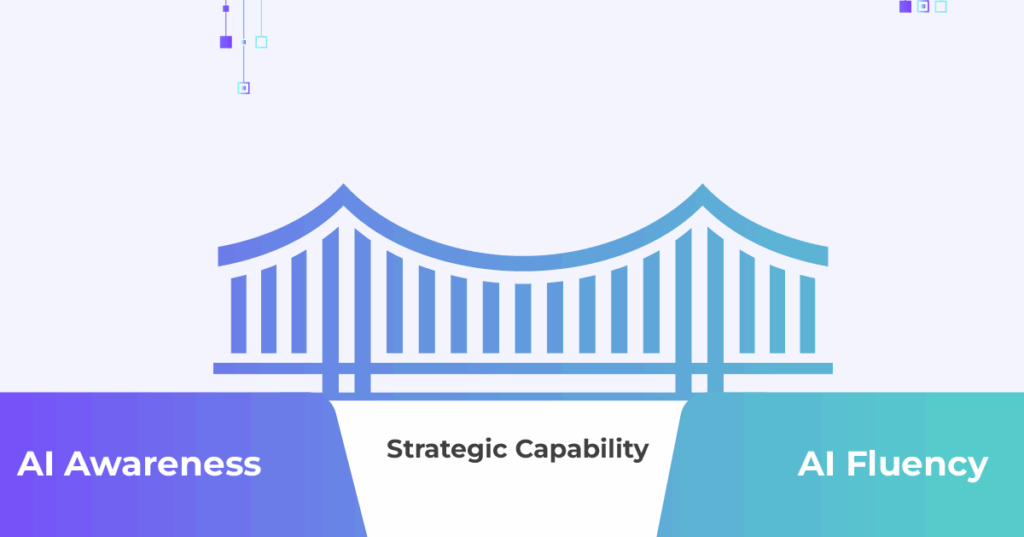
The integration challenge explains why organizations with strong technical AI capabilities still struggle with transformation. Technical excellence without fluency at all organizational levels creates what we call the AI chasm, where the majority of AI investments fail to translate insights into business decisions.

Organizations that achieve superior pilot-to-production success rates understand this integration requirement. They develop AI fluency systematically across all organizational levels, ensuring each level can perform their specific AI responsibilities while coordinating effectively with other levels.

Designing AI Education from Responsibilities Up, Not Technology Down

Most organizations approach AI education backwards. They start with technology features rather than role-specific responsibilities. They use generic curricula rather than level-appropriate requirements. They focus on individual learning rather than organizational coordination.

Effective AI fluency development begins with understanding what each organizational level actually needs to accomplish with AI. Board members need strategic oversight capability. Executive teams need decision-making confidence and resource allocation wisdom. Functional leaders need implementation intuition and outcome ownership skills. Employees need collaboration fluency and human-AI partnership capabilities.

The question for your organization isn’t whether people need AI fluency. Research shows that AI fluency and intuition serve as key levers for realizing value from AI and managing enterprise AI risks. The question is whether your current approach addresses the distinct responsibilities at each organizational level.

Start by assessing your organization’s current fluency gaps using the responsibility framework. Can your board ask the right questions about AI opportunities and risks? Can your executive team set realistic AI strategy and allocate resources effectively? Can your functional leaders own AI initiative outcomes confidently? Can your employees work effectively with AI tools while maintaining critical thinking and human judgment?

Organizations that answer these questions honestly and address gaps systematically position themselves for sustainable AI competitive advantage. Those that continue treating AI fluency as a generic requirement will join the 42% who abandon their AI initiatives when leadership gaps prevent transformation success.

Scaling Beyond Fluency: Building AI-Native Capability Through Training

Role-based fluency closes knowledge gaps, but it doesn’t close coordination gaps. Even when individuals across the organization understand AI’s value, transformation stalls without shared language, context, and systems that enable it to scale.

AI-Native Training by Scaled Agile, Inc. equips leaders and teams to bridge that gap. Each course builds on the last, creating an apprenticeship-style learning path that develops confidence, coordination, and capability across every level of the enterprise. Executives learn to align strategy and governance. Functional leaders learn to translate vision into execution. Teams learn to integrate AI responsibly into daily work.

These programs turn role-specific learning into enterprise results—transforming AI-literate individuals into aligned, AI-driven organizations ready to scale with confidence.

Explore AI-Native Training to discover how Scaled Agile helps leaders and teams strengthen fluency, accelerate transformation, and build the systems that turn potential into performance.

Schedule a conversation with our AI-Native team to discuss which training path is right for your organization and how to begin building coordinated AI capability across every level of leadership


About the Author:

Laks Srinivasan Headshot

Laks Srinivasan is a seasoned AI strategist and transformation leader at Scaled Agile, Inc., where he helps enterprises turn artificial intelligence from promise into performance. With more than 15 years of executive experience, Laks has guided global organizations through complex AI transformations, bridging the gap between strategy, technology, and measurable business outcomes.

As the Founder and CEO of the Return on AI Institute (ROAI), now part of Scaled Agile, he helped pioneer proven frameworks for AI operating models, value realization, and leadership fluency. His work continues to focus on demystifying AI for executives and equipping organizations with the knowledge and systems to apply AI responsibly and effectively.