Artificial Intelligence is no longer an abstract, future-oriented concept. It’s a present-day capability, woven into our lives and businesses. Increasingly, agile teams are turning to artificial intelligence to adapt to changing markets, respond quickly to demand, and deliver more value in a shorter timeframe.
From large enterprises to the smallest organizations, those that are becoming AI-Native are gaining a competitive advantage. But what tasks specifically should you hand over to AI? Generative AI (GAI) can’t replace the critical thinking or collaboration that makes agile teams successful. But leveraging AI tools and integrating them into workflows can free up resources and slash delivery time by automating some tasks for your role.
Kaitlin Whitney, PhD, Senior Predictive Insights and Analytics Manager at Scaled Agile, researched the effects of generative AI on agile team performance and found that smart implementation of AI can boost how many objectives an agile team actually accomplishes. The key, she said, is to ensure teams have a strong sense of where and how to apply GAI to work tasks and their roles. Teams should utilize best practices and ensure that everyone has access to the right knowledge and skills around GAI.
Most companies are experimenting with AI, but few understand how to generate meaningful value from AI tools in an agile setting.
Using AI to Augment the SAFe Scrum Master Role: Refine Backlogs and Improve Estimates
SAFe’s use of iterations and increments provides the ideal foundation for implementing rapidly changing technologies. Managing a backlog requires continuous refinement and prioritization. By automating repetitive tasks, Scrum Masters can free up time for more human-centric work like coaching, removing blocks, and empowering teams.
For example, AI tools can scan the backlog for duplicates or incomplete stories. It can identify stories that might be too large and need to be broken down. It can also assist with retrospective insights, helping Scrum Masters analyze patterns across multiple retros to identify recurring themes and track whether action items actually led to improvements. Other tasks that AI can support include metrics analysis to spot trends in velocity, cycle time, and throughput.
Responsible AI in Product Roles: Feedback Analysis and User Story Development
Product Owners and Product Managers can utilize AI tools to analyze customer feedback, group by common themes, and flag actionable items. Input value propositions, product information, user personas, constraints, and desired outcomes, and AI can generate a first draft of user stories that product professionals can then customize and refine. It can also help generate user personas and document updates for stakeholders.
AI tools may also help product professionals analyze the backlog and stories and compare them against product goals, value propositions, and user feedback. And, in the product role, AI tools can assist with competitor analysis and social listening to stay ahead of market trends and product release strategy.
AI Tasks for SAFe Professionals: Effort Estimation and AI Project Management
For agile team members, responsible AI is a valuable tool for breaking down epics into stories, summarizing historical data, and using that data to estimate effort and assign story points. By analyzing larger tasks, AI can help agile teams outline requirements, identify features and milestones, and flag any steps that might have been overlooked in the estimation process.
AI tools can also help teams forecast more realistic effort measurement based on past performance and current demands. Finally, day-to-day, AI can save practitioners valuable time by streamlining processes such as generating meeting notes and action items, summarizing research and documents, skill gap analysis, and accelerated learning.
Schedule a strategic conversation to explore how your team can evolve from AI-fluent to fully AI-Native—and start building the systems that make AI success repeatable.
Boards are now regularly requesting detailed AI strategy updates. Risk committees are probing AI-related governance frameworks. Audit committees are questioning AI investment returns and operational controls. Directors bring AI insights from other boards and portfolio companies, creating sophisticated expectations for strategic depth.
The questions have evolved from “What’s our AI strategy?” to “How do we measure sustainable competitive advantage from our AI investments?” Most companies find themselves navigating these complex governance discussions while working to develop the strategic frameworks that match board expectations.
In this blog, you’ll learn the specific questions that separate AI-fluent CEOs from those operating on awareness alone, why prepared talking points fail with sophisticated boards, and how to build the strategic understanding that transforms uncertainty into confidence.
The Strategic Challenge
What makes this particularly challenging is that the questions aren’t technical. They’re strategic. And they require the kind of AI fluency that builds confidence in high-stakes discussions rather than reliance on consultant-prepared talking points or deflection to technical teams.
The question every CEO should ask: “Am I prepared to lead AI strategy, or am I hoping my technical team can cover for my knowledge gaps?”
The Questions That Expose AI Fluency Gaps
Based on our extensive leadership interviews and research, here are the board questions that consistently catch unprepared CEOs off guard:
1. “How does our AI strategy align with our core business model, and what specific competitive advantages are we building?”
Why This is Hard: This question requires understanding how AI creates sustainable differentiation, not just operational efficiency. It demands knowledge of which AI capabilities become commoditized quickly versus those that build lasting advantage.
What Fluent CEOs Know: They can articulate specific AI applications that leverage their company’s unique data, processes, or market position. They understand the difference between AI tools anyone can buy and AI capabilities that create competitive moats.
2. “What are our key AI-related risks, and how are we managing them systematically?”
Why This is Hard: Beyond obvious concerns about data privacy and bias, this question requires understanding regulatory compliance, operational risks, strategic risks of falling behind, and the risks of poor AI investments. CEOs need to understand AI’s dangers and limitations without needing to know how AI works technically.
What Fluent CEOs Know: They can discuss AI risk across multiple dimensions: technical risks, reputational risks, regulatory risks, and competitive risks. They understand how AI decisions today create or mitigate risks five years from now. Most importantly, they grasp the strategic implications of AI limitations and failure modes without requiring technical implementation knowledge.
3. “How do we measure ROI on AI investments, and what metrics indicate we’re succeeding versus just spending money?”
Why This is Hard: Traditional ROI frameworks often don’t capture AI’s value creation patterns. AI investments may reduce costs, increase revenue, enable new business models, or create strategic options that are hard to quantify.
What Fluent CEOs Know: They use frameworks that evaluate opportunities through both analytical rigor and business impact potential. They understand the difference between AI investments that pay off quickly, those that build long-term capabilities, and have returns certified by the CFO validation
Most importantly, they can articulate how AI insights translate into strategic actions that drive measurable results.
They accomplish this through an “Outcome First, AI Next” approach that starts with business objectives rather than AI capabilities.
Traditional approaches start with AI capabilities and look for applications. The “Outcome First, AI Next” framework inverts this: start with desired business outcomes, then work backward to identify the AI capabilities needed.
Most organizations excel at generating impressive AI insights but fail to design the decision-making processes that create business value, leaving millions in AI investment without strategic returns.
4. “How confident are you that our current AI initiatives will scale effectively, and what would cause you to change course?”
Why This is Hard: This question probes understanding of AI implementation challenges, organizational readiness, and strategic flexibility. It requires honest assessment of current capabilities versus future needs.
What Fluent CEOs Know: They understand the organizational requirements for scaling AI beyond pilot projects, including talent development, change management, mental model shifts, and cultural transformation. They can articulate clear success criteria and decision points for AI investments. They recognize when organizations are stuck generating insights without driving business impact, and know how to bridge that gap systematically.
5. “What would happen to our competitive position if our primary competitors achieved AI maturity first?”
Why This is Hard: This scenario planning question requires deep understanding of how AI could disrupt the industry, change customer expectations, or create new competitive dynamics.
What Fluent CEOs Know: They’ve thought through competitive scenarios systematically. They understand their industry’s AI transformation timeline and their company’s position within that evolution.
Quick self-assessment: Which of these 5 board questions would challenge you most in your next board meeting? Rate your current confidence level (1-10) for each question above.
The CEO Time Challenge
CEOs face unprecedented near-term pressures with quarterly earnings, operational crises, and strategic decisions demanding immediate attention. With 60-hour weeks already stretched thin, how can leaders find time to develop AI fluency while managing these competing priorities?
This time constraint leads many CEOs to rely on shortcuts: consultant-prepared responses, technical briefings from their teams, or hoping their CTO can handle board questions. While understandable, this approach creates several risks:
Surface-Level Knowledge Gaps: When board discussions dive deeper than prepared talking points, the knowledge gaps become apparent. Sophisticated directors can distinguish between genuine strategic insight and memorized responses.
Context Blind Spots: AI strategy doesn’t exist in isolation. Board conversations weave together AI implications with talent strategy, risk management, capital allocation, and competitive positioning. Without foundational understanding, CEOs struggle to make these strategic connections in real-time.
Confidence Under Pressure: When facing unexpected questions or challenging scenarios, leaders without real fluency become visibly uncomfortable. This uncertainty undermines board confidence in leadership capability.
The Strategic Risk: In today’s competitive landscape, AI illiteracy at the CEO level creates vulnerability. Boards increasingly expect leaders who can think strategically about AI implications, not just delegate to technical teams.
Before reading further, consider this: Given your current time constraints and pressures, what’s the most efficient path to develop the AI fluency needed for confident board leadership?
The Business Case for CEO AI Fluency
The difference between AI awareness and AI fluency becomes clear when examining leaders who have successfully transformed their organizations. Consider Bill Niles, CEO of Brinks Home Security, who exemplifies how strategic AI fluency creates measurable competitive advantage.
Niles isn’t a tech guru (he’s a lawyer by training), yet he has led one of the most successful AI transformations in the home security industry. When he took over as CEO, Brinks faced 18% customer attrition and struggled with operational inefficiencies. Today, they’ve reduced churn to 10.4% and improved margins from 48% to 60% on $500 million in revenue.
What enabled this transformation wasn’t technical expertise, but what Niles calls being a “true believer” in AI’s strategic potential. His fluency allowed him to:
Make Strategic Connections: Niles connected AI capabilities to core business metrics that matter: customer retention, operational efficiency, and competitive positioning. He understood that reducing call center volume from 4 million to 1.2 million annually wasn’t just cost savings, but competitive advantage through superior customer experience.
Lead Through Uncertainty: Despite not being technical, Niles drove the organization through complex data consolidation, multiple reorganizations, and cultural change. His conviction came from understanding AI’s business implications, not its technical mechanics.
Create Organizational Alignment: Perhaps most importantly, Niles elevated AI strategy to board level and made it clear to direct reports that transformation wasn’t optional. He became what he calls the “chief evangelist,” creating company-wide belief in AI’s potential.
The results speak to strategic fluency’s power. Brinks didn’t just improve operations; they built sustainable competitive advantages that compound over time. Better customer retention means more resources for acquisition. Improved margins create pricing flexibility. Enhanced service capabilities enable market expansion.
This strategic capability extends beyond individual decisions to organizational confidence. When leadership understands AI’s strategic implications and can make informed decisions quickly, it accelerates adoption and improves execution quality throughout the organization. Teams see direction, not uncertainty.
The question for every CEO: Are you prepared to be the chief evangelist for your organization’s AI transformation, or will you delegate this strategic imperative to others?
From Board Confidence to Organizational Results
Your leadership team’s AI fluency creates strategic decision-making capability—but without the right systems, those insights never scale. The missing dimension is building the organizational infrastructure that turns informed leadership into coordinated execution.
AI-Native organizations embed AI into their DNA—navigating exponential change, continuous disruption, generative creativity, and emergent behaviors with clarity and confidence.
Our latest white paper, Becoming AI-Native: A Practical Guide to Thriving on the EDGE, reveals the seven interconnected success factors that transform organizational systems. This research complements your fluency development with the enterprise framework that connects individual capability to measurable business outcomes.
Schedule a strategic conversation to explore how your team can evolve from AI-fluent to fully AI-Native—and start building the systems that make AI success repeatable.
Laks Srinivasan is a seasoned AI strategist and transformation leader at Scaled Agile, Inc., where he helps enterprises turn artificial intelligence from promise into performance. With more than 15 years of executive experience, Laks has guided global organizations through complex AI transformations, bridging the gap between strategy, technology, and measurable business outcomes.
As the Founder and CEO of the Return on AI Institute (ROAI), now part of Scaled Agile, he helped pioneer proven frameworks for AI operating models, value realization, and leadership fluency. His work continues to focus on demystifying AI for executives and equipping organizations with the knowledge and systems to apply AI responsibly and effectively.
Why knowing about AI trends doesn’t equal the fluency needed for strategic AI decision-making
AI Awareness Isn’t Enough for Strategic Success
The Chief Data Analytics Officer of a large multinational company reached out to me with a challenge that’s becoming increasingly common.
“We do AI,” he explained, “but AI is in pockets. It’s an activity we do, it’s not coherent, it’s not coordinated.”
His leadership team was aware of AI developments. They read industry reports, attended conferences, and could discuss machine learning in board meetings. But when it came to making strategic decisions about AI investments and scaling, they lacked conviction.
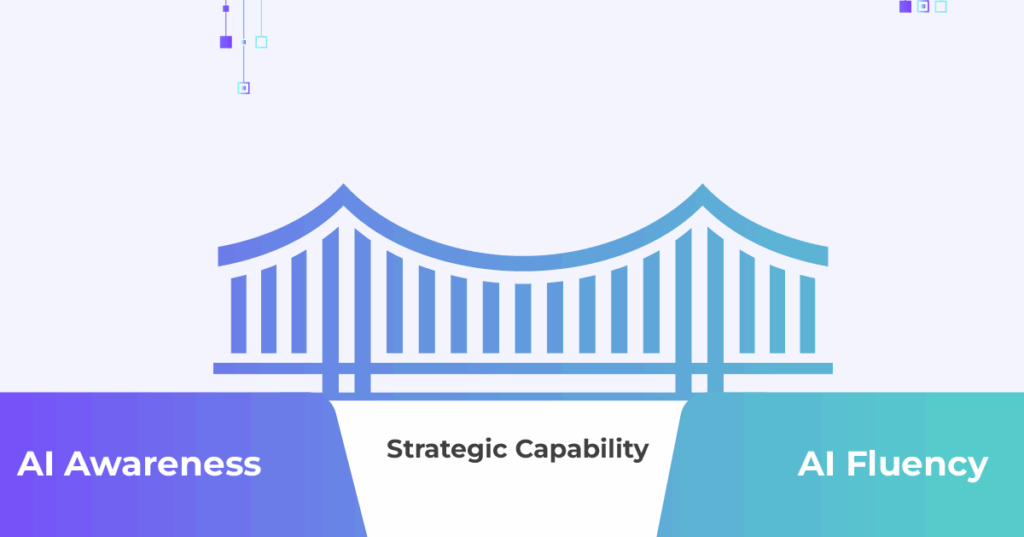
This leader had discovered the difference between AI awareness and AI fluency. This gap is quietly limiting competitive advantage across industries while early adopters gain strategic positioning.
Having guided 1000+ leaders through AI fluency development across small enterprises to Fortune 100 companies and multiple industries, we’ve seen this pattern repeatedly.
Board directors, C-suite executives, and senior leadership teams all struggle with the same fundamental challenge: translating AI awareness into strategic decision-making capability.
Why AI Awareness Isn’t Enough for Strategic Success
Recent research reveals a significant opportunity gap in enterprise AI adoption:
42% of companies abandon the majority of their AI initiatives, up from 17% the previous year (S&P Global, 2025)
70-85% of GenAI deployments fail to meet ROI expectations (NTT DATA, 2024)
80% of organizations see no tangible EBIT impact from GenAI investments (McKinsey, 2024)
Yet only 4% of 1,000+ executives qualify as AI/analytics leaders (Kearney, 2024), while most believe they understand AI well enough to guide strategic decisions.
The Strategic Distinction
AI Awareness means understanding that AI exists and recognizing that it’s creating significant business value for companies, but without knowing what AI actually is or how it generates that value.
AI Fluency means understanding foundational AI concepts and having the capability to make confident, strategic decisions about AI implementation, governance, and scaling. This includes knowing what AI actually is and how it creates sustainable business value for your specific organization. AI fluency, when put into practice, builds the intuition and conviction leaders need to assess AI opportunities and risks with the same confidence they demonstrate in their core business domains.
“The definition of adoption is getting people to work in a different way… why aren’t more specialists talking about this obvious missing link?” — NTT DATA Research, 2024
Most organizations focus on technology implementation without building the organizational fluency needed for sustainable AI advantage.
The High Cost of AI Fluency Gaps
Organizations with leadership fluency gaps face three critical disadvantages that compound over time:
1. Competitive Disadvantage: While competitors with AI-fluent leadership teams achieve productivity gains, organizations stuck in pilot purgatory fall further behind. The fluency gap becomes a permanent competitive moat—favoring those who developed it first.
2. Financial Waste: 46% of AI proofs-of-concept get discontinued due to poor strategic decisions (S&P Global, 2025). Without fluency to evaluate which projects create real business value, organizations fund technology potential instead of business outcomes, burning millions on initiatives that never scale.
4. Talent Acquisition Challenges: Top AI talent gravitates toward organizations where leadership understands their work and can make informed decisions about AI investments. Companies with fluency gaps struggle to attract and retain the best AI professionals, further widening the competitive gap.
These disadvantages persist because traditional approaches to AI education fundamentally misunderstand what leaders need to succeed.
Why Traditional AI Learning Programs Fail Leadership Teams
The AI fluency gap persists because existing solutions address the wrong problem:
Academic Programs Focus on Techniques, Not Decisions Programs teach supervised learning, neural networks, and algorithmic concepts. However, CEOs don’t need to understand gradient descent; they need confidence to evaluate which AI vendor claims are realistic.
Individual Learning vs. Team Capability Most executive education targets individuals. But as one of our clients explained: “There are two guys who know AI well, others don’t. The common denominator is that most don’t know, so it gets stuck in pockets.” Team fluency is only as strong as the weakest member.
Case Studies Don’t Build Decision-Making Confidence Consulting approaches rely on learning by analogy; teaching through project examples from other companies alone doesn’t work. But just because an AI strategy worked at one company doesn’t mean it will work for a competitor, even in the same industry. This approach doesn’t prepare leaders to evaluate what will actually work in their specific organizational context.
How Scaled Agile Builds AI Fluency: Beyond Traditional Executive Education
Most AI programs focus on tools and terminology. Scaled Agile focuses on transformation—the mindset, fluency, and leadership behaviors that define AI-Native organizations.
Through Scaled Agile’sAI-Native Training, we help leaders and teams move beyond using AI tools to developing the fluency to think, lead, and operate differently because AI exists. Each course builds on the last, creating an apprenticeship-style learning path that develops both confidence and capability over time.
Participants progress from foundational understanding to applied mastery, learning how to evaluate AI opportunities, redesign workflows for leverage (not just speed), and guide responsible adoption across the enterprise. Every experience translates complex AI concepts into actionable frameworks that leaders can apply immediately to drive measurable results.
Scaled Agile’s AI-Native Training isn’t just education. It’s an ongoing apprenticeship in how to lead, decide, and compete in an AI-augmented world.
From AI Fluency to AI-Native: Turn Insight into Systemic Advantage
Fluent leaders make better AI decisions. AI-Native organizations turn those decisions into enterprise results.
The next step in your transformation is understanding the EDGE forces—Exponential, Disruptive, Generative, and Emergent—that reshape how organizations must think, work, and scale in the age of AI.
Our latest white paper, Becoming AI-Native: A Practical Guide to Thriving on the EDGE, reveals how leading enterprises embed AI into their operating systems through seven interconnected success factors. This research complements your fluency development with the organizational design that turns capability into coordinated execution and measurable competitive advantage.
Download the white paper to see how AI-Native systems transform fluent leaders into organizations that learn, adapt, and outperform.
Schedule a strategic conversationto explore how your team can evolve from AI-fluent to fully AI-Native—and start building the systems that make AI success repeatable.
About the Author:
Laks Srinivasan is a seasoned AI strategist and transformation leader at Scaled Agile, Inc., where he helps enterprises turn artificial intelligence from promise into performance. With more than 15 years of executive experience, Laks has guided global organizations through complex AI transformations, bridging the gap between strategy, technology, and measurable business outcomes.
As the Founder and CEO of the Return on AI Institute (ROAI), now part of Scaled Agile, he helped pioneer proven frameworks for AI operating models, value realization, and leadership fluency. His work continues to focus on demystifying AI for executives and equipping organizations with the knowledge and systems to apply AI responsibly and effectively.
Why do 42% of companies abandon their AI initiatives while only 4% develop AI-capable leadership? The answer isn’t technical complexity or insufficient investment. It’s that organizations design AI training as if strategic decision-makers and daily AI users need identical knowledge and skills.
This fundamental mismatch plays out across industries because organizations treat AI fluency as a one-size-fits-all requirement. The reality? Each organizational level has fundamentally different responsibilities with AI, and generic training programs fail because they ignore these distinct roles.
Aligning AI Learning Programs with Role-Specific Requirements
The Return on AI Institute’s research across 45+ leadership interviews reveals that successful AI transformation requires each leadership level to master distinct responsibilities. When organizations understand this framework, they achieve significantly higher pilot-to-production success rates compared to the industry average.
The challenge lies in current approaches that treat board members, executive teams, and functional leaders as if they need identical AI knowledge. They don’t. Each level has specific responsibilities that require tailored fluency development:
Board & CEO responsibility: Deciding AI ambition and asking the right questions to assess opportunities and risks
Executive Leadership Team responsibility: Setting AI strategy and allocating capital and resources
Business/Functional Leaders responsibility: Owning outcomes from AI initiatives
All Employees responsibility: Working effectively with AI tools while maintaining human judgment and value creation
Generic AI training fails because it doesn’t address these distinct role requirements. When a pharmaceutical company’s Chief Data Officer told us, “We do AI, but AI is in pockets, it’s activity we do, it’s not coherent, it’s not coordinated,” the root cause wasn’t technical complexity. It was leadership fluency gaps preventing each level from performing their AI responsibilities effectively.
Board and CEO: Strategic Oversight Without Technical Overwhelm
Board members and CEOs must set organizational AI ambition and provide strategic oversight. However, many lack the fluency to fulfill these critical responsibilities effectively.
The core challenge: they struggle to distinguish between AI hype and genuine business opportunity. This leads to approving AI investments without clear success metrics, setting unrealistic expectations about AI capabilities, and providing vague strategic direction that confuses rather than guides implementation teams.
What this level actually needs: The ability to define realistic AI ambition aligned with business strategy, ask the right questions to evaluate AI proposals, understand AI’s fundamental capabilities and limitations, and establish governance frameworks that ensure AI investments deliver measurable business outcomes.
They don’t need technical training on algorithms. They need strategic fluency that enables confident decision-making about AI direction, investment, and risk management.
Executive Leadership Teams: Strategy Translation and Resource Allocation Mastery
Executive leadership teams face different challenges that prevent AI scaling. They often set unrealistic goals and commitments for AI initiatives while failing to prioritize AI projects with appropriate resources. This level gets caught between board expectations and operational realities.
What this level actually needs to know: How to translate AI vision into executable strategy, allocate capital and resources effectively across competing priorities, create realistic timelines and success metrics, and coordinate cross-functional AI initiatives.
When executive leadership teams master their AI responsibilities, they bridge the gap between board vision and operational execution. They become the strategic coordination layer that prevents AI initiatives from remaining isolated experiments.
Business/Functional Leaders: Implementation Intuition and Outcome Ownership
Business and functional leaders face the most complex AI fluency requirements because they own the actual outcomes from AI initiatives. Their challenges center on difficulty establishing key capabilities and inability to diagnose problems and execute effective actions when AI implementations don’t perform as expected.
What this level actually needs to know: How to establish AI capabilities within their functions, diagnose AI adoption issues, optimize human-AI collaboration, measure AI impact on business outcomes, and scale successful pilots across their operations.
This level requires what we call “implementation intuition” – the practical judgment to know when AI is working effectively, when it needs adjustment, and how to integrate it into existing business processes successfully.
Business leaders need enough AI understanding to be intelligent consumers of AI capabilities, effective managers of AI-human collaboration, and confident owners of AI-driven business outcomes.
All Employees: Thriving in AI-Enhanced Work Environments
While leadership levels require strategic and implementation fluency, every employee faces the reality of working alongside AI systems. The challenge isn’t technical complexity, but rather developing the practical skills needed to collaborate effectively with AI tools while maintaining human judgment and value creation.
The most common employee challenges center on uncertainty about when to trust AI outputs, how to effectively prompt and interact with AI systems, and understanding their evolving role in an AI-enhanced workplace. Many employees either over-rely on AI without applying critical thinking or under-utilize AI capabilities due to fear or misunderstanding.
What this level actually needs to know: How to effectively prompt and interact with AI systems, when to trust AI recommendations versus applying human judgment, how to maintain quality and accuracy in AI-assisted work, and understanding their unique human value in an AI-enhanced environment.
This level requires what we call “collaboration fluency” – the ability to work productively with AI tools while recognizing the boundaries of AI capabilities and maintaining essential human oversight, creativity, and critical thinking.
Employees need enough AI understanding to be effective collaborators with AI systems, intelligent consumers of AI-generated content, and confident contributors of uniquely human value in an increasingly AI-integrated workplace.
From Board to Operations to Frontline: Creating AI Alignment
AI transformation fails when any level cannot perform their specific AI responsibilities effectively. Board uncertainty creates resource constraints. Executive coordination gaps prevent scaling. Functional implementation struggles destroy ROI. Employee resistance or misuse undermines adoption at every level.
Successful organizations recognize that AI fluency must cascade through all four levels, with each level achieving competency in their distinct responsibilities. As one pharmaceutical executive noted, AI transformation is “a team sport” requiring coordinated capability across the entire organization.
The integration challenge explains why organizations with strong technical AI capabilities still struggle with transformation. Technical excellence without fluency at all organizational levels creates what we call the AI chasm, where the majority of AI investments fail to translate insights into business decisions.
Organizations that achieve superior pilot-to-production success rates understand this integration requirement. They develop AI fluency systematically across all organizational levels, ensuring each level can perform their specific AI responsibilities while coordinating effectively with other levels.
Designing AI Education from Responsibilities Up, Not Technology Down
Most organizations approach AI education backwards. They start with technology features rather than role-specific responsibilities. They use generic curricula rather than level-appropriate requirements. They focus on individual learning rather than organizational coordination.
Effective AI fluency development begins with understanding what each organizational level actually needs to accomplish with AI. Board members need strategic oversight capability. Executive teams need decision-making confidence and resource allocation wisdom. Functional leaders need implementation intuition and outcome ownership skills. Employees need collaboration fluency and human-AI partnership capabilities.
The question for your organization isn’t whether people need AI fluency. Research shows that AI fluency and intuition serve as key levers for realizing value from AI and managing enterprise AI risks. The question is whether your current approach addresses the distinct responsibilities at each organizational level.
Start by assessing your organization’s current fluency gaps using the responsibility framework. Can your board ask the right questions about AI opportunities and risks? Can your executive team set realistic AI strategy and allocate resources effectively? Can your functional leaders own AI initiative outcomes confidently? Can your employees work effectively with AI tools while maintaining critical thinking and human judgment?
Organizations that answer these questions honestly and address gaps systematically position themselves for sustainable AI competitive advantage. Those that continue treating AI fluency as a generic requirement will join the 42% who abandon their AI initiatives when leadership gaps prevent transformation success.
Scaling Beyond Fluency: Building AI-Native Capability Through Training
Role-based fluency closes knowledge gaps, but it doesn’t close coordination gaps. Even when individuals across the organization understand AI’s value, transformation stalls without shared language, context, and systems that enable it to scale.
AI-Native Training by Scaled Agile, Inc. equips leaders and teams to bridge that gap. Each course builds on the last, creating an apprenticeship-style learning path that develops confidence, coordination, and capability across every level of the enterprise. Executives learn to align strategy and governance. Functional leaders learn to translate vision into execution. Teams learn to integrate AI responsibly into daily work.
These programs turn role-specific learning into enterprise results—transforming AI-literate individuals into aligned, AI-driven organizations ready to scale with confidence.
Explore AI-Native Training to discover how Scaled Agile helps leaders and teams strengthen fluency, accelerate transformation, and build the systems that turn potential into performance.
Schedule a conversation with our AI-Native team to discuss which training path is right for your organization and how to begin building coordinated AI capability across every level of leadership
About the Author:
Laks Srinivasan is a seasoned AI strategist and transformation leader at Scaled Agile, Inc., where he helps enterprises turn artificial intelligence from promise into performance. With more than 15 years of executive experience, Laks has guided global organizations through complex AI transformations, bridging the gap between strategy, technology, and measurable business outcomes.
As the Founder and CEO of the Return on AI Institute (ROAI), now part of Scaled Agile, he helped pioneer proven frameworks for AI operating models, value realization, and leadership fluency. His work continues to focus on demystifying AI for executives and equipping organizations with the knowledge and systems to apply AI responsibly and effectively.
The AI-Native Launch Event brought together leaders, partners, and practitioners from around the world to explore how enterprises can move from using AI tools to thinking and working AI-natively.
If you joined us live — thank you. If you couldn’t make it, this page includes everything you need to catch up, explore resources, and continue your AI-Native journey.
What We Covered:
Business Imperative of Artificial Intelligence
The session opened with Andrew Sales and Laks Srinivasan, who set the stage by unpacking the business imperative of artificial intelligence. They reminded us that AI isn’t a future disruption — it’s a present capability — and that the organizations (and individuals) who learn to think and work AI-native will be the ones shaping what comes next. Their message was clear: AI adoption is no longer optional. It’s now part of how modern enterprises compete, deliver, and grow.
The AI-Naive Learning Path
From there, Dr. Steve Mayner guided us through the AI-Native Learning Path, showing how Scaled Agile is applying the same disciplined approach that scaled agility across enterprises to now build AI fluency at scale. He dove into the details of AI-Native Foundations, explaining how this first course equips teams with the shared language, confidence, and responsible practices needed to begin redesigning real workflows with AI.
Next, we turned it over to Arun Saraswat, a member of our Framework Team working on the AI side, who walked us through the second course in the journey — AI-Native Change Agent. Arun illustrated how this training helps change leaders move AI projects out of the proof-of-concept graveyard and into measurable business impact, giving participants practical frameworks to lead cross-functional initiatives that actually deliver.
Together, our speakers painted a clear picture of what it means to become AI-native: building capability, not dependency; fluency, not just familiarity; and a culture where innovation and governance move hand in hand.
AI-Native Whitepaper :: A practical guide to thriving in the Age of AI, introducing the EDGE Framework and the seven AI-Native Success Factors that help organizations turn exponential change into sustainable advantage.
AI-Native Training Calendar :: Your single source for upcoming in-person enablement sessions across North America, Europe, and APAC including Foundations and Change Agent courses.
AI-Native Foundations Course Page :: Explore how this two-day immersive training helps all professionals build core AI fluency, redesign real workflows, and apply responsible AI practices from day one.
AI-Native Change Agent Course Page :: Discover how this hands-on, project-based course equips change leaders to move AI initiatives from proof-of-concept to production impact using repeatable success patterns.