AI ML Product Managers: A Comprehensive Guide

Product management isn’t a new role; it’s been around for nearly a century, since Procter & Gamble coined the term in a memo. However, the position is almost unrecognizable from its early days and is still changing rapidly. Much of the reason for this is evolving technologies. Currently, AI and machine learning are transforming the way we conduct business, and our traditional roles must evolve with them to accommodate this new technology. 

In product development, especially, AI/ML is moving from research endeavours into practical application, and organizations require support from specialists in this area to successfully envision, create, and deploy AI products. 

This is where the role of an AI ML Product Manager is becoming increasingly crucial. 

What Is an AI Product Manager?

A traditional PM oversees the vision and strategy for a product and defines a roadmap for developing it. An AI product manager does the same thing, but specifically for products where artificial intelligence or ML is a core part of the product itself, not merely a tool used by the team during development. This change, however, is enough to alter the role significantly.

Implementing AI within the product makes the development process more dynamic, as the products evolve with the data they process. Essentially, they have the capacity to learn. As such, their development process must be continually adaptive, which requires a new skillset and mindset. 

That’s why the role of an AI product manager is distinct; they are responsible not just for what the application does today, but for how it learns and changes over time. This means balancing standard product strategy with an understanding of data and machine learning behavior, as well as ongoing model iteration.

A few unique core aspects of the role of an AI PM include:

  • Data-driven decision-making: AI products rely on data, so PMs must be well-versed in how this is collected and processed, and understand model training
  • Model lifecycle management: AI and ML models are anything but static. They require PMs to guide continual iteration and retraining to keep it aligned with its objectives
  • Cross-functional collaboration: AI teams will include personnel from many disciplines, from engineers to analysts. The PM bridges these roles and ensures everyone collaborates smoothly towards shared goals

The role of an AI product manager is not only related to technical AI use in the products you’re developing; it’s more about connecting AI/ML potential with business value, adopting an AI‑Native mindset that treats AI as a fundamental part of organizational decision-making and workflow design. They must assess entire value streams, identifying where AI products can improve customer experiences or enhance processes, rather than focusing just on machine learning components or features.

What’s The Difference Between Traditional vs AI Product Management?

As mentioned earlier, AI/ML product management has unique requirements due to the dynamic nature of AI-driven products. This isn’t the only way the role contrasts with traditional PM responsibilities, however. Here are several significant ways in which they differ:

Communication and Culture

Although product management has always involved translating features into business outcomes, it becomes even more important when AI is involved. An AI-Native culture is one where responsible AI practices and ongoing learning are commonplace and integrated into decision-making. 

To develop such a culture, it is necessary to bridge technical complexity with a holistic business understanding that doesn’t just include value creation but also ethical considerations, regulatory compliance, and the responsible use of AI in ways that protect users and society.

Unpredictable Outcomes and Development Lifecycle

In traditional product management, products and their features generally behave as expected after they’re released, so it’s easy to predict timelines. This is not always the case with AI-driven solutions. Their results can vary based on factors such as training data and real-world interactions. As a result, PMs must be prepared to adapt and iterate to keep outcomes aligned with expectations, which can affect timelines. This is where our AI-Empowered PO/PM certification can help you.

Success Metrics

Traditionally, the success of a product was measured by standard metrics like adoption and engagement rates, as well as revenue. While these are naturally still relevant to AI products, there are more organization-centric benchmarks to judge success on, too. These include the fairness and trustworthiness of AI outputs, as well as their explainability and business impact. 

For example, an AI‑driven recommendation engine might be evaluated not only on click-through or conversion rates but also on whether its suggestions are equitable across different user groups and whether product teams can understand and explain why specific recommendations are made. These metrics ensure both business value and responsible AI use.

Organizational Impact

AI/ML product managers don’t just influence individual projects or features; instead, they shape entire workflows and value streams. They help businesses embed AI into operations at scale and automate decisions. Essentially, they guide organizations to think with AI, not just use it as a tool. This company-wide influence is necessary because AI’s value is realized only when it transforms business processes, not just individual products. 

Ethics and Regulations

Beyond compliance, traditional PMs don’t have much focus on governance, and accountability largely centres on product success and adoption. An AI product manager, on the other hand, must consider everything from bias and fairness to transparency, privacy, and security (everything that makes up responsible and ethical AI practices). Additionally, they’re accountable for model errors and societal impacts of AI outputs. Put simply, the stakes are higher. 

AI ML Product Manager Role and Responsibilities

The specific responsibilities of an AI Product Manager will vary greatly depending on their industry and use cases. However, there are some obligations that unite all roles in this area. Generally, these all come under the umbrella of balancing tech with business, but here are some specific commitments:

Identifying Where AI Holds Real Value

An AI PM’s role is not to apply AI wherever possible; it’s far more considered than this. Instead, they must evaluate whether a problem actually needs AI to be solved and whether the use of intelligence would meaningfully outperform simpler alternatives. This process sets an AI-Native organization apart from others, ensuring that AI initiatives align business processes, data, and decision-making so that they drive consistent, measurable outcomes.

Driving Enterprise-Scale Adoption

Many AI initiatives fail because they don’t integrate: they remain siloed. A product manager holds the task of ensuring these products move beyond proof-of-concept by planning integration across functions and aligning workflows to prevent barriers to scaling. 

Aligning People With Technology

AI solutions deliver real value only when teams know how to use them effectively. AI/ML product managers are responsible for embedding AI into workflows and decision-making, ensuring it supports business goals. They coordinate cross-functional teams to help organizations adopt a mindset where AI is a tool for meaningful outcomes, not just experimentation.

Managing Ethics and Risk

As we’ve noted, there are significant amounts of ethical and regulatory considerations to prioritize when managing an AI product lifecycle. AI/ML managers are responsible for anticipating potential failures, such as biases, and putting guardrails in place to maintain fairness and transparency. This also involves coordinating with legal and compliance teams. 

By ingraining these practices into development, PMs balance innovation with accountability and ensure products deliver value safely. 

Facilitating Continuous Learning 

One of an AI product manager’s main roles is ensuring that their products improve over time by effectively utilizing AI models. To do this, they must establish feedback loops that connect user interaction, the resulting business outcomes, and the AI model’s performance. Insight from these will guide updates and keep AI accurate and aligned with evolving organizational goals.

AI/ML Product Management Guiding Principles

Why > What

Naturally, the quality of a completed AI product is important. But why it’s created is of equal or greater concern for product managers in this space. What objective will this solution help you achieve, and will it help organizations become closer to being AI Native?

Outcomes > Metrics

Quantitative metrics are always important in measuring success, but an AI product’s impact is measured through more than just hard figures like uptake and revenue. While these shouldn’t be ignored, it’s vital to focus on the outcomes that these deliverables create, such as improved decision-making, that drive business value.

Responsibility > Speed

Usually, fast delivery periods are a differentiating factor that helps businesses stay competitive: the faster you can deliver a product, the greater your chances of staying ahead of the market. 

While this is still important in AI product development, the priority is ensuring ethics and transparency before launch. Responsible AI fosters long-term trust and enhances adoption, and should therefore be your primary concern. 

Integration > Isolation

In traditional product development, features can often succeed on their own (e.g. a new UI element or reporting dashboard). While integration matters, siloed products can still bring value. In contrast, AI delivers the greatest benefits when embedded across every aspect of your business, augmenting human capabilities, and enhancing workflows and decision-making while scaling impact. 

Why Demand for AI and Machine Learning PM Roles is Growing

AI has developed significantly in a short period of time, and its benefits are evident across industries. AI-driven products improve efficiency and accuracy, and therefore allow businesses to improve their performance. But to achieve these results, product development needs to be managed with care and expertise, hence the rapidly increasing demand for quality AI/ML PMs who can leverage AI effectively. 

With AI adoption among companies now at around 72%, product managers with artificial intelligence expertise are now highly sought after across a range of industries. 

But the initial buzz of implementing AI in any way possible and experimenting with results has now worn off. Today, it’s no longer a niche technology; it’s becoming central to how businesses compete and operate. 

As a result, organizations need professionals who can confidently translate AI’s capabilities into user-friendly products that can be embedded into their workflows and inform decision-making. They’re actively seeking product managers who have the skills to bridge the gap between data science and business value.

How to Become an AI Product Manager

Perhaps you’re already a product manager and want to upgrade your role, or you have a distinct interest in AI and feel a desire to focus your working life on making an impact with this technology. Alternatively, if you already hold this position, there are always ways to improve the way you carry out your responsibilities. 

Whatever your reasons, there are a few concrete steps you can take to increase your chances of being successful in managing AI/ML products:

Increase Your AI Knowledge

You’ll be working alongside many data scientists and ML engineers in this role, so while you don’t need to match their technical expertise, it’s important to have AI literacy. 

Learn how models are trained, algorithms are optimized, and how LLMs operate at a high level, for instance. The more you know, the more you can speak the language of your team and make informed product decisions based on how intelligence systems work.

But building the necessary knowledge extends beyond technical know-how. To truly succeed as a PM, you need to understand how AI can be beneficially ingrained into all day-to-day operations so you can design products that don’t just use intelligence but apply it meaningfully across organizations. 

Immerse Yourself in AI Courses

If you truly want to know how to build products that allow businesses to upskill, scale, and succeed with AI, take a course produced by specialists in this area. 

Scaled Agile’s AI-Native courses are backed by partners with decades of enterprise transformation experience. Through instructor-led, hands-on programs, we help you build the capabilities and culture to confidently deliver measurable AI value. 

Undertaking this training will equip you with the mindset and practical skills needed to translate AI potential into products that deliver meaningful impact and business outcomes. 

Get Hands-On Experience With AI Systems

While the theory is useful, getting practical experience experimenting with AI tools and working directly with AI-driven products will be most effective in equipping you with confidence and better judgment. 

The more you get hands-on with intelligence models, the better you’ll be able to convert their capabilities into strategically important and high-value products. 

Studying successful AI product case studies is also helpful here. Look at companies that have embedded intelligence in an admirable way, such as Netflix’s personalization engine or Sephora’s AI-driven recommendations, and learn from their approach. These stories may highlight challenges in AI products that your stakeholders could look to solve, or reveal patterns in how they’re integrated into decision-making at scale. 

With this practical insight, you’ll be better prepared to design AI products that deliver sustained business value rather than isolated experimentation.

Scaled Agile Gives You A Roadmap to AI and ML Product Management Success

Cultivate the skills your organization requires to fully embrace AI with Scaled Agile’s AI Native courses. Designed to help PMs develop products that integrate intelligence into daily decision-making processes and workflows, they support the translation of AI’s possibilities into tangible business results.

The AI-Native Foundations Course offers a two-day, intensive experience suitable for professionals at any stage of their career. It prepares participants to grasp AI’s significance in the transformation process. The course is structured to help you manage change and achieve a higher return on investment through the responsible application of AI.

The AI-Native Change Agent Course spans three days, immersing attendees in a practical AI project. The program walks participants through the entire process, from spotting potential to realizing value, all while sidestepping frequent mistakes.

Built on SAFe®’s established framework for business agility, Scaled Agile’s training prioritizes results, not just tools. This approach equips product managers to confidently and purposefully expand their AI initiatives.

AI Certifications for Product Managers

Oversee the development of AI products that are more than isolated tools; instead, they’re built into workflows to transform business outcomes.

Master the Future: Why AI Certification Matters for Product Managers

Organizations are currently facing an AI problem, with 95% of artificial intelligence initiatives failing to deliver impact despite significant investment. Why is this?

  1. Organizations aren’t developing a clear AI strategic vision and intent, set at the highest level of leadership, so efforts aren’t aligned with business outcomes
  2. Businesses aren’t upskilling their workforce to think with AI rather than using it in isolation
  3. AI initiatives aren’t being scaled from an experiential stage to a reliable solution

Overcome these challenges with instructor-led, hands-on courses designed by experts to help you become more Agile in your approach and integrate AI into all aspects of your organization.

With these insights, you can develop AI products that deliver consistent, measurable value business-wide.

SAFe Product Owner/Product Manager Certification

Learn the skills needed to take on additional responsibility as a product leader, and strengthen your role in product strategy and execution.

View training calendar

  • Foundational level: New to SAFe
  • Course duration: 2 days
  • Instructor-led: In-person or remote training
  • APM certification: Accreditation upon passing the exam

Why take this course?

  • ✓ Industry-leading SAFe Product Owner/Product Manager certification
  • ✓ Course certificate upon completion
  • ✓ Lifetime access to course workbook and online learning experiences for additional preparation
  • ✓ Unlimited attempt practice test with question-level feedback and coaching report that acts as a simulation and study tool
  • ✓ Customer support for learning and certification questions
  • ✓ Digital badge with social media share capability to grow your network
  • ✓ PMI PDUs, Scrum Alliance SEUs

Download course benefits

What You Will Learn

Role & Responsibilities for Product Owners & Product Managers

Find out how to do the daily tasks of a SAFe Product Owner or Product Manager, such as managing backlogs, making predictions, and dealing with risks and dependencies.

Product Delivery

Use lean-agile thinking and a focus on the customer to define, prioritize, and deliver stories and features that can be built, tested, and delivered quickly.

Lead and Support PI Planning

Learn how to get ready for and run PI planning, making sure that the vision and roadmaps are in line with business goals and working with teams to set clear PI goals.

AI Skills for Modern Product Roles

Discover how to use AI responsibly in backlog refinement, prioritization, feature discovery, and connecting with customers.

Learn more

Take Your Skills Even Further: AI-Native Training 

Expand your product skills by becoming AI-Native.

Build on your Agile foundation to lead products that adapt and can scale. Move beyond feature delivery to embedding AI responsibly across organizations, redesigning workflows and transforming experiments into impact. 

Find a course

AI-Native Foundations Certification

Upskilling in AI is no longer optional if you want to stay relevant. To remain competitive, product managers need to move from planning features to developing business-wide intelligence systems that prioritize ethical considerations. 

This two-day immersive course builds fundamental fluency in the best practices and mindsets needed to thrive in the Age of AI.

Learn more

Understand the EDGE™ Imperative

Get a good grasp of the exponential, disruptive, generative, and emergent forces reshaping the nature of work.

Breaking Down AI Jargon

Make sense of AI, ML, Generative AI, LLMs, RAG, and intelligent agents, using straightforward language.

Prompt With Confidence

Use safe and effective prompt engineering methods to achieve the best results.

Redesign Workflows

Plan how you can use AI to improve a specific work process of yours, and implement impactful results right away.

Attend a class today

AI-Native Change Agent Certification

Learn how to take AI products from proof of concept to measurable success, with an AI-Native value blueprint. The course focuses on achieving organizational change and stakeholder alignment, with effective risk management and governance. 

Gain the skills and confidence to not only understand AI but to use it for wide-scale transformation, fully embedding it across teams and workflows. 

Find a course

Lead the Value Maximizer Playbook

Learn the Audit, Activate, Optimize, Centralize framework, a practical approach to revealing and harnessing the hidden 80% of value in your AI tools. This offers real impact, far beyond basic adoption.

Translate Risk Into Strategic Advantage

Master the art of Advanced AI Fluency, enabling you to navigate intricate trade-offs (e.g. RAG vs. Fine-Tuning economics), using language that resonates in the business world. Also, employ Feasibility Filters to mitigate risks before a single line of code is written.

Orchestrate the AI Solution Lifecycle

Lead solutions through the Sense, Discover, Design, and Deliver stages. Transform a vague mandate into a concrete, cross-functional AI-Native Value Blueprint, which ensures everyone involved is on the same page.

Amplify Success with AI-Powered Storytelling

Use the AI-Powered Story Amplifier to turn technical success metrics into a captivating narrative, one that resonates with the C-suite. The result? Secure your next round of funding and drive company-wide adoption.

Attend a class today

What You Gain from an AI for Product Management Certificate

Earning an AI certification, either in Agile Product Management or becoming AI-Native, unlocks many career development opportunities. Not only will it signal your abilities to future employers, but you’ll also gain access to our community forums, expert resources, and training toolkits, among much more. 

Career Growth and Professional Credibility

Earning one of our recognized AI certifications for product managers signposts your drive and capability. It signals that you’re able to lead in AI-driven environments and translate intelligent technology into real business impact. Want to stand out as a product professional and strengthen your role as a trusted partner to cross-functional teams? Get certified. 

Practical, Real-World AI Skills 

Learn how to apply AI responsibly and effectively from the get-go in realistic day-to-day product development scenarios. Transform your daily decision workflows with hands-on experience in identifying and prioritizing beneficial AI use cases. Build confidence working with modern AI concepts that hold weight in the real world, including generative AI and intelligent systems.

Continued Learning and Resource Access

Gain full access to Scaled Agile Framework articles and skills library, along with webinars, community forums, certified-exclusive events, and much more. Your growth doesn’t stop once you’ve received your certificate; keep learning from expert-led instruction and real-world case studies, and apply practical frameworks you can reuse across roles and initiatives. 

Cross-Industry Transferability

AI skills are sought more and more across a wide range of industries, making your certification valuable, whatever sector you work in or move to in the future. Therefore, your achievement affords you greater career mobility as AI and machine learning become core aspects of businesses everywhere. 

Why Choose Scaled Agile AI Certification to Accelerate Your Product Career?

  1. Proven impact: Scaled Agile has trained over 2 million professionals across 20,000+ enterprises worldwide
  2. Enterprise-grade, global credibility: Proven track record enabling large-scale change with 15+ years of enterprise transformation success
  3. Global partner ecosystem: Expert instructors and coaches in every major market
  4. Human-centric AI enablement integrated with business agility: Offers practical tools to deliver measurable impact while empowering people, not replacing them
  5. Real-world frameworks that deliver measurable success: Designed for production, not pilots, to ensure direct business outcomes
AI Certifications for Product Managers course testimonial

Frequently Asked Questions

What are the key considerations when choosing an AI certification?

Finding the best AI certification for product managers depends on your priorities. 

Consider the course curriculum and learning outcomes, and whether these align with your career goals. If so, ask what level of expertise and experience the instructor has, and assess whether the learning format (online, in-person, or hybrid) works for you. Additionally, check whether you fit the target audience the course aims to capture. All these considerations will ensure you’re taking the right course for you to excel in product concepts and AI integration. 

Scaled Agile offers a range of in-person and online courses through their global partner network. All training is delivered by highly experienced experts in their field, and is designed to offer transferable skills that deliver career growth and mobility.

What ethical considerations in AI product development do your courses cover?

Ethical AI principles are non-negotiable in product development. Our courses address the most important factors, such as fairness, bias, transparency, data privacy, and accountability. We help product managers leverage AI to develop and scale solutions responsibly and in line with organizational and regulatory expectations.

Are there any prerequisites to taking Scaled Agile’s AI and product management courses?

Our SAFe Product Owner/Product Manager Certification is a foundation-level course, open to anyone new to SAFe.

Similarly, the AI-Native Foundations course also has no requirements. If you’re new to AI or want to build foundational fluency, this course is for you. No prior AI experience or coding knowledge is required.

The AI-Native Change Agent certification requires you to have completed and passed the AI-Native Foundations course before you enroll in this more advanced program. 

What is the duration and format of your AI courses for product managers?

  • SAFe Product Owner/Product Manager Certification: 2-day-long, in-person or remote training
  • AI-Native Foundations Certification: 2-day-long, in-person only training
  • AI-Native Change Agent Certification: 3-day-long, in-person only training


Why AI is the Ultimate Partner for Product Owners and Product Managers

Editor’s Note: Unprecedented business challenges are impacting your day-to-day role. You need more than theories—you need a plan and tactics. Welcome to the AI-Empowered blog series: Your guide to the what, why, and how of embracing AI to adapt and amplify your impact.

You’ve seen the headlines. You’ve felt the quiet buzz of AI chatbots in the background of your daily stand-ups. As a Product Owner (PO) or Product Manager (PM), your world is shifting beneath your feet.

Perhaps you’re staring at a backlog that feels more like a feature factory than a value-driven roadmap, wondering if artificial intelligence is about to automate your job away. You might feel the pressure to use AI tools but find yourself stuck in prompt purgatory, writing generic requests and getting hallucinated results that don’t fit your business context. The world of the modern product owner and product manager today looks like a frantic race to acquire new skills while simultaneously managing stakeholders who expect “AI magic” yesterday. The uncertainty isn’t just about the technology; it’s about your role in a world where data moves faster than your current workflows can handle.

The Hidden Costs of AI Inertia

Ignoring the AI evolution isn’t just a missed opportunity; it’s a direct threat to organizational health. When product leaders fail to integrate AI for POs and PMs, the business pays the price in three critical areas:

The productivity gap: Without AI augmentation, product teams spend up to 40 percent of their time on administrative debt—drafting user stories, manually summarizing feedback, and chasing status updates.

Strategic blindness: Companies failing to leverage AI-driven data analysis miss market signals that competitors catch in real time. This leads to strategic drift, where you build features that were relevant six months ago but are obsolete today.

The innovation tax: Research shows a widening chasm between AI-native firms and laggards.

Additionally, organizations that adopted AI for business functions saw a drop in productivity of 1.33 percentage points initially, but failing to redesign workflows around AI leads to a long-term ‘productivity paradox’ where legacy processes stifle new technology. 2

A Glimpse of Tomorrow: The AI-Empowered Product Leader

The future isn’t about AI taking over PO and PM jobs; it’s about the AI Product Owner taking over the market. Think of it as a world where your AI tools act as a tireless chief of staff. In this new reality, you aren’t just a task manager; you are an architect of outcomes. You use GenAI to synthesize thousands of customer tickets into actionable personas in seconds. You use prompt engineering to generate high-quality User Stories that are 90 percent ready-to-code, allowing you to spend your Mondays talking to customers instead of fighting with Jira. These are impactful skills you’ll gain from the AI-Empowered SAFe® Product Owner/Product Manager (POPM) course.

Your Expertise Enhanced: Defining the New Roles

The distinction between traditional roles and their AI-empowered counterparts is simple: leverage.

The AI Product Manager focuses on the what and the why by using AI to identify market gaps, conduct competitive research, and align AI initiatives with the long-term product vision. The AI Product Owner focuses on the how and when, utilizing AI-integrated tools to refine the backlog, automate acceptance criteria, and ensure the team is building the right thing at the right time. The Data Product Manager is a specialized role focused on the data supply chain, ensuring the models that power your product are fed high-quality, ethical, and unbiased data. Here are some specific examples of what AI could look like in your daily workflow as a PM or PO.

The AI product manager’s daily workflow

As an AI Product Manager, you leverage AI’s immense data processing power to anticipate a range of outcomes that inform your strategy:

Dynamic roadmapping. Research is vital, but roadmapping and prioritization are the heartbeat of a PM’s daily life. AI helps you move beyond static spreadsheets to create flexible, living roadmaps. You can use AI to create flexible roadmaps and “think around corners” to simulate what-if scenarios. If a competitor launches a surprise feature or a key dependency fails, AI can quickly re-calculate prioritization scores across your entire portfolio, helping you pivot without the usual panic.

Market sentiment synthesis. Instead of reading hundreds of App Store reviews, you use AI tools to ingest quarterly feedback and generate a “Top five friction points” report in minutes.

Strategic planning. Use AI to run “pre-mortem” simulations. “Act as a skeptical stakeholder. Identify three ways our proposed AI-driven recommendation engine might fail to meet our Q3 North Star Metric.”

Persona development. Use GenAI to create hyper-specific user personas based on actual behavioral data segments. This allows you to tailor features to a late-night power user rather than a generic customer.

The AI product owner’s daily workflow

For the AI Product Owner, the focus is on maximizing the flow of value through the Agile Team:

Accelerated User Stories. Writing user stories is no longer a blank-page exercise. By applying prompt engineering—such as providing the AI with a Feature description and asking for a breakdown into INVEST-compliant stories—you reduce drafting time by 70 percent.

Backlog refinement and estimation. During refinement, the PO can use AI tools to cluster sticky notes and identify dependencies across teams. AI can even suggest story point ranges based on historical velocity data for similar past tasks.

Automated acceptance criteria: Use AI to generate edge case scenarios. For a new login feature, the AI might suggest testing for “expired session during active API call,” a detail often missed in manual drafting.

By mastering these skills, you move from being a process follower to an AI-augmented strategist. You can link your expertise directly to tangible business results, such as reducing cycle time or increasing feature hit rates; benefits that are foundational to the SAFe Product Owner/Product Manager certification.

Practical applications: AI in your agile workflow

You don’t need to be a data scientist to lead an AI-empowered team. Here is how you can start today:

Prompt engineering. Stop asking AI to write a story. Instead, use structured prompts like this one: “As a SAFe AI Product Owner, draft three user stories for a new checkout feature, including acceptance criteria in Gherkin format, focusing on mobile-first users.

Backlog refinement: Use AI tools and chatbots to cluster similar feature requests and identify themes that your human eyes might miss.

Step by step: Integrating AI into SAFe workflows

Preparation (PI Planning). Use AI to ingest your Strategic Themes and generate draft PI Objectives.

Execution. Use AI to record and summarize Daily Stand-ups, automatically updating the team’s blockers list.

Refinement. Use chatbots to take a high-level Feature and break it down into small, estimable User Stories.

The Conscience of the Machine: Responsible and Ethical AI

Innovation without ethics is a liability. As an AI Product Owner or Product Manager, you are the primary steward of how artificial intelligence interacts with your customers and their data. Implementing responsible AI isn’t a one-time task; it is a mindset that must be woven into every User Story and architectural decision.

The ethical guardrails for product leaders

To lead responsibly, you should implement four guardrails of ethical AI within your agile teams:

Data privacy and compliance. Establish clear data classification (public, internal, restricted). Never feed sensitive customer data or intellectual property into a public GenAI tool without anonymization. Ensure your AI features comply with global standards, such as GDPR or the EU AI Act.

Human-in-the-loop (HITL). AI should assist, not decide. High-stakes decisions—such as those involving financial approvals, medical data, or hiring—must always have a final human review. Use AI for drafting and analysis, but keep the human product conscience at the center of the backlog.

Fairness and bias mitigation. Actively audit your training data and outputs for bias. If your product uses AI to recommend features or predict user behavior, ask: Does this system treat all demographic groups equitably? Regularly conduct consequence scanning workshops to identify potential harms before they reach production.

Transparency and explainability. Be open with your stakeholders about where AI is used. Maintain an AI contribution registry and provide transparency notes for AI-powered features so users understand how decisions were reached.

By championing these principles, you don’t just protect the company from legal risk; you build the one thing AI cannot generate on its own: trust. You can further develop these leadership skills by exploring the SAFe Achieving Responsible AI guidance.

Unlock Your Full Potential

It’s time to rewrite the old product playbook. You have a choice: watch from the sidelines or become the author of your career’s next chapter. The AI-Empowered SAFe Product Owner/Product Manager course is more than a certification; it’s your survival guide for the AI-native era.


In this series:

Coming soon: The AI-Empowered SAFe® for Teams

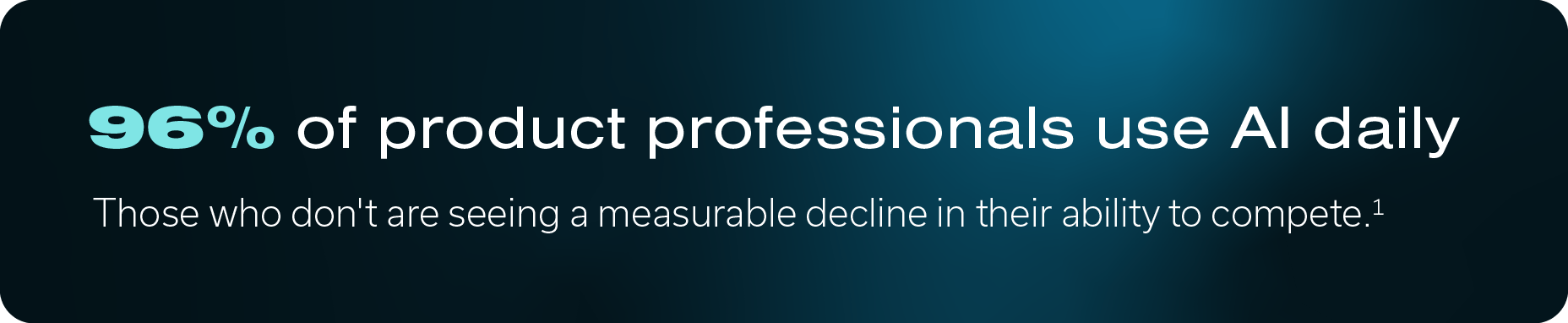
“The New Reality of AI in Product Management.” Productboard Report, October 22, 2025. https://www.productboard.com/blog/ai-in-product-management-report/.

McElheran, Kristina. “The ‘Productivity Paradox’ of AI Adoption in Manufacturing Firms.” MIT Sloan Management Review, July 9, 2025. https://mitsloan.mit.edu/ideas-made-to-matter/productivity-paradox-ai-adoption-manufacturing-firms.

The Sound of Silence: When a Lack of Customer Feedback Derails Your Strategy

Editor’s Note: You’re facing unprecedented business challenges. You need more than theories—you need a blueprint. Welcome to a Leader’s Blueprint, your weekly guide to proven strategies that get results. 

Sound Familiar?

You’ve just launched. The team invested months of effort, the budget was approved, and the strategic decks were flawless. But now, instead of the sound of soaring adoption and positive buzz, you’re met with… silence. Engagement metrics are flat, the innovative features you debated for weeks are being ignored, and the market seems completely indifferent. You’re left wondering, “Did we just spend a year building something nobody wants?

If this scenario feels familiar, you’re not alone. This is the painful result of a disconnect—a gap between your organization and the customers you exist to serve.

The Hidden Cost of Guessing

Operating without a direct line to your customer isn’t just inefficient; it’s a significant business risk. The costs ripple across the entire organization:

  • Wasted Capital: Every dollar spent on unwanted features is a dollar not spent on true innovation.
  • Demoralized Teams: Nothing crushes motivation faster than pouring your energy into work that fails to make an impact.
  • Lost Market Share: While you’re guessing, you can be sure your competitors are listening, adapting, and winning over your customers.

From Silence to Insight: A Glimpse of the Solution

Turning this around requires more than an annual survey. It requires building a systematic listening engine. In SAFe®, we call this the Harnessing Customer Feedback competency.

This isn’t just about collecting data; it’s about creating a holistic view of your customer’s reality. It means blending quantitative data (like usage metrics and satisfaction scores) with powerful qualitative insights. One of the most effective methods is Gemba, which involves going to the customer’s environment to observe them using your product. By seeing their struggles and successes firsthand, you replace assumptions with undeniable facts.

Your First Step

You don’t need a new tool or a big budget to start. Here is one simple action you can take this week:

Empower your team or a team you lead to dedicate an hour this week to observe a real customer using your product. This isn’t a demo or a sales call, but a quiet observation to uncover genuine insights. Afterward, share with each other the single most surprising discovery they made.

Unlock Your Full Potential

That single observation is just the beginning. To truly thrive and lead, a systematic approach is not merely essential for survival—it’s the catalyst for unprecedented growth. The Harnessing Customer Feedback competency provides a complete blueprint for designing robust feedback loops, extracting profound insights from data, and transforming customer understanding into winning product decisions that redefine your market.


Upcoming Blogs in this Series

  • Measuring Product Performance
  • Creating Responsive Roadmaps
  • Accelerating Product Flow


1 Deloitte Digital – https://www.deloittedigital.com/mt/en/insights/perspective/Personalising-The-Customer-Experience.html