Betting the Business on a Guess: When “Good Ideas” Waste Millions

Editor’s Note: You’re facing unprecedented business challenges. You need more than theories—you need a blueprint. Welcome to a Leader’s Blueprint, your weekly guide to proven strategies that get results.

It’s the annual planning meeting, and the star project is unveiled—a massive digital transformation, a new product line, a major platform overhaul. It has executive backing, a compelling narrative, and a huge budget. Everyone nods; it feels right. The entire organization begins to mobilize, committing months, or even years, of effort to this single, big bet.

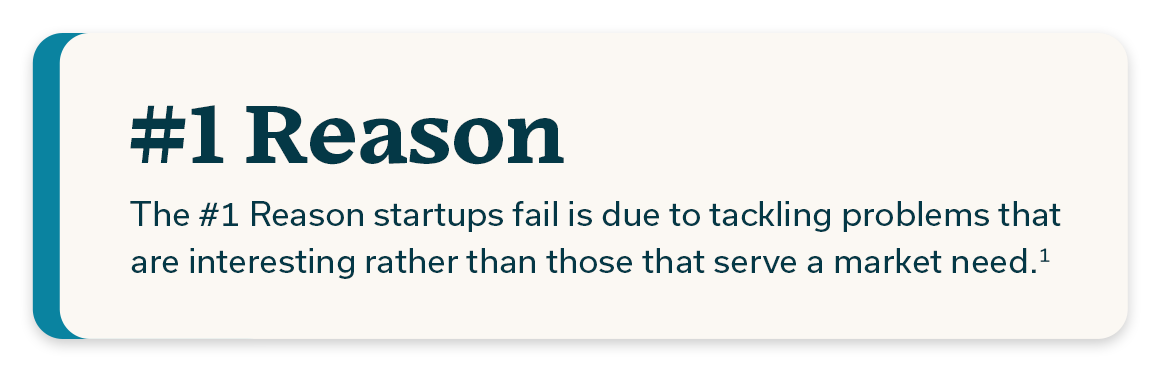
But deep down, a quiet question lingers: “How do we know this is what customers actually want?” Too often, the answer is, “We just do.” You’re building what you think the market needs, hoping your intuition pays off, all while precious resources are poured into an unvalidated future.

The Hidden Costs of Unvalidated Bets

When an investment is based on an unvalidated assumption—even a “really good” one—the cost isn’t just the initial budget. It’s a cascade of failures that silently drain your organization’s potential and can lead to significant financial losses.

  • Wasted Capacity: Entire departments spend months building a complex solution that customers don’t adopt, leading to 100% opportunity cost. That’s time and talent you will never get back, delaying other potentially valuable initiatives.
  • Delayed Value & Diminished Competitive Advantage: While you’re busy building the wrong thing, your competitors are capturing market share by solving the real customer problem first. This directly impacts your growth, market position, and ability to innovate, leaving you to play catch-up.
  • Eroding Morale: Nothing burns out a team faster than seeing their hard work and long hours shelved because the initial hypothesis was wrong. It breeds cynicism and resistance to the next big idea, impacting future productivity and retention.

From Gambling to Learning: A Glimpse of the Solution

The antidote to this high-stakes gambling is to treat big ideas not as directives, but as hypotheses. In SAFe®, this is the core of the Validating Investment Opportunities competency.

Instead of funding a massive, multi-year project, you fund the smallest possible experiment—a Minimum Viable Product (MVP)—designed to test a critical hypothesis with real customers. By applying a rapid Build-Measure-Learn cycle, you use real data—not opinions—to decide whether to pivot, persevere, or stop the initiative before you’ve wasted millions. This shifts the conversation from “Are we finished?” to “Did we learn?” It’s about reducing waste, de-risking innovation, and accelerating value delivery by ensuring your investments align with real customer needs.

Your First Step

You can start de-risking your investments this week. Look at the biggest, most expensive initiative (Epic) currently funded or being considered in your portfolio. Write down in the lean business case, what business outcome do we hypothesize will occur because this is delivered to our customers? Ask product leadership and architects, what’s the smallest thing we can build in under 3 months to see if that hypothesis might be true?

Then, gather the Epic Owner and relevant Business Owners and ask this one crucial question:

“What is the single, riskiest assumption this entire investment rests upon, and what is the cheapest, fastest experiment we could run next week to prove or disprove that assumption with real customer feedback?”

If the answer involves building a large part of the final product, you’re still planning a bet, not a validated investment. Your goal is to find the smallest actionable learning, not the first deliverable.

Unlock the Full Blueprint

Knowing you should test assumptions is easy. Building an organizational system that does it repeatedly, at scale, is hard. The Validating Investment Opportunities competency provides a complete blueprint for defining Epics, crafting compelling MVPs, and establishing the processes to make data-driven portfolio decisions that accelerate learning and value.


In this Series:


1 Stanford University, “Top 20 Reasons Startups Fail,” VCS 2019 Conference Report, 2018, accessed October 28, 2025, https://conferences.law.stanford.edu/vcs2019/wp-content/uploads/sites/63/2018/09/001-top-10.pdf

Rowing in Different Directions: Don’t Let Your Legacy Portfolios Prevent Future Success

Editor’s Note: You’re facing unprecedented business challenges. You need more than theories—you need a blueprint. Welcome to a Leader’s Blueprint, your weekly guide to proven strategies that get results.

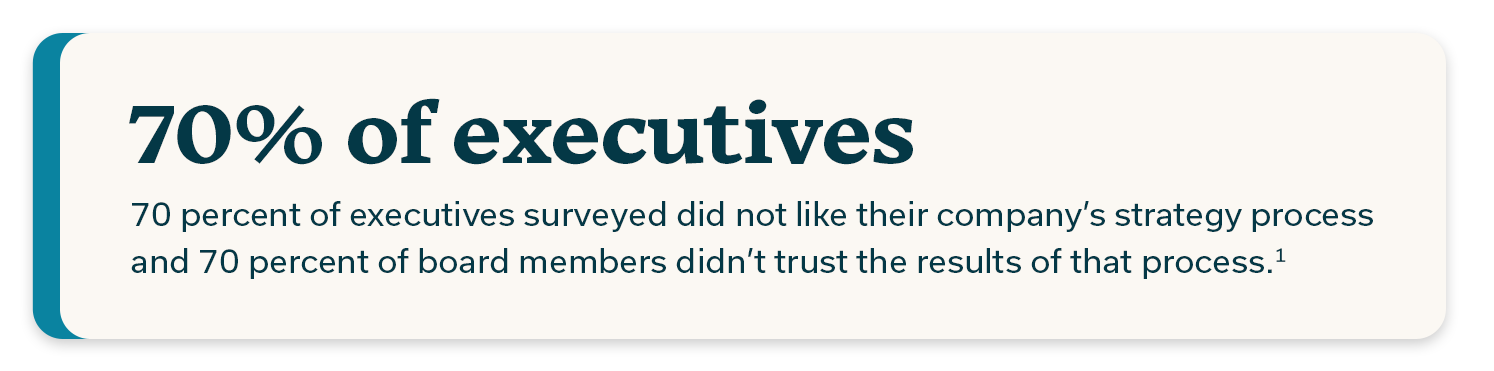
You’ve just concluded the annual strategy offsite. The vision is bold, the goals are ambitious, and the leadership team is energized to conquer new markets. But when you and your peer portfolio leaders return to the office, the energy slowly fizzles out.

Despite the new slide decks, the new strategy never translates into action. Realignment is difficult; most companies have to hire expensive consulting firms just to untangle their organization and identify the value streams and product lines that matter. Because you lack a native model to organize these portfolios yourself, your funding and focus remain perfectly aligned to deliver last year’s strategy. You are trying to row in a new direction, but every portfolio is pulling its oar a different way.

The Hidden Costs of a Strategy-Structure Gap

When your organizational structure is not aligned with your strategic goals, it creates constant friction that silently sabotages your success.

  • Wasted Investment: Precious capital and talent are spent on low-priority work. Worse, different teams in different portfolios unknowingly duplicate efforts, solving the same problem in isolation and wasting valuable resources.
  • Strategic Drift: The company’s vision points north, but the inertia of the existing portfolios keeps pulling the execution south. This gap between what you say and what you do widens over time, making strategic goals impossible to reach.
  • Decision Paralysis: With unclear ownership of value streams, even simple decisions are endlessly escalated. Agility dies as leaders wait for approvals from committees that lack the context to make an informed choice.

From Complexity to Clarity: Identifying Value

The solution is to intentionally design your organization to match your strategy. In SAFe®, this is the Organizing Portfolios competency. This involves structuring your organization around clearly identified products, solutions and value streams—the end-to-end set of steps required to deliver a product or solution to a customer.

Instead of grouping people by function, you create a portfolio with all the people, funding, and authority needed to serve the value streams within it. This clarity of purpose and responsibility is what enables clear strategic execution. Teams are empowered to make fast, smart choices because they are fully aligned and have the context of the larger strategic goal.

Your First Step

You can begin to diagnose your strategy-structure gap this week with a simple exercise. Take your company’s single most important strategic goal for this year and ask your leaders:

“Which teams and which budgets are directly contributing to this goal?”

If they can’t draw that map with clarity in under 30 minutes, your organizational structure is obscuring—not enabling—your strategy.

Unlock the Full Blueprint

Visualizing the problem is the first step, but realigning an enterprise requires a proven approach. The Organizing Portfolios competency provides a complete blueprint for defining value streams, structuring portfolios for flow, and dynamically adapting them as your strategy evolves.


In this Series:


1 Richard P. Rumelt, “Getting Strategy Wrong—and How to Do It Right Instead,” McKinsey Quarterly, accessed October 28, 2025, https://www.mckinsey.com/capabilities/strategy-and-corporate-finance/our-insights/getting-strategy-wrong-and-how-to-do-it-right-instead