The Role of Emotional Intelligence in SAFe – Business Agility Planning

Safe Business Agility Podcast Cover Image

When people think of intelligence, most associate it with IQ. But emotional intelligence is actually a better indication of how a person will succeed in their career. In this podcast episode, Jennifer Fawcett, SAFe Fellow and semi-retired Agile coach, consultant, and speaker joins us to discuss emotional intelligence, how it can help individuals and organizations to succeed, and the role it plays in SAFe for an effective business agility transformation in an organization.

Click the “Subscribe” button to subscribe to the SAFe Business Agility podcast on Apple Podcasts

Share:

When people think of intelligence, most associate it with IQ. But emotional intelligence is actually a better indication of how a person will succeed in their career. In this episode, Jennifer Fawcett, SAFe Fellow and semi-retired Agile coach, consultant, and speaker joins us to discuss emotional intelligence, how it can help individuals and organizations succeed, and the role it plays in SAFe.

Melissa and Jennifer discuss topics including:

  • Where to start with emotional intelligence
  • Soft skills versus hard skills
  • Coaching people around emotional intelligence
  • How emotional intelligence affects flow and outcomes in a SAFe implementation

Follow these links to Jennifer’s blog posts:

Hosted by: Melissa Reeve

Melissa Reeve is the Vice President of Marketing at Scaled Agile

Melissa Reeve is the Vice President of Marketing at Scaled Agile, Inc. In this role, Melissa guides the marketing team, helping people better understand Scaled Agile, the Scaled Agile Framework (SAFe), and its mission. Connect with Melissa on LinkedIn.

Guest: Jennifer Fawcett

Jennifer Fawcett - empathetic Lean and Agile leader

Jennifer is a retired, empathetic Lean and Agile leader, practitioner, coach, speaker, and consultant. A SAFe Fellow, she has contributed to and helped develop SAFe content and courseware. Her passion and focus have been in delivering value in the workplace and by creating communities and culture through effective product management, product ownership, executive portfolio coaching, and leadership. She has provided dedicated service in these areas to technology companies for over 35 years. Learn more about Jennifer on LinkedIn.

The Role of Emotional Intelligence in SAFe Podcast Episode Transcript

Speaker 1:

Looking for the latest news, experiences, and answers to questions about SAFe®? You’ve come to the right place. This podcast is for you, the SAFe community of practitioners, trainers, users, and everyone who engages SAFe on a daily basis.

Melissa Reeve:

Welcome to the SAFe Business Agility podcast recorded from our homes around the world. I’m Melissa Reeve, your host for today’s episode. Joining me today is Jennifer Fawcett, SAFe Fellow and semi-retired Agile coach, consultant, and speaker. Thanks for joining me today, Jennifer. It’s so great to have you back on the show.

Jennifer Fawcett:

Ah, thanks, Melissa. It’s always great to be back.

Melissa Reeve:

So in this episode, we’ll discuss emotional intelligence, how it can contribute to success for individuals and organizations, and the role it plays in SAFe. Let’s get started.

So, Jennifer, most people associate intelligence with IQ, a number that represents a person’s reasoning ability. But you wrote in your blog post on scaledagile.com, that emotional intelligence is actually a better indicator of how a person will succeed in their career. Help us understand that.

Jennifer Fawcett:

Yeah. Well, let’s start with the “what.” What is emotional intelligence? Emotional intelligence represents a series of emotional competencies that manifest in how you show up in the workplace, how you show up in personal life, and in society. It’s your ability to recognize and control your emotions. And given that every enterprise is impacted by massive changes in the marketplaces these days, these emotional competencies and behaviors affect the human aspect of change—that natural resistance to change and the ability to inspire everyone around the shifts and direction, visions and value. And even more important, they impact our social networks: those Agile Release Trains and the complex interactions that happen within those networks that help grow your career and the careers of those around you.

Melissa Reeve:

So where do you think the most important place to start is when we’re talking about emotional intelligence?

Jennifer Fawcett:

Yeah, I think the most important emotional intelligence place to start is, in my view, with self and self-awareness. Now, once you intimately know yourself, who you are, and you’re able to reflect and manage and grow your self-awareness on how you show up and the impact that your words and your behaviors and your moods and your actions have around all the humans that you interact with, you create the ability to not only positively advance and succeed in your career, but you can also help those around you as well.

Melissa Reeve:

And I can really see how self-regulation and self-awareness can contribute to emotional intelligence. What about things like your ability to relate to others? I tend to think of emotional intelligence as the ability to also read the room and respond accordingly.

Jennifer Fawcett:

Well said, and so true. And this pulls on the empathy aspect of emotional intelligence. This is the ability to put yourself in the shoes of others and truly understand what’s happening from their perspective. What are they feeling? What are they thinking? What are they seeing? And what do they care about? And what don’t they care about? So reading the room is part of that. Watching for body language, a tilt of the head, your eyebrows furrowing, or the shoulders sinking or leaning in. So back to knowing-of-self, in order to be able to read the room and show up with empathy, recognizing and managing your own emotions creates that foundation for you to be able to show up with empathy and really understand from others’ perspectives.

Melissa Reeve:

Yeah, that makes a lot of sense. It’s the ability to hold this space for others’ perspectives too to really come in. So some people might say that these emotional intelligence competencies are soft skills, but you call them hard skills. What do you mean by that phrase?

Jennifer Fawcett:

Yeah. Well, for one, these skills are tough to embody, because you have to be vulnerable as well as emotionally transparent and available. And not everyone wants to lead from the heart or become vulnerable in leadership. Now, Brené Brown says this well in her Dare to Lead book. She calls this our armor. It’s that armor that’s based on fear and how we use our thoughts and emotions and behavior to protect ourselves rather than help others.

And even more difficult is that some folks aren’t even aware of how their lack of emotional intelligence and their own personal armor is directly impacting those around them. It’s this lack of awareness that creates an even more challenging situation, because if they’re not aware that there’s even a lack of emotional intelligence, then there’s not much desire to work on anything. This, in my mind, creates a very powerful coaching opportunity.

Melissa Reeve:

Yeah. I can really see that. And as somebody who probably needs coaching, I would really welcome the opportunity for somebody to coach me. And then as somebody who’s also seen other people who could use coaching, I can see why it could be a coaching opportunity. Having said that, it seems like it could be very delicate. How would you go about clueing somebody into the fact that they’re not leading with authenticity?

Jennifer Fawcett:

It is very delicate. And thanks for saying that you’d be open for coaching. I need a coach every day.

Melissa Reeve:

We all do.

Jennifer Fawcett:

And I think we all do. So where to start? Well, I’d start with helping them be more self-aware and reflect upon their behaviors. Now, having them understand where they are from both an emotional standpoint and a physical standpoint at any given moment is part of the skill. That skilled coach can help coach this in quite a few ways. If that person, being you or me, is open to coaching, one opportunity is to use a method called the “Red Zone, Blue Zone” method. This is from Joe Jurkowski’s and Jim Osterhaus’s book, Turning Conflict Into Opportunity. Now, this method asks the person to stop and call a timeout, take a deep breath, and remove themselves from the situation, or do whatever it takes to recalibrate.

Now, obviously, this happens in a one-on-one environment. It could happen on a break or a natural pause to the event that’s happening. The more real-time you can make this, the better chance you have at the person recognizing what’s happening. Now, the next step would be to help them locate themselves and their emotions at that moment. Are they in the red zone of being focused on themselves and closed off and defensive or opinionated? Is that armor up? Or are they in the blue zone of being open-minded, curious, listening, and showing up with humility? Reflect, ground, and learn from those moments. They create that foundation for self-awareness that can help with how they can regulate their emotions.

Melissa Reeve:

I hadn’t heard of the “Red Zone, Blue Zone,” but it’s very much similar to something called conscious leadership. And in that context, they say something’s either above the line or below the line. And above the line is exactly as you described; it’s open, honest, and willing to connect with others. And below the line is closed, defensive, and committed to being right. So that seems like a really powerful technique when somebody’s open to that. What happens if somebody isn’t aware of what’s going on?

Jennifer Fawcett:

Yeah. This is where the magic of coaching comes in as well. If the person is perhaps not aware, I like to use a technique called “the mirror and the window,” and you’ve probably encountered this in your work or your personal relationships as well. Now, the mantra is always to pick up the mirror before peering through the window. In this scenario, the coach can model vulnerability and authenticity and perhaps say, “Hey, I have never been in a situation like this, where I didn’t personally contribute problems like the ones we’re seeing here. It’s easy to look out the window and say, ‘The problems are out there,’ but perhaps we can reflect on this situation and recognize how we are being part of that system and we’re helping create this problem.”

Now that was a little role play. So, the reflection being the mirror, you might get all kinds of resistance with this role play. You might get denial; you might get comparison blame. But it also creates an opportunity to continue to reflect and unpeel the behavior until it becomes recognized. And that person begins their self-awareness journey. Now, don’t always expect immediate results. Just like changing our organization takes time, coaching a change in someone else’s behavior takes time as well. Now, once they know that folks are advancing their emotional intelligence is when they genuinely ask for help and they’re open for feedback.

Melissa Reeve:

Well, I’m glad you mentioned the part about not expecting immediate results. I was just talking to somebody in a coaching position the other day. And he was really discouraged because he was trying to do some coaching and he was getting a lot of resistance to the coaching. And the discussion we had was, this does take time. And interestingly enough, that same day I was on LinkedIn and I saw a little meme, I guess, is what you call it. And it said, “No really stands for next opportunity.” So, if somebody’s giving you a no, just think in your mind, “Well, alright, there’ll be a next opportunity for me to bring this up again.”

Jennifer Fawcett:

There always will be. Yep. Thank you.

Melissa Reeve:

So this all sounds absolutely amazing, and it sounds like you’ve done this in the field. Can you share with our listeners an experience from the field on how showing up with emotional intelligence can impact success or inhibit a digital transformation?

Jennifer Fawcett:

I’ve seen it from so many different aspects. And I can think of many emotional intelligence experiences that impacted or inhibited that change. Now we’ve all had that colleague that walks into a room or meeting with their own agenda. And because of that agenda and the lack of emotional intelligence represented from that agenda, everyone in the room or that meeting suffers. Either that agenda changes to the person’s agenda, or they bully their way out, or they bully their way in without respecting, hearing, or opening up to the other diverse views in the room. And this leaves others feeling lost and neglected and disrespected, and most importantly, not heard. And also the feeling that that precious time that they had allotted for that meeting or event had been wasted and hijacked.

Melissa Reeve:

I recognize that. And I describe it as almost feeling like the air gets sucked out of the room. There’s only room for that person and their agenda.

Jennifer Fawcett:

Yeah. Energy vampires.

Melissa Reeve:

There you go. So where else have you seen this?

Jennifer Fawcett:

Well, I’ve seen it a lot at PI Planning, where that single Business Owner or stakeholder didn’t accept the plan. And it’s terrifying because, after two and a half days of passionate planning over five time zones, the teams came up with a plan to deliver against the vision. But, that plan didn’t seem to match what that stakeholder’s personal objectives or goals were. Now that stakeholder started to ask things like, “Hey, it looks like these features are just going to land a week or two or an iteration or two after the PI boundary. Can’t you just pull them in?”

Now, this could have been better if there was a negotiation around scope, but prior to that moment, there wasn’t. Now this frustration and that lack of trust and overwhelmingly helplessness and disappointment in the room were really obvious with the teams, and it caused a lot of delays. Now they re-planned and they eventually renegotiated and got to a plan, but in reflection, there was a huge opportunity for that Business Owner to be more involved, interact directly with the teams and the other stakeholders during planning, and most importantly, trust that the teams did everything they could based on what they knew to deliver against that vision.

Melissa Reeve:

Oh, that sounds painful [laughter]. So what about leaders? And leaders, I feel like have a special role when it comes to emotional intelligence, because they have that positional authority, but they also have a responsibility to not use that in a harmful way.

Jennifer Fawcett:

Yeah. With authority comes responsibility. So here’s another one that might sound familiar, that you could relate to based on that little conversation. Now, many of us have seen a leader or Business Owner that has made a commitment on behalf of an organization without effectively socializing that commitment and equally important, doing effective capacity planning or road mapping with their teams. Or even worse, they come in sideways with a new direction, without the opportunity to effectively collaborate on cost-of-delay and that ultimate value to the business with the other stakeholders.

Now, this generates somewhat of a top-down, pathological or bureaucratic leadership model that makes the people who are creating or developing the value feel like they’re in a no-win situation. Feels like they have no control over their destiny. It’s constantly going to change. Somebody’s always going to come in sideways. And that everything’s a lost cause. And guess what? Most of those initiatives either fail to deliver, or they miss the mark from a customer perspective because that type of behavior causes a whiplash. Employment motivation gets low. It creates waste in the system because people start to complain; they start to gossip; they start to commiserate with each other; and the goal becomes uninspiring and disconnected from the values to those social networks. And this is a disaster waiting to happen.

Melissa Reeve:

Yeah, you can’t see me, but I’m sitting here nodding my head because I’ve just seen this play out so many times. And it just feels like the trust starts to erode, especially in an Agile organization, because you are saying that you value the input of people and you value their capacity. But what you’re demonstrating is something completely different.

Jennifer Fawcett:

Right. And those social networks are so delicate. It’s the emotional intelligence that I like to call the glue that keeps people together, that keeps people wanting to work together and evolve towards the highest level of value that they can deliver to their customers.

Melissa Reeve:

So these are all just amazing examples. And you talked a little bit about PI Planning. I’d love to hear how emotional intelligence and that competency applies to other aspects of SAFe and how they can affect flow and outcomes.

Yeah. All of emotional intelligence relates in some ways to SAFe. But let’s talk specifically about some of the SAFe competencies and some of the constructs and how they connect. Let’s start with a Lean-Agile Leadership competency. Leaders set the example. They enable the evolution of emotional intelligence and they model all of the emotional intelligence competencies so that our development value streams can evolve. Both their business agility competencies and their emotional competencies. Now, if we don’t consider the human emotion, the inspiration and motivation aspects of change, we can inhibit flow, and people shut down and lose their motivation. And thus, that jeopardizes providing value to our customers.

Melissa Reeve:

Well, I could see that for sure. And while we’re on the subject of our customers, it seems like emotional intelligence is vital in connecting with customers.

Jennifer Fawcett:

Absolutely. Connecting to the customer involves all of our Agile product delivery and enterprise solution delivery competencies. Plus, the design thinking skills to listen, reflect, empathize, and connect with the people that we’re designing those solutions for. It puts the customer first. And this means going deep into the empathy competency of emotional intelligence to use our service orientation mindset to foresee, recognize, and exceed our customer needs. Now, if we can evolve the empathy competency in all aspects of product and solution delivery, then we have the opportunity to excel beyond our competitors in delivering value and continue to thrill our customers.

Melissa Reeve:

So, it seems like there’s a lot here, and I know I’ve read your blogs out on the scaledagile.com website. Do you want to talk for a minute about your blogs?

Jennifer Fawcett:

Yeah, there’s more, and I do explore some of the additional elements of the connection between emotional intelligence and SAFe in part two of my emotional intelligence blog series on the Scaled Agile website.

Melissa Reeve:

And I’d encourage anybody to go out and find those two blogs. They’re great reading for anyone. So these are amazing perspectives to apply to the whole organization. What advice do you have for individuals like myself who are trying to evolve their emotional intelligence competency?

Jennifer Fawcett:

Just like we said from the beginning, start with you. Really cherish yourself, allow time for self-reflection, self-work, and to recharge yourself. Tap into the outcomes of your retrospectives and your team activities and take feedback and show your gratitude for those giving you feedback. So integrate emotional intelligence workshops with leaders and teams and start with self-awareness and self-regulation. This will help build trust so that you can go deeper and go deeper into those more sensitive competencies, like empathy and those social skills.

Get a personal coach or find a practice that helps you reflect and learn from your behaviors. Practice “the mirror and the window” technique with your folks and yourself; role-play it. Personally, I like to spend time in nature. I like to hike. I like to play music and practice yoga. I also rehearse. I videotape myself so I can see how I show up. It’s horrifying, but it works.

Melissa Reeve:

I get it. [laughter]

Jennifer Fawcett:

Now, these are some of my self-awareness techniques that help me reflect and grow. And others might have different practices like religious practices or our belief networks and coaching groups that can help them with self-awareness and growth as well.

Melissa Reeve:

Yeah. And I want to take a moment here, just a pause because as I hear this, it makes intellectual sense to me. And I’m putting myself back into a time where I had meetings nonstop from 8:00 in the morning, till 6:00 at night. I was maybe working from 6:00 in the morning till 9:00 at night. And this whole part of self-awareness got lost. It got squeezed out. And so, I’m just curious if you have any guidance for people in that situation. How do you make this a priority?

Jennifer Fawcett:

Yeah. You do have to make the time. Block out your calendar, grow that internal and external coaching network. I tend to use a lot of friends and family in that internal and external coaching network and colleagues from the past. Now, coaches can help with all aspects of emotional intelligence and they can help provide the tools and techniques for self-awareness and self-regulation and for practicing empathy. Now, all the coaches I know bring their own unique self to their environments. So ensure that you’re investing in coaching for yourself and your people. Now in a previous career, I was a release manager and my leader brought in a release manager coach for me. And at first, I was really taken aback. I thought, “Well, why do I need a coach? I know what I’m doing.”

Melissa Reeve:

Mm-hmm (affirmative).

Jennifer Fawcett:

But after a few sessions, I realized that she wasn’t there to help me with the practice of release management. She was there to help me reflect on all the other aspects of my behavior and help demonstrate how everything I did impacted the environment and the social network that I was in. I’m so grateful for that leader for investing in me.

Melissa Reeve:

Prior to this recording, I was in a meeting and we were talking about feedback, and most people in that meeting were so hungry for the feedback. It is that balance of vulnerability, yet, wanting the feedback in a safe way. I can see why you’re grateful for this leader who invested in you and provided a safe way for you to receive the feedback you needed to hear.

Jennifer Fawcett:

Yeah. Creating that type of network provides the power of that safe space so the people can always come back and practice and share ideas and concerns and grow without being judged or having fear of getting that feedback.

Melissa Reeve:

So it seems like creating a community of practice would really also create that safe space.

Jennifer Fawcett:

You bet. Creating that community of practice around the emotional intelligence competencies is a beautiful way to get going. In the latest Leading by Example module that Scaled Agile released, one of the most cherished outcomes was a cohort that trusted each other and was willing to share their deepest challenges with authenticity.

Melissa Reeve:

I really admire the work that’s been done in the Leading by Example class. And I have firsthand seen a palpable shift in leaders who’ve taken that class. So, Jennifer, you have done an amazing job here today just sharing your perspective and your advice on emotional intelligence. I feel richer for having spent this 20 minutes with you and hope our listeners do as well.

Jennifer Fawcett:

Aw, I do as well. Thank you, Melissa. It’s always a pleasure to be here.

Melissa Reeve:

And thanks for listening to our show today. Be sure to check out the show notes and more at scaledagile.com/podcast. Revisit past topics at scaledagile.com/podcast.

Speaker 1:

Relentless improvement is in our DNA and we welcome your input on how we can improve the show. Drop us a line at podcast@scaledagile.com.

Strategy and Execution: Business Owners are the Key – Business Agility

Safe Business Agility

It’s hard to practice SAFe® effectively and achieve business agility if your key stakeholders aren’t fully engaged at the right level. In this episode, Charlene Cuenca, principal consultant and SPCT at Icon Agility, joins us to discuss why SAFe Business Owners are the key to connecting strategy to execution and driving a successful implementation.

Click the “Subscribe” button to subscribe to the SAFe Business Agility podcast on Apple Podcasts

Share:

It’s hard to practice SAFe® effectively and achieve business agility if your key stakeholders aren’t fully engaged at the right level. In this episode, Charlene Cuenca, principal consultant and SPCT at Icon Agility, joins us to discuss why business owners are critical to successfully connect strategy to execution—and deliver better business outcomes.  

Charlene explains how a business owner’s involvement in a SAFe implementation needs to span all of the organization’s planning horizons. Why a proxy isn’t a substitute for the real thing. And what happened at one organization when she convinced a business owner to actively participate in a PI Planning cycle.

Follow these links to learn more about these topics discussed in the podcast:

Hosted by: Melissa Reeve

Melissa Reeve is the Vice President of Marketing at Scaled Agile

Melissa Reeve is the Vice President of Marketing at Scaled Agile, Inc. In this role, Melissa guides the marketing team, helping people better understand Scaled Agile, the Scaled Agile Framework (SAFe) and its mission.

Guest: Charlene Cuenca

Using a people-focused approach, Charlene provides coaching, training, and consulting to help organizations achieve sustainable transformation success. While she has a technical background, she focuses more on business, product, portfolio and program process, and organizational transformation strategy to achieve Organizational Agility.

Learn more about Charlene on LinkedIn

Leading with Intention – Agile Leadership

Safe Business Agility

Business Leaders cultivate Agile leadership by exemplifying behaviors that align with their organization’s values, and by integrating these values into their decision-making processes. In this episode, Audrey Boydston, SPCT and Scaled Agile senior consultant, joins us to talk about leading with intention, and why core values are so important personally and professionally.

Click the “Subscribe” button to subscribe to the SAFe Business Agility podcast on Apple Podcasts

Share:

Leaders cultivate success by exemplifying behaviors that align with their organization’s values, and by integrating these values into their decision-making processes. In this episode, Audrey Boydston, SPCT and Scaled Agile senior consultant, joins us to talk about leading with intention, and why core values are so important personally and professionally. 

Follow these links to learn more about the following topics mentioned in the podcast:

Hosted by: Melissa Reeve

Melissa Reeve is the Vice President of Marketing at Scaled Agile

Melissa Reeve is the Vice President of Marketing at Scaled Agile, Inc. In this role, Melissa guides the marketing team, helping people better understand Scaled Agile, the Scaled Agile Framework (SAFe) and its mission.

Guest: Audrey Boydston

Audrey Boydston is a senior consultant at Scaled Agile

Audrey Boydston is a senior consultant at Scaled Agile and an experienced SPCT, Lean-Agile coach, trainer, and facilitator. Her work focuses on continuous learning, building fundamentals, re-orienting around principles, and helping clients—from senior executives to developers—build networks and communities that support their transformations.

Learn more about Audrey on LinkedIn

The Role of a SAFe® Coach In Agile Transformation

Safe Business Agility

There are lots of key roles associated with SAFe®: Business Owners, Product Managers, Release Train Engineers, Scrum Masters. But probably the most ubiquitous is the SAFe Coach, a role that’s elemental throughout all of SAFe’s core competencies. But it’s also a role that doesn’t have its own guidance article on the SAFe website. In this episode, SAFe Fellow Jennifer Fawcett joins us as we dive into all the different aspects of the SAFe Coach and how they facilitate change and support an Agile transformation.

Click the “Subscribe” button to subscribe to the SAFe Business Agility podcast on Apple Podcasts

Share:

There are lots of key roles associated with SAFe: Business Owners, Product Managers, Release Train Engineers, Scrum Masters. But probably the most ubiquitous is the SAFe coach, a role that’s elemental throughout all of SAFe’s core competencies. But it’s also a role that doesn’t have its own guidance article on the SAFe website. In this episode, SAFe Fellow Jennifer Fawcett joins us as we dive into all the different aspects of the SAFe coach. She’ll share her firsthand experiences facilitating change, key resources she’s leaned on as a coach, and the associated mindsets that directly relate to succeeding in the role.

Visit these links to learn more about SAFe coach references in the podcast:

Hosted by: Melissa Reeve

Melissa Reeve is the Vice President of Marketing at Scaled Agile

Melissa Reeve is the Vice President of Marketing at Scaled Agile, Inc. In this role, Melissa guides the marketing team, helping people better understand Scaled Agile, the Scaled Agile Framework (SAFe) and its mission.

Guest: Jennifer Fawcett

Jennifer Fawcett is a retired, empathetic Lean and Agile leader

Jennifer is a retired, empathetic Lean and Agile leader, practitioner, coach, speaker, and consultant. A SAFe Fellow, she has contributed to and helped develop SAFe content and courseware. Her passion and focus has been in delivering value in the workplace and by creating communities and culture through effective product management, product ownership, executive portfolio coaching, and leadership. She has provided dedicated service in these areas to technology companies for over 35 years.

Learn more about Jennifer on LinkedIn

Three Lessons I Learned in My First Year as a Product Owner – Agility Planning

My First Year as a Product Owner

I had managed marketing teams before, but being a product owner (PO) of an Agile marketing team was a completely new concept. As a team member, I was fortunate to spend a year watching POs do the job, which gave me a leg up. But I never really appreciated the intricacy of the position until I became one. Looking back at a year in the role, here are three key lessons I’ve taken from this experience.

The Scrum Master Is a PO’s Best Friend

Stop trying to do it all by yourself. You can’t, and you don’t have to. The scrum master is your co-leader. They don’t just run retros; they’re your sounding board and partner.  

Consider this: scrum masters spend their entire day thinking about how to support the team. Not the customer, not the executives—the team. So, listen to them. When they give you constructive criticism, listen. If they give you advice, listen. Scrum masters are often the ones at the back of the room watching everyone’s body language and unspoken communication while you’re busy thinking about the stories and features. They can catch things you don’t, so listen to them.

Planning Is Hard but Don’t Give Up

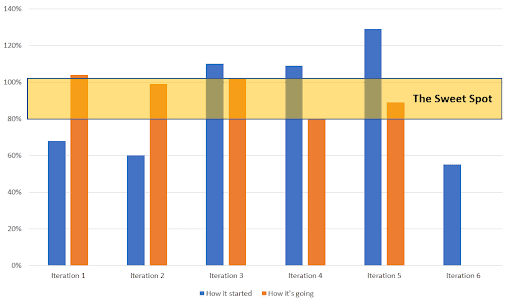
A year ago, you would find me crying after each iteration planning. Somehow we would start with 270 percent of capacity and be lucky if we got down to 170 percent—almost twice as much work planned than we could ever physically complete. If our planned capacity was ridiculous, our predictability was nonexistent. One iteration, we’d complete 120 percent, the next 50 percent—who knew what you were going to get from us.  

But we stuck with it.

We invested in iteration planning and backlog refinement. We went back to basics, agreeing on the definition of a “1” so we could do relative sizing. We started planning poker, where everyone on the team had a say in how to size stories, even if they personally were not doing the work.  And we started getting more serious and explicit about what we could and couldn’t accomplish inside two weeks.

A year later, I beam with pride. We’re a predictable and high-performing team. When we tell another team we can deliver something within an iteration; it’s the truth. Not a gut check, and employees don’t have to work insane hours to make it happen.

Pro Tip: If you’re struggling with iteration planning, I strongly recommend downloading the Iteration Planning Facilitator Checklist on the SAFe Community Platform. There’s also a good instructional video on the Team Events page.

iteration planning

PI Planning Is Not A Drill

I usually start thinking about PI Planning in iteration four. I don’t have features, I don’t know what the pivots will be, but I’m already thinking about what conversations I have to have to get my team ready. I’ve already got my finger in the air to sense the direction of the proverbial wind. My scrum master and I spend a lot of time thinking about preparing the team for PI Planning, creating space for exploration, and making sure we discuss every possible dependency, so there aren’t surprises later.

Virtual PI Planning offers another level of complexity. It’s absolutely critical that I have everything organized for my team and me, documented, and ready to go before we log in. The team knows where to find information, what the marketing objectives are, and what teams we need to sync with to plan our work.

Are you a PO? What lessons have you learned? What do you wish you knew when you started? Join the conversation in the SAFe Product Owners/Managers Forum on the SAFe Community Platform.

About Hannah Bink

Hannah Bink heads the Marketing Success team at Scaled Agile

Hannah Bink heads the Marketing Success team at Scaled Agile. She has nearly 15 years of B2B marketing experience and studied business at Pennsylvania State University. Prior to Scaled Agile, Hannah spent the majority of her career in telecommunications and healthcare sectors, running global marketing divisions. She is also author of the “Musings of a Marketeer” blog, and lives in Denver, Colorado.

View all posts by Hannah Bink

Share:

Back to: All Blog Posts

Next: How Vendors Can Apply Customer Centricity When Organizing Around Value

Leading the SAFe® Conversation to Win Over Other Leaders

Has your agency, program, corporation or company given Agile a try? Perhaps with one of the myriad techniques or methodologies out there? Perhaps with a homegrown model that would “fit just right?” Let’s explore some of the questions you might encounter along the way as you connect with other leaders, and field some tough conversations. 

Stock photo of people placing sticky notes on a glass wall

In my role as an advisor to aid US government leaders in their journey, I’ve worked with them through common perceptions to achieve greater success. Topics such as Agile not being one-size-fits-all. Situations where they may have Agile teams but certain processes slow things to a crawl, even with faster development. In these particular cases, it’s necessary to realize that it’s not just about converting your waterfall teams. Instead, let’s understand your leaders’ desired outcomes, accept the reality of the current landscape, and talk about ways you can navigate these challenges and gain support for pursuing business agility with the Scaled Agile Framework® ( SAFe®).

Explaining SAFe

While many people have heard of SAFe, they haven’t necessarily experienced the Framework in action. Or if they did, perhaps it was during an implementation where the agency tried to implement everything on the Big Picture at the same time. As a leader, one of the first challenges you’ll likely face as you seek to begin your journey is helping your peers understand what the Framework is and what it isn’t. This is a pivotal moment where your own understanding is critical.

Leading the SAFe®

* * * * * * * * * *

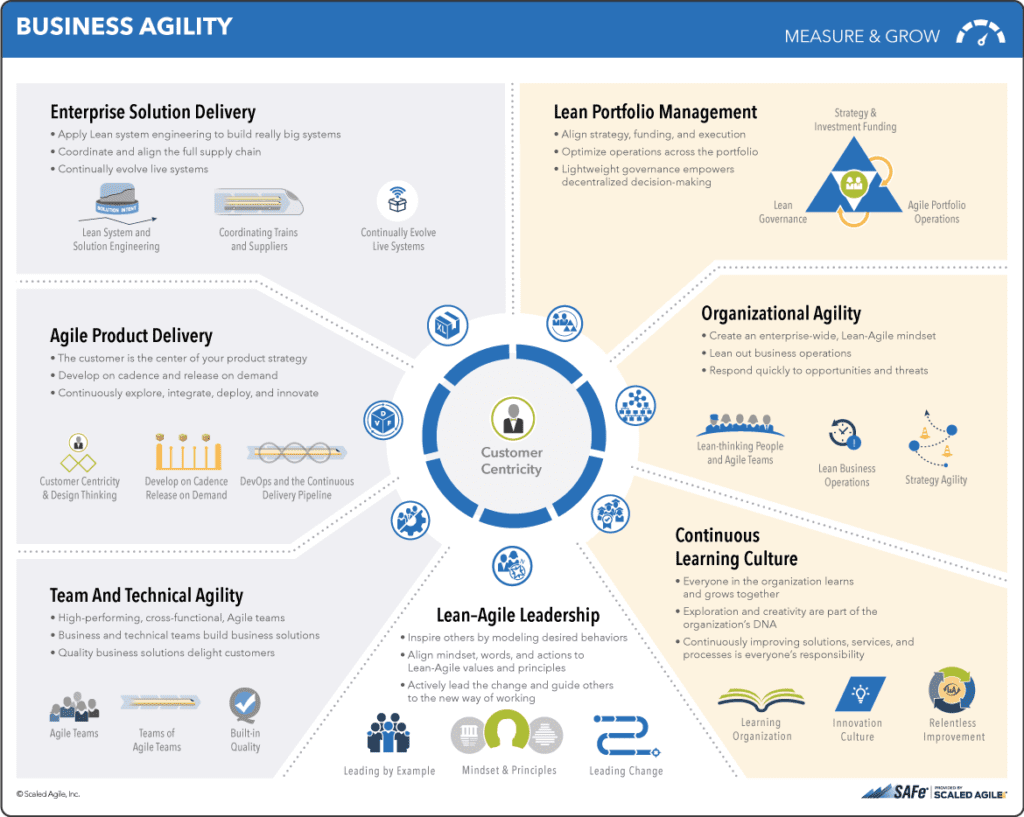
Tip: Use the SAFe overview to describe SAFe as opposed to the Big Picture. The overview illustrates that the Framework provides seven core competencies, made up of twenty-one dimensions, all designed to help you connect with your customer and achieve greater Business Agility. Each competency and its dimensions provide potential starting points, and can serve to prompt discussions regarding desired outcomes.

* * * * * * * * * *

When I meet with leaders, executives, and officers, I describe SAFe as:

  • A vehicle that will help you reach greater Business Agility.
  • A framework of proven techniques, patterns, practices and principles that can be leveraged to focus on the outcomes that matter the most.
  • A knowledge base of the best patterns, practices, and principles from Lean, Agile, and business thought leaders. All of which can help you accelerate the delivery of value to the warfighter or customer with increased quality, with people who are inspired and engaged.
  • A set of patterns, practices, and principles that will help your people find a new way of working. One where they can deliver more value, sooner, at a pace they can sustain and improve.

While the descriptions above are not canned sayings, I hope that they help convey the spirit and content that describes SAFe. Because it’s more than something to “just do” by launching an Agile Release Train (ART). 

Here’s what I don’t say:

  • SAFe says you will get all these benefits by training everyone and launching an ART.
  • SAFe is the number one scaling framework so you should use it.
  • SAFe will fix all of your problems if you have a SAFe Program Consultant (SPC) helping you.

Why do I avoid positioning SAFe as something that can make problems miraculously disappear? Because it’s imperative that leadership conversations are grounded in core values such as transparency.

* * * * * * * * * *

Tip: One of the best ways to help a leader understand what’s possible with SAFe is to connect them to another leader who has already started the journey to agility. There are many officers, civil servants, and executives that have accomplished their mission with greater speed and quality. Connecting with the SAFe Community through meetups, forums, and informal learning networks is a great place to find them.

* * * * * * * * * *

Talking about the Tipping Point

When leaders are open to exploring options to change the way work is done, it’s often because they’ve reached a point where they realize that something needs to change.  This is not the time to sugar-coat things.

The reality that change is hard and takes time must be part of the initial conversations.  Otherwise, organizations risk creating a foundation that’s built on fear, mistrust, and uncertainty. During these conversations, having a partner that can help you navigate your leaders’ questions, concerns, and perceptions will help greatly. If that’s not possible, please do some research and learn about others who have embarked upon the journey in your industry. In addition to the people you can find in the communities, you can tap into a variety of customer stories about organizations that have implemented SAFe. Most of these contain candid descriptions of the challenges, growing pains, and successes.

Leading the SAFe®

* * * * * * * * * *

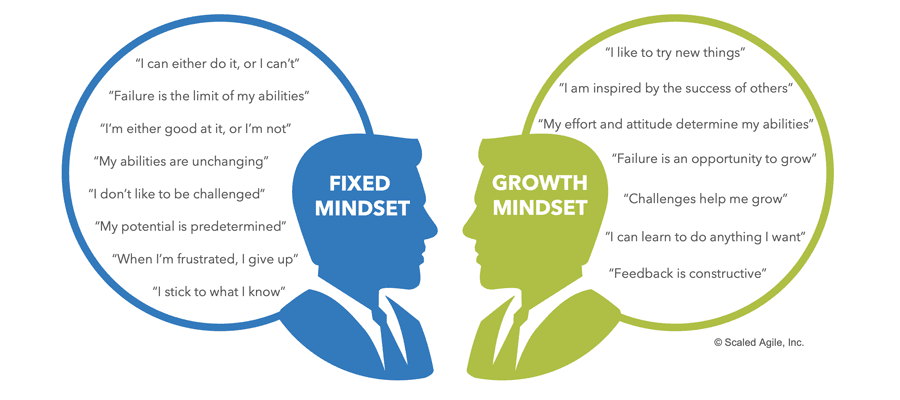
Tip: Mindset matters. Initial conversations go much smoother when both the presenter and the audience have individuals with a growth mindset. If the one seeking to implement the framework or the leaders of the organization or program have a fixed mindset, you may want to work to resolve that impediment prior to beginning your journey.

* * * * * * * * * *

Once you have the audience, it’s time to talk about the journey ahead, This is where transparency, alignment, and execution begin. Whether you’re leveraging the Introducing SAFe® 5.0 PowerPoint available from the SAFe Presentations and Videos page, or using one of the toolkits available to SPCs and SPCTs, the goal is to obtain leadership engagement—not just support. In addition to providing a general understanding of the Framework and Business Agility, I’ll facilitate discussions with senior civil servants, officers, and executives to better understand:

  • What are the outcomes they desire?
  • What keeps them up at night?
  • What are the expectations?
  • What have they tried that’s worked?
  • What have they tried that hasn’t?
  • What’s in the way?
  • What does success look like to them?
  • Will they invest in learning about a new way of working?

Once you and the leaders have aligned on the journey ahead, the SAFe Implementation Roadmap provides a guide to leading change as you pursue a new way of working.  Remember, it’s a roadmap, not a prescription or process. You’ll still need to have more conversations to figure out how to align and adjust.

Find out for yourself how government agencies are getting buy-in for SAFe. Explore the agenda for SAFe Day Government and consider attending. I’ll be giving a talk with my colleague, Michael Robertson, about Following the Implementation Roadmap. The event is also a great place to connect with your peers and find out how they’re using SAFe. I hope to see you (virtually) there.

About Phil Gardiner

Blog author SPCT Phil Gardiner headshot

Phil Gardiner, an SPCT, is focused on enabling people to achieve sustainable success through greater business agility. He has served various markets from Fortune 10 corporations to the U.S. federal government.

View all posts by Phil Gardiner

Share:

Back to: All Blog Posts

Next: Happy Anniversary, Agile Manifesto!

Stories from the Field: Coaching SAFe in Government

Safe Business Agility

In this ongoing series, our customers and partners share their stories from the field about working with SAFe ceremonies, implementing SAFe, and fostering business agility. In this episode, Phil Gardiner, enterprise Agile coach at SAIC (a Scaled Agile partner) talks to us about his coaching experiences in the public sector, including how “business agility” can be applied in government and some interesting a-ha moments.

Click the “Subscribe” button to subscribe to the SAFe Business Agility podcast on Apple Podcasts

Share:

Visit these links to learn more about SAFe in the government space referenced in the podcast:

Hosted by: Melissa Reeve

Melissa Reeve is the Vice President of Marketing at Scaled Agile

Melissa Reeve is the Vice President of Marketing at Scaled Agile, Inc. In this role, Melissa guides the marketing team, helping people better understand Scaled Agile, the Scaled Agile Framework (SAFe) and its mission.

Guest: Phil Gardiner 

Phil Gardiner

Phil Gardiner is on a mission to help organizations transform the way they work. Having served as an internal change agent, an enterprise coach, and a ‘coaches’ coach,’ Phil has enabled large-scale Lean-Agile transformations within the telecom, entertainment, finance, cybersecurity, healthcare, and government markets. His current focus is to enable people within the federal government space achieve greater business agility within their agencies and programs.

Experiences Using the IJI SAFe Principle Cards – Benefits of SAFe

Games to play with leaders and teams to embed the principles in your organization.

IJI Principle Cards

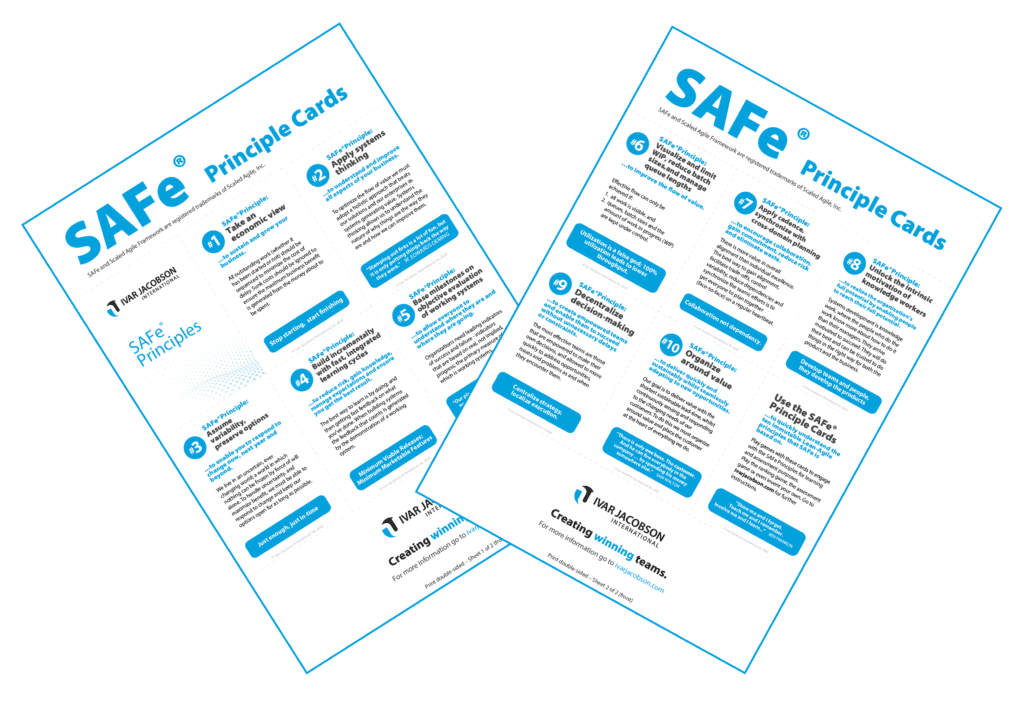
It’s been over two years since we first launched our popular SAFe® Principle cards. With the advent of SAFe version 5.0, the introduction of a new 10th principle and the launch of a new, updated set of principle cards, it’s a great time to look back at how we’ve been using the cards and the benefits they’ve generated.

This blog post is split into four sections, covering:

  1. A brief introduction to the cards (and where to get them)
  2. Engaging executives and other leaders
  3. Reflecting on how well the principles are being applied
  4. Brightening up training events

A brief introduction to the cards

As one of the first SPCTs in Europe, I’ve delivered more than my fair share of Implementing SAFe® and Leading SAFe® courses, and, to be completely honest, I’ve always struggled to get through all of the principles (I’m usually flagging by principle 6 or 7) and thought there must be some way to make them more accessible. To me, it always felt like we were learning the theory behind the principles rather than getting excited about the principles themselves.

Whilst co-teaching with my colleague, and fellow SAFe Fellow, Brian Tucker, I tried to come up with a simpler, more accessible way for people to engage with, sign up to, and remember the principles. The end result was the set of Ivar Jacobson International (IJI) SAFe Principle cards, now updated with the new 10th principle—Organize Around Value.

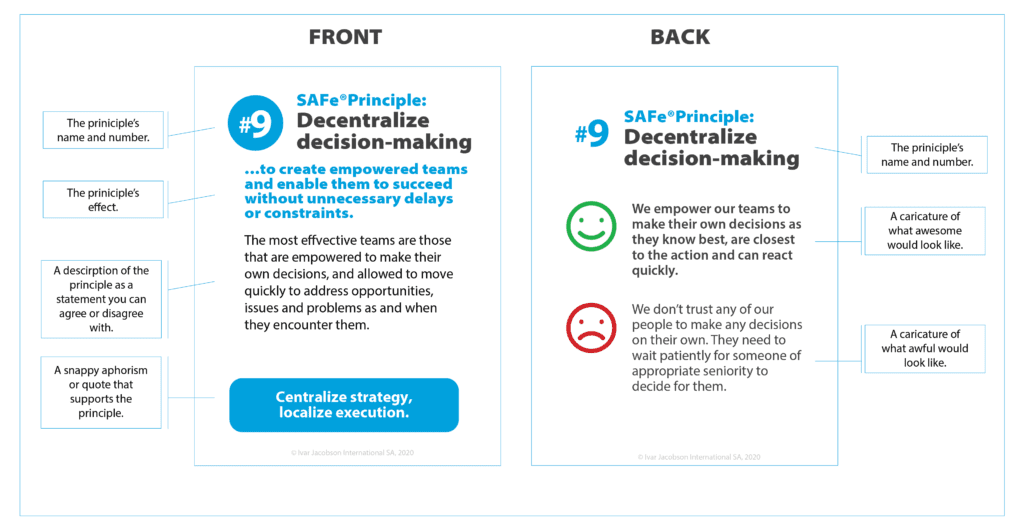
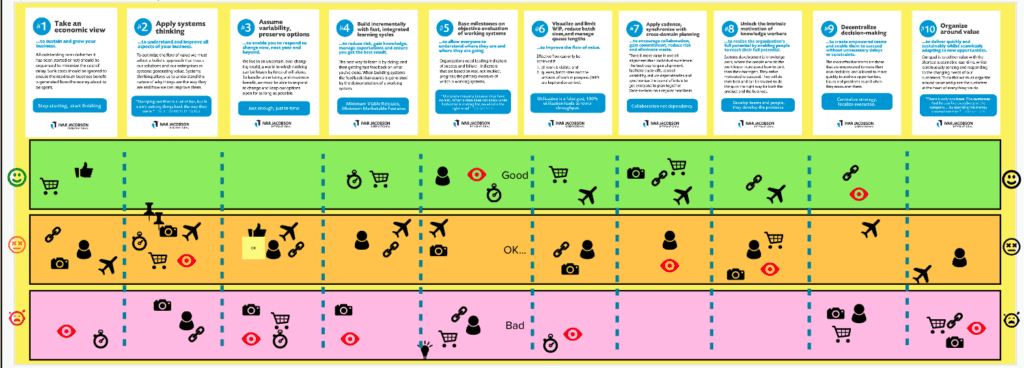
The cards try to do a number of things. For each principle, they:

  • Explain why the principle is important
  • Describe it in a form that is more like a principle and less like an instruction
  • Provide a snappy quote or aphorism that can be used to support it
  • Bring it to life with examples of what awesome and awful behaviour would look like
IJI Principle Cards
IJI Principle Cards

All on something the size of a small playing card.

In the old days, the full set would readily fit on one sheet of paper, but now with the introduction of the new 10th principle, we’ve had to expand to two sheets of paper.

The cards are freely available from the IJI website here.

Engaging executives and other leaders

Our experience with executives is that you are unlikely to get them to attend a two-day course or sit through an hour or more’s lecture on the SAFe Principles. They will play the penny game, but their appetite for being talked at is minimal.

This is a shame, as it is absolutely essential that they support and embody the principles in their day-to-day work.

Using the SAFe Principle cards to play the ‘principle ranking’ game, we’ve found that we can get them to engage with, understand, discuss and sign up to the SAFe Principles—all in under 30 minutes (20 is usually enough).

The game itself is very simple and can be played in a number of ways.

It is best played in groups of 3 – 4 people, as this maximizes discussion and ensures that everyone stays engaged throughout.

Equipment: One set of cut cards for each group and one set of uncut cards for each participant. The cut cards will be used to play the game and the uncut cards as a reference. If you want to look up a specific principle, it’s a lot easier to find it on the uncut set of cards than in a pack of cut cards.

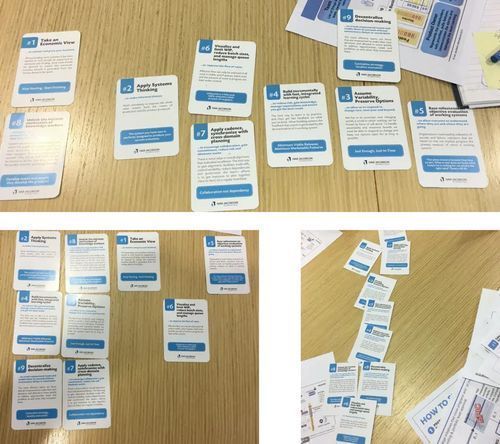
The game: Give each group a set of cut principle cards and ask them to rank them in importance to the execution of their business. Separate any that don’t apply, or that they explicitly disagree with, from those that they would actively support.

Once the groups have finished their rankings, ask them if there are any principles they would discard.  We’ve done this many times, at many different organizations, in many different industries and no one has ever discounted or rejected any of the principles. There are a number of ways to produce the ranking:

  • Higher/lower. Someone takes the lead and places the first card on the table. The group discusses and makes sure they understand the principle. The next principle is then selected, discussed, and placed higher or lower relative to the ones already in play. The game continues until all cards are placed.
  • Turn-based. A more formal variation of the previous approach where the members of the group take turns to either add a card to the ranking or reposition one of the cards that have already been played, explaining and discussing their justification as they place or move the cards. The game continues until no one wants to move any of the cards.
  • Four piles. A simplified ranking where you distinguish the top three, the bottom three, and any rejected cards, and leave those not selected in a pile in the middle. This usually results in three piles as typically none are rejected.

Whichever way you choose to rank the cards, remember that it is OK for cards to have the same rank.

The results of the ranking can be interesting, particularly the difference between the different groups—but really this is just a forcing function to make them play with the cards. These pictures show the results from playing this game with a company’s IT leadership team. I’ll leave it as an exercise for the reader to spot which group was the architecture team.

IJI Principle Cards

The real goal of the exercise though isn’t the ranking itself; it’s to get everyone actively engaged with and discussing the principles. The discussions can get quite lively with the participants often referring to the awesome/awful caricatures as well as the descriptions of the principles themselves.

As mentioned above, we’ve never seen any of the principles rejected but we have seen many different rankings. Rankings that often reflect the executive’s area of responsibility— for example, the CFO will typically place the cards in a different order to the head of human resources (HR).

This activity has always gone down really well—it’s active learning, engages everyone in the discussion and doesn’t take a lot of time. It has been so well received we’ve had executives ask to take the cards away to share with their teams. In one case, the head of HR grabbed one of the cards and said, “This is just what I need. I thought one of the ‘Agile’ team leaders was encouraging the wrong behaviours, but I had nothing to challenge them with.”

A good trick to close out the activity is to ask them, as they now understand the principles, “Would you be prepared to sign up to them?” If they say yes, take an uncut set of cards and get them all to physically sign them.

We’ve found that this exercise works almost as well in a virtual environment as it does face-to-face. Using tools such as Mural, it is possible to create an interactive experience that is close to that of playing with the cards face-to-face (but let’s be honest, nothing beats standing up with the cards in your hands).

Reflecting on how well the principles are being applied

The cards are a great tool to use in retrospectives to remind people of the principles they should be applying and to generate actions to encourage everyone to be better at applying them.

One simple way is to use them as a trigger for improvements during a retrospective. The two most effective approaches we have used are:

Pick a card. A very simple activity that throws a bit of randomness into the retrospective process. Every so often (every other retro / once a PI), randomly pick one or two cards to discuss and generate ideas for improvement. To make things fun, you could generate your own awesome and awful examples. The more methodical of you might want to work your way through all the principles one at a time—reducing the set of cards to be picked from each retrospective until you’ve got through all 10.

IJI Principle Cards

Value versus practice.

  1. Create a three-by-three grid with the x-axis being how important the principle is to the group (high, medium, low), and the y-axis being how well the principle is being applied (badly, meh, excellently).
  2. For those in the highly important/badly applied section, discuss what is going on, identify specific examples of bad behaviour, and generate concrete actions for improvement.

You can also use the cards to do a simple principle-based assessment. This is a great complement to the SAFe self-assessments and other practice-based assessments.

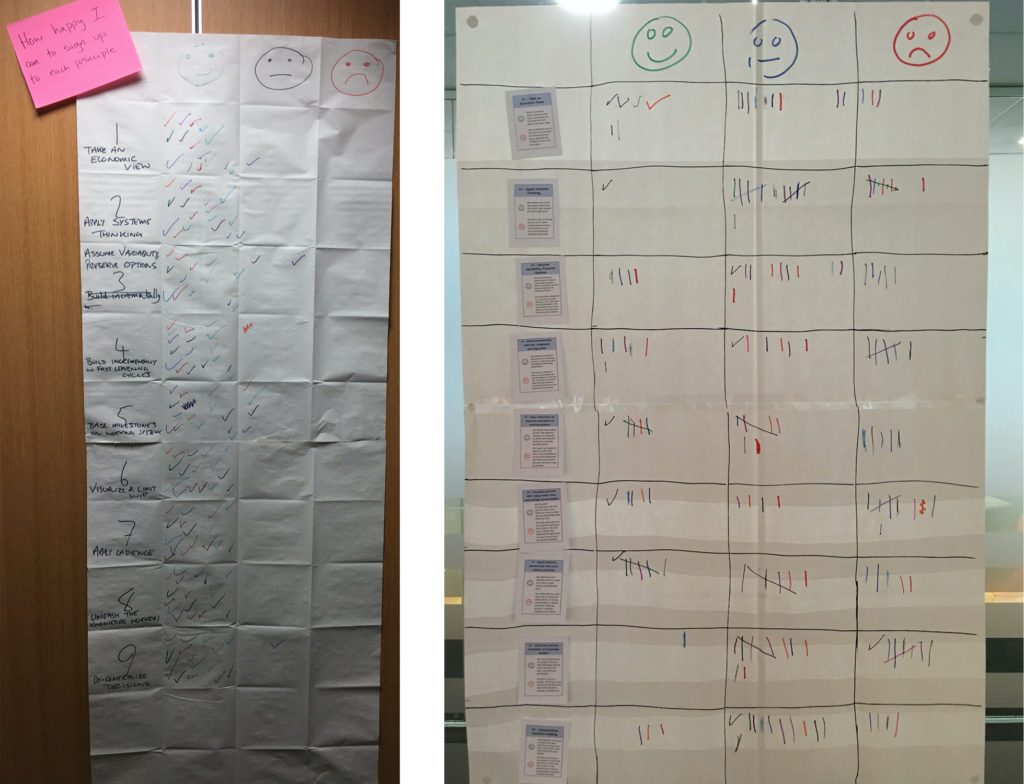
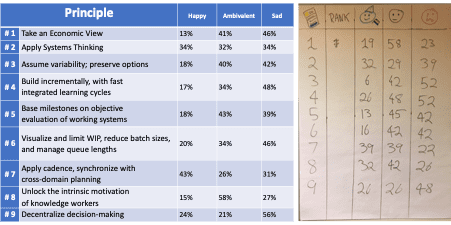
The simplest approach is to create a ‘happiness radiator’ with four columns (principle, happy face, neutral face, and sad face) and then get the assessors to tick the relevant box—as shown in the photos below. This can be done at the team level, train level, or even for the whole organization. The important thing is that everyone has their own vote—you want to avoid consensus bias as much as possible.

Note: If people are new to the principles, play the ranking game first to ensure that they understand the principle before voting.

IJI Principle Cards
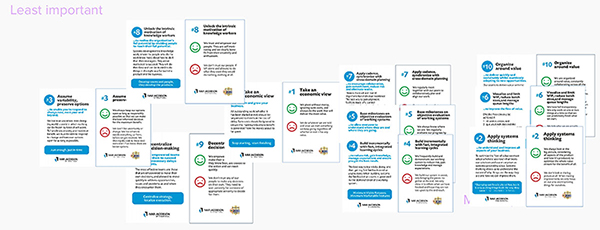
Here are examples of the cards being used in Mural to perform both the ranking exercise and to build a happiness radiator, respectively.
IJI Principle Cards
The Mural Template for both these exercises is freely available from the IJI website here.

These assessments could, of course, be done without using the cards, but we’ve found that having the cards in their hands really helps people relate to the principle and tick the correct boxes. Even when working virtually, being able to see and manipulate the cards is invaluable.

To make life interesting, the feedback can be generated about a specific community or aspect of the framework such as Product Management and Product Ownership. The table below shows a set of results generated at the Global SAFe Summit in 2017. It also shows the results of performing the assessment at a meetup in Amsterdam.

It is scary how few Product Management Teams are exemplifying the SAFe Principles. I was shocked to see that only 13 percent of the SAFe practitioners surveyed at the SAFe Summit (about 100 people) thought that the Product Managers in their organization took an economic view. If the Product Management Team isn’t adhering to our underlying Lean and Agile principles, then I truly believe this will severely limit how Agile and effective the teams can be. If the Product Managers and Product Owners are not behaving in an Agile way, then there is no way that their teams can be truly Agile.

IJI Principle Cards

To help with these role-based assessments, we have produced sets of role-specific principle cards, one of which is shown on the left.

To get access to these cards and for more information on how to use them, go to the main Principle card page here. RTE and Architect cards are also in the works and will be accessible from the same area.

About Ian Spence

Ian Spence is an Agile coach, SAFe® Fellow

Ian Spence is an Agile coach, SAFe® Fellow, and Chief Scientist at Ivar Jacobson International. He has helped literally hundreds of organizations in their Agile transformations by providing leadership, training, consultancy, facilitation and all levels of coaching. An experienced Agile coach, consultant, team leader, analyst, architect, and scrum master, Ian has practical experience of the full project lifecycle and a proven track record of delivery within the highly competitive and challenging IT solutions environment.

View all posts by Ian Spence

Share:

Back to: All Blog Posts

Next: Quarantine and COVID-19: Beware of Burnout

Ten Steps to Landing Meaningful Change Well – Business Agility Planning

Change is hard. 

For more than a decade, I’ve used that simple reminder to start every discovery and transformation engagement. Even with that warning in mind, those responsible for leading change in any business will often underestimate just how hard it can be to land meaningful change well. Change is a very personal thing. Only by proper agility planning one can land meaningful change in any business.

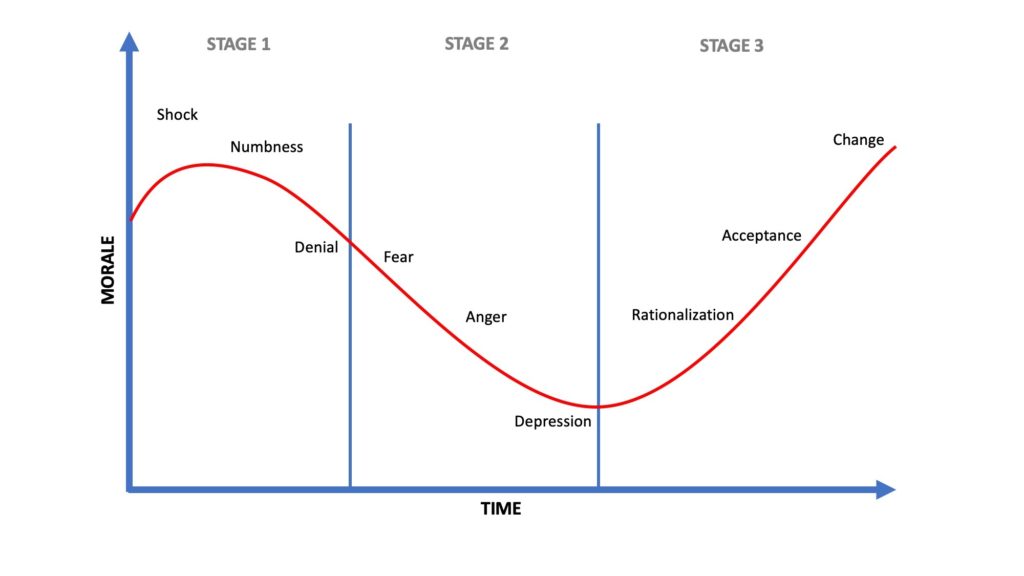
In general, people will process change in three stages, beginning with shock before finally accepting the change and moving on.

Business Agility Planning

Though no formula can smooth the change adoption curve, there are things we can do to help people as they move through the stages of acceptance and shorten the amount of time between shock and ‘the new normal.’

  1. Address the humanness of the system. When introducing change, we are often tempted to focus on the system, the process, or the outcome. We inadvertently marginalize the most critical component to successful change: the people. By placing the people first and doing our best to understand how the change will impact the organization and customers, we can do our best to forecast and mitigate the negative emotions that may emerge. Ask yourself: “What fear may emerge as a result of this change?”
  2. Start with leadership. Change must be thoughtfully led. Too often, change initiatives fail because a leader will issue a directive and then check out. Change needs a champion, and the broader the impact, the stronger advocate that change will need. When leading change, it’s best to be visible, be consistent, empathize with the current, and maintain focus on the goal.
  3. Involve everyone. When introducing change, it’s important that those involved do not feel that there are two sides: those impacted (us) and those imposing (them). Again, change leaders need to create an environment that is empathetic to the pain of change (all of us, together) and keeps those involved focused on the outcome resulting from having changed.
  4. Create a compelling business case. Start with why. Why is this change important? What risk is it mitigating? What opportunity is it enabling? What efficiency will we be able to exploit? How will we be better positioned to serve our customers? John Kotter notes that we underestimate the power of vision by a factor of 10. That perspective proves true no matter the size of change. Without understanding why the pain we are about to endure is worth it, change is harder to overcome.
  5. Create shared ownership. Change in an organization or value stream is not something to be done in isolation. If the change is beholden to a single person or small group, it will matter much less to others and quality will suffer. Change outcomes are a shared responsibility of the team. Creating an all-of-us-together culture helps avoid feelings of pain endured in isolation.
  6. Communicate the message. Communicate the message early, communicate it consistently, and communicate it often. In alignment with the SAFe® Core Values, we must assure alignment and transparency in the system to achieve optimal outcomes.
  7. Assess the cultural landscape. Even if we prepare the organization well for change, even if we say and do all of the right things, organizational culture will dictate how well people in the system process change. I am often reminded of the wise words of Kim Scott: “Culture is what is said in the halls, not what is written on the walls.” Employee engagement surveys, rolling feedback walls, and hallway conversations can go far in helping change leaders understand how people are really feeling.
  8. Address cultural challenges directly. If understanding the cultural landscape is step one, doing something with what you learn is step two. When the pain of change rears its ugly head, change leaders must address this pain immediately and directly. This is not a time for political grandstanding but for using the organization’s own words with a sense of empathy. Remember, as Brené Brown teaches us, being empathetic does not always mean fixing the pain. Simply acknowledging the circumstance and validating how people feel can have a profound impact on morale.
  9. Prepare for the unknown unknown.  As Murphy’s Law reminds us, if something can go wrong, it will. Though there is not a lot we can do to prevent unforeseen circumstances, we can prepare for them. Actively seek risk, break things, pressure test, and create fallback and recovery plans. The SAFe approach to DevOps can serve as a good guide to monitor for and respond to the unknown.
  10. Speak to team members. The most important component in addressing the human element of change is to talk to the people involved. Be visible, be accessible, and be the kind of leader that people trust. When leading change, if you can successfully manage the emotional component, you are well on your way to helping the team land change well.

    The next challenge? Avoid change saturation to land change well. Stay tuned!

About Adam Mattis

Adam Mattis headshot

Adam Mattis is a SAFe Program Consultant Trainer (SPCT) at Scaled Agile with many years of experience overseeing SAFe implementations across a wide range of industries. He’s also an experienced transformation architect, engaging speaker, energetic trainer, and a regular contributor to the broader Lean-Agile and educational communities. Learn more about Adam at adammattis.com.

View all posts by Adam Mattis

Share:

Back to: All Blog Posts

Next: POs and PMs: A Dynamic Duo

Manager Responsibilities in SAFe Transformation – Leadership Agility

Safe Business Agility

In this podcast episode, we address the manager’s responsibilities in a successful SAFe transformation and leadership Agility. Learn the six responsibilities of managers in an agile organization and success patterns for rolling out a SAFe transformation. We’ll also be addressing the difference between System Demo and PI system demo, along with how to estimate Epics and Features.

Click the “Subscribe” button to subscribe to the SAFe Business Agility podcast on Apple Podcasts

Share:

SAFe in the News

Lean-Agile Leadership: The six responsibilities of management

Published By Michael Kusters on LinkedIn

Full article

Six responsibilities of the Lean-Agile Leader

  • Lead the Change
  • Lifelong Learning
  • Develop people
  • Inspire, align, minimize constraints
  • Decentralize Decisions
  • Unlock intrinsic motivation

SAFe in the Trenches

Hear Dr. Steve Mayner, Principal Contributor to the Scaled Agile Framework and thought leader on Innovation and transformational leadership share organizations successfully engaged leadership in their transformations.

To learn more about Lean-Agile Leadership – one of the Core Competencies of a Lean Enterprise, visit scaledagileframework.com/lean-agile-leadership/

Audio CoP

The Audio Community of Practice section of the show is where we answer YOUR most frequently asked and submitted questions. If you have a question for us to answer on air, please send it to podcast@scaledagile.com

The two questions we answer in this episode are:

  • What resources would you recommend to get leadership engaged in transformations?
  • I know I have to ‘embrace the mindset’ – how do I do this?

Hosted by: Melissa Reeve

Melissa Reeve is the Vice President of Marketing at Scaled Agile

Melissa Reeve is the Vice President of Marketing at Scaled Agile, Inc. In this role, Melissa guides the marketing team, helping people better understand Scaled Agile, the Scaled Agile Framework (SAFe) and its mission.

Hosted by: Dr. Steve Mayner

Lean-Agile evangelist Dr. Steve Mayner

Dr. Steve Mayner is an executive coach and Lean-Agile evangelist with a passion for cultivating transformational leaders and high performing teams. His 30-year career in business includes roles as Vice President in multiple Fortune 500 companies, as well as Chief Technology Officer for an Internet startup. Steve has been a thought leader and change agent for Lean-Agile and DevOps adoption within the federal government. He was responsible for the first official use of the Scaled Agile Framework® (SAFe) in a government program, which led to the successful turnaround of a large, mission-critical Department of Homeland Security mainframe modernization initiative. In his current role as a SAFe Fellow for Scaled Agile, Inc., Steve is using his experience as an innovator, strategist, and transformational leader to help the largest enterprises around the world implement Lean-Agile and DevOps at scale.Steve holds a Doctor of Business Administration in Strategy and Innovation, as well as Masters degrees in Business Administration and Divinity, and a Bachelors in Education. He retired in 2003 as a commissioned officer in the reserve component of the US Air Force. He is married with five children and three grandsons. He lives in Southern Maryland, and is an avid golfer, runner, cyclist, and backpacker.