Editor’s Note: Unprecedented business challenges are impacting your day-to-day role. You need more than theories—you need a plan and tactics. Welcome to the AI-Empowered blog series: Your guide to the what, why, and how of embracing AI to adapt and amplify your impact.
You’ve seen the headlines. You’ve felt the quiet buzz of AI chatbots in the background of your daily stand-ups. As a Product Owner (PO) or Product Manager (PM), your world is shifting beneath your feet.
Perhaps you’re staring at a backlog that feels more like a feature factory than a value-driven roadmap, wondering if artificial intelligence is about to automate your job away. You might feel the pressure to use AI tools but find yourself stuck in prompt purgatory, writing generic requests and getting hallucinated results that don’t fit your business context. The world of the modern product owner and product manager today looks like a frantic race to acquire new skills while simultaneously managing stakeholders who expect “AI magic” yesterday. The uncertainty isn’t just about the technology; it’s about your role in a world where data moves faster than your current workflows can handle.
The Hidden Costs of AI Inertia
Ignoring the AI evolution isn’t just a missed opportunity; it’s a direct threat to organizational health. When product leaders fail to integrate AI for POs and PMs, the business pays the price in three critical areas:
The productivity gap: Without AI augmentation, product teams spend up to 40 percent of their time on administrative debt—drafting user stories, manually summarizing feedback, and chasing status updates.
Strategic blindness: Companies failing to leverage AI-driven data analysis miss market signals that competitors catch in real time. This leads to strategic drift, where you build features that were relevant six months ago but are obsolete today.
The innovation tax: Research shows a widening chasm between AI-native firms and laggards.
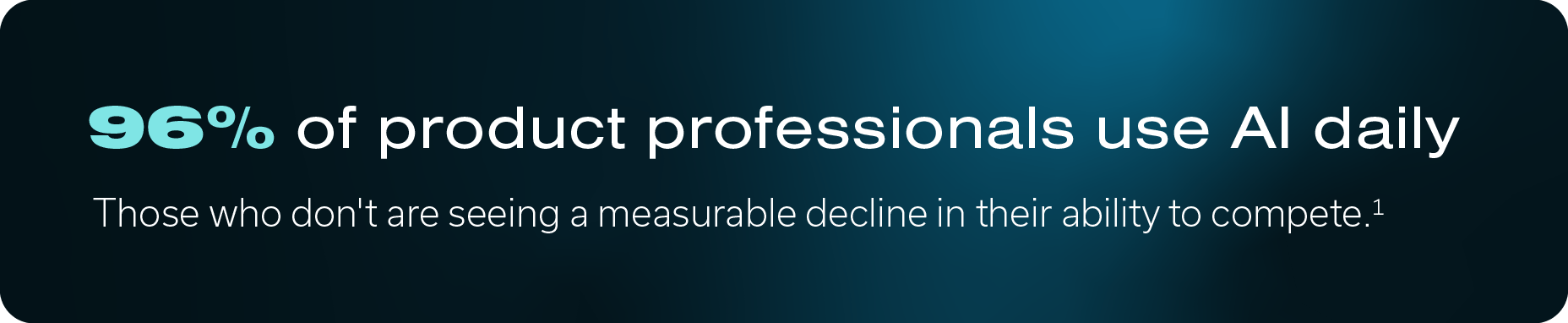
Additionally, organizations that adopted AI for business functions saw a drop in productivity of 1.33 percentage points initially, but failing to redesign workflows around AI leads to a long-term ‘productivity paradox’ where legacy processes stifle new technology. 2
A Glimpse of Tomorrow: The AI-Empowered Product Leader
The future isn’t about AI taking over PO and PM jobs; it’s about the AI Product Owner taking over the market. Think of it as a world where your AI tools act as a tireless chief of staff. In this new reality, you aren’t just a task manager; you are an architect of outcomes. You use GenAI to synthesize thousands of customer tickets into actionable personas in seconds. You use prompt engineering to generate high-quality User Stories that are 90 percent ready-to-code, allowing you to spend your Mondays talking to customers instead of fighting with Jira. These are impactful skills you’ll gain from the AI-Empowered SAFe® Product Owner/Product Manager (POPM) course.
Your Expertise Enhanced: Defining the New Roles
The distinction between traditional roles and their AI-empowered counterparts is simple: leverage.
The AI Product Manager focuses on the what and the why by using AI to identify market gaps, conduct competitive research, and align AI initiatives with the long-term product vision. The AI Product Owner focuses on the how and when, utilizing AI-integrated tools to refine the backlog, automate acceptance criteria, and ensure the team is building the right thing at the right time. The Data Product Manager is a specialized role focused on the data supply chain, ensuring the models that power your product are fed high-quality, ethical, and unbiased data. Here are some specific examples of what AI could look like in your daily workflow as a PM or PO.
The AI product manager’s daily workflow
As an AI Product Manager, you leverage AI’s immense data processing power to anticipate a range of outcomes that inform your strategy:
Dynamic roadmapping. Research is vital, but roadmapping and prioritization are the heartbeat of a PM’s daily life. AI helps you move beyond static spreadsheets to create flexible, living roadmaps. You can use AI to create flexible roadmaps and “think around corners” to simulate what-if scenarios. If a competitor launches a surprise feature or a key dependency fails, AI can quickly re-calculate prioritization scores across your entire portfolio, helping you pivot without the usual panic.
Market sentiment synthesis. Instead of reading hundreds of App Store reviews, you use AI tools to ingest quarterly feedback and generate a “Top five friction points” report in minutes.
Strategic planning. Use AI to run “pre-mortem” simulations. “Act as a skeptical stakeholder. Identify three ways our proposed AI-driven recommendation engine might fail to meet our Q3 North Star Metric.”
Persona development. Use GenAI to create hyper-specific user personas based on actual behavioral data segments. This allows you to tailor features to a late-night power user rather than a generic customer.
The AI product owner’s daily workflow
For the AI Product Owner, the focus is on maximizing the flow of value through the Agile Team:
Accelerated User Stories. Writing user stories is no longer a blank-page exercise. By applying prompt engineering—such as providing the AI with a Feature description and asking for a breakdown into INVEST-compliant stories—you reduce drafting time by 70 percent.
Backlog refinement and estimation. During refinement, the PO can use AI tools to cluster sticky notes and identify dependencies across teams. AI can even suggest story point ranges based on historical velocity data for similar past tasks.
Automated acceptance criteria: Use AI to generate edge case scenarios. For a new login feature, the AI might suggest testing for “expired session during active API call,” a detail often missed in manual drafting.
By mastering these skills, you move from being a process follower to an AI-augmented strategist. You can link your expertise directly to tangible business results, such as reducing cycle time or increasing feature hit rates; benefits that are foundational to the SAFe Product Owner/Product Manager certification.
Practical applications: AI in your agile workflow
You don’t need to be a data scientist to lead an AI-empowered team. Here is how you can start today:
Prompt engineering. Stop asking AI to write a story. Instead, use structured prompts like this one: “As a SAFe AI Product Owner, draft three user stories for a new checkout feature, including acceptance criteria in Gherkin format, focusing on mobile-first users.”
Backlog refinement: Use AI tools and chatbots to cluster similar feature requests and identify themes that your human eyes might miss.
Step by step: Integrating AI into SAFe workflows
Preparation (PI Planning). Use AI to ingest your Strategic Themes and generate draft PI Objectives.
Execution. Use AI to record and summarize Daily Stand-ups, automatically updating the team’s blockers list.
Refinement. Use chatbots to take a high-level Feature and break it down into small, estimable User Stories.
The Conscience of the Machine: Responsible and Ethical AI
Innovation without ethics is a liability. As an AI Product Owner or Product Manager, you are the primary steward of how artificial intelligence interacts with your customers and their data. Implementing responsible AI isn’t a one-time task; it is a mindset that must be woven into every User Story and architectural decision.
The ethical guardrails for product leaders
To lead responsibly, you should implement four guardrails of ethical AI within your agile teams:
Data privacy and compliance. Establish clear data classification (public, internal, restricted). Never feed sensitive customer data or intellectual property into a public GenAI tool without anonymization. Ensure your AI features comply with global standards, such as GDPR or the EU AI Act.
Human-in-the-loop (HITL). AI should assist, not decide. High-stakes decisions—such as those involving financial approvals, medical data, or hiring—must always have a final human review. Use AI for drafting and analysis, but keep the human product conscience at the center of the backlog.
Fairness and bias mitigation. Actively audit your training data and outputs for bias. If your product uses AI to recommend features or predict user behavior, ask: Does this system treat all demographic groups equitably? Regularly conduct consequence scanning workshops to identify potential harms before they reach production.
Transparency and explainability. Be open with your stakeholders about where AI is used. Maintain an AI contribution registry and provide transparency notes for AI-powered features so users understand how decisions were reached.
By championing these principles, you don’t just protect the company from legal risk; you build the one thing AI cannot generate on its own: trust. You can further develop these leadership skills by exploring the SAFe Achieving Responsible AI guidance.
Unlock Your Full Potential
It’s time to rewrite the old product playbook. You have a choice: watch from the sidelines or become the author of your career’s next chapter. The AI-Empowered SAFe Product Owner/Product Manager course is more than a certification; it’s your survival guide for the AI-native era.

Feeling the AI pressure?
Learn how AI-Empowered SAFe Product Owners use GenAI to automate the boring stuff and lead with strategic vision.
In this series:
Coming soon: The AI-Empowered SAFe® for Teams
“The New Reality of AI in Product Management.” Productboard Report, October 22, 2025. https://www.productboard.com/blog/ai-in-product-management-report/.
McElheran, Kristina. “The ‘Productivity Paradox’ of AI Adoption in Manufacturing Firms.” MIT Sloan Management Review, July 9, 2025. https://mitsloan.mit.edu/ideas-made-to-matter/productivity-paradox-ai-adoption-manufacturing-firms.