Left in the Dust: When Your Delivery Speed Kills Your Competitive Edge

Editor’s Note: You’re facing unprecedented business challenges. You need more than theories—you need a blueprint. Welcome to a Leader’s Blueprint, your weekly guide to proven strategies that get results.

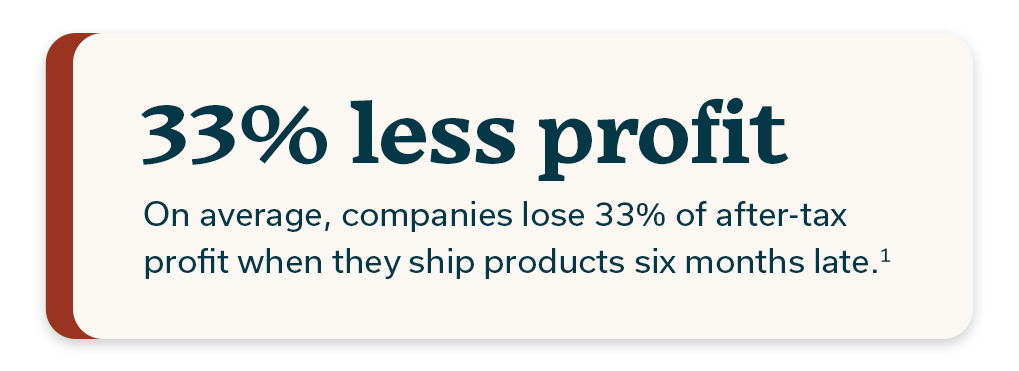
Your team had a brilliant idea six months ago. The market was ready for it. But by the time you navigated the internal processes, approvals, and development cycles, a smaller, faster competitor launched a similar product. They captured the market’s attention while your “perfect” solution is still weeks from release.

You weren’t out-innovated; you were out-paced. In today’s market, the speed at which you deliver value is just as important as the value itself.

The Hidden Costs of Delay

A slow time-to-market is more than a single missed opportunity; it’s a symptom of a system that is bleeding resources and relevance.

  • Market Irrelevance: When your delivery cycles are longer than market cycles, your solutions are always a step behind what customers actually need.
  • Wasted Innovation: Great ideas die on the vine, stuck in a slow-moving process. Your organization doesn’t have a shortage of innovation, but a shortage of velocity.
  • Decreased Morale: Nothing is more frustrating for talented teams than to see their hard work beaten to the punch or become irrelevant before it even launches.

From Gridlock to Velocity: A Glimpse of the Solution

The solution isn’t to ask your teams to work harder—it’s to redesign your system for speed. In SAFe®, this is the Accelerating Product Flow competency. It’s about streamlining the entire value stream, from idea to delivery, by systematically removing delays.

Two of the eight “flow accelerators” are:

  1. Limiting Work in Process (WIP): It’s like a highway—too many cars create a traffic jam where nothing moves. By limiting the number of new features being built right now, you clear the road, allowing high-priority work to move at maximum speed.
  2. Eliminating Bottlenecks: A bottleneck is any part of your process—like code reviews or testing—where work piles up. By identifying and addressing these choke points, you ensure work moves smoothly through the system.

Your First Step

You can start identifying your biggest constraint this week with a single question. Ask some of your product teams:

“What is the one thing that, if we could fix it, would most speed up our ability to deliver value to the customer?”

Don’t try to solve it yet. Just listen. The answers will point directly to your most significant bottleneck.

Unlock the Full Blueprint

Identifying your bottleneck is the first step, but building a sustainable competitive advantage requires a system designed for speed. The Accelerating Product Flow competency is a complete guide to all eight flow accelerators, including how to get faster feedback and minimize handoffs.


In this Series:


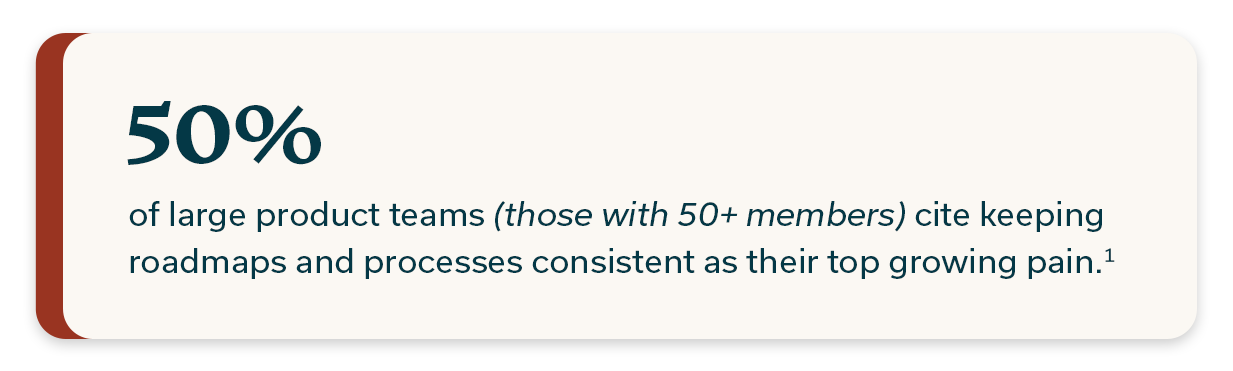
1 Charles H. House and Raymond L. Price, “The Return Map: Tracking Product Teams,” Harvard Business Review, January–February 1991, accessed October 28, 2025, https://hbr.org/1991/01/the-return-map-tracking-product-teams

Your Roadmap: A Windshield or a Rearview Mirror?

Editor’s Note: You’re facing unprecedented business challenges. You need more than theories—you need a blueprint. Welcome to a Leader’s Blueprint, your weekly guide to proven strategies that get results.

In your last product strategy meeting, how much time was spent looking forward versus looking back? It’s a common scene: we do the next item of work without considering if it’s the right thing, pointing to a line item on a twelve-month-old roadmap, a plan created in a different reality. You’re trying to drive the business forward, but your teams are navigating by looking in the rearview mirror.

A plan like this doesn’t illuminate the road ahead; it only reflects commitments made in the past. When your roadmap focuses only on where you’ve been, you’re guaranteed to miss the opportunities right in front of you.

The Hidden Costs of a Static Plan

An inflexible roadmap isn’t just an administrative headache; it’s a direct threat to your business agility and a quiet killer of innovation.

  • Paralysis by Plan: Teams are forced to choose between following an irrelevant plan or going rogue, creating friction and misalignment.
  • Wasted Opportunity: By locking in features months in advance, you lose the ability to react to new market insights or customer feedback, effectively ceding ground to more nimble competitors.
  • Broken Trust: When roadmaps consistently fail to reflect reality, they undermine trust between leadership, product teams, and stakeholders, making true alignment impossible.

From Fixed Plans to Living Guides: A Glimpse of the Solution

The solution is to transform your roadmap from a rigid, feature-based timeline into a dynamic, outcome-focused guide. In SAFe®, this is the Creating Responsive Roadmaps competency.

This approach reframes a roadmap as a strategic communication tool, not an unbreakable promise. It’s a living document that adapts to new information. One of the key tools SAFe uses to prioritize items on this flexible roadmap is Weighted Shortest Job First (WSJF). Instead of prioritizing based on emotion or seniority, WSJF provides an economic framework to determine which features will deliver the most value in the shortest time, ensuring you’re always working on the most important thing.

Your First Step

You can start making your roadmap more responsive today with a simple change in language. This week, pick one high-level initiative on your current roadmap and reframe it with this question:

“For every item currently listed on our roadmap, can we clearly articulate the specific desired outcome and the measurable impact it is expected to have?”

This question helps foster a shared understanding of success criteria and forces everyone to step back from the feature list to ensure the work is tied to the overarching business goals. If a feature cannot be tied to any expected outcome, reconsider its place on the roadmap.

Unlock the Full Blueprint

Shifting your language is the first step, but building a truly responsive planning process requires a complete system. The Creating Responsive Roadmaps competency provides a full blueprint for connecting strategy to execution, using milestones effectively, and facilitating collaborative planning events.


In this Series:


1 “Why Product Teams Keep Roadmaps and Processes Consistent,” ProductPlan, accessed October 28, 2025, https://www.productplan.com/roadmap-processes-consistent/.

Why You Should Build a Data-Driven Product Strategy for Modern Product Management

data-driven product strategy - a SAFe series

Editor’s Note: You’re facing unprecedented business challenges. You need more than theories—you need a blueprint. Welcome to a Leader’s Blueprint, your weekly guide to proven strategies that get results.

You’re in the quarterly strategy meeting. The stakes are high, and a critical decision must be made: which major initiative should be prioritized for funding? The debate is passionate, but it’s driven by compelling arguments and seniority, not data. You have dashboards, but they’re filled with vanity metrics. No one can definitively answer the most important question: “Which of these options will actually move the needle on our business goals?”

When the loudest voice in the room becomes your primary decision-making tool, you’re not strategizing; you’re gambling.

What is a Data-Driven Product Strategy?

A data-driven product strategy is one that relies upon product analytics and qualitative insights to inform decision-making and which direction you should take your products in.

It’s a product management and development approach that aims to improve strategy by ensuring it’s driven by a comprehensive understanding of product usage based on concrete information and evidence, such as usage patterns, customer behavior, and performance metrics, rather than guessing what should be done next using assumptions or intuition.

The Hidden Costs of an Opinion-Driven Culture

Operating without clear, consistent product metrics is like flying a plane without an instrument panel. The risks are immense and go far beyond inefficient meetings:

Strategic Drift

Teams invest significant time and effort into features that feel important but are never tied back to defined outcomes. Over time, this disconnect causes the product to slowly drift away from its original goals and customer needs, as well as market position. Without data to course-correct and identify areas for improvement, even well-intentioned work can pull the product in conflicting directions.

Wasted Investment

When priorities aren’t grounded in measurable impact, precious capital and talent are spread thin across initiatives that don’t really make a difference. Engineering time, design effort, and marketing spend are consumed by features or experiments that fail to improve business performance or user experience and satisfaction. And this is often done without anyone realizing the true cost.

Inability to Learn

Without measuring the results of decisions, product teams lose the ability to learn from their work. Every launch becomes a shot in the dark, with no feedback loop to indicate success or failure. This prevents continuous improvement, making it difficult to refine strategy or build confidence in future decisions.

Slower Decision-Making

In the absence of data, decisions rely heavily on debate to try to reach a consensus. This leads to prolonged discussions and decision paralysis. Instead of moving quickly with clarity, teams spend time defending opinions rather than aligning around evidence and quantitative data.

Erosion of Trust and Alignment

When decisions are driven by opinion, stakeholders often question why certain choices were made. This can erode trust between teams and leadership, which creates friction across functions and makes it harder to align around a shared vision. Product development guided by the right data provides a common language; Without it, alignment becomes fragile and short-lived.

Data-Driven Product Management: From Guesswork to Guidance

The antidote to this uncertainty is building a culture of data-driven decision-making. In SAFe®, this is guided by the Measuring Product Performance competency. This framework provides clarity by viewing your product through four essential lenses: Business Outcomes, User Engagement, Customer Satisfaction, and Technical Performance.

This holistic view is powered by combining two types of metrics:

  • KPIs (Key Performance Indicators): hese are your instruments, providing a continuous pulse-check on the operational health of your product.
  • OKRs (Objectives and Key Results): This is your destination, aligning everyone toward ambitious, strategic goals.

Using both, you always know your current health and where you’re headed.

Benefits of Using Product Data to Make Strategic Decisions

Product management data analytics help PMs in several ways:

Enable Better Product Decisions for Product Managers

For a product manager, data provides the foundation for confident prioritization. By relying on key data instead of intuition alone, teams can optimize product decisions, focusing effort on initiatives that deliver the greatest value to users and the business.

Leverage Data Analysis to Move Faster with Confidence

Strong data analysis helps teams to reduce uncertainty and accelerate decision-making. When evidence is readily available, discussions become more focused, alignment happens faster, and teams can make data-driven decisions without unnecessary debate.

Create a Data-Driven Culture with Shared Metrics

Shared metrics help create a data-driven culture where teams align around outcomes instead of opinions. This common language enables better collaboration across functions and ensures everyone is working toward the same strategic goals.

Reduce Risk and Waste

When teams use product data effectively, they can identify underperforming initiatives early. This reduces risk and avoids wasted investment. It also ensures resources are allocated based on evidence rather than guesswork.

Support a Strategy Framework with Transparency and Accountability

An effective strategy depends on having a clear view of how the product is performing. When decisions are grounded in measurable outcomes, it becomes easier to understand the reasoning behind them and assess their impact over time. This shared visibility helps teams stay aligned and reinforces ownership of decisions. What’s more, it allows strategic choices to be evaluated and refined over time.

How to Use Data to Drive Product Growth and Actionable Insights

Start With a Clear, Measurable Question

You can begin this shift with a single question. This week, pick one significant feature on your upcoming roadmap and ask the team:

“If this feature is wildly successful, which single, measurable metric will change, and in what direction?”

If there isn’t a clear answer, the feature’s purpose—and its value—is a mystery.

Define Meaningful Metrics

Metrics should tell you something important about your product, not just fill a report. Think about engagement, retention, revenue impact, or operational efficiency—whatever shows real customer value. The key is choosing measures that are specific and actionable. They should be directly tied to decisions, so you always know which levers to pull next.

Integrate Metrics Into a Strategy Framework

Undertaking the first two steps above brings immediate clarity. But creating a true data-driven engine requires a complete system. The Measuring Product Performance competency provides a full blueprint for defining meaningful metrics across all four lenses and integrating them into powerful OKRs and KPIs. Stop flying blind. Unlock the full framework, competencies, and guidance you need to make every product decision with confidence. Get access by purchasing your SAFe® Insider membership today.

Continuously Measure and Adjust

Data isn’t a one-time check; it’s a constant feedback loop. Track results for every launch, experiment, or update, then analyze what’s working and what’s not. Use these insights to refine priorities, validate assumptions, and make smarter decisions for the next round of features. Your product evolves with each insight.

Embed a Data-Driven Culture

A data-driven strategy only works if the team lives it. Encourage using metrics in discussions and planning. Share results openly to celebrate wins and learn from misses. Over time, using data becomes second nature, helping everyone make better decisions and keeping the product aligned with real customer needs.


In this Series:


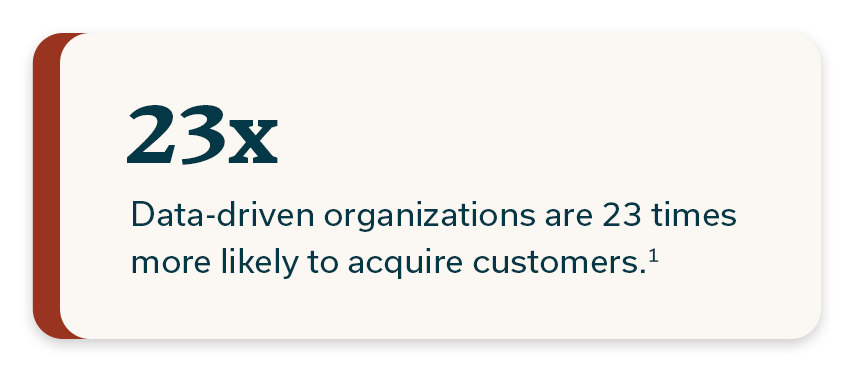
1 According to the McKinsey Global Institute, as cited on the Data Ideology website, “Data-Driven Organizations Are 23 Times More Likely to Acquire Customers, Six Times as Likely to Retain Customers, and 19 Times as Likely to Be Profitable as a Result”. Retrieved on October 22, 2025, https://www.dataideology.com/data/data-driven-organizations-are-23-times-more-likely-to-acquire-customers-six-times-as-likely-to-retain-customers-and-19-times-as-likely-to-be-profitable-as-a-result/
Philips

“The Lean Portfolio Management is really unique for our business and now it’s being requested all over the place, because it really was a game changer. We outperformed in 2023 financially. We achieved our OKRs. The strategy was super clear. We had improved our quality significantly. So we didn’t have any major noncompliance… and most importantly we gained back the trust from the markets and the customers first.”

Ruti Avitan, VMO Leader, EMR & CM, Philips

Industry:

Healthcare, Medical Devices, Technology

Quick Facts:

  • Philips Global has 18 businesses across multiple continents, including 5 informatics businesses, which have adopted SAFe
  • In 2021, Philips Global invested 1.8 billion euros in research and development across all its business units
  • The Philips EMR & CM informatics products alone improve the lives of 95 million patients every year
  • Informatics customers include more than 9,000 hospitals across 70 countries

Lessons Learned:

  • Transformation is possible in a highly regulated environment like healthcare. Philips EMR & CM assigned a person to each team who was dedicated to documentation and validation in order to reduce delays and meet the more than 27 different compliance requirements they faced.
  • By moving away from an endless backlog of service tickets and managing defects to developing new tools and services, teams create more room for growth and innovation. They do this by defining epics, MVPs, and understanding value streams.
  • People-centric innovation: Philips asked themselves, what do people (in this case, patients and clinicians, nurses and technicians, consumers) really need? And how can they best support healthcare professionals with their workflow?
  • Sometimes focusing on fewer projects allows for greater scale, more innovation, better quality, and better flow of value to the customer.

Overview

In the past decade, Philips has transformed from a household products company to a focused leader in healthcare technology. The company offers medical devices such as CT and MRI machines, healthcare devices for personal use such as toothbrushes, and informatic systems for hospitals. 

Philips has five informatics or software business units ranging from electronic medical records (EMR) and care management to clinical informatics, radiology, cardiovascular, and more. They began their SAFe transformation within informatics. “When I joined, this business specifically was fully waterfall, very hierarchical, especially in the R&D organization,” says Ruti Avitan, VMO Leader of the EMR & CM informatics business at Philips. “It was a business in trouble. We had a lot of red projects because of delays. We have more than 25 projects running in parallel. Each one had a different delivery date. We had escalation from customers on quality, and so on. So the motivation to do something was really high.” 

Beginning in 2022, SAFe allowed the organization to define a Lean-Agile way of working and move from the traditional hierarchy to cross-functional teams. They shifted from project to product centricity, enhanced their knowledge, reduced the backlog, and made room for innovation. The result is an enterprise that is people- and patient-centric, focused on scalable innovations that prioritize safety, patient outcomes, supply chain resilience, and quality.

“When I joined, this business specifically was fully waterfall, very hierarchical, especially in the R&D organization… It was a business in trouble. We had a lot of red projects because of delays. We have more than 25 projects running in parallel. Each one has a different delivery date. We had escalation from customers on quality and so on. So the motivation to do something was really high.”

Ruti Avitan, VMO Leader, EMR & CM, Philips

Back to: All Case Studies

Suggested Case Study: Royal Philips

Mercedes-Benz Mobility AG: Global Transformation with SAFe

Quick Facts:

  • 34 global markets
  • 10,000 employees worldwide
  • Started using SAFe in 2017 with customer-facing domains, then scaled and expanded to the portfolio level
  • Has 1,000 tech experts worldwide working in 6 tech hubs, producing 169 global products

Key Outcomes:

  • Six years ago, they had one or two product rollouts a year in just a couple of markets. In 2022, they were able to introduce roughly 40 products in 34 markets.
  • In 2022, reached €130 billion portfolio: €58 billion in new business and €27 billion in revenue
  • Faster application-to-payout times: Reduced time for customers applying for financing from several days to minutes. In China, for example, customers can apply and receive payment in 2.3 minutes. 
  • Moving away from waterfall methods and adopting SAFe, they were able to launch better technology, better operating systems, AI and face recognition, integrate different data sources, and utilize better risk models. 
  • Customer focus: Responded to customer apprehension about electric cars and fear of not having enough range by introducing rental and subscription models. This way, customers can become more familiar with the electric offerings and the charging ecosystem before buying.
  • Increased digitization and automation rate to 90 percent. SAFe allowed Mercedes-Benz to achieve the shift from hardware to software, master the electrification of vehicles, meet requirements for zero emission, and adapt to environmental, geopolitical, and consumer demands. 
  • Created a culture of collaboration. Instead of relying solely on roles like RTE, Scrum Master, and Product Owner, Mercedes-Benz Mobility fosters a culture that prioritizes diversity and uses the best skill sets.

Watch The Full Interview

Back to: All Case Studies

Suggested Case Study: Royal Philips

Oracle Boosts Order Velocity and Productivity with SAFe

Oracle is a tech company with a long history of providing software products and services. They operate in a few main business segments — cloud and license, hardware, and services — selling cloud-engineering services, systems, and database management solutions to customers around the world. Oracle’s overarching mission is “to help people see data in new ways, discover insights, and unlock endless possibilities.”

One thing that makes Oracle unique is their in-house Oracle Labs, where researchers look for novel approaches and methodologies to solve complex technical problems. Oracle Labs are known for taking on projects with high risk and uncertainty that are difficult to tackle within a product-development organization. This is where agility is crucial to success, and where Oracle began its SAFe® journey.

Quick Facts:

  • 170,000 employees worldwide; 48,000 developers and engineers
  • Industry’s broadest and deepest suite of cloud applications
  • Serves 2 million customers in 175 countries
  • The Oracle Applications Lab started SAFe with 8 teams and less than 100 people. By the second PI, the teams doubled to 16. By the fourth PI, they grew to 34 teams.
  • Oracle tailored SAFe to their unique needs and challenges using “sub-ARTs” and arrays, or groupings of people to accelerate flow

Key Outcomes:

  • Saw significant improvement in order velocity: Oracle reported a 15% increase in touchless orders. More than 80% of all orders became automated and 95% of cloud orders became automated.
  • Saw a 10% increase in employee productivity due to reliable data capture, an intuitive UI, and simplified validations
  • 54% of manual accounting was eliminated across the organization
  • Oracle’s books closed and earnings were reported to shareholders in less than 10 days (21 days faster than the average Fortune 500 company)

Watch The Full Interview

Back to: All Case Studies

Suggested Case Study: Royal Philips

An Oracle Success Story: How a Mission-critical Cloud Migration Brought the Business and IT Together

When your CEO sponsors a strategic initiative to replace a core system in just two years, the pressure to deliver is enormous.

When your CEO sponsors a strategic initiative to rip and replace a core system in just two years, the pressure to deliver is enormous. To add to the challenge, the migration would have to be a hard cutover from the old system to the new; there was just no way to run two systems simultaneously.

This is what the teams at Oracle’s Application Labs (OAL) were faced with when they were tasked with migrating their entire Order-to-Revenue system from on-premise to the Oracle Fusion Cloud ERP.  It’s well known that only a fraction of cloud migrations get completed on time, and even fewer deliver all the value that was hoped for. The Oracle teams were determined that this wasn’t going to be their story. 

SAFe was adopted to handle the scale and complexity of the work and to provide an engagement model that would help keep the teams connected, engaged, and aligned with each other and with the business. SAFe would also help Oracle’s thinking evolve from a project to product mindset.

The goals were ambitious, and with the addition of a new way of working, there was no shortage of skeptics. Transformation leaders took a light-handed approach to help people get comfortable with the process and slowly build trust. They’d say, “Hey, try this out, we are only going to use it for two weeks, then we can adjust.” This approach ultimately paid off in big ways.

The migration took place as planned over a summer weekend in 2021, which was, by itself, an enormous win for the OAL teams. There were bonus benefits as well. The product was better than anticipated with improvements in order productivity, velocity, data quality, and usability, as well as automation.

Perhaps the most profound effect is that their sense of identity has changed. It’s no longer IT vs. the business; it’s all one organization. From the CEO’s office to the EVP of Fusion Product Development to OAL’s leadership, there is alignment from strategy to execution. As Oracle’s VP of Global Quote to Order Operations, Maninder Bedi said, “We are working together. We became one.”

Presented at the 2022 SAFe Summit

About Oracle:

Oracle offers integrated suites of applications plus secure, autonomous infrastructure in the Oracle Cloud. For more information about Oracle (NYSE: ORCL), please visit oracle.com.

S&P Global: Implementing LPM—5 Things to Know Before you Start

Navigating the resistance, culture issues, and product strategy transparency challenges when adopting Lean Portfolio Management

Does your organization have trouble prioritizing? Does your organization understand how much investment they are making into certain product and technology areas? Are your C-levels aligned around the current year goals? Do they have common incentives? Do you have the right tooling to support this process?

All these questions were asked at the beginning of our Lean Portfolio Management (LPM) transition at a division within S&P Global and not all the answers were clear.

After training our C-levels in a Leading SAFe® class, the consensus was that we needed to implement LPM NOW!

In this story, we share the resistance, culture issues, and product strategy transparency challenges that we navigated when adopting LPM. We will also dive into the outcomes that made the implementation worth it. By the end of this talk, you will leave with five things that might help you with an easier LPM implementation journey.

About S&P Global:

S&P Global (NYSE: SPGI) provides essential intelligence. We enable governments, businesses and individuals with the right data, expertise and connected technology so that they can make decisions with conviction. From helping our customers assess new investments to guiding them through ESG and energy transition across supply chains, we unlock new opportunities, solve challenges and accelerate progress for the world.

Presented at the 2022 SAFe Summit by:

Mary Thorn
Vice President IT Strategy and Transformation, S&P Global

Business Agility Takes Off at Southwest Airlines

How the world’s largest low-cost carrier leverages SAFe as a business operating model to live up to its mantra of “Better, Faster, More Efficient”

Southwest Airlines is famous for its employee-first culture and “Fun-LUVing” Attitude. And when it comes to meeting the urgent demands of technology development in a highly-complex logistical environment, a thriving culture is just the start to meeting the challenge.

To live up to Southwest’s purpose of connecting People to what’s important in their lives through friendly, reliable, low-cost air travel, Southwest began its Agile transformation in 2018 in Operations. The fantastic results led to SAFe adoption throughout Southwest.

Now four years (and counting) into their Agile transformation, more than 2,000 Southwest Employees collaborate cross-functionally across the organization. View this rare keynote interview to learn how the world’s largest low-cost air carrier is breaking ground in the airline industry by leveraging SAFe to deliver business value to its customers.

Presented at the 2022 SAFe Summit by: 

  • Katie Morris, Director IT Transformation, Southwest Airlines
  • Marty Garza, Vice President, Air Operations Technology, Southwest Airlines
  • Moderator: Michael Clarkin, Chief Marketing Officer, Scaled Agile, Inc. 

Designing the Digital Future at Porsche

Learn how the separate worlds of vehicle engineering and IT came together at Porsche to reimagine the sports car of the future

Share:

Revolutionary things can happen when pizza is being served. You’ll find out why when you join Porsche visionaries Mattias Ulbrich and Dr. Oliver Seifert for a candid discussion about transforming one of the world’s most iconic motoring brands into a digital-first pacesetter.

As huge technological advances usher in an automotive renaissance, Porsche is moving at top speed to meet the evolving needs of its customers. They are fully focused on making their cars a central element of their buyers’ lifestyles through digitalization, connectivity, and electromobility. This requires total business agility throughout the enterprise, a new mindset, and a new way of working together closely. It also requires vehicle engineering and software teams to collaborate closely and harmonize the differing speeds at which they traditionally work. This might have been daunting for any company that is as storied and successful as Porsche.

The most important thing is that you shouldn’t underestimate that the digital world is totally different from the physical world,” says Ulbrich.

But Porsche didn’t let this slow them down. To build bridges between the groups, the company created new opportunities for people to talk, learn, and understand each other with the help of SAFe. They created the Porsche “Takt,” the heartbeat that synchronizes the teams. They focus on results and communicate the vision in a way that motivates people to visualize opportunities for change.

Says Ulbrich, “If you look right now in a team, you couldn’t distinguish whether a person is from R&D, IT, sales, or marketing. They work together.

Presented at the 2021 Global SAFe Summit, October 2021 by:

  • Mattias Ulbrich, Chief Information Officer of Porsche AG and CEO of Porsche Digital
  • Dr. Oliver Seifert, Vice President R&D Electric/Electronics /Porsche AG
  • Interviewer: Michael Clarkin, Chief Marketing Officer, Scaled Agile, Inc.SHOW LESS

Back to: Customer Stories

Next: CVS Health Customer Story